




Total runs:
719.4K
Run Growth:
-831.3K
Growth Rate:
-115.57%
BLOOM LM
BigScience Large Open-science Open-access Multilingual Language Model
Model Card

Version 1.3 / 11.July.2022 - Available intermediary checkpoints - global steps:
1000
,
10000
,
50000
,
100000
,
150000
,
200000
,
250000
,
300000
You can check the available checkpoints by clicking on the branches section of the repo
We use
git tags
to load a model in a specific version (eg.
global_step1000
):
from transformers import AutoModelForCausalLM

model = AutoModelForCausalLM.from_pretrained(
    "bigscience/bloom-6b3-intermediate",
    revision="global_step1000",
    torch_dtype="auto",
)
BLOOM is a type of language model, which is a probability distribution over sequences of words. Specifically, BLOOM is a Large Language Model (LLM), meaning that it is trained on vast amounts of text data using industrial-scale computational resources. As such, the model is able to capture the statistical tendencies of words, phrases, sentences, and larger spans of text that it is exposed to in the training data.
This section provides information about the model type, version, license, funders, release date, developers, and contact information. It is useful for anyone who wants to reference the model.
Developed by: BigScience ( website )
All collaborators are either volunteers or have an agreement with their employer. (Further breakdown of participants forthcoming.)
Model Type: Transformer-based Language Model
Version: 1.0.0
Languages: Multiple; see training data
License: RAIL License v1.0 ( link )
Release Date Estimate: Monday, 11.July.2022
Send Questions to: [email protected]
Cite as: BigScience, BigScience Language Open-science Open-access Multilingual (BLOOM) Language Model . International, May 2021-May 2022
Funded by:
The French government.
Hugging Face ( website ).
Organizations of contributors. (Further breakdown of organizations forthcoming.)
This section includes details about the model objective and architecture, and the compute infrastructure. It is useful for people interested in model development.
Please see the BLOOM training README for full details on replicating training.
Modified from Megatron-LM GPT2 (see paper , BLOOM Megatron code ):
Decoder-only architecture
Layer normalization applied to word embeddings layer (
StableEmbedding
; see
code
,
paper
)
ALiBI positional encodings (see paper ), with GeLU activation functions
176 billion parameters:
70 layers, 112 attention heads
Hidden layers are 14336-dimensional
Sequence length of 2048 tokens used (see BLOOM tokenizer , tokenizer description )
Objective Function: Cross Entropy with mean reduction (see API documentation ).
Jean Zay Public Supercomputer, provided by the French government (see announcement ).
384 A100 80GB GPUs (48 nodes)
Additional 32 A100 80GB GPUs (4 nodes) in reserve
8 GPUs per node Using NVLink 4 inter-gpu connects, 4 OmniPath links
CPU: AMD
CPU memory: 512GB per node
GPU memory: 640GB per node
Inter-node connect: Omni-Path Architecture (OPA)
NCCL-communications network: a fully dedicated subnet
Disc IO network: shared network with other types of nodes
Megatron-DeepSpeed ( Github link )
DeepSpeed ( Github link )
PyTorch (pytorch-1.11 w/ CUDA-11.5; see Github link )
apex ( Github link )
This section provides information about the training data, the speed and size of training elements, and the environmental impact of training. It is useful for people who want to learn more about the model inputs and training footprint.
This section provides a high-level overview of the training data. It is relevant for anyone who wants to know the basics of what the model is learning.
Details for each dataset are provided in individual Data Cards .
Training data includes:
45 natural languages
12 programming languages
In 1.5TB of pre-processed text, converted into 350B unique tokens (see the tokenizer section for more.)
The pie chart shows the distribution of languages in training data.
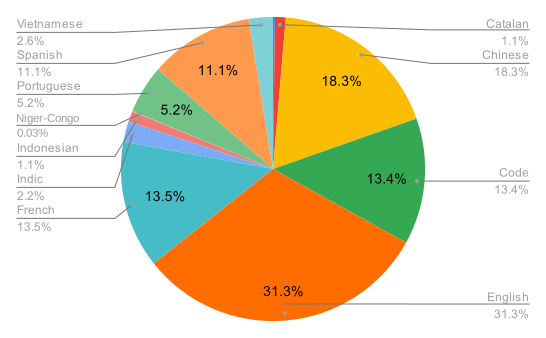
The following tables shows the further distribution of Niger-Congo & Indic languages and programming languages in the training data.
Distribution of Niger Congo and Indic languages.
| Niger Congo | Percentage | Indic | Percentage | |
|---|---|---|---|---|
| Chi Tumbuka | 0.00002 | Assamese | 0.01 | |
| Kikuyu | 0.00004 | Odia | 0.04 | |
| Bambara | 0.00004 | Gujarati | 0.04 | |
| Akan | 0.00007 | Marathi | 0.05 | |
| Xitsonga | 0.00007 | Punjabi | 0.05 | |
| Sesotho | 0.00007 | Kannada | 0.06 | |
| Chi Chewa | 0.0001 | Nepali | 0.07 | |
| Setswana | 0.0002 | Telugu | 0.09 | |
| Northern Sotho | 0.0002 | Malayalam | 0.10 | |
| Fon | 0.0002 | Urdu | 0.10 | |
| Kirundi | 0.0003 | Tamil | 0.20 | |
| Wolof | 0.0004 | Bengali | 0.50 | |
| Kuganda | 0.0004 | Hindi | 0.70 | |
| Chi Shona | 0.001 | |||
| Isi Zulu | 0.001 | |||
| Igbo | 0.001 | |||
| Xhosa | 0.001 | |||
| Kinyarwanda | 0.003 | |||
| Yoruba | 0.006 | |||
| Swahili | 0.02 |
Distribution of programming languages.
| Extension | Language | Number of files |
|---|---|---|
| java | Java | 5,407,724 |
| php | PHP | 4,942,186 |
| cpp | C++ | 2,503,930 |
| py | Python | 2,435,072 |
| js | JavaScript | 1,905,518 |
| cs | C# | 1,577,347 |
| rb | Ruby | 6,78,413 |
| cc | C++ | 443,054 |
| hpp | C++ | 391,048 |
| lua | Lua | 352,317 |
| go | GO | 227,763 |
| ts | TypeScript | 195,254 |
| C | C | 134,537 |
| scala | Scala | 92,052 |
| hh | C++ | 67,161 |
| H | C++ | 55,899 |
| tsx | TypeScript | 33,107 |
| rs | Rust | 29,693 |
| phpt | PHP | 9,702 |
| c++ | C++ | 1,342 |
| h++ | C++ | 791 |
| php3 | PHP | 540 |
| phps | PHP | 270 |
| php5 | PHP | 166 |
| php4 | PHP | 29 |
Tokenization: The BLOOM tokenizer ( link ), a learned subword tokenizer trained using:
A byte-level Byte Pair Encoding (BPE) algorithm
A simple pre-tokenization rule, no normalization
A vocabulary size of 250,680
It was trained on a subset of a preliminary version of the corpus using alpha-weighting per language.
Training logs: Tensorboard link
Dates:
Started 11th March, 2022 11:42am PST
Estimated end: 5th July, 2022
Checkpoint size:
Bf16 weights: 329GB
Full checkpoint with optimizer states: 2.3TB
Training throughput: About 150 TFLOP per GPU per second
Number of epochs: 1
Estimated cost of training: Equivalent of $2-5M in cloud computing (including preliminary experiments)
Server training location: Île-de-France, France
The training supercomputer, Jean Zay ( website ), uses mostly nuclear energy. The heat generated by it is reused for heating campus housing.
Estimated carbon emissions: (Forthcoming.)
Estimated electricity usage: (Forthcoming.)
This section addresses questions around how the model is intended to be used, discusses the foreseeable users of the model (including those affected by the model), and describes uses that are considered out of scope or misuse of the model. It is useful for anyone considering using the model or who is affected by the model.
This model is being created in order to enable public research on large language models (LLMs). LLMs are intended to be used for language generation or as a pretrained base model that can be further fine-tuned for specific tasks. Use cases below are not exhaustive.
Text generation
Exploring characteristics of language generated by a language model
This section addresses what users ought not do with the model.
See the BLOOM License , Attachment A, for detailed usage restrictions. The below list is non-exhaustive, but lists some easily foreseeable problematic use cases.
Using the model in high-stakes settings is out of scope for this model. The model is not designed for critical decisions nor uses with any material consequences on an individual's livelihood or wellbeing. The model outputs content that appears factual but is not correct.
Out-of-scope Uses Include:
Usage in biomedical domains, political and legal domains, or finance domains
Usage for evaluating or scoring individuals, such as for employment, education, or credit
Applying the model for critical automatic decisions, generating factual content, creating reliable summaries, or generating predictions that must be correct
Intentionally using the model for harm, violating human rights , or other kinds of malicious activities, is a misuse of this model. This includes:
Spam generation
Disinformation and influence operations
Disparagement and defamation
Harassment and abuse
Unconsented impersonation and imitation
Unconsented surveillance
Generating content without attribution to the model, as specified in the RAIL License, Use Restrictions
General Public
Researchers
Students
Educators
Engineers/developers
Non-commercial entities
Community advocates, including human and civil rights groups
Users of derivatives created by Direct Users, such as those using software with an intended use
Users of Derivatives of the Model, as described in the License
People and groups referred to by the LLM
People and groups exposed to outputs of, or decisions based on, the LLM
People and groups whose original work is included in the LLM
This section identifies foreseeable harms and misunderstandings.
Model may:
Overrepresent some viewpoints and underrepresent others
Contain stereotypes
Contain personal information
Generate:
Hateful, abusive, or violent language
Discriminatory or prejudicial language
Content that may not be appropriate for all settings, including sexual content
Make errors, including producing incorrect information as if it were factual
Generate irrelevant or repetitive outputs
This section describes the evaluation protocols and provides the results.
This section describes the different ways performance is calculated and why.
Includes:
| Metric | Why chosen |
|---|---|
| Perplexity | Standard metric for quantifying model improvements during training |
| Cross Entropy Loss | Standard objective for language models. |
And multiple different metrics for specific tasks. (More evaluation metrics forthcoming upon completion of evaluation protocol.)
This section lists some different aspects of what BLOOM models. Its focus is on those aspects that are likely to give rise to high variance in model behavior.
Language, such as English or Yoruba
Domain, such as newswire or stories
Demographic characteristics, such as gender or nationality
Results are based on the Factors and Metrics .
Train-time Evaluation:
As of 25.May.2022, 15:00 PST:
Training Loss: 2.0
Validation Loss: 2.2
Perplexity: 8.9
(More evaluation scores forthcoming.)
This section provides information on warnings and potential mitigations.
Indirect users should be made aware when the content they're working with is created by the LLM.
Users should be aware of Risks and Limitations , and include an appropriate age disclaimer or blocking interface as necessary.
Models trained or finetuned downstream of BLOOM LM should include an updated Model Card.
Users of the model should provide mechanisms for those affected to provide feedback, such as an email address for comments.
This section defines common terms and how metrics are calculated.
Loss: A calculation of the difference between what the model has learned and what the data shows ("groundtruth"). The lower the loss, the better. The training process aims to minimize the loss.
Perplexity: This is based on what the model estimates the probability of new data is. The lower the perplexity, the better. If the model is 100% correct at predicting the next token it will see, then the perplexity is 1. Mathematically this is calculated using entropy.
High-stakes settings: Such as those identified as "high-risk AI systems" and "unacceptable risk AI systems" in the European Union's proposed Artificial Intelligence (AI) Act .
Critical decisions: Such as those defined in the United States' proposed Algorithmic Accountability Act .
Human rights: Includes those rights defined in the Universal Declaration of Human Rights .
Personal Data and Personal Information: Personal data and information is defined in multiple data protection regulations, such as " personal data " in the European Union's General Data Protection Regulation ; and "personal information" in the Republic of South Africa's Protection of Personal Information Act , The People's Republic of China's Personal information protection law .
Sensitive characteristics: This includes specifically protected categories in human rights (see UHDR, Article 2 ) and personal information regulation (see GDPR, Article 9; Protection of Personal Information Act, Chapter 1 )
Deception: Doing something to intentionally mislead individuals to believe something that is false, such as by creating deadbots or chatbots on social media posing as real people, or generating text documents without making consumers aware that the text is machine generated.
This section provides links to writing on dataset creation, technical specifications, lessons learned, and initial results.
Blog post detailing the design choices during the dataset creation: https://bigscience.huggingface.co/blog/building-a-tb-scale-multilingual-dataset-for-language-modeling
Blog post summarizing how the architecture, size, shape, and pre-training duration where selected: https://bigscience.huggingface.co/blog/what-language-model-to-train-if-you-have-two-million-gpu-hours
More details on the architecture/optimizer: https://github.com/bigscience-workshop/bigscience/tree/master/train/tr11-176B-ml
Blog post on the hardware/engineering side: https://bigscience.huggingface.co/blog/which-hardware-to-train-a-176b-parameters-model
Details on the distributed setup used for the training: https://github.com/bigscience-workshop/bigscience/tree/master/train/tr11-176B-ml
Tensorboard updated during the training: https://huggingface.co/bigscience/tr11-176B-ml-logs/tensorboard#scalars&tagFilter=loss
Insights on how to approach training, negative results: https://github.com/bigscience-workshop/bigscience/blob/master/train/lessons-learned.md
Details on the obstacles overcome during the preparation on the engineering side (instabilities, optimization of training throughput, so many technical tricks and questions): https://github.com/bigscience-workshop/bigscience/blob/master/train/tr11-176B-ml/chronicles.md
Initial prompting experiments using interim checkpoints: https://huggingface.co/spaces/bigscience/bloom-book
Ordered roughly chronologically and by amount of time spent.
Margaret Mitchell, Giada Pistilli, Yacine Jernite, Ezinwanne Ozoani, Marissa Gerchick, Nazneen Rajani, Sasha Luccioni, Irene Solaiman, Maraim Masoud, Somaieh Nikpoor, Carlos Muñoz Ferrandis, Stas Bekman, Christopher Akiki, Danish Contractor, David Lansky, Angelina McMillan-Major, Tristan Thrush, Suzana Ilić, Gérard Dupont, Shayne Longpre, Manan Dey, Stella Biderman, Douwe Kiela, Emi Baylor, Teven Le Scao, Aaron Gokaslan, Julien Launay, Niklas Muennighoff