



Sponsored by
ThumbnailCreator.com
Alphatao / Affine-3235227
Model's Last Updated: September 28 2025
text-generation
Introduction of Affine-3235227
Model Details of Affine-3235227
Qwen3-235B-A22B-Thinking-2507

Highlights
Over the past three months, we have continued to scale the thinking capability of Qwen3-235B-A22B, improving both the quality and depth of reasoning. We are pleased to introduce Qwen3-235B-A22B-Thinking-2507 , featuring the following key enhancements:
- Significantly improved performance on reasoning tasks, including logical reasoning, mathematics, science, coding, and academic benchmarks that typically require human expertise — achieving state-of-the-art results among open-source thinking models .
- Markedly better general capabilities , such as instruction following, tool usage, text generation, and alignment with human preferences.
- Enhanced 256K long-context understanding capabilities.
NOTE : This version has an increased thinking length. We strongly recommend its use in highly complex reasoning tasks.
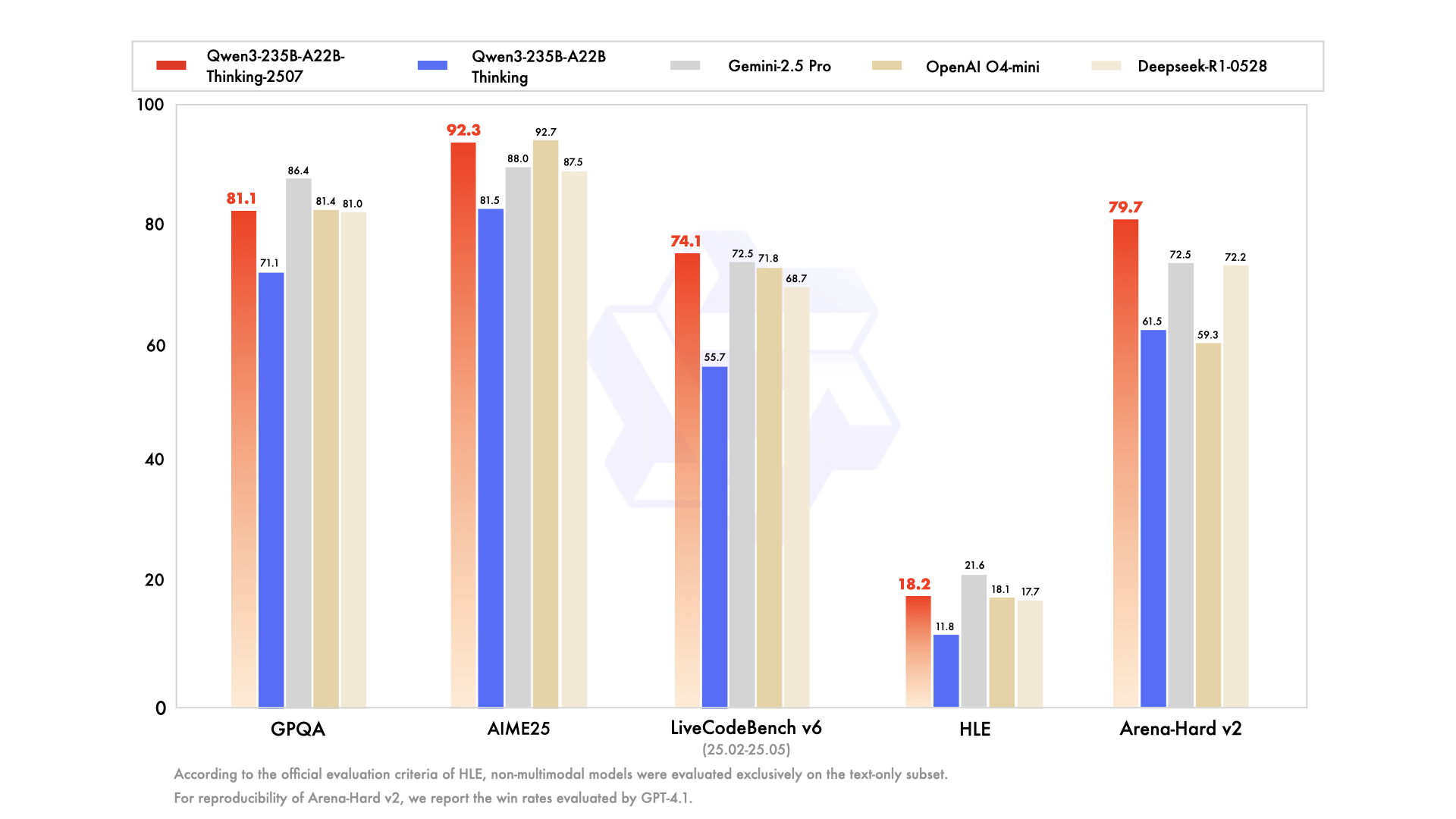
Model Overview
Qwen3-235B-A22B-Thinking-2507 has the following features:
- Type: Causal Language Models
- Training Stage: Pretraining & Post-training
- Number of Parameters: 235B in total and 22B activated
- Number of Paramaters (Non-Embedding): 234B
- Number of Layers: 94
- Number of Attention Heads (GQA): 64 for Q and 4 for KV
- Number of Experts: 128
- Number of Activated Experts: 8
- Context Length: 262,144 natively .
NOTE: This model supports only thinking mode.
Additionally, to enforce model thinking, the default chat template automatically includes
<think>
. Therefore, it is normal for the model's output to contain only
</think>
without an explicit opening
<think>
tag.
For more details, including benchmark evaluation, hardware requirements, and inference performance, please refer to our blog , GitHub , and Documentation .
Performance
| Deepseek-R1-0528 | OpenAI O4-mini | OpenAI O3 | Gemini-2.5 Pro | Claude4 Opus Thinking | Qwen3-235B-A22B Thinking | Qwen3-235B-A22B-Thinking-2507 | |
|---|---|---|---|---|---|---|---|
| Knowledge | |||||||
| MMLU-Pro | 85.0 | 81.9 | 85.9 | 85.6 | - | 82.8 | 84.4 |
| MMLU-Redux | 93.4 | 92.8 | 94.9 | 94.4 | 94.6 | 92.7 | 93.8 |
| GPQA | 81.0 | 81.4* | 83.3* | 86.4 | 79.6 | 71.1 | 81.1 |
| SuperGPQA | 61.7 | 56.4 | - | 62.3 | - | 60.7 | 64.9 |
| Reasoning | |||||||
| AIME25 | 87.5 | 92.7 * | 88.9* | 88.0 | 75.5 | 81.5 | 92.3 |
| HMMT25 | 79.4 | 66.7 | 77.5 | 82.5 | 58.3 | 62.5 | 83.9 |
| LiveBench 20241125 | 74.7 | 75.8 | 78.3 | 82.4 | 78.2 | 77.1 | 78.4 |
| HLE | 17.7# | 18.1* | 20.3 | 21.6 | 10.7 | 11.8# | 18.2# |
| Coding | |||||||
| LiveCodeBench v6 (25.02-25.05) | 68.7 | 71.8 | 58.6 | 72.5 | 48.9 | 55.7 | 74.1 |
| CFEval | 2099 | 1929 | 2043 | 2001 | - | 2056 | 2134 |
| OJBench | 33.6 | 33.3 | 25.4 | 38.9 | - | 25.6 | 32.5 |
| Alignment | |||||||
| IFEval | 79.1 | 92.4 | 92.1 | 90.8 | 89.7 | 83.4 | 87.8 |
| Arena-Hard v2$ | 72.2 | 59.3 | 80.8 | 72.5 | 59.1 | 61.5 | 79.7 |
| Creative Writing v3 | 86.3 | 78.8 | 87.7 | 85.9 | 83.8 | 84.6 | 86.1 |
| WritingBench | 83.2 | 78.4 | 85.3 | 83.1 | 79.1 | 80.3 | 88.3 |
| Agent | |||||||
| BFCL-v3 | 63.8 | 67.2 | 72.4 | 67.2 | 61.8 | 70.8 | 71.9 |
| TAU1-Retail | 63.9 | 71.8 | 73.9 | 74.8 | - | 54.8 | 67.8 |
| TAU1-Airline | 53.5 | 49.2 | 52.0 | 52.0 | - | 26.0 | 46.0 |
| TAU2-Retail | 64.9 | 71.0 | 76.3 | 71.3 | - | 40.4 | 71.9 |
| TAU2-Airline | 60.0 | 59.0 | 70.0 | 60.0 | - | 30.0 | 58.0 |
| TAU2-Telecom | 33.3 | 42.0 | 60.5 | 37.4 | - | 21.9 | 45.6 |
| Multilingualism | |||||||
| MultiIF | 63.5 | 78.0 | 80.3 | 77.8 | - | 71.9 | 80.6 |
| MMLU-ProX | 80.6 | 79.0 | 83.3 | 84.7 | - | 80.0 | 81.0 |
| INCLUDE | 79.4 | 80.8 | 86.6 | 85.1 | - | 78.7 | 81.0 |
| PolyMATH | 46.9 | 48.7 | 49.7 | 52.2 | - | 54.7 | 60.1 |
* For OpenAI O4-mini and O3, we use a medium reasoning effort, except for scores marked with *, which are generated using high reasoning effort.
# According to the official evaluation criteria of HLE, scores marked with # refer to models that are not multi-modal and were evaluated only on the text-only subset.
$ For reproducibility, we report the win rates evaluated by GPT-4.1.
& For highly challenging tasks (including PolyMATH and all reasoning and coding tasks), we use an output length of 81,920 tokens. For all other tasks, we set the output length to 32,768.
Quickstart
The code of Qwen3-MoE has been in the latest Hugging Face
transformers
and we advise you to use the latest version of
transformers
.
With
transformers<4.51.0
, you will encounter the following error:
KeyError: 'qwen3_moe'
The following contains a code snippet illustrating how to use the model generate content based on given inputs.
from transformers import AutoModelForCausalLM, AutoTokenizer

model_name = "Qwen/Qwen3-235B-A22B-Thinking-2507"

# load the tokenizer and the model
tokenizer = AutoTokenizer.from_pretrained(model_name)
model = AutoModelForCausalLM.from_pretrained(
    model_name,
    torch_dtype="auto",
    device_map="auto"
)

# prepare the model input
prompt = "Give me a short introduction to large language model."
messages = [
    {"role": "user", "content": prompt}
]
text = tokenizer.apply_chat_template(
    messages,
    tokenize=False,
    add_generation_prompt=True,
)
model_inputs = tokenizer([text], return_tensors="pt").to(model.device)

# conduct text completion
generated_ids = model.generate(
    **model_inputs,
    max_new_tokens=32768
)
output_ids = generated_ids[0][len(model_inputs.input_ids[0]):].tolist()

# parsing thinking content
try:
    # rindex finding 151668 (</think>)
    index = len(output_ids) - output_ids[::-1].index(151668)
except ValueError:
    index = 0

thinking_content = tokenizer.decode(output_ids[:index], skip_special_tokens=True).strip("\n")
content = tokenizer.decode(output_ids[index:], skip_special_tokens=True).strip("\n")

print("thinking content:", thinking_content) # no opening <think> tag
print("content:", content)
For deployment, you can use
sglang>=0.4.6.post1
or
vllm>=0.8.5
or to create an OpenAI-compatible API endpoint:
-
SGLang:
python -m sglang.launch_server --model-path Qwen/Qwen3-235B-A22B-Thinking-2507 --tp 8 --context-length 262144 --reasoning-parser deepseek-r1 -
vLLM:
vllm serve Qwen/Qwen3-235B-A22B-Thinking-2507 --tensor-parallel-size 8 --max-model-len 262144 --enable-reasoning --reasoning-parser deepseek_r1
Note: If you encounter out-of-memory (OOM) issues, you may consider reducing the context length to a smaller value. However, since the model may require longer token sequences for reasoning, we strongly recommend using a context length greater than 131,072 when possible.
For local use, applications such as Ollama, LMStudio, MLX-LM, llama.cpp, and KTransformers have also supported Qwen3.
Agentic Use
Qwen3 excels in tool calling capabilities. We recommend using Qwen-Agent to make the best use of agentic ability of Qwen3. Qwen-Agent encapsulates tool-calling templates and tool-calling parsers internally, greatly reducing coding complexity.
To define the available tools, you can use the MCP configuration file, use the integrated tool of Qwen-Agent, or integrate other tools by yourself.
from qwen_agent.agents import Assistant

# Define LLM
# Using Alibaba Cloud Model Studio
llm_cfg = {
    'model': 'qwen3-235b-a22b-thinking-2507',
    'model_type': 'qwen_dashscope',
}

# Using OpenAI-compatible API endpoint. It is recommended to disable the reasoning and the tool call parsing
# functionality of the deployment frameworks and let Qwen-Agent automate the related operations. For example,
# `VLLM_USE_MODELSCOPE=true vllm serve Qwen/Qwen3-235B-A22B-Thinking-2507 --served-model-name Qwen3-235B-A22B-Thinking-2507 --tensor-parallel-size 8 --max-model-len 262144`.
#
# llm_cfg = {
#     'model': 'Qwen3-235B-A22B-Thinking-2507',
#
#     # Use a custom endpoint compatible with OpenAI API:
#     'model_server': 'http://localhost:8000/v1',  # api_base without reasoning and tool call parsing
#     'api_key': 'EMPTY',
#     'generate_cfg': {
#         'thought_in_content': True,
#     },
# }

# Define Tools
tools = [
    {'mcpServers': {  # You can specify the MCP configuration file
            'time': {
                'command': 'uvx',
                'args': ['mcp-server-time', '--local-timezone=Asia/Shanghai']
            },
            "fetch": {
                "command": "uvx",
                "args": ["mcp-server-fetch"]
            }
        }
    },
  'code_interpreter',  # Built-in tools
]

# Define Agent
bot = Assistant(llm=llm_cfg, function_list=tools)

# Streaming generation
messages = [{'role': 'user', 'content': 'https://qwenlm.github.io/blog/ Introduce the latest developments of Qwen'}]
for responses in bot.run(messages=messages):
    pass
print(responses)
Processing Ultra-Long Texts
To support ultra-long context processing (up to 1 million tokens ), we integrate two key techniques:
- Dual Chunk Attention (DCA) : A length extrapolation method that splits long sequences into manageable chunks while preserving global coherence.
- MInference : A sparse attention mechanism that reduces computational overhead by focusing on critical token interactions.
Together, these innovations significantly improve both generation quality and inference efficiency for sequences beyond 256K tokens. On sequences approaching 1M tokens, the system achieves up to a 3× speedup compared to standard attention implementations.
For full technical details, see the Qwen2.5-1M Technical Report .
How to Enable 1M Token Context
To effectively process a 1 million token context, users will require approximately 1000 GB of total GPU memory. This accounts for model weights, KV-cache storage, and peak activation memory demands.
Step 1: Update Configuration File
Download the model and replace the content of your
config.json
with
config_1m.json
, which includes the config for length extrapolation and sparse attention.
export MODELNAME=Qwen3-235B-A22B-Thinking-2507
huggingface-cli download Qwen/${MODELNAME} --local-dir ${MODELNAME}
mv ${MODELNAME}/config.json ${MODELNAME}/config.json.bak
mv ${MODELNAME}/config_1m.json ${MODELNAME}/config.json
Step 2: Launch Model Server
After updating the config, proceed with either vLLM or SGLang for serving the model.
Option 1: Using vLLM
To run Qwen with 1M context support:
pip install -U vllm \
    --torch-backend=auto \
    --extra-index-url https://wheels.vllm.ai/nightly
Then launch the server with Dual Chunk Flash Attention enabled:
VLLM_ATTENTION_BACKEND=DUAL_CHUNK_FLASH_ATTN VLLM_USE_V1=0 \
vllm serve ./Qwen3-235B-A22B-Thinking-2507 \
  --tensor-parallel-size 8 \
  --max-model-len 1010000 \
  --enable-chunked-prefill \
  --max-num-batched-tokens 131072 \
  --enforce-eager \
  --max-num-seqs 1 \
  --gpu-memory-utilization 0.85 \
  --enable-reasoning --reasoning-parser deepseek_r1
Key Parameters
| Parameter | Purpose |
|---|---|
VLLM_ATTENTION_BACKEND=DUAL_CHUNK_FLASH_ATTN
|
Enables the custom attention kernel for long-context efficiency |
--max-model-len 1010000
|
Sets maximum context length to ~1M tokens |
--enable-chunked-prefill
|
Allows chunked prefill for very long inputs (avoids OOM) |
--max-num-batched-tokens 131072
|
Controls batch size during prefill; balances throughput and memory |
--enforce-eager
|
Disables CUDA graph capture (required for dual chunk attention) |
--max-num-seqs 1
|
Limits concurrent sequences due to extreme memory usage |
--gpu-memory-utilization 0.85
|
Set the fraction of GPU memory to be used for the model executor |
Option 2: Using SGLang
First, clone and install the specialized branch:
git clone https://github.com/sgl-project/sglang.git
cd sglang
pip install -e "python[all]"
Launch the server with DCA support:
python3 -m sglang.launch_server \
    --model-path ./Qwen3-235B-A22B-Thinking-2507 \
    --context-length 1010000 \
    --mem-frac 0.75 \
    --attention-backend dual_chunk_flash_attn \
    --tp 8 \
    --chunked-prefill-size 131072 \
    --reasoning-parser deepseek-r1
Key Parameters
| Parameter | Purpose |
|---|---|
--attention-backend dual_chunk_flash_attn
|
Activates Dual Chunk Flash Attention |
--context-length 1010000
|
Defines max input length |
--mem-frac 0.75
|
The fraction of the memory used for static allocation (model weights and KV cache memory pool). Use a smaller value if you see out-of-memory errors. |
--tp 8
|
Tensor parallelism size (matches model sharding) |
--chunked-prefill-size 131072
|
Prefill chunk size for handling long inputs without OOM |
Troubleshooting:
-
Encountering the error: "The model's max sequence length (xxxxx) is larger than the maximum number of tokens that can be stored in the KV cache." or "RuntimeError: Not enough memory. Please try to increase --mem-fraction-static."
The VRAM reserved for the KV cache is insufficient.
-
vLLM: Consider reducing the
max_model_lenor increasing thetensor_parallel_sizeandgpu_memory_utilization. Alternatively, you can reducemax_num_batched_tokens, although this may significantly slow down inference. -
SGLang: Consider reducing the
context-lengthor increasing thetpandmem-frac. Alternatively, you can reducechunked-prefill-size, although this may significantly slow down inference.
-
vLLM: Consider reducing the
-
Encountering the error: "torch.OutOfMemoryError: CUDA out of memory."
The VRAM reserved for activation weights is insufficient. You can try lowering
gpu_memory_utilizationormem-frac, but be aware that this might reduce the VRAM available for the KV cache. -
Encountering the error: "Input prompt (xxxxx tokens) + lookahead slots (0) is too long and exceeds the capacity of the block manager." or "The input (xxx xtokens) is longer than the model's context length (xxx tokens)."
The input is too lengthy. Consider using a shorter sequence or increasing the
max_model_lenorcontext-length.
Long-Context Performance
We test the model on an 1M version of the RULER benchmark.
| Model Name | Acc avg | 4k | 8k | 16k | 32k | 64k | 96k | 128k | 192k | 256k | 384k | 512k | 640k | 768k | 896k | 1000k |
|---|---|---|---|---|---|---|---|---|---|---|---|---|---|---|---|---|
| Qwen3-235B-A22B (Thinking) | 82.9 | 97.3 | 95.9 | 95.3 | 88.7 | 91.7 | 91.5 | 87.9 | 85.4 | 78.4 | 75.6 | 73.7 | 73.6 | 70.6 | 69.9 | 67.6 |
| Qwen3-235B-A22B-Thinking-2507 (Full Attention) | 95.4 | 99.6 | 100.0 | 99.5 | 99.6 | 99.1 | 100.0 | 98.8 | 98.1 | 96.1 | 95.2 | 90.0 | 91.7 | 89.7 | 87.9 | 85.9 |
| Qwen3-235B-A22B-Thinking-2507 (Sparse Attention) | 95.5 | 100.0 | 100.0 | 100.0 | 100.0 | 98.6 | 99.5 | 98.8 | 98.1 | 95.4 | 93.0 | 90.7 | 91.9 | 91.7 | 87.8 | 86.6 |
- All models are evaluated with Dual Chunk Attention enabled.
- Since the evaluation is time-consuming, we use 260 samples for each length (13 sub-tasks, 20 samples for each).
- To avoid overly verbose reasoning, we set the thinking budget to 8,192 tokens.
Best Practices
To achieve optimal performance, we recommend the following settings:
-
Sampling Parameters :
-
We suggest using
Temperature=0.6,TopP=0.95,TopK=20, andMinP=0. -
For supported frameworks, you can adjust the
presence_penaltyparameter between 0 and 2 to reduce endless repetitions. However, using a higher value may occasionally result in language mixing and a slight decrease in model performance.
-
We suggest using
-
Adequate Output Length : We recommend using an output length of 32,768 tokens for most queries. For benchmarking on highly complex problems, such as those found in math and programming competitions, we suggest setting the max output length to 81,920 tokens. This provides the model with sufficient space to generate detailed and comprehensive responses, thereby enhancing its overall performance.
-
Standardize Output Format : We recommend using prompts to standardize model outputs when benchmarking.
- Math Problems : Include "Please reason step by step, and put your final answer within \boxed{}." in the prompt.
-
Multiple-Choice Questions
: Add the following JSON structure to the prompt to standardize responses: "Please show your choice in the
answerfield with only the choice letter, e.g.,"answer": "C"."
-
No Thinking Content in History : In multi-turn conversations, the historical model output should only include the final output part and does not need to include the thinking content. It is implemented in the provided chat template in Jinja2. However, for frameworks that do not directly use the Jinja2 chat template, it is up to the developers to ensure that the best practice is followed.
Citation
If you find our work helpful, feel free to give us a cite.
@misc{qwen3technicalreport,
      title={Qwen3 Technical Report},
      author={Qwen Team},
      year={2025},
      eprint={2505.09388},
      archivePrefix={arXiv},
      primaryClass={cs.CL},
      url={https://arxiv.org/abs/2505.09388},
}
Runs of Alphatao Affine-3235227 on huggingface.co
12
Total runs
0
24-hour runs
0
3-day runs
-7
7-day runs
-43
30-day runs
More Information About Affine-3235227 huggingface.co Model
Url of Affine-3235227
Affine-3235227 huggingface.co Url
Provider of Affine-3235227 huggingface.co
Other API from Alphatao
Total runs:
33
Run Growth:
28
Growth Rate:
84.85%
Total runs:
27
Run Growth:
21
Growth Rate:
77.78%
Total runs:
26
Run Growth:
11
Growth Rate:
42.31%
Total runs:
25
Run Growth:
19
Growth Rate:
76.00%
Total runs:
23
Run Growth:
0
Growth Rate:
0.00%
Total runs:
18
Run Growth:
15
Growth Rate:
83.33%
Total runs:
18
Run Growth:
8
Growth Rate:
44.44%
Total runs:
17
Run Growth:
10
Growth Rate:
58.82%
Total runs:
17
Run Growth:
1
Growth Rate:
5.88%
Total runs:
17
Run Growth:
0
Growth Rate:
0.00%
Total runs:
17
Run Growth:
10
Growth Rate:
58.82%
Total runs:
16
Run Growth:
4
Growth Rate:
25.00%
Total runs:
16
Run Growth:
11
Growth Rate:
68.75%
Total runs:
15
Run Growth:
10
Growth Rate:
66.67%
Total runs:
15
Run Growth:
14
Growth Rate:
87.50%
Total runs:
15
Run Growth:
8
Growth Rate:
53.33%
Total runs:
14
Run Growth:
8
Growth Rate:
57.14%
Total runs:
14
Run Growth:
8
Growth Rate:
57.14%
Total runs:
14
Run Growth:
10
Growth Rate:
71.43%
Total runs:
14
Run Growth:
4
Growth Rate:
28.57%
Total runs:
14
Run Growth:
6
Growth Rate:
42.86%
Total runs:
13
Run Growth:
8
Growth Rate:
57.14%
Total runs:
13
Run Growth:
7
Growth Rate:
53.85%
Total runs:
13
Run Growth:
8
Growth Rate:
61.54%
Total runs:
12
Run Growth:
9
Growth Rate:
75.00%
Total runs:
12
Run Growth:
4
Growth Rate:
33.33%
Total runs:
12
Run Growth:
10
Growth Rate:
83.33%
Total runs:
12
Run Growth:
9
Growth Rate:
75.00%
Total runs:
12
Run Growth:
0
Growth Rate:
0.00%
Total runs:
12
Run Growth:
7
Growth Rate:
58.33%
Total runs:
11
Run Growth:
9
Growth Rate:
81.82%
Total runs:
11
Run Growth:
8
Growth Rate:
72.73%
Total runs:
11
Run Growth:
9
Growth Rate:
81.82%
Total runs:
11
Run Growth:
7
Growth Rate:
63.64%
Total runs:
11
Run Growth:
7
Growth Rate:
63.64%
Total runs:
11
Run Growth:
9
Growth Rate:
81.82%
Total runs:
11
Run Growth:
8
Growth Rate:
72.73%
Total runs:
11
Run Growth:
8
Growth Rate:
72.73%
Total runs:
11
Run Growth:
9
Growth Rate:
81.82%
Total runs:
11
Run Growth:
9
Growth Rate:
81.82%
Total runs:
11
Run Growth:
8
Growth Rate:
72.73%
Total runs:
11
Run Growth:
8
Growth Rate:
72.73%
Total runs:
11
Run Growth:
9
Growth Rate:
81.82%
Total runs:
11
Run Growth:
9
Growth Rate:
81.82%
Total runs:
11
Run Growth:
8
Growth Rate:
72.73%
Total runs:
11
Run Growth:
9
Growth Rate:
81.82%
Total runs:
11
Run Growth:
9
Growth Rate:
81.82%
Total runs:
11
Run Growth:
8
Growth Rate:
72.73%
Total runs:
11
Run Growth:
8
Growth Rate:
72.73%
Total runs:
10
Run Growth:
7
Growth Rate:
70.00%
Total runs:
10
Run Growth:
5
Growth Rate:
50.00%
Total runs:
10
Run Growth:
8
Growth Rate:
80.00%
Total runs:
10
Run Growth:
7
Growth Rate:
70.00%
Total runs:
10
Run Growth:
7
Growth Rate:
70.00%
Total runs:
10
Run Growth:
7
Growth Rate:
70.00%
Total runs:
10
Run Growth:
3
Growth Rate:
30.00%
Total runs:
10
Run Growth:
8
Growth Rate:
80.00%
Total runs:
10
Run Growth:
7
Growth Rate:
70.00%
Total runs:
10
Run Growth:
8
Growth Rate:
80.00%
Total runs:
10
Run Growth:
9
Growth Rate:
81.82%
Total runs:
10
Run Growth:
5
Growth Rate:
45.45%
Total runs:
10
Run Growth:
7
Growth Rate:
70.00%
Total runs:
10
Run Growth:
6
Growth Rate:
60.00%
Total runs:
10
Run Growth:
5
Growth Rate:
50.00%
Total runs:
10
Run Growth:
8
Growth Rate:
80.00%
Total runs:
10
Run Growth:
8
Growth Rate:
80.00%
Total runs:
10
Run Growth:
5
Growth Rate:
50.00%
Total runs:
10
Run Growth:
8
Growth Rate:
80.00%
Total runs:
10
Run Growth:
8
Growth Rate:
80.00%
Total runs:
10
Run Growth:
7
Growth Rate:
70.00%
Total runs:
10
Run Growth:
8
Growth Rate:
80.00%