




Total runs:
96.1K
Run Growth:
18.0K
Growth Rate:
18.74%
Perceiver IO model trained on Kinetics-700-2020 for auto-encoding videos that consist of images, audio and a class label. It was introduced in the paper Perceiver IO: A General Architecture for Structured Inputs & Outputs by Jaegle et al. and first released in this repository .
The goal of multimodal autoencoding is to learn a model that can accurately reconstruct multimodal inputs in the presence of a bottleneck induced by an architecture.
Disclaimer: The team releasing Perceiver IO did not write a model card for this model so this model card has been written by the Hugging Face team.
Perceiver IO is a transformer encoder model that can be applied on any modality (text, images, audio, video, ...). The core idea is to employ the self-attention mechanism on a not-too-large set of latent vectors (e.g. 256 or 512), and only use the inputs to perform cross-attention with the latents. This allows for the time and memory requirements of the self-attention mechanism to not depend on the size of the inputs.
To decode, the authors employ so-called decoder queries, which allow to flexibly decode the final hidden states of the latents to produce outputs of arbitrary size and semantics. For multimodal autoencoding, the output contains the reconstructions of the 3 modalities: images, audio and the class label.
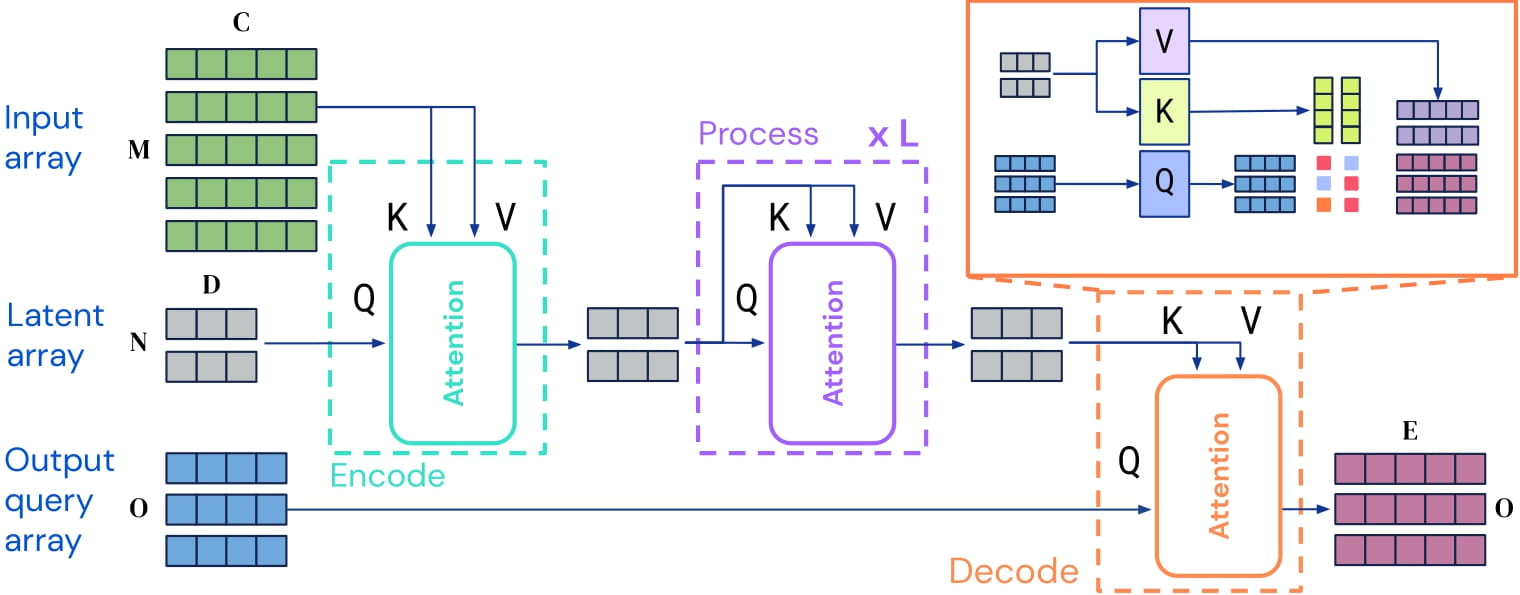
Perceiver IO architecture.
As the time and memory requirements of the self-attention mechanism don't depend on the size of the inputs, the Perceiver IO authors can train the model by padding the inputs (images, audio, class label) with modality-specific embeddings and serialize all of them into a 2D input array (i.e. concatenate along the time dimension). Decoding the final hidden states of the latents is done by using queries containing Fourier-based position embeddings (for video and audio) and modality embeddings.
You can use the raw model for multimodal autoencoding. Note that by masking the class label during evaluation, the auto-encoding model becomes a video classifier.
See the [model hub]( https://huggingface.co/models search=deepmind/perceiver) to look for other versions on a task that may interest you.
We refer to the tutorial notebook regarding using the Perceiver for multimodal autoencoding.
This model was trained on Kinetics-700-200 , a dataset consisting of videos that belong to one of 700 classes.
The authors train on 16 frames at 224x224 resolution, preprocessed into 50k 4x4 patches as well as 30k raw audio samples, patched into a total of 1920 16-dimensional vectors and one 700-dimensional one-hot representation of the class label.
Hyperparameter details can be found in Appendix F of the paper .
For evaluation results, we refer to table 5 of the paper .
@article{DBLP:journals/corr/abs-2107-14795,
  author    = {Andrew Jaegle and
               Sebastian Borgeaud and
               Jean{-}Baptiste Alayrac and
               Carl Doersch and
               Catalin Ionescu and
               David Ding and
               Skanda Koppula and
               Daniel Zoran and
               Andrew Brock and
               Evan Shelhamer and
               Olivier J. H{\'{e}}naff and
               Matthew M. Botvinick and
               Andrew Zisserman and
               Oriol Vinyals and
               Jo{\~{a}}o Carreira},
  title     = {Perceiver {IO:} {A} General Architecture for Structured Inputs {\&}
               Outputs},
  journal   = {CoRR},
  volume    = {abs/2107.14795},
  year      = {2021},
  url       = {https://arxiv.org/abs/2107.14795},
  eprinttype = {arXiv},
  eprint    = {2107.14795},
  timestamp = {Tue, 03 Aug 2021 14:53:34 +0200},
  biburl    = {https://dblp.org/rec/journals/corr/abs-2107-14795.bib},
  bibsource = {dblp computer science bibliography, https://dblp.org}
}