




Total runs:
10.7K
Run Growth:
-1.8K
Growth Rate:
-16.57%
XEUS - A Cross-lingual Encoder for Universal Speech
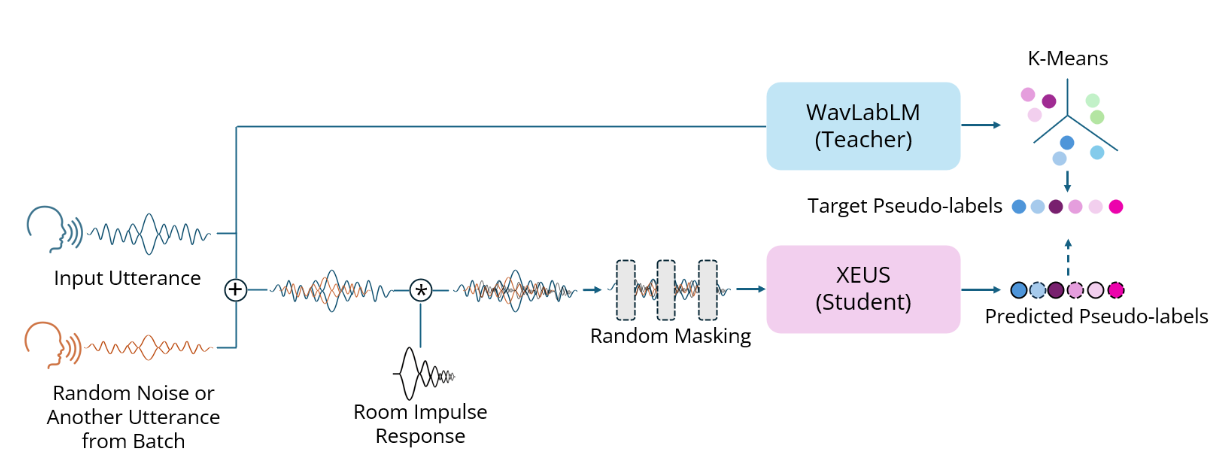
XEUS is a large-scale multilingual speech encoder by Carnegie Mellon University's WAVLab that covers over 4000 languages. It is pre-trained on over 1 million hours of publicly available speech datasets. It requires fine-tuning to be used in downstream tasks such as Speech Recognition or Translation. Its hidden states can also be used with k-means for semantic Speech Tokenization. XEUS uses the E-Branchformer architecture and is trained using HuBERT -style masked prediction of discrete speech tokens extracted from WavLabLM . During training, the input speech is also augmented with acoustic noise and reverberation, making XEUS more robust. The total model size is 577M parameters.
XEUS tops the ML-SUPERB multilingual speech recognition leaderboard, outperforming MMS , w2v-BERT 2.0 , and XLS-R . XEUS also sets a new state-of-the-art on 4 tasks in the monolingual SUPERB benchmark.
More information about XEUS, including download links for our crawled 4000-language dataset , can be found in the project page and paper .
The code for XEUS is still in progress of being merged into the main ESPnet repo. It can instead be used from the following fork:
pip install 'espnet @ git+https://github.com/wanchichen/espnet.git@ssl'
git lfs install
git clone https://huggingface.co/espnet/XEUS
XEUS supports Flash Attention , which can be installed as follows:
pip install flash-attn --no-build-isolation
from torch.nn.utils.rnn import pad_sequence
from espnet2.tasks.ssl import SSLTask
import soundfile as sf

device = "cuda" if torch.cuda.is_available() else "cpu"

xeus_model, xeus_train_args = SSLTask.build_model_from_file(
    None,
    '/path/to/checkpoint/here/checkpoint.pth',
    device,
)

wavs, sampling_rate = sf.read('/path/to/audio.wav') # sampling rate should be 16000
wav_lengths = torch.LongTensor([len(wav) for wav in [wavs]]).to(device)
wavs = pad_sequence(torch.Tensor([wavs]), batch_first=True).to(device)

# we recommend use_mask=True during fine-tuning
feats = xeus_model.encode(wavs, wav_lengths, use_mask=False, use_final_output=False)[0][-1] # take the output of the last layer -> batch_size x seq_len x hdim
With Flash Attention:
[layer.use_flash_attn = True for layer in xeus_model.encoder.encoders]

with torch.cuda.amp.autocast(dtype=torch.bfloat16):
  feats = xeus_model.encode(wavs, wav_lengths, use_mask=False, use_final_output=False)[0][-1]
Tune the masking settings:
xeus_model.masker.mask_prob = 0.65 # default 0.8
xeus_model.masker.mask_length = 20 # default 10
xeus_model.masker.mask_selection = 'static' # default 'uniform'
xeus_model.train()
feats = xeus_model.encode(wavs, wav_lengths, use_mask=True, use_final_output=False)[0][-1]


@misc{chen2024robustspeechrepresentationlearning,
      title={Towards Robust Speech Representation Learning for Thousands of Languages},
      author={William Chen and Wangyou Zhang and Yifan Peng and Xinjian Li and Jinchuan Tian and Jiatong Shi and Xuankai Chang and Soumi Maiti and Karen Livescu and Shinji Watanabe},
      year={2024},
      eprint={2407.00837},
      archivePrefix={arXiv},
      primaryClass={cs.CL},
      url={https://arxiv.org/abs/2407.00837},
}