




Total runs:
120.5K
Run Growth:
6.0K
Growth Rate:
5.01%
Distil-Whisper for English Automatic Speech Recognition (ASR) was proposed in the paper Robust Knowledge Distillation via Large-Scale Pseudo Labelling .
This is the knowledge distilled version of OpenAI's Whisper large-v3 for French ASR.
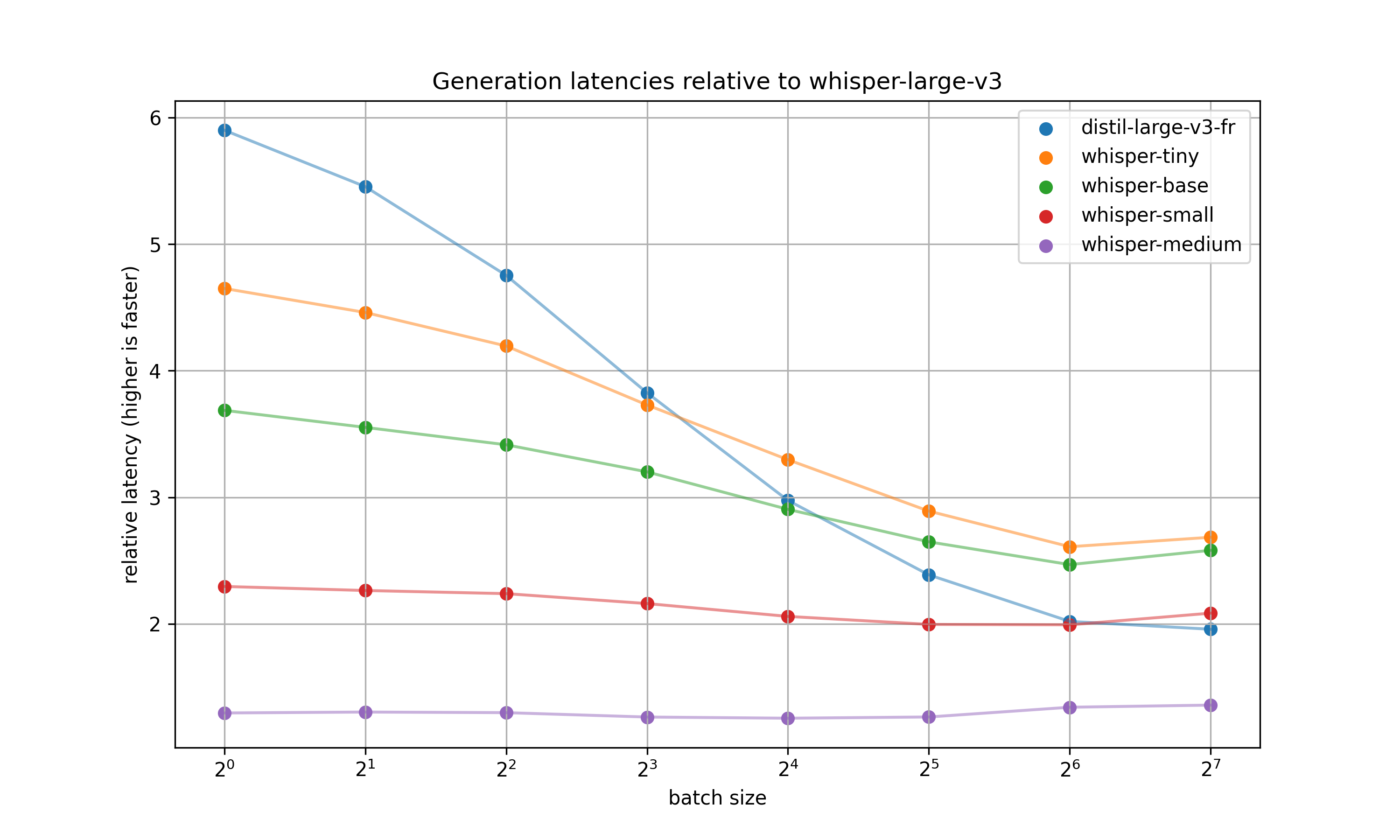
The result is a distilled model that performs within 2% WER of Whisper large-v3 on out-of-distribution evaluation sets for both short-form and long form transcription. Moreover, it is 5.9x faster than Whisper large-v3 and 1.3 times faster than the tiniest version of whisper while being incomparably more accurate.
| Model | Params (M) | Rel. Latency | Short-Form WER | Long-Form WER |
|---|---|---|---|---|
| whisper-tiny | 37.8 | 4.7 | 43.7 | 28.2 |
| whisper-base | 72.6 | 3.7 | 30.6 | 18.7 |
| whisper-small | 242 | 2.3 | 16.2 | 12.6 |
| whisper-medium | 764 | 1.3 | 11.7 | 11.0 |
| whisper-large-v3 | 1540 | 1.0 | 7.8 | 9.0 |
| distil-large-v3-fr | 756 | 5.9 | 9.3 | 11.1 |
*latencies benchmarked to generate 128 tokens on A100 40GB with a batch size of 1. More details about inference performances in
inference speed
section.
*WERs are averaged on the test sets. More details in
short-form
and
long-form
results sections.
distil-large-v3-fr is supported in the Hugging Face 🤗 Transformers library from version 4.41 onwards. To run the model, first install the latest version of Transformers. For this example, we'll also install 🤗 Datasets to load a toy audio dataset from the Hugging Face Hub:
pip install --upgrade pip
pip install --upgrade transformers accelerate datasets[audio]
The model can be used with the
pipeline
class to transcribe short-form audio files (< 30-seconds) as follows:
import torch
from transformers import AutoModelForSpeechSeq2Seq, AutoProcessor, pipeline
from datasets import load_dataset


device = "cuda:0" if torch.cuda.is_available() else "cpu"
torch_dtype = torch.float16 if torch.cuda.is_available() else torch.float32

model_id = "eustlb/distil-large-v3-fr"

model = AutoModelForSpeechSeq2Seq.from_pretrained(
    model_id, torch_dtype=torch_dtype, low_cpu_mem_usage=True, use_safetensors=True
)
model.to(device)

processor = AutoProcessor.from_pretrained(model_id)

pipe = pipeline(
    "automatic-speech-recognition",
    model=model,
    tokenizer=processor.tokenizer,
    feature_extractor=processor.feature_extractor,
    max_new_tokens=128,
    torch_dtype=torch_dtype,
    device=device,
)

dataset = load_dataset("google/fleurs", "fr_fr", split="train", streaming=True)
sample = next(iter(dataset))["audio"]

result = pipe(sample)
print(result["text"])
To transcribe a local audio file, simply pass the path to your audio file when you call the pipeline:
- result = pipe(sample)
+ result = pipe("audio.mp3")
For segment-level timestamps, pass the argument
return_timestamps=True
and return the
"chunks"
output:
result = pipe(sample, return_timestamps=True)
print(result["chunks"])
Ad-hoc generation arguments can be passed to
model.generate
, including
num_beams
for beam-search,
return_timestamps
for segment-level timestamps, and
prompt_ids
for prompting. See the
docstrings
for more details.
import torch
from transformers import AutoModelForSpeechSeq2Seq, AutoProcessor
from datasets import Audio, load_dataset


device = "cuda:0" if torch.cuda.is_available() else "cpu"
torch_dtype = torch.float16 if torch.cuda.is_available() else torch.float32

model_id = "eustlb/distil-large-v3-fr"

model = AutoModelForSpeechSeq2Seq.from_pretrained(
    model_id, torch_dtype=torch_dtype, low_cpu_mem_usage=True, use_safetensors=True
)
model.to(device)

processor = AutoProcessor.from_pretrained(model_id)

dataset = load_dataset("google/fleurs", "fr_fr", split="train", streaming=True)
dataset = dataset.cast_column("audio", Audio(processor.feature_extractor.sampling_rate))
sample = next(iter(dataset))["audio"]

input_features = processor(
  sample["array"], sampling_rate=sample["sampling_rate"], return_tensors="pt"
).input_features

input_features = input_features.to(device, dtype=torch_dtype)

gen_kwargs = {
  "max_new_tokens": 128,
  "num_beams": 1,
  "return_timestamps": False,
}

pred_ids = model.generate(input_features, **gen_kwargs)
pred_text = processor.batch_decode(pred_ids, skip_special_tokens=True, decode_with_timestamps=gen_kwargs["return_timestamps"])

print(pred_text)
distil-large-v3 is compatible with OpenAI's sequential long-form transcription algorithm. This algorithm uses a sliding window for buffered inference of long audio files (> 30-seconds), and returns more accurate transcriptions compared to the chunked long-form algorithm .
The sequential long-form algorithm should be used in either of the following scenarios:
If you are transcribing single long audio files and latency is the most important factor, you should use the chunked algorithm described below . For a detailed explanation of the different algorithms, refer to Sections 5 of the Distil-Whisper paper .
The
pipeline
class can be used to transcribe long audio files with the sequential algorithm as follows:
import torch
from transformers import AutoModelForSpeechSeq2Seq, AutoProcessor, pipeline
from datasets import load_dataset


device = "cuda:0" if torch.cuda.is_available() else "cpu"
torch_dtype = torch.float16 if torch.cuda.is_available() else torch.float32

model_id = "eustlb/distil-large-v3-fr"

model = AutoModelForSpeechSeq2Seq.from_pretrained(
    model_id, torch_dtype=torch_dtype, low_cpu_mem_usage=True, use_safetensors=True
)
model.to(device)

processor = AutoProcessor.from_pretrained(model_id)

pipe = pipeline(
    "automatic-speech-recognition",
    model=model,
    tokenizer=processor.tokenizer,
    feature_extractor=processor.feature_extractor,
    max_new_tokens=128,
    torch_dtype=torch_dtype,
    device=device,
)

dataset = load_dataset("eustlb/french-long-form-test", split="test", streaming=True)
sample = next(iter(dataset))["audio"]

result = pipe(sample)
print(result["text"])
import torch
from transformers import AutoModelForSpeechSeq2Seq, AutoProcessor
from datasets import Audio, load_dataset


device = "cuda:0" if torch.cuda.is_available() else "cpu"
torch_dtype = torch.float16 if torch.cuda.is_available() else torch.float32

model_id = "eustlb/distil-large-v3-fr"

model = AutoModelForSpeechSeq2Seq.from_pretrained(
    model_id, torch_dtype=torch_dtype, low_cpu_mem_usage=True, use_safetensors=True
)
model.to(device)

processor = AutoProcessor.from_pretrained(model_id)

dataset = load_dataset("eustlb/french-long-form-test", split="test", streaming=True)
dataset = dataset.cast_column("audio", Audio(processor.feature_extractor.sampling_rate))
sample = next(iter(dataset))["audio"]

inputs = processor(
    sample["array"],
    sampling_rate=sample["sampling_rate"],
    return_tensors="pt",
    truncation=False,
    padding="longest",
    return_attention_mask=True,
)
inputs = inputs.to(device, dtype=torch_dtype)

gen_kwargs = {
    "max_new_tokens": 448,
    "num_beams": 1,
    "condition_on_prev_tokens": False,
    "compression_ratio_threshold": 1.35,  # zlib compression ratio threshold (in token space)
    "temperature": (0.0, 0.2, 0.4, 0.6, 0.8, 1.0),
    "logprob_threshold": -1.0,
    "no_speech_threshold": 0.6,
    "return_timestamps": True,
}

pred_ids = model.generate(**inputs, **gen_kwargs)
pred_text = processor.batch_decode(pred_ids, skip_special_tokens=True, decode_with_timestamps=False)

print(pred_text)
distil-large-v3-fr remains compatible with the Transformers chunked long-form algorithm. This algorithm should be used when a single large audio file is being transcribed and the fastest possible inference is required. In such circumstances, the chunked algorithm is up to 9x faster than OpenAI's sequential long-form implementation (see Table 7 of the Distil-Whisper paper ).
To enable chunking, pass the
chunk_length_s
parameter to the
pipeline
. For distil-large-v3-fr, a chunk length of 25-seconds
is optimal. To activate batching over long audio files, pass the argument
batch_size
:
import torch
from transformers import AutoModelForSpeechSeq2Seq, AutoProcessor, pipeline
from datasets import load_dataset


device = "cuda:0" if torch.cuda.is_available() else "cpu"
torch_dtype = torch.float16 if torch.cuda.is_available() else torch.float32

model_id = "eustlb/distil-large-v3-fr"

model = AutoModelForSpeechSeq2Seq.from_pretrained(
    model_id, torch_dtype=torch_dtype, low_cpu_mem_usage=True, use_safetensors=True
)
model.to(device)

processor = AutoProcessor.from_pretrained(model_id)

pipe = pipeline(
    "automatic-speech-recognition",
    model=model,
    tokenizer=processor.tokenizer,
    feature_extractor=processor.feature_extractor,
    max_new_tokens=128,
    chunk_length_s=25,
    batch_size=16,
    torch_dtype=torch_dtype,
    device=device,
)

dataset = load_dataset("eustlb/french-long-form-test", split="test", streaming=True)
sample = next(iter(dataset))["audio"]

result = pipe(sample)
print(result["text"])
distil-large-v3 is the first Distil-Whisper model that can be used as an assistant to Whisper large-v3 for speculative decoding . Speculative decoding mathematically ensures that exactly the same outputs as Whisper are obtained, while being 2 times faster. This makes it the perfect drop-in replacement for existing Whisper pipelines, since the same outputs are guaranteed.
In the following code-snippet, we load the assistant Distil-Whisper model standalone to the main Whisper pipeline. We then specify it as the "assistant model" for generation:
from transformers import pipeline, AutoModelForCausalLM, AutoModelForSpeechSeq2Seq, AutoProcessor
import torch
from datasets import load_dataset

device = "cuda:0" if torch.cuda.is_available() else "cpu"
torch_dtype = torch.float16 if torch.cuda.is_available() else torch.float32

assistant_model_id = "eustlb/distil-large-v3-fr"

assistant_model = AutoModelForCausalLM.from_pretrained(
    assistant_model_id, torch_dtype=torch_dtype, low_cpu_mem_usage=True, use_safetensors=True
)
assistant_model.to(device)

model_id = "openai/whisper-large-v3"

model = AutoModelForSpeechSeq2Seq.from_pretrained(
    model_id, torch_dtype=torch_dtype, low_cpu_mem_usage=True, use_safetensors=True
)
model.to(device)

processor = AutoProcessor.from_pretrained(model_id)

pipe = pipeline(
    "automatic-speech-recognition",
    model=model,
    tokenizer=processor.tokenizer,
    feature_extractor=processor.feature_extractor,
    max_new_tokens=128,
    generate_kwargs={"assistant_model": assistant_model},
    torch_dtype=torch_dtype,
    device=device,
)

dataset = load_dataset("google/fleurs", "fr_fr", split="train", streaming=True)
sample = next(iter(dataset))["audio"]

result = pipe(sample)
print(result["text"])
For more details on speculative decoding, refer to the blog post Speculative Decoding for 2x Faster Whisper Inference .
You can apply additional speed and memory improvements to Distil-Whisper to further reduce the inference speed and VRAM requirements. These optimisations primarily target the attention kernel, swapping it from an eager implementation to a more efficient flash attention version.
We recommend using Flash-Attention 2 if your GPU allows for it. To do so, you first need to install Flash Attention :
pip install flash-attn --no-build-isolation
Then pass
attn_implementation="flash_attention_2"
to
from_pretrained
:
- model = AutoModelForSpeechSeq2Seq.from_pretrained(model_id, torch_dtype=torch_dtype, low_cpu_mem_usage=True, use_safetensors=True)
+ model = AutoModelForSpeechSeq2Seq.from_pretrained(model_id, torch_dtype=torch_dtype, low_cpu_mem_usage=True, use_safetensors=True, attn_implementation="flash_attention_2")
If your GPU does not support Flash Attention, we recommend making use of PyTorch scaled dot-product attention (SDPA) . This attention implementation is activated by default for PyTorch versions 2.1.1 or greater. To check whether you have a compatible PyTorch version, run the following Python code snippet:
from transformers.utils import is_torch_sdpa_available

print(is_torch_sdpa_available())
If the above returns
True
, you have a valid version of PyTorch installed and SDPA is activated by default. If it
returns
False
, you need to upgrade your PyTorch version according to the
official instructions
Once a valid PyTorch version is installed, SDPA is activated by default. It can also be set explicitly by specifying
attn_implementation="sdpa"
as follows:
- model = AutoModelForSpeechSeq2Seq.from_pretrained(model_id, torch_dtype=torch_dtype, low_cpu_mem_usage=True, use_safetensors=True)
+ model = AutoModelForSpeechSeq2Seq.from_pretrained(model_id, torch_dtype=torch_dtype, low_cpu_mem_usage=True, use_safetensors=True, attn_implementation="sdpa")
For more information about how to use the SDPA refer to the Transformers SDPA documentation .
Coming soon...
Coming soon...
distil-large-v3-fr can be run with the Whisper.cpp package with the original sequential long-form transcription algorithm. In a provisional benchmark on Mac M1, distil-large-v3 is over 5x faster than Whisper large-v3, while performing to within 0.8% WER over long-form audio.
Steps for getting started:
git clone https://github.com/ggerganov/whisper.cpp.git
cd whisper.cpp
pip install --upgrade huggingface_hub
And download the GGML weights for distil-large-v3 using the following Python snippet:
from huggingface_hub import hf_hub_download

hf_hub_download(repo_id='eustlb/distil-large-v3-fr-ggml', filename='ggml-distil-large-v3-fr.bin', local_dir='./models')
Note that if you do not have a Python environment set-up, you can also download the weights directly with
wget
:
wget https://huggingface.co/eustlb/distil-large-v3-fr-ggml/resolve/main/ggml-distil-large-v3-fr.bin -P ./models
wget https://huggingface.co/spaces/eustlb/whisper-vs-distil-whisper-fr/resolve/main/assets/example_1.wav
make -j && ./main -m models/ggml-distil-large-v3-fr.bin -f example_1.wav
Distil-Whisper can be run completely in your web browser with Transformers.js :
npm i @xenova/transformers
import { pipeline } from '@xenova/transformers';

const transcriber = await pipeline('automatic-speech-recognition', 'eustlb/distil-large-v3-fr');

const url = 'https://huggingface.co/datasets/Xenova/transformers.js-docs/resolve/main/jfk.wav';
const output = await transcriber(url);
// { text: " And so, my fellow Americans, ask not what your country can do for you. Ask what you can do for your country." }
Refer to the Transformers.js docs for further information.
Distil-Whisper inherits the encoder-decoder architecture from Whisper. The encoder maps a sequence of speech vector inputs to a sequence of hidden-state vectors. The decoder auto-regressively predicts text tokens, conditional on all previous tokens and the encoder hidden-states. Consequently, the encoder is only run forward once, whereas the decoder is run as many times as the number of tokens generated. In practice, this means the decoder accounts for over 90% of total inference time. Thus, to optimise for latency, the focus is on minimising the inference time of the decoder.
To distill the Whisper model, we reduce the number of decoder layers while keeping the encoder fixed. The encoder (shown in green) is entirely copied from the teacher to the student and frozen during training. The student's decoder structure is copied from Whisper large-v3 , with the only difference being a reduction from 32 to 2 decoder layers. These layers are initialized from distil-large-v3 to leverage language transfer from English to French (more details here ).
distil-large-v3-fr is trained on 4,515 hours of audio data from three open-source, permissively licensed speech datasets on the Hugging Face Hub:
| Dataset | Size / h | Speakers | Domain | Licence |
|---|---|---|---|---|
| Common Voice 17 | 1,014 | unknown | Narrated Wikipedia | CC0-1.0 |
| MultiLingual LibriSpeech | 1,077 | 142 | Audiobook | CC-BY-4.0 |
| YODAS fr000 split | 2,424 | unknown | YouTube | CC-BY-3.0 |
| Total | 4,515 | 142+ |
The audio data is then pseudo-labelled using the Whisper large-v3 model: we use Whisper to generate predictions for all the audio in our training set and use these as the target labels during training. Using pseudo-labels ensures that the transcriptions are consistently formatted across datasets and provides sequence-level distillation signal during training.
The Whisper pseudo-label predictions are subject to mis-transcriptions and hallucinations. To ensure we only train on accurate pseudo-labels, we employ a simple WER heuristic during training. First, we normalise the Whisper pseudo-labels and the ground truth labels provided by each dataset. We then compute the WER between these labels. If the WER exceeds a specified threshold, we discard the training example. Otherwise, we keep it for training.
We chose for this training a WER threshold of 20%, resulting in an effective training set of 2110 hours (750 for Common Voice 17 , 1040 for MultiLingual LibriSpeech and 320 for YODAS fr000 split ).
Section 9.2 of the Distil-Whisper paper demonstrates the effectiveness of this filter for improving downstream performance of the distilled model. We also partially attribute Distil-Whisper's robustness to hallucinations to this filter.
The model was trained for 18,000 optimisation steps (or 14 epochs) with batch size 256. We saved the best model, based on the global wer score on validation splits, reached after 14,000 optimization steps (or 11 epochs). See the Distil-Whisper paper for more details (training objective, etc).
The distilled model performs to within 1% WER of Whisper large-v3 on out-of-distribution (Voxpopuli, Fleurs) short-form audio and within 2.5% WER on out-of-distribuion sequential long-form decoding.
The model has been tested for both in-distribution (Common Voice 17 and Multilingual Librispeech) and out-of-distribution (Fleurs, Voxpopuli, custom long-form test set ) short-form and long-form transcription performances. Models have been evaluated with SDPA, float32 and batch size 32.
Short-form evaluations are conducted on the four given datasets by first applying a filter to exclude samples longer than 30 seconds.
Long-form evaluation is conducted on a custom out-of-distribution long-form test set using OpenAI's sequential long-form transcription algorithm (see Sequential Long-Form section) with long-form generation parameters that can be found here .
| Model | Common Voice 17 | Multilingual Librispeech | voxpopuli | fleurs | RTFx |
|---|---|---|---|---|---|
| whisper-tiny | 57.141 | 38.049 | 32.346 | 47.4 | 265.226 |
| whisper-base | 42.58 | 25.235 | 26.701 | 27.773 | 237.195 |
| whisper-small | 22.56 | 13.576 | 14.486 | 14.165 | 196.932 |
| whisper-medium | 15.51 | 9.541 | 11.836 | 9.992 | 93.428 |
| whisper-large-v3 | 11.038 | 4.762 | 9.83 | 5.624 | 62.845 |
| distil-large-v3-fr | 12.675 | 5.865 | 10.832 | 7.989 | 106.291 |
*the above datasets correspond to test splits
*RTFx = 1 / RTF, where RTF is the Real Time Factor . To be interpreted as audio processed (in seconds) per second of processing.
| Model Name | RTFx | long-form test set |
|---|---|---|
| whisper-tiny | 121.389 | 28.158 |
| whisper-base | 109.366 | 18.665 |
| whisper-small | 83.049 | 12.557 |
| whisper-medium | 47.807 | 11.023 |
| whisper-large-v3 | 38.294 | 9.008 |
| distil-large-v3-fr | 101.326 | 11.13 |
Reported latencies were benchmarked on a 40GB nvidia A100, generating 128 tokens with SDPA, bfloat16, 3 warmup steps, 5 measures, one beam. The benchmarking script can be found here . The time measured is the time do one forward pass of the encoder and 128 autoregressive forward passes of the decoder.
Training and evaluation code to reproduce Distil-Whisper is available under the Distil-Whisper repository: https://github.com/huggingface/distil-whisper/tree/main/training
distil-large-v3-fr inherits the MIT license from OpenAI's Whisper model.
If you use this model, please consider citing the Distil-Whisper paper :
@misc{gandhi2023distilwhisper,
      title={Distil-Whisper: Robust Knowledge Distillation via Large-Scale Pseudo Labelling},
      author={Sanchit Gandhi and Patrick von Platen and Alexander M. Rush},
      year={2023},
      eprint={2311.00430},
      archivePrefix={arXiv},
      primaryClass={cs.CL}
}