




Sponsored by
PostMcpAi
zai-org / GLM-Z1-9B-0414
Model's Last Updated: April 28 2025
text-generation
Introduction of GLM-Z1-9B-0414
Model Details of GLM-Z1-9B-0414
GLM-4-Z1-9B-0414
Introduction
The GLM family welcomes a new generation of open-source models, the GLM-4-32B-0414 series, featuring 32 billion parameters. Its performance is comparable to OpenAI's GPT series and DeepSeek's V3/R1 series, and it supports very user-friendly local deployment features. GLM-4-32B-Base-0414 was pre-trained on 15T of high-quality data, including a large amount of reasoning-type synthetic data, laying the foundation for subsequent reinforcement learning extensions. In the post-training stage, in addition to human preference alignment for dialogue scenarios, we also enhanced the model's performance in instruction following, engineering code, and function calling using techniques such as rejection sampling and reinforcement learning, strengthening the atomic capabilities required for agent tasks. GLM-4-32B-0414 achieves good results in areas such as engineering code, Artifact generation, function calling, search-based Q&A, and report generation. Some benchmarks even rival larger models like GPT-4o and DeepSeek-V3-0324 (671B).
GLM-Z1-32B-0414 is a reasoning model with deep thinking capabilities . This was developed based on GLM-4-32B-0414 through cold start and extended reinforcement learning, as well as further training of the model on tasks involving mathematics, code, and logic. Compared to the base model, GLM-Z1-32B-0414 significantly improves mathematical abilities and the capability to solve complex tasks. During the training process, we also introduced general reinforcement learning based on pairwise ranking feedback, further enhancing the model's general capabilities.
GLM-Z1-Rumination-32B-0414 is a deep reasoning model with rumination capabilities (benchmarked against OpenAI's Deep Research). Unlike typical deep thinking models, the rumination model employs longer periods of deep thought to solve more open-ended and complex problems (e.g., writing a comparative analysis of AI development in two cities and their future development plans). The rumination model integrates search tools during its deep thinking process to handle complex tasks and is trained by utilizing multiple rule-based rewards to guide and extend end-to-end reinforcement learning. Z1-Rumination shows significant improvements in research-style writing and complex retrieval tasks.
Finally, GLM-Z1-9B-0414 is a surprise. We employed the aforementioned series of techniques to train a 9B small-sized model that maintains the open-source tradition. Despite its smaller scale, GLM-Z1-9B-0414 still exhibits excellent capabilities in mathematical reasoning and general tasks. Its overall performance is already at a leading level among open-source models of the same size. Especially in resource-constrained scenarios, this model achieves an excellent balance between efficiency and effectiveness, providing a powerful option for users seeking lightweight deployment.
Performance
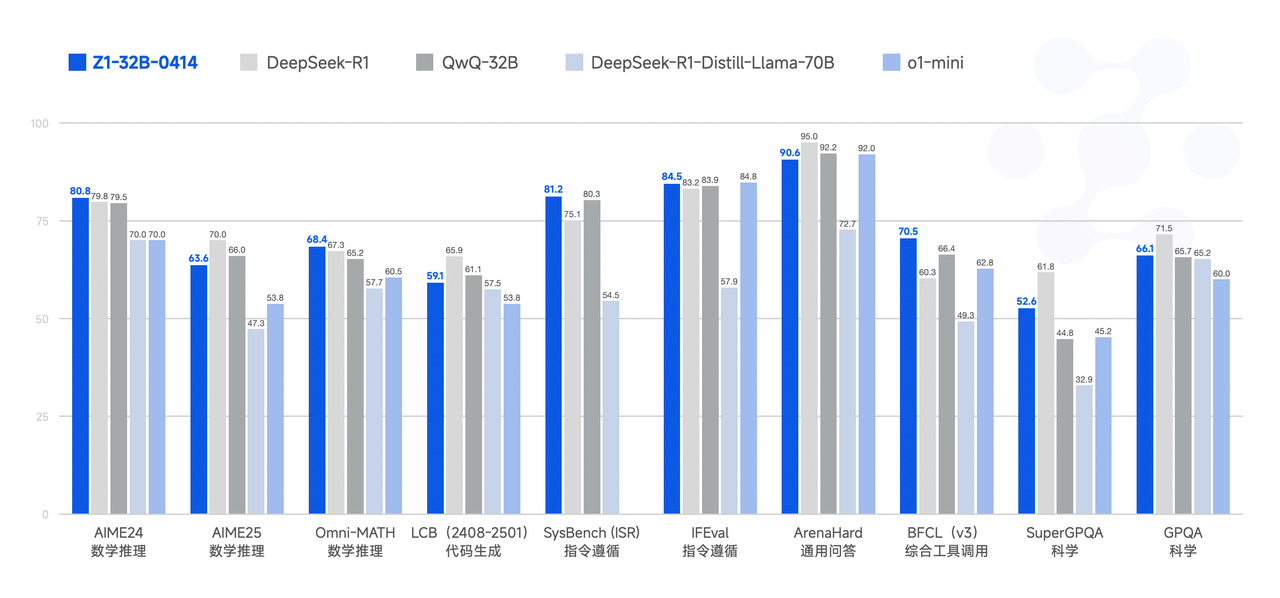
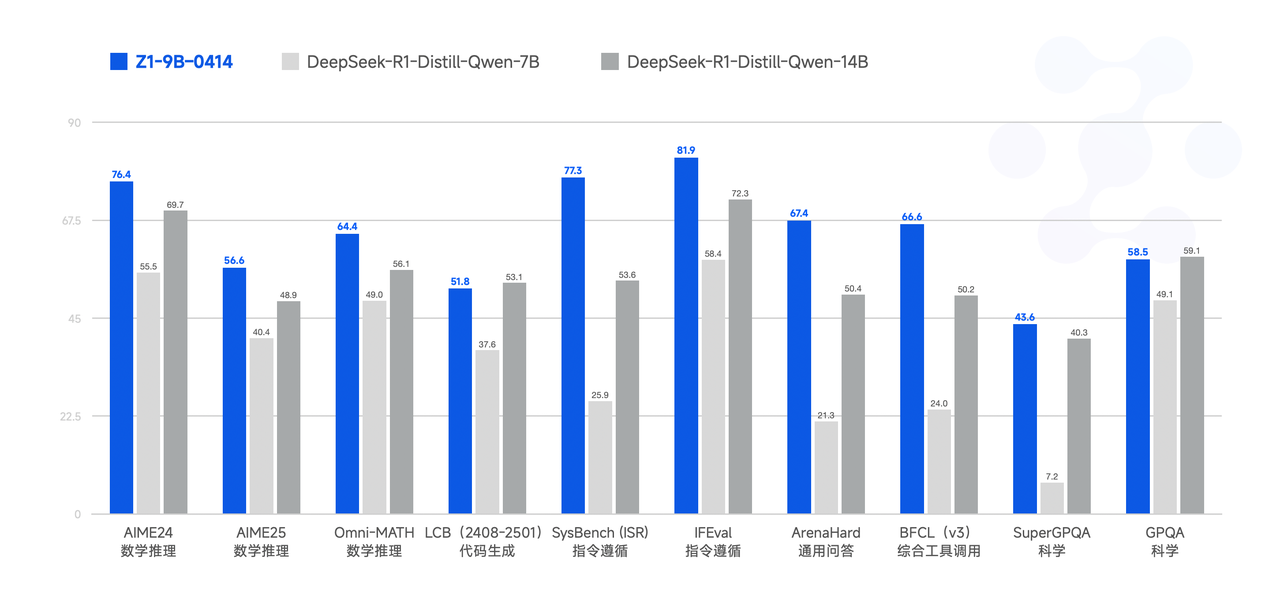
Model Usage Guidelines
I. Sampling Parameters
| Parameter | Recommended Value | Description |
|---|---|---|
| temperature | 0.6 | Balances creativity and stability |
| top_p | 0.95 | Cumulative probability threshold for sampling |
| top_k | 40 | Filters out rare tokens while maintaining diversity |
| max_new_tokens | 30000 | Leaves enough tokens for thinking |
II. Enforced Thinking
- Add <think>\n to the first line : Ensures the model thinks before responding
-
When using
chat_template.jinja, the prompt is automatically injected to enforce this behavior
III. Dialogue History Trimming
-
Retain only the
final user-visible reply
.
Hidden thinking content should not be saved to history to reduce interference—this is already implemented inchat_template.jinja
IV. Handling Long Contexts (YaRN)
-
When input length exceeds 8,192 tokens , consider enabling YaRN (Rope Scaling)
-
In supported frameworks, add the following snippet to
config.json:"rope_scaling": { "type": "yarn", "factor": 4.0, "original_max_position_embeddings": 32768 } -
Static YaRN applies uniformly to all text. It may slightly degrade performance on short texts, so enable as needed.
Inference Code
Make Sure Using
transforemrs>=4.51.3
.
from transformers import AutoModelForCausalLM, AutoTokenizer

MODEL_PATH = "THUDM/GLM-4-Z1-9B-0414"

tokenizer = AutoTokenizer.from_pretrained(MODEL_PATH)
model = AutoModelForCausalLM.from_pretrained(MODEL_PATH, device_map="auto")

message = [{"role": "user", "content": "Let a, b be positive real numbers such that ab = a + b + 3. Determine the range of possible values for a + b."}]

inputs = tokenizer.apply_chat_template(
    message,
    return_tensors="pt",
    add_generation_prompt=True,
    return_dict=True,
).to(model.device)

generate_kwargs = {
    "input_ids": inputs["input_ids"],
    "attention_mask": inputs["attention_mask"],
    "max_new_tokens": 4096,
    "do_sample": False,
}
out = model.generate(**generate_kwargs)
print(tokenizer.decode(out[0][inputs["input_ids"].shape[1]:], skip_special_tokens=True))
Citations
If you find our work useful, please consider citing the following paper.
@misc{glm2024chatglm,
      title={ChatGLM: A Family of Large Language Models from GLM-130B to GLM-4 All Tools},
      author={Team GLM and Aohan Zeng and Bin Xu and Bowen Wang and Chenhui Zhang and Da Yin and Diego Rojas and Guanyu Feng and Hanlin Zhao and Hanyu Lai and Hao Yu and Hongning Wang and Jiadai Sun and Jiajie Zhang and Jiale Cheng and Jiayi Gui and Jie Tang and Jing Zhang and Juanzi Li and Lei Zhao and Lindong Wu and Lucen Zhong and Mingdao Liu and Minlie Huang and Peng Zhang and Qinkai Zheng and Rui Lu and Shuaiqi Duan and Shudan Zhang and Shulin Cao and Shuxun Yang and Weng Lam Tam and Wenyi Zhao and Xiao Liu and Xiao Xia and Xiaohan Zhang and Xiaotao Gu and Xin Lv and Xinghan Liu and Xinyi Liu and Xinyue Yang and Xixuan Song and Xunkai Zhang and Yifan An and Yifan Xu and Yilin Niu and Yuantao Yang and Yueyan Li and Yushi Bai and Yuxiao Dong and Zehan Qi and Zhaoyu Wang and Zhen Yang and Zhengxiao Du and Zhenyu Hou and Zihan Wang},
      year={2024},
      eprint={2406.12793},
      archivePrefix={arXiv},
      primaryClass={id='cs.CL' full_name='Computation and Language' is_active=True alt_name='cmp-lg' in_archive='cs' is_general=False description='Covers natural language processing. Roughly includes material in ACM Subject Class I.2.7. Note that work on artificial languages (programming languages, logics, formal systems) that does not explicitly address natural-language issues broadly construed (natural-language processing, computational linguistics, speech, text retrieval, etc.) is not appropriate for this area.'}
}
Runs of zai-org GLM-Z1-9B-0414 on huggingface.co
2.0K
Total runs
0
24-hour runs
31
3-day runs
735
7-day runs
-1.9K
30-day runs
More Information About GLM-Z1-9B-0414 huggingface.co Model
Url of GLM-Z1-9B-0414
GLM-Z1-9B-0414 huggingface.co Url
Provider of GLM-Z1-9B-0414 huggingface.co
Other API from zai-org
Total runs:
1.9M
Run Growth:
-106.5K
Growth Rate:
-5.66%
Total runs:
1.3M
Run Growth:
1.2M
Growth Rate:
100.00%
Total runs:
1.3M
Run Growth:
-706.1K
Growth Rate:
-53.41%
Total runs:
932.2K
Run Growth:
-1.7M
Growth Rate:
-184.79%
Total runs:
272.7K
Run Growth:
-733.7K
Growth Rate:
-269.02%
Total runs:
263.9K
Run Growth:
-178.7K
Growth Rate:
-61.88%
Total runs:
177.1K
Run Growth:
-190.9K
Growth Rate:
-107.80%
Total runs:
101.7K
Run Growth:
-187.4K
Growth Rate:
-184.31%
Total runs:
83.9K
Run Growth:
-71.7K
Growth Rate:
-85.44%
Total runs:
78.4K
Run Growth:
-82.6K
Growth Rate:
-105.42%
Total runs:
76.3K
Run Growth:
-8.1K
Growth Rate:
-10.65%
Total runs:
56.1K
Run Growth:
-91.2K
Growth Rate:
-162.64%
Total runs:
50.6K
Run Growth:
43.0K
Growth Rate:
84.93%
Total runs:
50.6K
Run Growth:
27.7K
Growth Rate:
54.67%
Total runs:
22.0K
Run Growth:
-2.3K
Growth Rate:
-10.22%
Total runs:
22.0K
Run Growth:
4.2K
Growth Rate:
19.09%
Total runs:
20.7K
Run Growth:
-20.8K
Growth Rate:
-100.51%
Total runs:
17.8K
Run Growth:
17.2K
Growth Rate:
96.57%
Total runs:
16.6K
Run Growth:
16.0K
Growth Rate:
99.85%
Total runs:
15.4K
Run Growth:
-2.5K
Growth Rate:
-16.41%
Total runs:
15.3K
Run Growth:
1.5K
Growth Rate:
9.67%
Total runs:
15.1K
Run Growth:
-13.3K
Growth Rate:
-87.97%
Total runs:
14.2K
Run Growth:
-13.3K
Growth Rate:
-93.35%
Total runs:
13.4K
Run Growth:
12.2K
Growth Rate:
96.20%
Total runs:
13.1K
Run Growth:
2.5K
Growth Rate:
18.98%
Total runs:
10.3K
Run Growth:
3.0K
Growth Rate:
29.59%
Total runs:
8.5K
Run Growth:
3.7K
Growth Rate:
42.98%
Total runs:
5.5K
Run Growth:
-12.0K
Growth Rate:
-219.26%
Total runs:
4.3K
Run Growth:
578
Growth Rate:
13.35%
Total runs:
3.0K
Run Growth:
-672
Growth Rate:
-22.51%
Total runs:
2.9K
Run Growth:
-1.6K
Growth Rate:
-53.96%
Total runs:
2.3K
Run Growth:
1.3K
Growth Rate:
56.65%
Total runs:
2.1K
Run Growth:
-114
Growth Rate:
-5.49%
Total runs:
2.0K
Run Growth:
1.4K
Growth Rate:
67.67%
Total runs:
1.7K
Run Growth:
-2.5K
Growth Rate:
-148.32%
Total runs:
1.6K
Run Growth:
-16.9K
Growth Rate:
-1029.69%
Total runs:
1.4K
Run Growth:
645
Growth Rate:
45.68%
Total runs:
1.4K
Run Growth:
524
Growth Rate:
37.59%
Total runs:
1.2K
Run Growth:
-1.0K
Growth Rate:
-82.54%
Total runs:
994
Run Growth:
576
Growth Rate:
57.95%
Total runs:
994
Run Growth:
295
Growth Rate:
29.68%
Total runs:
852
Run Growth:
-721
Growth Rate:
-84.62%
Total runs:
631
Run Growth:
-706
Growth Rate:
-111.89%
Total runs:
625
Run Growth:
338
Growth Rate:
54.08%
Total runs:
567
Run Growth:
208
Growth Rate:
36.68%
Total runs:
560
Run Growth:
258
Growth Rate:
46.07%
Total runs:
504
Run Growth:
35
Growth Rate:
6.94%
Total runs:
488
Run Growth:
167
Growth Rate:
34.22%
Total runs:
458
Run Growth:
103
Growth Rate:
22.49%
Total runs:
443
Run Growth:
-353
Growth Rate:
-79.68%
Total runs:
423
Run Growth:
-1.2K
Growth Rate:
-294.09%
Total runs:
413
Run Growth:
266
Growth Rate:
64.41%
Total runs:
312
Run Growth:
-281
Growth Rate:
-90.06%
Total runs:
307
Run Growth:
277
Growth Rate:
90.23%
Total runs:
298
Run Growth:
93
Growth Rate:
31.21%
Total runs:
289
Run Growth:
-51
Growth Rate:
-17.65%
Total runs:
289
Run Growth:
153
Growth Rate:
52.94%
Total runs:
283
Run Growth:
148
Growth Rate:
52.30%
Total runs:
278
Run Growth:
147
Growth Rate:
52.88%
Total runs:
268
Run Growth:
132
Growth Rate:
49.25%
Total runs:
264
Run Growth:
-1.4K
Growth Rate:
-517.42%
Total runs:
245
Run Growth:
76
Growth Rate:
31.02%
Total runs:
225
Run Growth:
118
Growth Rate:
52.44%
Total runs:
217
Run Growth:
111
Growth Rate:
51.15%