




Sponsored by
APIMart
AIDC-AI / Marco-DeepResearch-8B
Model's Last Updated: May 08 2026
text-generation
Introduction of Marco-DeepResearch-8B
Model Details of Marco-DeepResearch-8B
Marco-DeepResearch-8B
Introduction
Marco DeepResearch is an efficient 8B-scale deep research agent developed by Alibaba International Digital Commerce (AIDC-AI) . It autonomously conducts open-ended investigations by integrating complex information retrieval with multi-step reasoning across diverse web sources.
Marco DeepResearch is optimized through a verification-centric framework at three levels:
- Verified Data Synthesis — Graph-based and agent-based QA synthesis with explicit verification to control difficulty and ensure answer uniqueness/correctness.
- Verification-Driven Trajectory Construction — Multi-agent framework (main agent + search sub-agent + verifier sub-agent) that injects explicit verification patterns into training trajectories.
- Verifier-Guided Test-Time Scaling — Uses the agent itself as a verifier at inference time, achieving +12.1 avg. improvement on benchmarks.
Under a maximum budget of 600 tool calls, Marco DeepResearch significantly outperforms 8B-scale agents and surpasses or approaches several 30B-scale agents (e.g., Tongyi DeepResearch-30B) on challenging benchmarks.
Model Details
| Attribute | Details |
|---|---|
| Base Model | Qwen3-8B |
| Parameters | ~8B |
| Context Window | 128K tokens (extended via YaRN) |
| Training | SFT + RL (GRPO) |
| Training Hardware | 64 × NVIDIA A100 GPUs |
| Max Generation Length | 16,384 tokens |
| Decoding | Temperature 0.7, Top-p 0.95 |
| Max Tool Calls | 600 (evaluation budget) |
Prompt Format
Prompt Structure
The prompt follows a System + User two-part design (similar to OpenAI native function calling):
- System Prompt = Role definition + Output format + Current date + Tool definitions
- User Prompt = Only the user question
This ensures tool definitions stay at the front of context and won't be diluted by long multi-turn conversations.
System Prompt Template
Below is the complete system prompt. Replace
{current_date}
with the actual date and
{tools_json}
with your tool definitions.
You are an expert web researcher. Your task is to find accurate, complete answers through iterative search, extraction, and verification.

## Core Principles

1) Strategic Planning
   - Decompose complex questions into targeted sub-tasks
   - Choose the right tool for each step
   - Refine your approach based on what you learn

2) Precise Execution
   - Define clear objectives before using any tool
   - Provide sufficient detail for accurate results
   - Avoid vague or overly broad requests

3) Rigorous Verification
   - Cross-check important facts across multiple sources
   - Resolve conflicts by gathering additional evidence
   - Only conclude when evidence is sufficient and consistent

## Output Format

In each turn, you can either call a tool or provide the final answer.

**Call a tool:**
<think>your reasoning process</think>
<tool_call>
{"name": "tool_name", "arguments": {"param1": "value1", "param2": "value2"}}
</tool_call>

**Provide final answer (when you have gathered enough information):**
<think>your reasoning and analysis</think>
<answer>the direct answer to the question</answer>

Note: All reasoning should be in <think>, <answer> should contain only the final answer.

Current date: {current_date}

# Tools

You may call one or more functions to assist with the user query.

You are provided with function signatures within <tools></tools> XML tags:
<tools>
{tools_json}
</tools>

For each function call, return a json object with function name and arguments within <tool_call></tool_call> XML tags:
<tool_call>
{"name": <function-name>, "arguments": <args-json-object>}
</tool_call>
Tool Definition Format
Tools use the OpenAI function calling format and are placed inside the system prompt. Example:
[
  {
    "type": "function",
    "function": {
      "name": "search",
      "description": "Search the web via Google to find relevant information and URLs.",
      "parameters": {
        "type": "object",
        "properties": {
          "querys": {
            "type": "array",
            "items": {"type": "string"},
            "description": "Search queries for finding relevant information. Supports single or multiple queries."
          }
        },
        "required": ["querys"]
      }
    }
  },
  {
    "type": "function",
    "function": {
      "name": "visit",
      "description": "Read webpage content to extract specific information, verify claims, or understand context.",
      "parameters": {
        "type": "object",
        "properties": {
          "urls": {
            "type": "array",
            "items": {"type": "string"},
            "description": "URL(s) to visit. Supports single or multiple urls."
          },
          "goal": {
            "type": "string",
            "description": "The specific information to retrieve. Be precise, not vague."
          }
        },
        "required": ["urls", "goal"]
      }
    }
  }
]
Model Output Format
In each turn, the model produces one of two structured outputs:
Tool call turn:
<think>
I need to search for information about X to answer the user's question.
Let me start by searching for...
</think>
<tool_call>
{"name": "search", "arguments": {"querys": ["search query here"]}}
</tool_call>
Final answer turn:
<think>
Based on the evidence gathered from multiple sources, I can now conclude that...
Let me verify: Source A says X, Source B confirms X, and Source C also supports X.
</think>
<answer>
The direct answer to the question.
</answer>
Multi-Turn Conversation Format
A complete multi-turn agent session looks like:
[System]  Role + Tools + Date

[User]    What is the population of the largest city in Switzerland?

[Asst]    <think>I need to find the largest city in Switzerland first...</think>
          <tool_call>{"name": "search", "arguments": {"querys": ["largest city in Switzerland"]}}</tool_call>

[User]    <tool_response>{"results": [{"title": "Zürich - Wikipedia", ...}]}</tool_response>

[Asst]    <think>Zürich is the largest city. Now let me find its population...</think>
          <tool_call>{"name": "visit", "arguments": {"urls": ["..."], "goal": "population of Zürich"}}</tool_call>

[User]    <tool_response>{"found": true, "content": "Population: 434,335 (2024)"}</tool_response>

[Asst]    <think>I found the answer with a reliable source...</think>
          <answer>The largest city in Switzerland is Zürich, with a population of approximately 434,335.</answer>
Quick Start
from transformers import AutoModelForCausalLM, AutoTokenizer
import json
from datetime import datetime

model_name = "AIDC-AI/Marco-DeepResearch-8B"

tokenizer = AutoTokenizer.from_pretrained(model_name, trust_remote_code=True)
model = AutoModelForCausalLM.from_pretrained(
    model_name,
    torch_dtype="auto",
    device_map="auto",
    trust_remote_code=True,
)

# 1. Define tools (OpenAI function calling format)
tools = [
    {
        "type": "function",
        "function": {
            "name": "search",
            "description": "Search the web via Google to find relevant information and URLs.",
            "parameters": {
                "type": "object",
                "properties": {
                    "querys": {
                        "type": "array",
                        "items": {"type": "string"},
                        "description": "Search queries for finding relevant information. Supports single or multiple queries."
                    }
                },
                "required": ["querys"]
            }
        }
    },
    {
        "type": "function",
        "function": {
            "name": "visit",
            "description": "Read webpage content to extract specific information, verify claims, or understand context.",
            "parameters": {
                "type": "object",
                "properties": {
                    "urls": {
                        "type": "array",
                        "items": {"type": "string"},
                        "description": "URL(s) to visit. Supports single or multiple urls."
                    },
                    "goal": {
                        "type": "string",
                        "description": "The specific information to retrieve. Be precise, not vague."
                    }
                },
                "required": ["urls", "goal"]
            }
        }
    }
]

# 2. Build system prompt
ROLE_PROMPT = """You are an expert web researcher. Your task is to find accurate, complete answers through iterative search, extraction, and verification.

## Core Principles

1) Strategic Planning
   - Decompose complex questions into targeted sub-tasks
   - Choose the right tool for each step
   - Refine your approach based on what you learn

2) Precise Execution
   - Define clear objectives before using any tool
   - Provide sufficient detail for accurate results
   - Avoid vague or overly broad requests

3) Rigorous Verification
   - Cross-check important facts across multiple sources
   - Resolve conflicts by gathering additional evidence
   - Only conclude when evidence is sufficient and consistent

## Output Format

In each turn, you can either call a tool or provide the final answer.

**Call a tool:**
<think>your reasoning process</think>
<tool_call>
{"name": "tool_name", "arguments": {"param1": "value1", "param2": "value2"}}
</tool_call>

**Provide final answer (when you have gathered enough information):**
<think>your reasoning and analysis</think>
<answer>the direct answer to the question</answer>

Note: All reasoning should be in <think>, <answer> should contain only the final answer."""

current_date = datetime.now().strftime("%Y-%m-%d")
tools_json = "\n".join([json.dumps(t, ensure_ascii=False) for t in tools])

system_prompt = f"""{ROLE_PROMPT}

Current date: {current_date}

# Tools

You may call one or more functions to assist with the user query.

You are provided with function signatures within <tools></tools> XML tags:
<tools>
{tools_json}
</tools>

For each function call, return a json object with function name and arguments within <tool_call></tool_call> XML tags:
<tool_call>
{{"name": <function-name>, "arguments": <args-json-object>}}
</tool_call>"""

# 3. Build messages and generate
messages = [
    {"role": "system", "content": system_prompt},
    {"role": "user", "content": "Who won the 2026 Turing Award?"},
]

text = tokenizer.apply_chat_template(messages, tokenize=False, add_generation_prompt=True)
inputs = tokenizer([text], return_tensors="pt").to(model.device)
outputs = model.generate(**inputs, max_new_tokens=16384, temperature=0.7, top_p=0.95)
response = tokenizer.decode(outputs[0][inputs.input_ids.shape[-1]:], skip_special_tokens=True)
print(response)
For the full multi-turn agent loop , see the GitHub repository .
Benchmark Results
Evaluated on a suite of deep search benchmarks under a maximum budget of 600 tool calls .
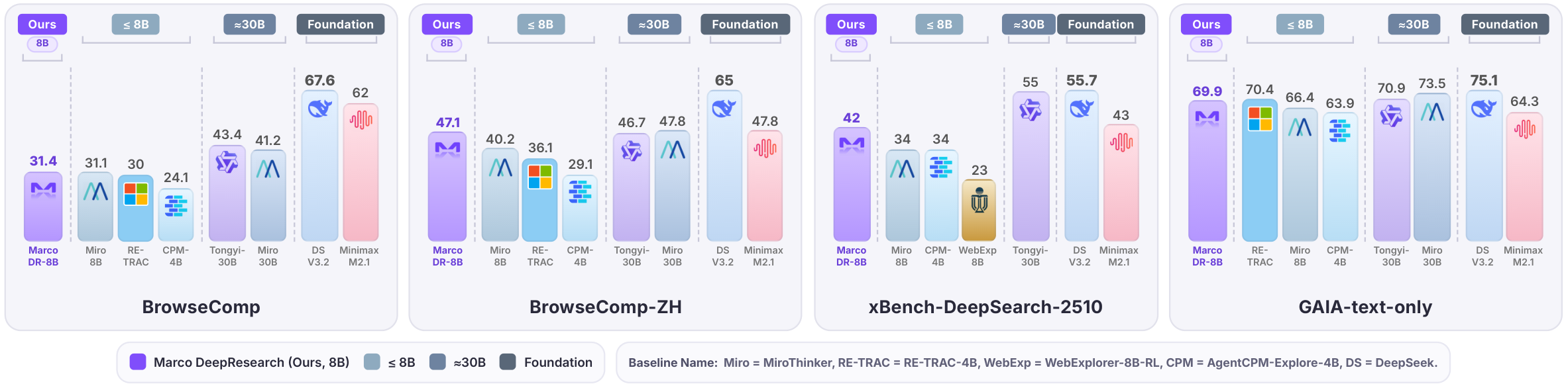
| Model | BrowseComp | BrowseComp-ZH | GAIA (text-only) | WebWalkerQA | xBench-DS-2505 | xBench-DS-2510 | DeepSearchQA | HLE-Text |
|---|---|---|---|---|---|---|---|---|
| Foundation Models with Tools | ||||||||
| GLM-4.7 | 67.5 | 66.6 | 61.9 | – | 72.0 | 52.3 | – | 42.8 |
| Minimax-M2.1 | 62.0 | 47.8 | 64.3 | – | 68.7 | 43.0 | – | 19.1 |
| DeepSeek-V3.2 | 67.6 | 65.0 | 75.1 | – | 78.0 | 55.7 | 60.9 | 40.8 |
| Kimi-K2.5 | 74.9 | 62.3 | – | – | – | 46.0 | 77.1 | – |
| Claude-4-Sonnet | 12.2 | 29.1 | 68.3 | 61.7 | 64.6 | – | – | – |
| Claude-4.5-Opus | 67.8 | 62.4 | – | – | – | – | 80.0 | – |
| OpenAI-o3 | 49.7 | 58.1 | – | 71.7 | 67.0 | – | – | – |
| OpenAI GPT-5 High | 54.9 | 65.0 | 76.4 | – | 77.8 | 75.0 | 79.0 | – |
| Gemini-3.0-Pro | 59.2 | 66.8 | – | – | – | 53.0 | 76.9 | – |
| Trained Agents (≥30B) | ||||||||
| MiroThinker-v1.7-mini | 67.9 | 72.3 | 80.3 | – | – | 57.2 | 67.9 | 36.4 |
| MiroThinker-v1.5-235B | 69.8 | 71.5 | 80.8 | – | 77.1 | – | – | 39.2 |
| MiroThinker-v1.5-30B | 56.1 | 66.8 | 72.0 | – | 73.1 | – | – | 31.0 |
| MiroThinker-v1.0-72B | 47.1 | 55.6 | 81.9 | 62.1 | 77.8 | – | – | 37.7 |
| MiroThinker-v1.0-30B | 41.2 | 47.8 | 73.5 | 61.0 | 70.6 | – | – | 33.4 |
| SMTL-30B-300 | 48.6 | – | 75.7 | 76.5 | 82.0 | – | – | – |
| Tongyi-DR-30B | 43.4 | 46.7 | 70.9 | 72.2 | 75.0 | 55.0 | – | 32.9 |
| WebSailor-V2-30B | 35.3 | 44.1 | 74.1 | – | 73.7 | – | – | – |
| DeepMiner-32B-RL | 33.5 | 40.1 | 58.7 | – | 62.0 | – | – | – |
| OpenSeeker-30B-SFT | 29.5 | 48.4 | – | – | 74.0 | – | – | – |
| Trained Agents (≤8B) | ||||||||
| AgentCPM-Explore-4B | 24.1 | 29.1 | 63.9 | 68.1 | 70.0 | 34.0* | 32.8* | 19.1 |
| WebExplorer-8B-RL | 15.7 | 32.0 | 50.0 | 62.7 | 53.7 | 23.0* | 17.8* | 17.3 |
| RE-TRAC-4B | 30.0 | 36.1 | 70.4 | – | 76.6 | – | – | 22.2 |
| MiroThinker-v1.0-8B | 31.1 | 40.2 | 66.4 | 60.6 | 60.6 | 34.0* | 36.7* | 21.5 |
| Marco-DR-8B (Ours) | 31.4 | 47.1 | 69.9 | 69.6 | 82.0 | 42.0 | 29.9 | 22.5 |
* marks scores we reproduced with our own implementation; other scores are from the respective official reports.
Intended Use
Marco DeepResearch is designed for:
- Open-ended web research — Autonomously investigating complex questions across multiple web sources
- Multi-hop question answering — Solving questions that require chaining information from multiple documents
- Information seeking — Navigating the web to locate specific, hard-to-find information
- Fact verification — Verifying claims through multi-source evidence aggregation
Limitations
- Performance depends on the quality and accessibility of external web search tools and APIs.
- The model is optimized for information-seeking tasks and may not generalize to all types of reasoning tasks.
- Enabling test-time scaling introduces extra inference overhead; the number of tool-call rounds can be tuned based on the use case.
Citation
@article{zhu2026marco,
  title={Marco DeepResearch: Unlocking Efficient Deep Research Agents via Verification-Centric Design},
  author={Bin Zhu and Qianghuai Jia and Tian Lan and Junyang Ren and Feng Gu and Feihu Jiang and Longyue Wang and Zhao Xu and Weihua Luo},
  journal={arXiv preprint arXiv:2603.28376},
  year={2026}
}
License
This model is released under the Apache 2.0 License .
Runs of AIDC-AI Marco-DeepResearch-8B on huggingface.co
199
Total runs
0
24-hour runs
-40
3-day runs
-112
7-day runs
-342
30-day runs
More Information About Marco-DeepResearch-8B huggingface.co Model
Url of Marco-DeepResearch-8B
Marco-DeepResearch-8B huggingface.co Url
Provider of Marco-DeepResearch-8B huggingface.co
Other API from AIDC-AI
Total runs:
87.7K
Run Growth:
7.4K
Growth Rate:
8.47%
Total runs:
86.6K
Run Growth:
5.5K
Growth Rate:
6.33%
Total runs:
12.5K
Run Growth:
-13.7K
Growth Rate:
-109.21%
Total runs:
2.5K
Run Growth:
396
Growth Rate:
15.67%
Total runs:
553
Run Growth:
-3.3K
Growth Rate:
-602.71%
Total runs:
463
Run Growth:
-1.7K
Growth Rate:
-358.32%
Total runs:
349
Run Growth:
-815
Growth Rate:
-233.52%
Total runs:
291
Run Growth:
-397
Growth Rate:
-136.43%
Total runs:
241
Run Growth:
143
Growth Rate:
59.34%
Total runs:
203
Run Growth:
-300
Growth Rate:
-147.78%
Total runs:
61
Run Growth:
39
Growth Rate:
63.93%
Total runs:
59
Run Growth:
-898
Growth Rate:
-1522.03%
Total runs:
27
Run Growth:
-20
Growth Rate:
-74.07%
Total runs:
26
Run Growth:
-113
Growth Rate:
-434.62%
Total runs:
19
Run Growth:
-82
Growth Rate:
-431.58%
Total runs:
14
Run Growth:
-41
Growth Rate:
-292.86%
Total runs:
9
Run Growth:
-29
Growth Rate:
-322.22%
Total runs:
8
Run Growth:
-19
Growth Rate:
-237.50%
Total runs:
6
Run Growth:
-20
Growth Rate:
-333.33%
Total runs:
5
Run Growth:
-8
Growth Rate:
-160.00%