




Total runs:
62.9K
Run Growth:
-12.4K
Growth Rate:
-19.76%
.jpg)




Watch this step-by-step guide to train your machine learning model! 🎥
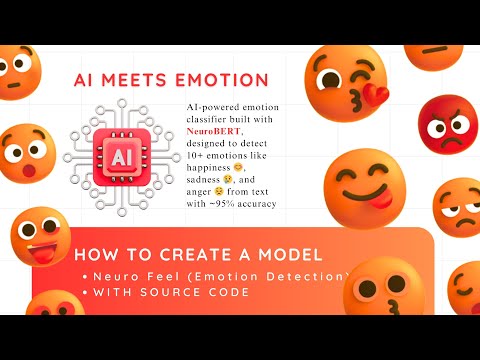
Click the image above to watch the tutorial!
NeuroFeel
is a
lightweight
NLP model built on
NeuroBERT
, fine-tuned for
short-text emotion detection
on
edge and IoT devices
. With a quantized size of
~25MB
and
~7M parameters
, it classifies text into
13 nuanced emotional categories
(e.g., Happiness, Sadness, Anger, Love) with high precision. Optimized for
low-latency
and
offline operation
, NeuroFeel is perfect for privacy-focused applications like chatbots, social media sentiment analysis, mental health monitoring, and contextual AI in resource-constrained environments such as wearables, smart home devices, and mobile apps.
NeuroFeel classifies text into one of 13 emotional categories, each paired with an emoji for enhanced interpretability:
| Emotion | Emoji |
|---|---|
| Sadness | 😢 |
| Anger | 😠 |
| Love | ❤️ |
| Surprise | 😲 |
| Fear | 😱 |
| Happiness | 😄 |
| Neutral | 😐 |
| Disgust | 🤢 |
| Shame | 🙈 |
| Guilt | 😔 |
| Confusion | 😕 |
| Desire | 🔥 |
| Sarcasm | 😏 |
NeuroFeel is derived from NeuroBERT , a lightweight transformer model optimized for edge computing. Key architectural details:
This architecture ensures NeuroFeel delivers high accuracy for emotion detection while maintaining compatibility with resource-constrained devices like Raspberry Pi, ESP32, or mobile NPUs.
Install the required dependencies:
pip install transformers torch
Ensure your environment supports Python 3.6+ and has ~25MB of storage for model weights.
Via Hugging Face :
git clone https://huggingface.co/boltuix/NeuroFeel
Via Transformers Library :
from transformers import AutoModelForSequenceClassification, AutoTokenizer
model = AutoModelForSequenceClassification.from_pretrained("boltuix/NeuroFeel")
tokenizer = AutoTokenizer.from_pretrained("boltuix/NeuroFeel")
Manual Download :
Dataset Download
:

Classify emotions in short text inputs using the Hugging Face pipeline:
from transformers import pipeline

# Load the fine-tuned NeuroFeel model
sentiment_analysis = pipeline("text-classification", model="boltuix/NeuroFeel")

# Analyze emotion
result = sentiment_analysis("i love you")
print(result)
Output :
[{'label': 'Love', 'score': 0.8563215732574463}]
This indicates the emotion is Love ❤️ with 85.63% confidence.
Enhance the output with human-readable emotions and emojis:
from transformers import pipeline

# Load the fine-tuned NeuroFeel model
sentiment_analysis = pipeline("text-classification", model="boltuix/NeuroFeel")

# Define label-to-emoji mapping
label_to_emoji = {
    "Sadness": "😢",
    "Anger": "😠",
    "Love": "❤️",
    "Surprise": "😲",
    "Fear": "😱",
    "Happiness": "😄",
    "Neutral": "😐",
    "Disgust": "🤢",
    "Shame": "🙈",
    "Guilt": "😔",
    "Confusion": "😕",
    "Desire": "🔥",
    "Sarcasm": "😏"
}

# Input text
text = "i love you"

# Analyze emotion
result = sentiment_analysis(text)[0]
label = result["label"].capitalize()
emoji = label_to_emoji.get(label, "❓")

# Output
print(f"Text: {text}")
print(f"Predicted Emotion: {label} {emoji}")
print(f"Confidence: {result['score']:.2%}")
Output :
Text: i love you
Predicted Emotion: Love ❤️
Confidence: 85.63%
Note : Fine-tune the model for domain-specific tasks to boost accuracy.
NeuroFeel excels in classifying a wide range of emotions in short texts, particularly in IoT, social media, and mental health contexts. Fine-tuning enhances performance on subtle emotions like Sarcasm or Shame.
| Metric | Value (Approx.) |
|---|---|
| ✅ Accuracy | ~92–96% on 13-class emotion tasks |
| 🎯 F1 Score | Balanced for multi-class classification |
| ⚡ Latency | <40ms on Raspberry Pi 4 |
| 📏 Recall | Competitive for lightweight models |
Note : Metrics depend on hardware and fine-tuning. Test on your target device for precise results.
NeuroFeel is tailored for edge and IoT scenarios requiring real-time emotion detection for short texts. Key applications include:
Quantization ensures efficient memory usage, making NeuroFeel ideal for resource-constrained devices.
NeuroFeel was fine-tuned on a custom emotion dataset augmented with ChatGPT-generated data to enhance diversity and robustness. Key training details:
Fine-tuning on domain-specific data is recommended to optimize performance for specific use cases (e.g., mental health apps or smart home devices).
To adapt NeuroFeel for custom emotion detection tasks:
 import pandas as pd
 from transformers import BertTokenizer, BertForSequenceClassification, Trainer, TrainingArguments
 from sklearn.model_selection import train_test_split
 import torch
 from torch.utils.data import Dataset

 # === 1. Load and preprocess data ===
 dataset_path = '/content/dataset.csv'
 df = pd.read_csv(dataset_path)
 # Use the correct original column name 'Label' in dropna
 df = df.dropna(subset=['Label'])  # Ensure no missing labels
 df.columns = ['text', 'label']  # Normalize column names

 # === 2. Encode labels ===
 labels = sorted(df["label"].unique())
 label_to_id = {label: idx for idx, label in enumerate(labels)}
 id_to_label = {idx: label for label, idx in label_to_id.items()}
 df['label'] = df['label'].map(label_to_id)

 # === 3. Train/val split ===
 train_texts, val_texts, train_labels, val_labels = train_test_split(
     df['text'].tolist(), df['label'].tolist(), test_size=0.2, random_state=42
 )

 # === 4. Tokenizer ===
 tokenizer = BertTokenizer.from_pretrained("boltuix/NeuroBERT-Pro")

 # === 5. Dataset class ===
 class SentimentDataset(Dataset):
     def __init__(self, texts, labels, tokenizer, max_length=128):
         self.texts = texts
         self.labels = labels
         self.tokenizer = tokenizer
         self.max_length = max_length

     def __len__(self):
         return len(self.texts)

     def __getitem__(self, idx):
         encoding = self.tokenizer(
             self.texts[idx],
             padding='max_length',
             truncation=True,
             max_length=self.max_length,
             return_tensors='pt'
         )
         return {
             'input_ids': encoding['input_ids'].squeeze(0),
             'attention_mask': encoding['attention_mask'].squeeze(0),
             'labels': torch.tensor(self.labels[idx], dtype=torch.long)
         }

 # === 6. Load datasets ===
 train_dataset = SentimentDataset(train_texts, train_labels, tokenizer)
 val_dataset = SentimentDataset(val_texts, val_labels, tokenizer)

 # === 7. Load model ===
 model = BertForSequenceClassification.from_pretrained(
     "boltuix/NeuroBERT-Pro",
     num_labels=len(label_to_id)
 )

 # Optional: Ensure tensor layout is contiguous
 for param in model.parameters():
     param.data = param.data.contiguous()

 # === 8. Training arguments ===
 training_args = TrainingArguments(
     output_dir='./results',
     run_name="NeuroFeel",
     num_train_epochs=5,
     per_device_train_batch_size=16,
     per_device_eval_batch_size=16,
     warmup_steps=500,
     weight_decay=0.01,
     logging_dir='./logs',
     logging_steps=10,
     eval_strategy="epoch",
     report_to="none"
 )

 # === 9. Trainer setup ===
 trainer = Trainer(
     model=model,
     args=training_args,
     train_dataset=train_dataset,
     eval_dataset=val_dataset
 )

 # === 10. Train and evaluate ===
 trainer.train()
 trainer.evaluate()

 # === 11. Save model and label mappings ===
 model.config.label2id = label_to_id
 model.config.id2label = id_to_label
 model.config.num_labels = len(label_to_id)

 model.save_pretrained("./neuro-feel")
 tokenizer.save_pretrained("./neuro-feel")

 print("✅ Training complete. Model and tokenizer saved to ./neuro-feel")
| Model | Parameters | Size | Edge/IoT Focus | Tasks Supported |
|---|---|---|---|---|
| NeuroFeel | ~7M | ~25MB | High | Emotion Detection, Classification |
| NeuroBERT | ~7M | ~30MB | High | MLM, NER, Classification |
| BERT-Lite | ~2M | ~10MB | High | MLM, NER, Classification |
| DistilBERT | ~66M | ~200MB | Moderate | MLM, NER, Classification, Sentiment |
NeuroFeel is specialized for 13-class emotion detection, offering superior performance for short-text sentiment analysis on edge devices compared to general-purpose models like NeuroBERT, while being far more efficient than DistilBERT.
#NeuroFeel
#edge-nlp
#emotion-detection
#on-device-ai
#offline-nlp
#mobile-ai
#sentiment-analysis
#text-classification
#emojis
#emotions
#lightweight-transformers
#embedded-nlp
#smart-device-ai
#low-latency-models
#ai-for-iot
#efficient-neurobert
#nlp2025
#context-aware
#edge-ml
#smart-home-ai
#emotion-aware
#voice-ai
#eco-ai
#chatbot
#social-media
#mental-health
#short-text
#smart-replies
#tone-analysis
#wearable-ai
Apache-2.0 License : Free to use, modify, and distribute for personal and commercial purposes. See LICENSE for details.
transformers
team for model hosting and tools
For issues, questions, or contributions:
We welcome community feedback to enhance NeuroFeel for IoT and edge applications!