




Total runs:
1.2M
Run Growth:
950.8K
Growth Rate:
81.75%
MiniCPM-V 2.6 is the latest and most capable model in the MiniCPM-V series. The model is built on SigLip-400M and Qwen2-7B with a total of 8B parameters. It exhibits a significant performance improvement over MiniCPM-Llama3-V 2.5, and introduces new features for multi-image and video understanding. Notable features of MiniCPM-V 2.6 include:
🔥 Leading Performance. MiniCPM-V 2.6 achieves an average score of 65.2 on the latest version of OpenCompass, a comprehensive evaluation over 8 popular benchmarks. With only 8B parameters, it surpasses widely used proprietary models like GPT-4o mini, GPT-4V, Gemini 1.5 Pro, and Claude 3.5 Sonnet for single image understanding.
🖼️ Multi Image Understanding and In-context Learning. MiniCPM-V 2.6 can also perform conversation and reasoning over multiple images . It achieves state-of-the-art performance on popular multi-image benchmarks such as Mantis-Eval, BLINK, Mathverse mv and Sciverse mv, and also shows promising in-context learning capability.
🎬 Video Understanding. MiniCPM-V 2.6 can also accept video inputs , performing conversation and providing dense captions for spatial-temporal information. It outperforms GPT-4V, Claude 3.5 Sonnet and LLaVA-NeXT-Video-34B on Video-MME with/without subtitles.
💪 Strong OCR Capability and Others. MiniCPM-V 2.6 can process images with any aspect ratio and up to 1.8 million pixels (e.g., 1344x1344). It achieves state-of-the-art performance on OCRBench, surpassing proprietary models such as GPT-4o, GPT-4V, and Gemini 1.5 Pro . Based on the the latest RLAIF-V and VisCPM techniques, it features trustworthy behaviors , with significantly lower hallucination rates than GPT-4o and GPT-4V on Object HalBench, and supports multilingual capabilities on English, Chinese, German, French, Italian, Korean, etc.
🚀 Superior Efficiency. In addition to its friendly size, MiniCPM-V 2.6 also shows state-of-the-art token density (i.e., number of pixels encoded into each visual token). It produces only 640 tokens when processing a 1.8M pixel image, which is 75% fewer than most models . This directly improves the inference speed, first-token latency, memory usage, and power consumption. As a result, MiniCPM-V 2.6 can efficiently support real-time video understanding on end-side devices such as iPad.
💫 Easy Usage. MiniCPM-V 2.6 can be easily used in various ways: (1) llama.cpp and ollama support for efficient CPU inference on local devices, (2) int4 and GGUF format quantized models in 16 sizes, (3) vLLM support for high-throughput and memory-efficient inference, (4) fine-tuning on new domains and tasks, (5) quick local WebUI demo setup with Gradio and (6) online web demo .

Single image results on OpenCompass, MME, MMVet, OCRBench, MMMU, MathVista, MMB, AI2D, TextVQA, DocVQA, HallusionBench, Object HalBench:

* We evaluate this benchmark using chain-of-thought prompting.
+ Token Density: number of pixels encoded into each visual token at maximum resolution, i.e., # pixels at maximum resolution / # visual tokens.
Note: For proprietary models, we calculate token density based on the image encoding charging strategy defined in the official API documentation, which provides an upper-bound estimation.
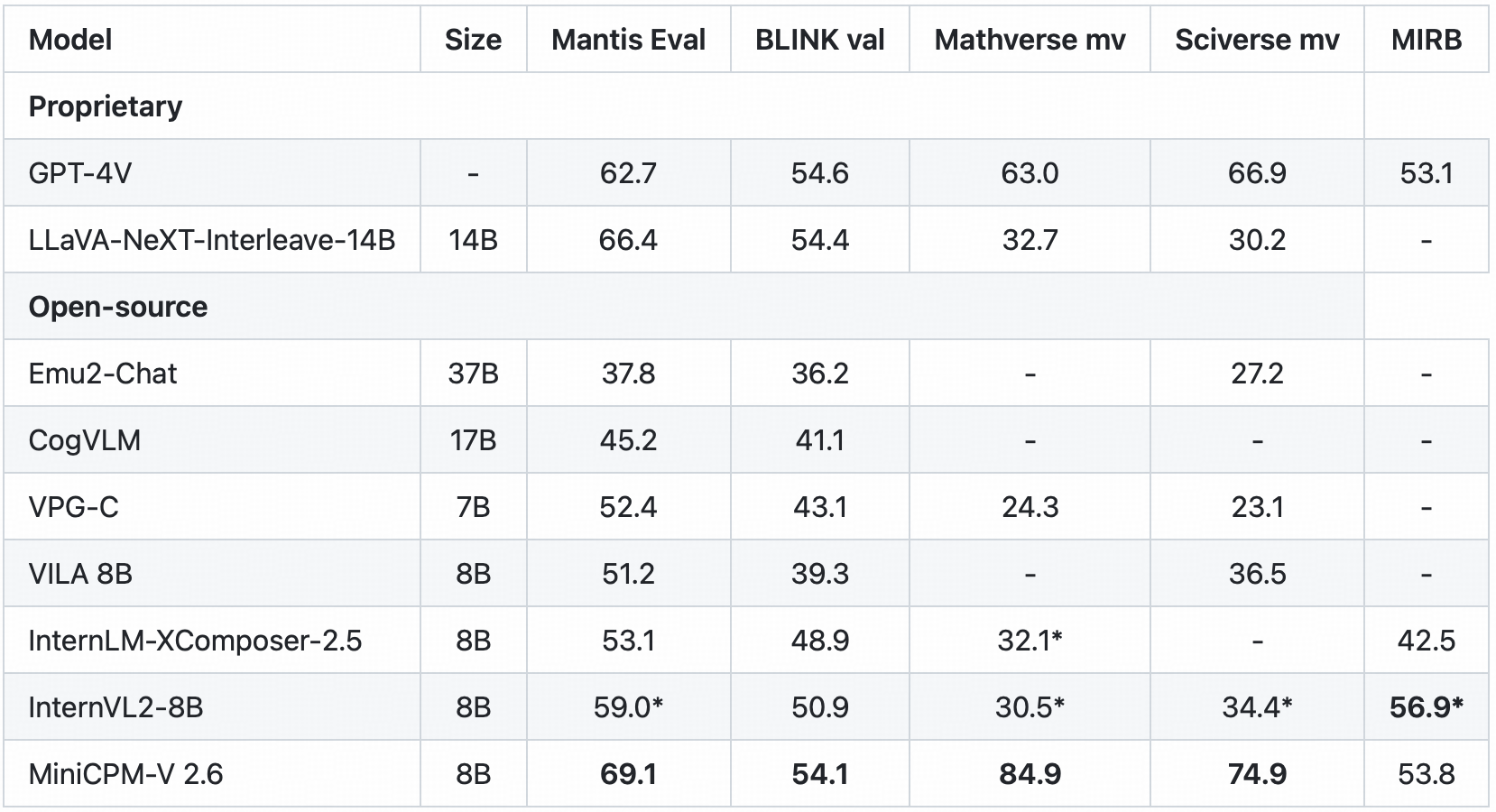


+ We evaluate the pretraining ckpt without SFT.


We deploy MiniCPM-V 2.6 on end devices. The demo video is the raw screen recording on a iPad Pro without edition.


Click here to try the Demo of MiniCPM-V 2.6 .
Inference using Huggingface transformers on NVIDIA GPUs. Requirements tested on python 3.10:
Pillow==10.1.0
torch==2.1.2
torchvision==0.16.2
transformers==4.40.0
sentencepiece==0.1.99
decord
# test.py
import torch
from PIL import Image
from transformers import AutoModel, AutoTokenizer

model = AutoModel.from_pretrained('openbmb/MiniCPM-V-2_6', trust_remote_code=True,
    attn_implementation='sdpa', torch_dtype=torch.bfloat16) # sdpa or flash_attention_2, no eager
model = model.eval().cuda()
tokenizer = AutoTokenizer.from_pretrained('openbmb/MiniCPM-V-2_6', trust_remote_code=True)

image = Image.open('xx.jpg').convert('RGB')
question = 'What is in the image?'
msgs = [{'role': 'user', 'content': [image, question]}]

res = model.chat(
    image=None,
    msgs=msgs,
    tokenizer=tokenizer
)
print(res)

## if you want to use streaming, please make sure sampling=True and stream=True
## the model.chat will return a generator
res = model.chat(
    image=None,
    msgs=msgs,
    tokenizer=tokenizer,
    sampling=True,
    stream=True
)

generated_text = ""
for new_text in res:
    generated_text += new_text
    print(new_text, flush=True, end='')
import torch
from PIL import Image
from transformers import AutoModel, AutoTokenizer

model = AutoModel.from_pretrained('openbmb/MiniCPM-V-2_6', trust_remote_code=True,
    attn_implementation='sdpa', torch_dtype=torch.bfloat16) # sdpa or flash_attention_2, no eager
model = model.eval().cuda()
tokenizer = AutoTokenizer.from_pretrained('openbmb/MiniCPM-V-2_6', trust_remote_code=True)

image1 = Image.open('image1.jpg').convert('RGB')
image2 = Image.open('image2.jpg').convert('RGB')
question = 'Compare image 1 and image 2, tell me about the differences between image 1 and image 2.'

msgs = [{'role': 'user', 'content': [image1, image2, question]}]

answer = model.chat(
    image=None,
    msgs=msgs,
    tokenizer=tokenizer
)
print(answer)
import torch
from PIL import Image
from transformers import AutoModel, AutoTokenizer

model = AutoModel.from_pretrained('openbmb/MiniCPM-V-2_6', trust_remote_code=True,
    attn_implementation='sdpa', torch_dtype=torch.bfloat16) # sdpa or flash_attention_2, no eager
model = model.eval().cuda()
tokenizer = AutoTokenizer.from_pretrained('openbmb/MiniCPM-V-2_6', trust_remote_code=True)

question = "production date"
image1 = Image.open('example1.jpg').convert('RGB')
answer1 = "2023.08.04"
image2 = Image.open('example2.jpg').convert('RGB')
answer2 = "2007.04.24"
image_test = Image.open('test.jpg').convert('RGB')

msgs = [
    {'role': 'user', 'content': [image1, question]}, {'role': 'assistant', 'content': [answer1]},
    {'role': 'user', 'content': [image2, question]}, {'role': 'assistant', 'content': [answer2]},
    {'role': 'user', 'content': [image_test, question]}
]

answer = model.chat(
    image=None,
    msgs=msgs,
    tokenizer=tokenizer
)
print(answer)
import torch
from PIL import Image
from transformers import AutoModel, AutoTokenizer
from decord import VideoReader, cpu    # pip install decord

model = AutoModel.from_pretrained('openbmb/MiniCPM-V-2_6', trust_remote_code=True,
    attn_implementation='sdpa', torch_dtype=torch.bfloat16) # sdpa or flash_attention_2, no eager
model = model.eval().cuda()
tokenizer = AutoTokenizer.from_pretrained('openbmb/MiniCPM-V-2_6', trust_remote_code=True)

MAX_NUM_FRAMES=64 # if cuda OOM set a smaller number

def encode_video(video_path):
    def uniform_sample(l, n):
        gap = len(l) / n
        idxs = [int(i * gap + gap / 2) for i in range(n)]
        return [l[i] for i in idxs]

    vr = VideoReader(video_path, ctx=cpu(0))
    sample_fps = round(vr.get_avg_fps() / 1)  # FPS
    frame_idx = [i for i in range(0, len(vr), sample_fps)]
    if len(frame_idx) > MAX_NUM_FRAMES:
        frame_idx = uniform_sample(frame_idx, MAX_NUM_FRAMES)
    frames = vr.get_batch(frame_idx).asnumpy()
    frames = [Image.fromarray(v.astype('uint8')) for v in frames]
    print('num frames:', len(frames))
    return frames

video_path="video_test.mp4"
frames = encode_video(video_path)
question = "Describe the video"
msgs = [
    {'role': 'user', 'content': frames + [question]},
]

# Set decode params for video
params={}
params["use_image_id"] = False
params["max_slice_nums"] = 2 # use 1 if cuda OOM and video resolution >  448*448

answer = model.chat(
    image=None,
    msgs=msgs,
    tokenizer=tokenizer,
    **params
)
print(answer)
Please look at GitHub for more detail about usage.
MiniCPM-V 2.6 can run with llama.cpp. See our fork of llama.cpp for more detail.
Download the int4 quantized version for lower GPU memory (7GB) usage: MiniCPM-V-2_6-int4 .
👏 Welcome to explore key techniques of MiniCPM-V 2.6 and other multimodal projects of our team:
VisCPM | RLHF-V | LLaVA-UHD | RLAIF-V
If you find our work helpful, please consider citing our papers 📝 and liking this project ❤️!
@article{yao2024minicpm,
  title={MiniCPM-V: A GPT-4V Level MLLM on Your Phone},
  author={Yao, Yuan and Yu, Tianyu and Zhang, Ao and Wang, Chongyi and Cui, Junbo and Zhu, Hongji and Cai, Tianchi and Li, Haoyu and Zhao, Weilin and He, Zhihui and others},
  journal={arXiv preprint arXiv:2408.01800},
  year={2024}
}