




Sponsored by
YouArt
tencent / Hy-Embodied-VLM-1.0
Model's Last Updated: July 15 2026
image-text-to-text
Introduction of Hy-Embodied-VLM-1.0
Model Details of Hy-Embodied-VLM-1.0
Hy-Embodied-VLM-1.0
Efficient Physical-World Agents
Tencent Robotics X × Hy Vision Team × Futian Laboratory





🔥 Updates
-
[2026-07-15]🚀 We have released Hy-Embodied-VLM-1.0 ! An efficient Mixture-of-Experts vision–language foundation model for embodied agents in the physical world, activating only ~3B parameters per token (~30B total) for high inference efficiency. Weights are available on Hugging Face , together with inference code for both HuggingFacetransformersand vLLM. -
[2026-06-15]🤖 We have released HY-VLA-0.5 ! The official code , UMI-trained weights and 2000+ hours of high-fidelity UMI data are now available. -
[2026-04-09]🚀 We have released HY-Embodied-0.5 , featuring the open-sourcedHY-Embodied-0.5 MoT-2Bweights on Hugging Face along with the official inference code!
📖 Abstract
Building capable embodied agents requires not only multimodal perception and understanding, but also agentic capabilities for reasoning about actions, adapting to evolving situations, and interacting with the physical world. In this report, we introduce Hy-Embodied-VLM-1.0 , an efficient and powerful embodied foundation model specifically designed for embodied agents operating in the physical world.
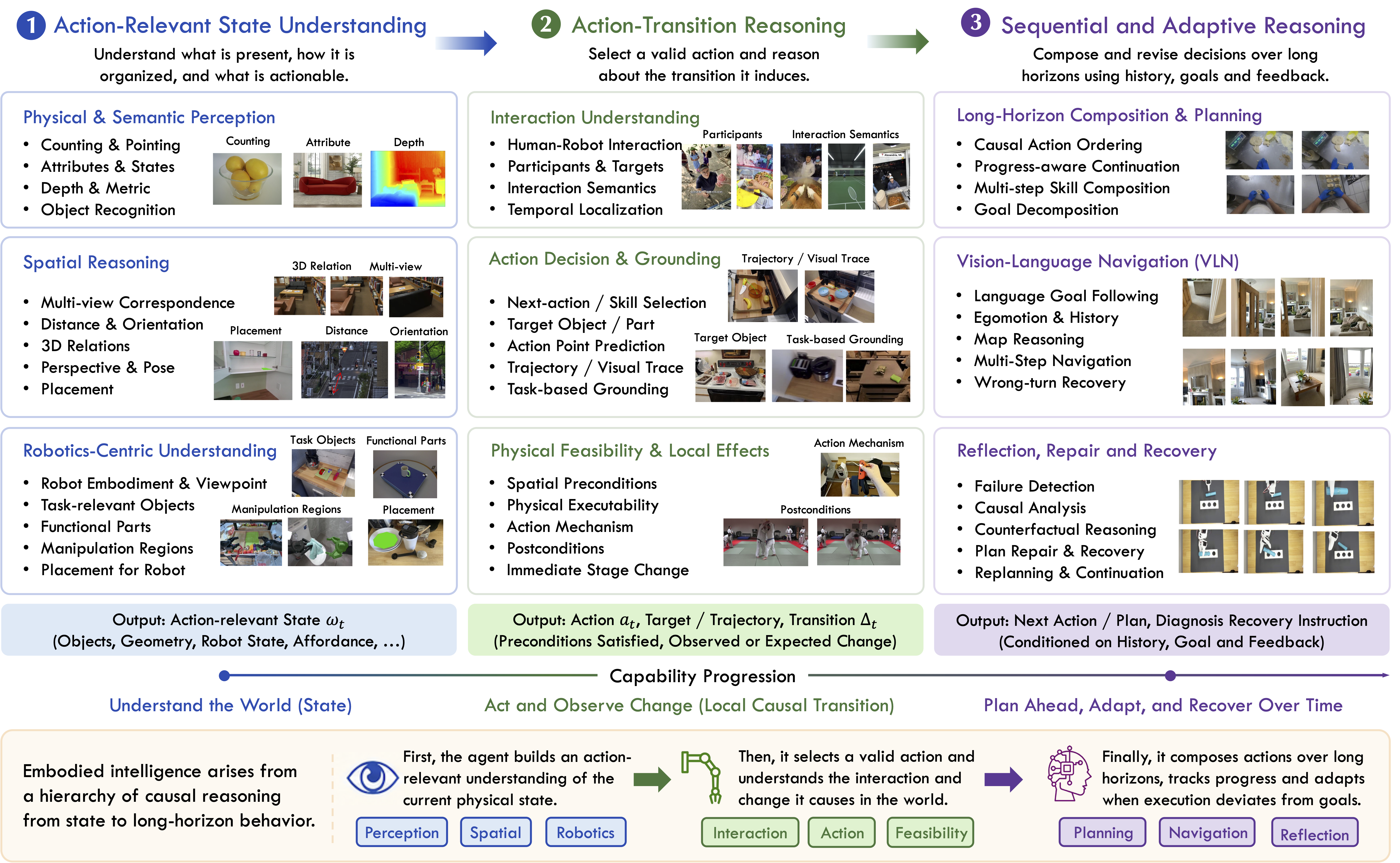
To cultivate such capabilities from the pre-training stage onward, we define an action-centric capability taxonomy comprising three progressive dimensions: Action-Relevant State Understanding , Action–Transition Reasoning , and Sequential and Adaptive Reasoning . Guided by this taxonomy, we develop a systematic data pipeline and curate data mixtures spanning both pre-training and post-training.
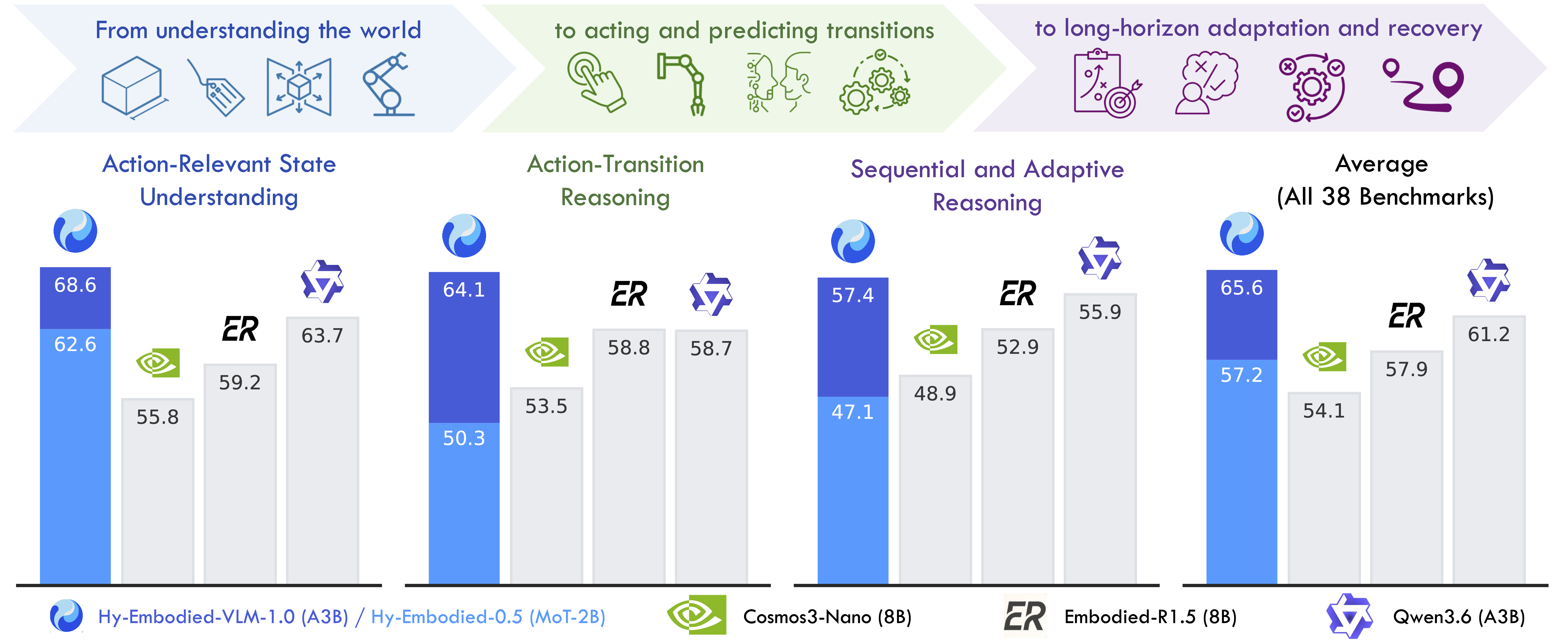
To deliver strong physical-world understanding and interaction capabilities while supporting latency-sensitive deployment, we build our model on the Hy3-A3B language backbone and the Hy-ViT2 vision encoder . Its efficient Mixture-of-Experts architecture combines strong model capacity with high inference efficiency. We evaluate Hy-Embodied-VLM-1.0 on a comprehensive suite of 38 benchmarks covering embodied perception, physical-world understanding, and embodied reasoning. The model achieves the best performance among similarly sized models on 19 of the 38 benchmarks and substantially outperforms strong competitors, including Qwen3.6-A3B and Cosmos 3 . Compared with the previous-generation Hy-Embodied-0.5 MoT-2B, Hy-Embodied-VLM-1.0 improves average performance by 8.4% . Despite activating only 3B parameters , it achieves performance close to that of the previous-generation model with 32B activated parameters. Beyond static benchmark evaluation, Hy-Embodied-VLM-1.0 also demonstrates strong performance on embodied agentic tasks requiring multi-turn interaction and long-horizon reasoning.
⭐️ Key Features
- 🧠 Efficient MoE, ~3B activated — Combines the Hy3-A3B language backbone with the Hy-ViT2 vision encoder in a Mixture-of-Experts architecture. Only ~3B parameters are activated per token — approximately one-tenth of the activated parameters of the previous-generation A32B system, while achieving nearly comparable overall performance.
- 🌏 Action-Centric Capability Taxonomy — We define three progressive levels of embodied intelligence: (i) Action-Relevant State Understanding for accurately understanding the states of the agent and its environment, (ii) Action–Transition Reasoning for understanding actions, planning them, and reasoning about their consequences, and (iii) Sequential and Adaptive Reasoning for long-horizon planning, reflection, repair, and recovery. Data and training are systematically designed around this taxonomy.
- 🔁 Self-Evolving Post-Training — Embodied agentic reasoning is cultivated through a self-evolving loop that couples reinforcement learning with rejection-sampling fine-tuning, seeded from a small curated set of high-quality thinking traces. A final reward-specialized stage trains continuous-reward and discrete-reward RL policies separately and fuses them, delivering sharp geometric precision alongside robust decision-making, planning, and reflection quality.
- 🏆 State-of-the-Art on Embodied Benchmarks — Ranks 1st on 19 of 38 benchmarks and 2nd on another 11, outperforming Qwen3.6-A3B (+4.4% avg), Cosmos 3-8B, and Embodied-R1.5-8B. State-of-the-art on R2R-CE vision-and-language navigation (RGB-only setting) and strong zero-shot performance on Matterport3D Object Goal Navigation.
🧱 Model Card
| Field | Value |
|---|---|
| Architecture |
HYV3VLForConditionalGeneration
(VL wrapper over
HYV3ForCausalLM
MoE LLM +
Hy-ViT2
vision encoder)
|
| Model type |
hy_v3_vl
|
| Total parameters | ~30B |
| Activated parameters per token | ~3B (8 of 128 experts + 1 shared) |
| Context length | 32,768 tokens |
| Precision | BF16 |
| Vision inputs | Image (up to 128 per prompt); native aspect ratios |
| Chat template |
Unified
chat_template.jinja
bundled with weights (supports
enable_thinking
kwarg)
|
🛠️ Dependencies and Installation
Prerequisites
- 🖥️ Operating System : Linux (recommended)
- 🐍 Python : 3.10+
- ⚡ CUDA : 12.x (H100 / H20 / A100 tested)
- 🔥 PyTorch : 2.4+
- 🎮 GPU : NVIDIA GPU(s). The full BF16 model requires ~86 GB across GPUs; a single 8×80 GB node is sufficient.
Installation
We pin dependencies to the versions we validated end-to-end
(
vllm==0.14.1
+
transformers==4.57.6
+
torch==2.9.1
). The cleanest
way to install these — with the CUDA build matched to your driver — is
uv
:
# Install uv once (skip if you already have it)
curl -LsSf https://astral.sh/uv/install.sh | sh

# Create a fresh venv (Python 3.10+)
uv venv --python 3.12
source .venv/bin/activate

# Clone the repo (provides the vLLM plugin and example scripts)
git clone https://github.com/Tencent-Hunyuan/HY-Embodied
cd HY-Embodied
🚀 Quick Start with vLLM (recommended)
vLLM is the
recommended
path for serving Hy-Embodied-VLM-1.0. Install
vLLM together with matched
torch
/
transformers
wheels, then install this
repo's plugin (registers the
HYV3VL
model and the reasoning / tool-call
parsers):
# One-shot install: vllm + torch + torchvision + transformers at matching
# versions, with the CUDA build picked from your driver.
uv pip install vllm==0.14.1 --torch-backend auto

# Install this repo's vLLM plugin (registers HYV3VL model + parsers)
uv pip install -e Hy-Embodied-VLM-1.0/inference/vllm/
Start the server
serve.sh
wraps
vllm serve
with the required flags
(
--reasoning-parser hunyuan_v3
,
--tool-call-parser hy_v3
,
--trust-remote-code
, image mm-limit, chat template). It defaults to the
Hub id
tencent/Hy-Embodied-VLM-1.0
, so no manual download is needed:
# TP=4 by default; override MODEL_PATH / TP / PORT via env vars.
bash Hy-Embodied-VLM-1.0/inference/vllm/serve.sh
Query the OpenAI-compatible endpoint
curl http://127.0.0.1:8080/v1/chat/completions \
  -H "Content-Type: application/json" \
  -d '{
    "model": "hy_a3b",
    "messages": [{"role": "user", "content": "Describe how to grasp a cup."}],
    "max_tokens": 512,
    "chat_template_kwargs": {"enable_thinking": true}
  }'
Python (OpenAI SDK) — text, image, and streaming
import base64
from pathlib import Path
from openai import OpenAI  # pip install "openai>=1.30" pillow

client = OpenAI(base_url="http://127.0.0.1:8080/v1", api_key="EMPTY")

# --- text-only ---
resp = client.chat.completions.create(
    model="hy_a3b",
    messages=[{"role": "user", "content": "How do you open a fridge?"}],
    max_tokens=512,
    temperature=0.7,
    extra_body={"chat_template_kwargs": {"enable_thinking": True}},
)
msg = resp.choices[0].message
if getattr(msg, "reasoning_content", None):
    print("[thinking]", msg.reasoning_content)
print("[answer]  ", msg.content)

# --- image + text ---
def encode_image(path):
    mime = "image/jpeg" if path.lower().endswith((".jpg", ".jpeg")) else "image/png"
    return f"data:{mime};base64,{base64.b64encode(Path(path).read_bytes()).decode()}"

resp = client.chat.completions.create(
    model="hy_a3b",
    messages=[{
        "role": "user",
        "content": [
            {"type": "image_url", "image_url": {"url": encode_image("example.jpg")}},
            {"type": "text", "text": "Describe the image in detail."},
        ],
    }],
    max_tokens=1024,
    temperature=0.7,
    extra_body={"chat_template_kwargs": {"enable_thinking": True}},
)
print(resp.choices[0].message.content)
See
Hy-Embodied-VLM-1.0/inference/vllm/README.md
for full serving options and
example_client.py
for the complete client (including streaming).
🤗 Alternative: HuggingFace
transformers
(single-instance)
For single-instance / offline inference without a server:
uv pip install torch==2.9.1 torchvision==0.24.1 --torch-backend auto
uv pip install transformers==4.57.6 accelerate pillow

# Run the demo (single image + a small batch; thinking and non-thinking modes)
cd Hy-Embodied-VLM-1.0/inference/transformers
python infer_hf.py
🧠 Reasoning-Mode Toggle
Hy-Embodied-VLM-1.0 is a hybrid reasoning model . Both modes are trained into the same weights; selection is per-request via a chat-template kwarg.
enable_thinking
|
Prompt suffix | When to use |
|---|---|---|
True
(default)
|
<think>
|
Complex spatial reasoning, planning, multi-step tasks |
False
|
<think></think>
|
Direct answers, low-latency single-turn Q&A |
We deliberately use
enable_thinking(Qwen3 convention) rather thanreasoning_effort. vLLM prior to v0.22 has a top-levelrequest.reasoning_effortfield that silently clobberschat_template_kwargs["reasoning_effort"](fixed by vllm-project/vllm#43401 );enable_thinkingavoids the clobber and works across all vLLM versions.
🖥️ Hardware Requirements
- Full-precision inference : A single 8×80 GB GPU node (H100 / H20 / A100 80G). Model weights are BF16 (~86 GB); tensor-parallel size 4–8 recommended.
- Serving : 4 GPUs of 80 GB (tp=4) per replica is the recommended configuration for maximum throughput.
- Development / debugging : Any CUDA GPU. Smaller GPUs may require offloading or additional tensor parallelism.
- Disk : ~120 GB (including cache) for the model weights, auto-downloaded from the Hub on first run.
📊 Evaluation
Note : We evaluated Hy-Embodied-VLM-1.0 A3B across 38 embodied-relevant benchmarks against parameter-comparable state-of-the-art models. For detailed methodology, please refer to our technical report .
Action-Relevant State Understanding
| Benchmark | Hy-Embodied 0.5 MoT-2B | Qwen3.6-A3B | Embodied-R1.5 8B | Cosmos3-Nano 8B | Hy-Embodied VLM-1.0 A3B |
|---|---|---|---|---|---|
| BLINK | 82.7 | 87.9 | 77.8 | 82.4 | 87.3 |
| CV-Bench | 89.2 | 88.6 | 86.8 | 88.0 | 89.7 |
| PixMo-Points | 51.4 | 57.5 | 57.1 | 59.8 | 64.6 |
| PointBench | 69.0 | 35.1 | 59.1 | 39.2 | 71.7 |
| Depth-InHouse | 45.7 | 63.0 | 52.0 | 47.0 | 67.6 |
| 3DSRBench | 57.0 | 49.9 | 42.6 | 31.9 | 52.6 |
| All-Angles-Bench | 55.1 | 64.0 | 48.4 | 51.9 | 63.4 |
| DA-2K | 92.3 | 81.4 | 80.5 | 82.8 | 83.2 |
| ERQA | 54.5 | 57.5 | 37.3 | 45.0 | 60.8 |
| EmbSpatial-Bench | 82.8 | 83.2 | 76.0 | 80.0 | 82.7 |
| MMSI-Bench | 33.2 | 41.9 | 29.8 | 34.0 | 41.8 |
| MindCube | 66.3 | 55.0 | 27.9 | 32.8 | 70.0 |
| SAT | 76.7 | 80.7 | 60.7 | 54.0 | 78.0 |
| SIBench-mini | 58.2 | 60.9 | 51.9 | 52.5 | 64.5 |
| SITE-Bench-Image | 62.7 | 71.7 | 60.3 | 59.6 | 72.3 |
| ViewSpatial-Bench | 53.1 | 49.0 | 43.7 | 52.0 | 53.3 |
| OpenEQA | 54.4 | 73.2 | 53.9 | 53.8 | 63.1 |
| PartAfford | 30.1 | 25.5 | 82.6 | 32.2 | 63.7 |
| RoboAfford | 73.5 | 66.7 | 60.6 | 76.2 | 71.5 |
| RoboRefIt | 82.8 | 78.5 | 77.2 | 55.4 | 88.2 |
| RefSpatial-Bench | 45.8 | 53.1 | 52.4 | 44.4 | 53.4 |
| RoboSpatial-Home | 55.7 | 70.9 | 69.1 | 58.3 | 69.4 |
| Where2Place | 68.0 | 70.0 | 73.0 | 71.0 | 65.0 |
Action–Transition Reasoning
| Benchmark | Hy-Embodied 0.5 MoT-2B | Qwen3.6-A3B | Embodied-R1.5 8B | Cosmos3-Nano 8B | Hy-Embodied VLM-1.0 A3B |
|---|---|---|---|---|---|
| FineBench | 56.9 | 76.9 | 67.1 | 63.5 | 80.3 |
| CrossHOI-Bench | 40.7 | 58.0 | 55.1 | 51.0 | 63.2 |
| PIO | 54.6 | 47.9 | 61.6 | 54.4 | 65.3 |
| VABench-Point | 26.0 | 50.5 | 61.4 | 45.2 | 59.7 |
| VABench-Visual-Trace | 75.0 | 80.3 | 89.8 | 81.6 | 79.7 |
| ShareRobot-Bench-Affordance | 26.8 | 28.2 | 25.2 | 23.0 | 26.7 |
| ShareRobot-Bench-Trajectory | 73.3 | 68.9 | 69.2 | 65.5 | 76.7 |
| RoboBench-MCQ | 49.2 | 59.1 | 41.1 | 43.5 | 61.2 |
Sequential and Adaptive Reasoning
| Benchmark | Hy-Embodied 0.5 MoT-2B | Qwen3.6-A3B | Embodied-R1.5 8B | Cosmos3-Nano 8B | Hy-Embodied VLM-1.0 A3B |
|---|---|---|---|---|---|
| SITE-Bench-Video | 63.5 | 71.1 | 59.1 | 57.6 | 69.2 |
| VSIBench | 60.5 | 57.5 | 59.2 | 50.4 | 58.9 |
| EgoPlan2 | 45.5 | 49.9 | 61.0 | 42.6 | 49.6 |
| Cosmos | 54.3 | 67.8 | 68.6 | 67.1 | 66.9 |
| VLABench | 16.2 | 49.9 | 39.4 | 48.9 | 51.1 |
| RoboBench-Planning | 54.2 | 53.9 | 39.4 | 41.5 | 54.9 |
| RoboFAC | 35.6 | 41.4 | 43.9 | 34.4 | 51.0 |
Note: Hy-Embodied variants and Qwen3.6-A3B are evaluated in thinking mode; Embodied-R1.5-8B is only available in its Instruct configuration; Cosmos3-Nano-8B is reported in non-thinking mode (enabling thinking substantially degrades its performance).
📜 Older Versions
Prior releases of the Hy-Embodied family remain fully available:
| Version | Description | Location |
|---|---|---|
| Hy-Embodied-0.5 (MoT-2B) | The first release: MoT architecture, 2B activated params, tuned for edge deployment |
Hy-Embodied-0.5/
|
| Hy-Embodied-0.5-VLA | UMI-trained VLA for real-robot manipulation | Tencent-Hunyuan/Hy-Embodied-0.5-VLA |
| Hy-Embodied-0.5-X | Extended variant with additional post-training | Tencent-Hunyuan/HY-Embodied-0.5-X |
📄 License
Released under
Apache License 2.0
. See
LICENSE
.
🏷️ Citation
If you find our work useful for your research and applications, please cite our tech reports using this BibTeX:
@article{tencent2026hyembodiedvlm10,
  title         = {Hy-Embodied-VLM-1.0: Efficient Physical-World Agents},
  author        = {Wang, Ziyi and Yu, Xumin and Rao, Yongming and Ling, Yonggen and Li, Yunheng and Wang, Oran and Gao, Mingqi and Zhou, Yuchen and Liang, Yves and Liu, Zuyan and others},
  year          = {2026},
  eprint        = {2607.12894},
  archivePrefix = {arXiv},
  url           = {https://arxiv.org/abs/2607.12894}
}

@article{tencent2026hyembodied05,
  title         = {HY-Embodied-0.5: Embodied Foundation Models for Real-World Agents},
  author        = {Team, HY and Yu, Xumin and Liu, Zuyan and Wang, Ziyi and Zhang, He and Rao, Yongming and Liu, Fangfu and Zhang, Yani and Zhao, Ruowen and Wang, Oran and others},
  year          = {2026},
  eprint        = {2604.07430},
  archivePrefix = {arXiv},
  url           = {https://arxiv.org/abs/2604.07430}
}
🙏 Acknowledgements
Built on the Hy3 MoE LLM backbone and the Hy-ViT2 vision encoder. We thank the broader Tencent Hunyuan and Robotics X communities for infrastructure, evaluation resources, and design feedback.
Runs of tencent Hy-Embodied-VLM-1.0 on huggingface.co
595
Total runs
0
24-hour runs
13
3-day runs
29
7-day runs
-539
30-day runs
More Information About Hy-Embodied-VLM-1.0 huggingface.co Model
Url of Hy-Embodied-VLM-1.0
Hy-Embodied-VLM-1.0 huggingface.co Url
Provider of Hy-Embodied-VLM-1.0 huggingface.co
Other API from tencent
Total runs:
347.4K
Run Growth:
318.4K
Growth Rate:
91.63%
Total runs:
98.4K
Run Growth:
-30.7K
Growth Rate:
-31.19%
Total runs:
90.7K
Run Growth:
-582.4K
Growth Rate:
-642.43%
Total runs:
55.2K
Run Growth:
-696
Growth Rate:
-1.26%
Total runs:
44.6K
Run Growth:
-374
Growth Rate:
-0.84%
Total runs:
39.9K
Run Growth:
39.3K
Growth Rate:
98.61%
Total runs:
31.8K
Run Growth:
7.9K
Growth Rate:
24.82%
Total runs:
29.6K
Run Growth:
5.1K
Growth Rate:
17.05%
Total runs:
19.1K
Run Growth:
-11.4K
Growth Rate:
-59.76%
Total runs:
17.4K
Run Growth:
9.2K
Growth Rate:
53.10%
Total runs:
16.8K
Run Growth:
16.8K
Growth Rate:
100.00%
Total runs:
10.9K
Run Growth:
-17.9K
Growth Rate:
-163.77%
Total runs:
8.6K
Run Growth:
927
Growth Rate:
10.73%
Total runs:
7.3K
Run Growth:
-2.1K
Growth Rate:
-28.31%
Total runs:
6.5K
Run Growth:
4.4K
Growth Rate:
67.85%
Total runs:
5.4K
Run Growth:
-3.6K
Growth Rate:
-67.11%
Total runs:
5.3K
Run Growth:
5.3K
Growth Rate:
100.00%
Total runs:
5.2K
Run Growth:
5.2K
Growth Rate:
100.00%
Total runs:
5.1K
Run Growth:
2.9K
Growth Rate:
56.39%
Total runs:
4.3K
Run Growth:
-1.2K
Growth Rate:
-28.37%
Total runs:
4.0K
Run Growth:
-1.0K
Growth Rate:
-26.07%
Total runs:
2.8K
Run Growth:
2.3K
Growth Rate:
80.50%
Total runs:
2.7K
Run Growth:
-209
Growth Rate:
-7.82%
Total runs:
2.6K
Run Growth:
2.6K
Growth Rate:
100.00%
Total runs:
2.2K
Run Growth:
2.1K
Growth Rate:
94.33%
Total runs:
1.9K
Run Growth:
-18.3K
Growth Rate:
-973.39%
Total runs:
1.8K
Run Growth:
327
Growth Rate:
17.71%
Total runs:
1.8K
Run Growth:
707
Growth Rate:
40.40%
Total runs:
1.7K
Run Growth:
-873
Growth Rate:
-51.17%
Total runs:
1.6K
Run Growth:
-933
Growth Rate:
-57.42%
Total runs:
1.4K
Run Growth:
1.2K
Growth Rate:
82.02%
Total runs:
916
Run Growth:
716
Growth Rate:
78.17%
Total runs:
693
Run Growth:
-114
Growth Rate:
-16.45%
Total runs:
587
Run Growth:
208
Growth Rate:
35.43%
Total runs:
552
Run Growth:
-1.7K
Growth Rate:
-301.45%
Total runs:
521
Run Growth:
67
Growth Rate:
12.86%
Total runs:
480
Run Growth:
79
Growth Rate:
16.46%
Total runs:
453
Run Growth:
-154
Growth Rate:
-34.00%
Total runs:
425
Run Growth:
254
Growth Rate:
59.76%
Total runs:
405
Run Growth:
115
Growth Rate:
28.40%
Total runs:
402
Run Growth:
65
Growth Rate:
16.17%
Total runs:
395
Run Growth:
309
Growth Rate:
78.23%
Total runs:
395
Run Growth:
395
Growth Rate:
100.00%
Total runs:
391
Run Growth:
64
Growth Rate:
16.20%
Total runs:
338
Run Growth:
123
Growth Rate:
36.39%
Total runs:
317
Run Growth:
-81
Growth Rate:
-25.55%
Total runs:
313
Run Growth:
-586
Growth Rate:
-187.22%
Total runs:
297
Run Growth:
-416
Growth Rate:
-140.07%
Total runs:
290
Run Growth:
177
Growth Rate:
61.03%
Total runs:
290
Run Growth:
-86
Growth Rate:
-29.66%
Total runs:
285
Run Growth:
-940
Growth Rate:
-329.82%
Total runs:
280
Run Growth:
-137
Growth Rate:
-48.93%
Total runs:
277
Run Growth:
-69
Growth Rate:
-24.91%
Total runs:
233
Run Growth:
-88
Growth Rate:
-37.77%
Total runs:
204
Run Growth:
-78
Growth Rate:
-38.24%
Total runs:
203
Run Growth:
-406
Growth Rate:
-200.00%
Total runs:
198
Run Growth:
41
Growth Rate:
20.71%
Total runs:
194
Run Growth:
34
Growth Rate:
17.53%
Total runs:
186
Run Growth:
-103
Growth Rate:
-55.38%
Total runs:
179
Run Growth:
121
Growth Rate:
67.60%
Total runs:
176
Run Growth:
6
Growth Rate:
3.41%
Total runs:
176
Run Growth:
4
Growth Rate:
2.27%
Total runs:
159
Run Growth:
107
Growth Rate:
67.30%
Total runs:
159
Run Growth:
-102
Growth Rate:
-64.15%
Total runs:
156
Run Growth:
-148
Growth Rate:
-94.87%
Total runs:
156
Run Growth:
28
Growth Rate:
17.95%