




Total runs:
427.1K
Run Growth:
32.9K
Growth Rate:
7.70%

TheBloke's LLM work is generously supported by a grant from andreessen horowitz (a16z)
This repo contains GGUF format model files for WizardLM's WizardCoder Python 13B V1.0 .
GGUF is a new format introduced by the llama.cpp team on August 21st 2023. It is a replacement for GGML, which is no longer supported by llama.cpp. GGUF offers numerous advantages over GGML, such as better tokenisation, and support for special tokens. It is also supports metadata, and is designed to be extensible.
Here is an incomplate list of clients and libraries that are known to support GGUF:
Below is an instruction that describes a task. Write a response that appropriately completes the request.

### Instruction:
{prompt}

### Response:
These quantised GGUFv2 files are compatible with llama.cpp from August 27th onwards, as of commit d0cee0d36d5be95a0d9088b674dbb27354107221
They are also compatible with many third party UIs and libraries - please see the list at the top of this README.
The new methods available are:
Refer to the Provided Files table below to see what files use which methods, and how.
| Name | Quant method | Bits | Size | Max RAM required | Use case |
|---|---|---|---|---|---|
| wizardcoder-python-13b-v1.0.Q2_K.gguf | Q2_K | 2 | 5.43 GB | 7.93 GB | smallest, significant quality loss - not recommended for most purposes |
| wizardcoder-python-13b-v1.0.Q3_K_S.gguf | Q3_K_S | 3 | 5.66 GB | 8.16 GB | very small, high quality loss |
| wizardcoder-python-13b-v1.0.Q3_K_M.gguf | Q3_K_M | 3 | 6.34 GB | 8.84 GB | very small, high quality loss |
| wizardcoder-python-13b-v1.0.Q3_K_L.gguf | Q3_K_L | 3 | 6.93 GB | 9.43 GB | small, substantial quality loss |
| wizardcoder-python-13b-v1.0.Q4_0.gguf | Q4_0 | 4 | 7.37 GB | 9.87 GB | legacy; small, very high quality loss - prefer using Q3_K_M |
| wizardcoder-python-13b-v1.0.Q4_K_S.gguf | Q4_K_S | 4 | 7.41 GB | 9.91 GB | small, greater quality loss |
| wizardcoder-python-13b-v1.0.Q4_K_M.gguf | Q4_K_M | 4 | 7.87 GB | 10.37 GB | medium, balanced quality - recommended |
| wizardcoder-python-13b-v1.0.Q5_0.gguf | Q5_0 | 5 | 8.97 GB | 11.47 GB | legacy; medium, balanced quality - prefer using Q4_K_M |
| wizardcoder-python-13b-v1.0.Q5_K_S.gguf | Q5_K_S | 5 | 8.97 GB | 11.47 GB | large, low quality loss - recommended |
| wizardcoder-python-13b-v1.0.Q5_K_M.gguf | Q5_K_M | 5 | 9.23 GB | 11.73 GB | large, very low quality loss - recommended |
| wizardcoder-python-13b-v1.0.Q6_K.gguf | Q6_K | 6 | 10.68 GB | 13.18 GB | very large, extremely low quality loss |
| wizardcoder-python-13b-v1.0.Q8_0.gguf | Q8_0 | 8 | 13.83 GB | 16.33 GB | very large, extremely low quality loss - not recommended |
Note : the above RAM figures assume no GPU offloading. If layers are offloaded to the GPU, this will reduce RAM usage and use VRAM instead.
Note for manual downloaders: You almost never want to clone the entire repo! Multiple different quantisation formats are provided, and most users only want to pick and download a single file.
The following clients/libraries will automatically download models for you, providing a list of available models to choose from:
text-generation-webui
Under Download Model, you can enter the model repo: TheBloke/WizardCoder-Python-13B-V1.0-GGUF and below it, a specific filename to download, such as: wizardcoder-python-13b-v1.0.q4_K_M.gguf.
Then click Download.
I recommend using the
huggingface-hub
Python library:
pip3 install huggingface-hub>=0.17.1
Then you can download any individual model file to the current directory, at high speed, with a command like this:
huggingface-cli download TheBloke/WizardCoder-Python-13B-V1.0-GGUF wizardcoder-python-13b-v1.0.q4_K_M.gguf --local-dir . --local-dir-use-symlinks False
You can also download multiple files at once with a pattern:
huggingface-cli download TheBloke/WizardCoder-Python-13B-V1.0-GGUF --local-dir . --local-dir-use-symlinks False --include='*Q4_K*gguf'
For more documentation on downloading with
huggingface-cli
, please see:
HF -> Hub Python Library -> Download files -> Download from the CLI
.
To accelerate downloads on fast connections (1Gbit/s or higher), install
hf_transfer
:
pip3 install hf_transfer
And set environment variable
HF_HUB_ENABLE_HF_TRANSFER
to
1
:
HUGGINGFACE_HUB_ENABLE_HF_TRANSFER=1 huggingface-cli download TheBloke/WizardCoder-Python-13B-V1.0-GGUF wizardcoder-python-13b-v1.0.q4_K_M.gguf --local-dir . --local-dir-use-symlinks False
Windows CLI users: Use
set HUGGINGFACE_HUB_ENABLE_HF_TRANSFER=1
before running the download command.
llama.cpp
command
Make sure you are using
llama.cpp
from commit
d0cee0d36d5be95a0d9088b674dbb27354107221
or later.
./main -ngl 32 -m wizardcoder-python-13b-v1.0.q4_K_M.gguf --color -c 4096 --temp 0.7 --repeat_penalty 1.1 -n -1 -p "Below is an instruction that describes a task. Write a response that appropriately completes the request.\n\n### Instruction:\n{prompt}\n\n### Response:"
Change
-ngl 32
to the number of layers to offload to GPU. Remove it if you don't have GPU acceleration.
Change
-c 4096
to the desired sequence length. For extended sequence models - eg 8K, 16K, 32K - the necessary RoPE scaling parameters are read from the GGUF file and set by llama.cpp automatically.
If you want to have a chat-style conversation, replace the
-p <PROMPT>
argument with
-i -ins
For other parameters and how to use them, please refer to the llama.cpp documentation
text-generation-webui
Further instructions here: text-generation-webui/docs/llama.cpp.md .
You can use GGUF models from Python using the llama-cpp-python or ctransformers libraries.
# Base ctransformers with no GPU acceleration
pip install ctransformers>=0.2.24
# Or with CUDA GPU acceleration
pip install ctransformers[cuda]>=0.2.24
# Or with ROCm GPU acceleration
CT_HIPBLAS=1 pip install ctransformers>=0.2.24 --no-binary ctransformers
# Or with Metal GPU acceleration for macOS systems
CT_METAL=1 pip install ctransformers>=0.2.24 --no-binary ctransformers
from ctransformers import AutoModelForCausalLM

# Set gpu_layers to the number of layers to offload to GPU. Set to 0 if no GPU acceleration is available on your system.
llm = AutoModelForCausalLM.from_pretrained("TheBloke/WizardCoder-Python-13B-V1.0-GGUF", model_file="wizardcoder-python-13b-v1.0.q4_K_M.gguf", model_type="llama", gpu_layers=50)

print(llm("AI is going to"))
Here's guides on using llama-cpp-python or ctransformers with LangChain:
For further support, and discussions on these models and AI in general, join us at:
Thanks to the chirper.ai team!
Thanks to Clay from gpus.llm-utils.org !
I've had a lot of people ask if they can contribute. I enjoy providing models and helping people, and would love to be able to spend even more time doing it, as well as expanding into new projects like fine tuning/training.
If you're able and willing to contribute it will be most gratefully received and will help me to keep providing more models, and to start work on new AI projects.
Donaters will get priority support on any and all AI/LLM/model questions and requests, access to a private Discord room, plus other benefits.
Special thanks to : Aemon Algiz.
Patreon special mentions : Alicia Loh, Stephen Murray, K, Ajan Kanaga, RoA, Magnesian, Deo Leter, Olakabola, Eugene Pentland, zynix, Deep Realms, Raymond Fosdick, Elijah Stavena, Iucharbius, Erik Bjäreholt, Luis Javier Navarrete Lozano, Nicholas, theTransient, John Detwiler, alfie_i, knownsqashed, Mano Prime, Willem Michiel, Enrico Ros, LangChain4j, OG, Michael Dempsey, Pierre Kircher, Pedro Madruga, James Bentley, Thomas Belote, Luke @flexchar, Leonard Tan, Johann-Peter Hartmann, Illia Dulskyi, Fen Risland, Chadd, S_X, Jeff Scroggin, Ken Nordquist, Sean Connelly, Artur Olbinski, Swaroop Kallakuri, Jack West, Ai Maven, David Ziegler, Russ Johnson, transmissions 11, John Villwock, Alps Aficionado, Clay Pascal, Viktor Bowallius, Subspace Studios, Rainer Wilmers, Trenton Dambrowitz, vamX, Michael Levine, 준교 김, Brandon Frisco, Kalila, Trailburnt, Randy H, Talal Aujan, Nathan Dryer, Vadim, 阿明, ReadyPlayerEmma, Tiffany J. Kim, George Stoitzev, Spencer Kim, Jerry Meng, Gabriel Tamborski, Cory Kujawski, Jeffrey Morgan, Spiking Neurons AB, Edmond Seymore, Alexandros Triantafyllidis, Lone Striker, Cap'n Zoog, Nikolai Manek, danny, ya boyyy, Derek Yates, usrbinkat, Mandus, TL, Nathan LeClaire, subjectnull, Imad Khwaja, webtim, Raven Klaugh, Asp the Wyvern, Gabriel Puliatti, Caitlyn Gatomon, Joseph William Delisle, Jonathan Leane, Luke Pendergrass, SuperWojo, Sebastain Graf, Will Dee, Fred von Graf, Andrey, Dan Guido, Daniel P. Andersen, Nitin Borwankar, Elle, Vitor Caleffi, biorpg, jjj, NimbleBox.ai, Pieter, Matthew Berman, terasurfer, Michael Davis, Alex, Stanislav Ovsiannikov
Thank you to all my generous patrons and donaters!
And thank you again to a16z for their generous grant.
🤗
HF Repo
•🐱
Github Repo
• 🐦
Twitter
• 📃
[WizardLM]
• 📃
[WizardCoder]
• 📃
[WizardMath]
👋 Join our Discord
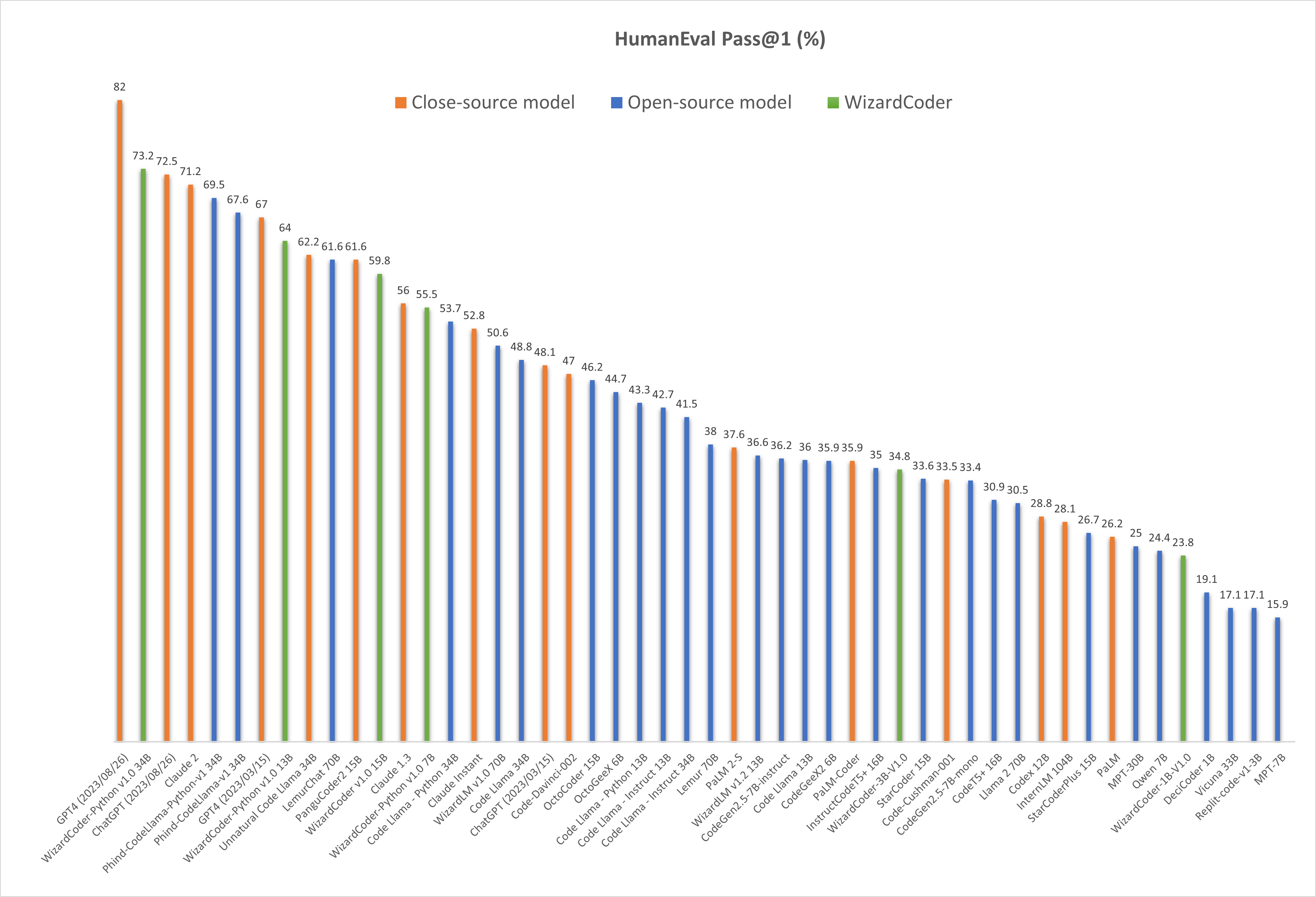
❗Note: There are two HumanEval results of GPT4 and ChatGPT-3.5. The 67.0 and 48.1 are reported by the official GPT4 Report (2023/03/15) of OpenAI . The 82.0 and 72.5 are tested by ourselves with the latest API (2023/08/26).
| Model | Checkpoint | Paper | HumanEval | MBPP | Demo | License |
|---|---|---|---|---|---|---|
| WizardCoder-Python-34B-V1.0 | 🤗 HF Link | 📃 [WizardCoder] | 73.2 | 61.2 | Demo | Llama2 |
| WizardCoder-15B-V1.0 | 🤗 HF Link | 📃 [WizardCoder] | 59.8 | 50.6 | -- | OpenRAIL-M |
| WizardCoder-Python-13B-V1.0 | 🤗 HF Link | 📃 [WizardCoder] | 64.0 | 55.6 | -- | Llama2 |
| WizardCoder-Python-7B-V1.0 | 🤗 HF Link | 📃 [WizardCoder] | 55.5 | 51.6 | Demo | Llama2 |
| WizardCoder-3B-V1.0 | 🤗 HF Link | 📃 [WizardCoder] | 34.8 | 37.4 | -- | OpenRAIL-M |
| WizardCoder-1B-V1.0 | 🤗 HF Link | 📃 [WizardCoder] | 23.8 | 28.6 | -- | OpenRAIL-M |
| Model | Checkpoint | Paper | GSM8k | MATH | Online Demo | License |
|---|---|---|---|---|---|---|
| WizardMath-70B-V1.0 | 🤗 HF Link | 📃 [WizardMath] | 81.6 | 22.7 | Demo | Llama 2 |
| WizardMath-13B-V1.0 | 🤗 HF Link | 📃 [WizardMath] | 63.9 | 14.0 | Demo | Llama 2 |
| WizardMath-7B-V1.0 | 🤗 HF Link | 📃 [WizardMath] | 54.9 | 10.7 | Demo | Llama 2 |
| Model | Checkpoint | Paper | MT-Bench | AlpacaEval | GSM8k | HumanEval | License |
|---|---|---|---|---|---|---|---|
| WizardLM-70B-V1.0 | 🤗 HF Link | 📃 Coming Soon | 7.78 | 92.91% | 77.6% | 50.6 | Llama 2 License |
| WizardLM-13B-V1.2 | 🤗 HF Link | 7.06 | 89.17% | 55.3% | 36.6 | Llama 2 License | |
| WizardLM-13B-V1.1 | 🤗 HF Link | 6.76 | 86.32% | 25.0 | Non-commercial | ||
| WizardLM-30B-V1.0 | 🤗 HF Link | 7.01 | 37.8 | Non-commercial | |||
| WizardLM-13B-V1.0 | 🤗 HF Link | 6.35 | 75.31% | 24.0 | Non-commercial | ||
| WizardLM-7B-V1.0 | 🤗 HF Link | 📃 [WizardLM] | 19.1 | Non-commercial | |||
🔥 The following figure shows that our WizardCoder-Python-34B-V1.0 attains the second position in this benchmark , surpassing GPT4 (2023/03/15, 73.2 vs. 67.0), ChatGPT-3.5 (73.2 vs. 72.5) and Claude2 (73.2 vs. 71.2).
"Below is an instruction that describes a task. Write a response that appropriately completes the request.\n\n### Instruction:\n{instruction}\n\n### Response:"
We provide the inference demo code here .
Note: This script supports
WizardLM/WizardCoder-Python-34B/13B/7B-V1.0
. If you want to inference with
WizardLM/WizardCoder-15B/3B/1B-V1.0
, please change the
stop_tokens = ['</s>']
to
stop_tokens = ['<|endoftext|>']
in the script.
Please cite the repo if you use the data, method or code in this repo.
@article{luo2023wizardcoder,
  title={WizardCoder: Empowering Code Large Language Models with Evol-Instruct},
  author={Luo, Ziyang and Xu, Can and Zhao, Pu and Sun, Qingfeng and Geng, Xiubo and Hu, Wenxiang and Tao, Chongyang and Ma, Jing and Lin, Qingwei and Jiang, Daxin},
  journal={arXiv preprint arXiv:2306.08568},
  year={2023}
}