



Total runs:
343.3K
Run Growth:
127.1K
Growth Rate:
37.02%
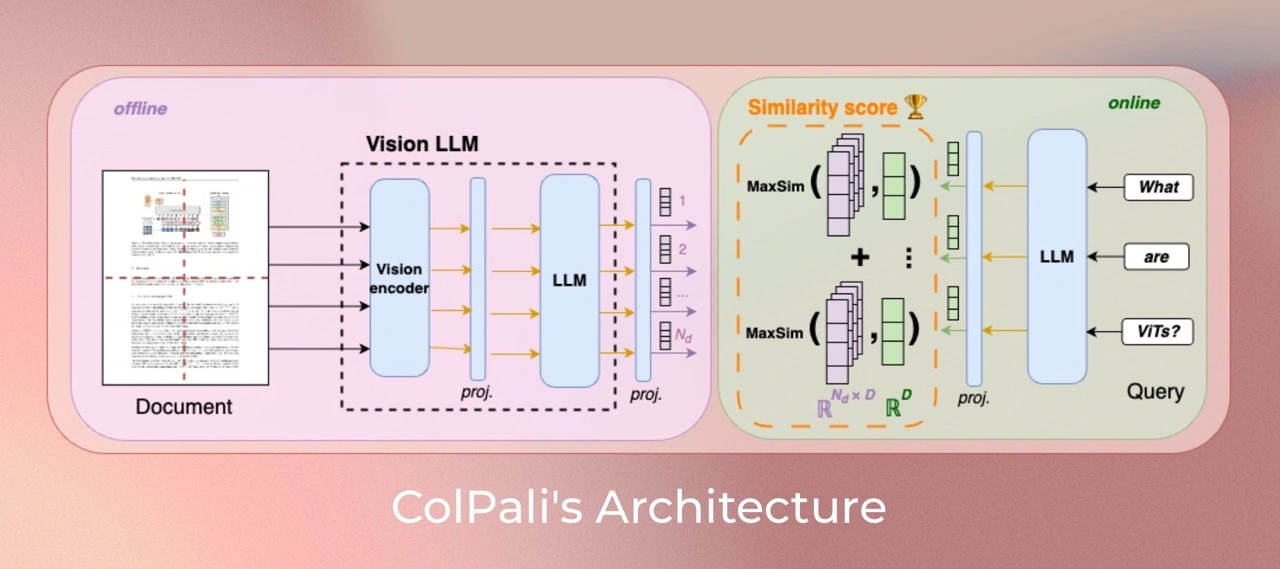
ColPali is a model based on a novel model architecture and training strategy based on Vision Language Models (VLMs) to efficiently index documents from their visual features. It is a PaliGemma-3B extension that generates ColBERT - style multi-vector representations of text and images. It was introduced in the paper ColPali: Efficient Document Retrieval with Vision Language Models and first released in this repository
This version is trained with
colpali-engine==0.2.0
but can be loaded for any version
>=0.2.0
.
Compared to
vidore/colpali
, this version is trained with right padding for queries to fix unwanted tokens in the query encoding.
It also stems from the fixed
vidore/colpaligemma-3b-pt-448-base
to guarantee deterministic projection layer initialization.
It was trained for 5 epochs, with in-batch negatives and hard mined negatives and a warmup of 1000 steps (10x longer) to help reduce non-english language collapse.
Data is the same as the ColPali data described in the paper.
This model is built iteratively starting from an off-the-shelf SigLIP model. We finetuned it to create BiSigLIP and fed the patch-embeddings output by SigLIP to an LLM, PaliGemma-3B to create BiPali .
One benefit of inputting image patch embeddings through a language model is that they are natively mapped to a latent space similar to textual input (query). This enables leveraging the ColBERT strategy to compute interactions between text tokens and image patches, which enables a step-change improvement in performance compared to BiPali.
Our training dataset of 127,460 query-page pairs is comprised of train sets of openly available academic datasets (63%) and a synthetic dataset made up of pages from web-crawled PDF documents and augmented with VLM-generated (Claude-3 Sonnet) pseudo-questions (37%). Our training set is fully English by design, enabling us to study zero-shot generalization to non-English languages. We explicitly verify no multi-page PDF document is used both ViDoRe and in the train set to prevent evaluation contamination. A validation set is created with 2% of the samples to tune hyperparameters.
Note: Multilingual data is present in the pretraining corpus of the language model (Gemma-2B) and potentially occurs during PaliGemma-3B's multimodal training.
All models are trained for 1 epoch on the train set. Unless specified otherwise, we train models in
bfloat16
format, use low-rank adapters (
LoRA
)
with
alpha=32
and
r=32
on the transformer layers from the language model,
as well as the final randomly initialized projection layer, and use a
paged_adamw_8bit
optimizer.
We train on an 8 GPU setup with data parallelism, a learning rate of 5e-5 with linear decay with 2.5% warmup steps, and a batch size of 32.
Install
colpali-engine
:
pip install colpali-engine>=0.3.0,<0.4.0
Then run the following code:
from typing import cast

import torch
from PIL import Image

from colpali_engine.models import ColPali, ColPaliProcessor

model_name = "vidore/colpali-v1.3"

model = ColPali.from_pretrained(
    model_name,
    torch_dtype=torch.bfloat16,
    device_map="cuda:0",  # or "mps" if on Apple Silicon
).eval()

processor = ColPaliProcessor.from_pretrained(model_name)

# Your inputs
images = [
    Image.new("RGB", (32, 32), color="white"),
    Image.new("RGB", (16, 16), color="black"),
]
queries = [
    "Is attention really all you need?",
    "Are Benjamin, Antoine, Merve, and Jo best friends?",
]

# Process the inputs
batch_images = processor.process_images(images).to(model.device)
batch_queries = processor.process_queries(queries).to(model.device)

# Forward pass
with torch.no_grad():
    image_embeddings = model(**batch_images)
    querry_embeddings = model(**batch_queries)

scores = processor.score_multi_vector(querry_embeddings, image_embeddings)
ColPali's vision language backbone model (PaliGemma) is under
gemma
license as specified in its
model card
. The adapters attached to the model are under MIT license.
If you use any datasets or models from this organization in your research, please cite the original dataset as follows:
@misc{faysse2024colpaliefficientdocumentretrieval,
  title={ColPali: Efficient Document Retrieval with Vision Language Models},
  author={Manuel Faysse and Hugues Sibille and Tony Wu and Bilel Omrani and Gautier Viaud and Céline Hudelot and Pierre Colombo},
  year={2024},
  eprint={2407.01449},
  archivePrefix={arXiv},
  primaryClass={cs.IR},
  url={https://arxiv.org/abs/2407.01449},
}