































Table of Contents
- Key Points
- Understanding Memory in AI Agents
- Designing Long-Term Memory Systems for AI Agents
- FAQ
- Related Questions


Designing Long-Term Memory Systems for AI Agents
Key Considerations for Memory Implementation
When designing a memory system for an AI agent, several factors must be considered. The memory capacity of the system must be sufficient to store all the relevant information that the agent needs to perform its tasks. The memory access speed must be fast enough to allow the agent to retrieve information in a timely manner. The memory organization must be efficient enough to allow the agent to locate the right information when it needs it. Furthermore, it’s imperative to consider the type of model needed, as this affects a wide range of factors like retrieval, access and actions after retrieval.
Additionally, the memory system must be able to handle changing information. AI agents often operate in dynamic environments, where new information is constantly becoming available and old information is becoming obsolete. The memory system must be able to update its contents accordingly, ensuring that the agent always has access to the most relevant and up-to-date information.
Choosing the Right Memory Type
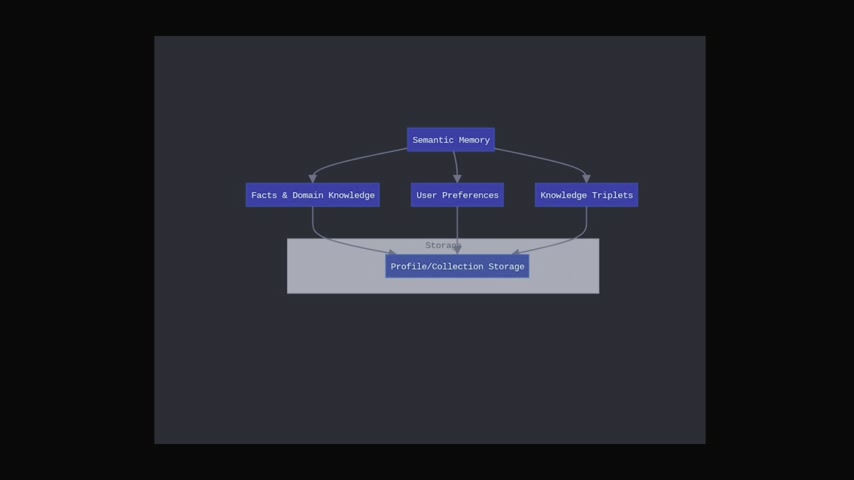
The appropriate memory type depends on what you want to store. Some memories are more permanent like semantic memory, which is great for storing facts and user profiles. If you need to focus on the recent, episodic memory might be the best bet. If you want the AI to adapt and become more refined then the procedural memory should help. Knowing which memory type is best will help get the most out of your AI.
To choose the right memory you need to answer questions about your agent. Start with what your agent is supposed to do. Then see how you want it to access the memory, and thirdly see what you want the agent to do after it has the memory. These questions will help dictate how the memory functions.
| Category | Semantic Memory | Episodic Memory | Procedural Memory |
|---|---|---|---|
| Use Cases | Providing context, storing user data for personalized results | Provide context in the past, needed context from user interactions, few-shot prompts | Adaptive behaviors, learning from feedback, adapt response patterns |
| Type of Data Stored | Facts, domain knowledge, user profiles, knowledge triplets | Conversations, interactions and user history. | Adaptive actions and behavior |
Langchain AI Tools for AI Agent Memory Management
Langchain is an open source AI framework for helping streamline and create AI models that are complex and help perform more intelligent results. It works by helping link and search up data more intelligently to help create a response.
Langchain tools like LangMem, allow you to store the memory as well as search to help your AI models and are able to create even longer memories as a result. LangMem focuses on 2 approaches for memories, in the hot path and in the background.
- In the hot path means you ask a question, and before it can respond you update the memory.
- In the background helps to update the memory as needed.






Most people like




































Report
Please select a reason for reporting
- 13 Reasons to Switch from Snapchat to Text Messaging
- 7 Powerful Speech to Text Apps to Boost Productivity
- 10 Best Speech to Text Tools for Effortless Transcription
- 13 Free Tools to Easily Transcribe Audio to Text
- 15 Surprising Ways Google's Speech-to-Text Boosts Productivity
- 7 Best Free Online Audio to Text Transcription Tools
- 9 Tips to Transcribe Speech to Text Faster and Better
- 13 Best Speech to Text Software for Windows 10 in 2023
- 7 Tips for Choosing the Best Transcriber for Audio to Text
- 11 Reasons Why Dragon Speech-to-Text Apps are Game-Changers
- 6 Secrets to Enhance Your Speech to Text Transcription
- 6 Brilliant Ways to Boost Productivity with Talk-to-Text on Your MacBook
- 6 Ways Transcription Software Converts Audio to Text
- 8 Tips to Transcribe Speech to Text Like a Pro
- 6 Reasons IBM Watson Speech to Text is a Game-Changer
- 14 Powerful Ways Talk-to-Text Improves Your Workflow
- 12 Top Windows Speech-to-Text Software for Efficient Transcription
- 12 Game-Changing Benefits of Apple's Speech to Text Technology
- 9 Powerful Use Cases for AWS Speech to Text Technology
- 10 Easy Steps to Transcribe YouTube Videos to Text
- transcription audio en texte
- online audio transcription
- free audio file transcription
- free ai audio transcription
- audio transcription service
- audio transcription online free
- audio transcription free online
- audio to transcription software
- audio and transcript
- ai audio transcription free
- voice recording to text converter
- translate voice recording to text
- record voice to text
- audio recording to text converter
- voice recording and transcription
- chatgpt voice to text
- gmail voice to text
- speech to text reader
- speech to text ai free
- speech to talk
- How SEO and Marketing Dashboards Empower Agencies to Drive Results
- How to Use AI Tools to Find Internal Linking Opportunities Across a Business Website
- Discover Your Perfect Haircut with AI Hairstyle Apps
- Free Reputation Calculator Tools: How They're Adapting to Score AI Visibility, Not Just Rankings
- Design Professional Flyers for Free on Your Phone
- Best Free Flyer Maker Apps for Android: Design Like a Pro
- How to Know If Your Business Is Ready for an AI Customer Service Agent
- Revolutionizing Storytelling: From Novels to Screenplays with AI
- Create Engaging Animated Explainer Videos with a Free AI Tool
- Stop Multi-Subscribing: Benchmark Top AI Visual Models in One Canvas
- AI & Elections: Defending Democracy Against Misinformation
- Navigating Political Discourse: AI, Deepfakes, and Reality Checks
- Detecting Political Bias in News Articles: A Powerful AI Algorithm
- AI Bias Unveiled: Political Leanings in ChatGPT & Beyond
- Revolutionize Learning: Discover Quizzes AI for Engaging Interactive Quizzes
- From AI-Generated to Audience-Ready: How Quillbot Humanize AI Is Changing the Content Editing Process
- Building an AI Writing Stack in 2026: LLMs, Detectors, and Humanizers
- 7 Top AI-Powered Database Assistant Platforms
- An Objective Look at Modern Web-Based Visual Modifications
- My Honest Experience with VideoAI: The Secret Weapon for Creators Who Need Character Voices

Copyright ©2026 toolify