






Table of Contents
- Key Points
- Generating Structured Data with AI: Arrays and Enums
- Customizing AI Data Output with Zod
- FAQ
- Related Questions


Generating Structured Data with AI: Arrays and Enums
Understanding AI's Role in Data Generation
Artificial intelligence is revolutionizing software development, especially in how data is structured and utilized. Traditionally, developers manually define data structures. Now, AI SDKs allow for dynamic data generation, opening doors to more flexible and adaptive applications. Specifically, the ability to generate arrays and enums using AI can drastically improve the efficiency and predictability of AI outputs within your projects. This is particularly helpful in scenarios where the possible outputs are well defined, allowing for stronger type safety and reduced errors.
By using arrays, you can organize and manage lists of related items. Enums, on the other hand, allow you to classify data into predefined categories. These structured outputs are easier to process, validate, and present to users, making your applications more maintainable and user-friendly. Let’s delve into how these structures are built and implemented using specific examples.
Building a Pokémon Generator: Leveraging Arrays
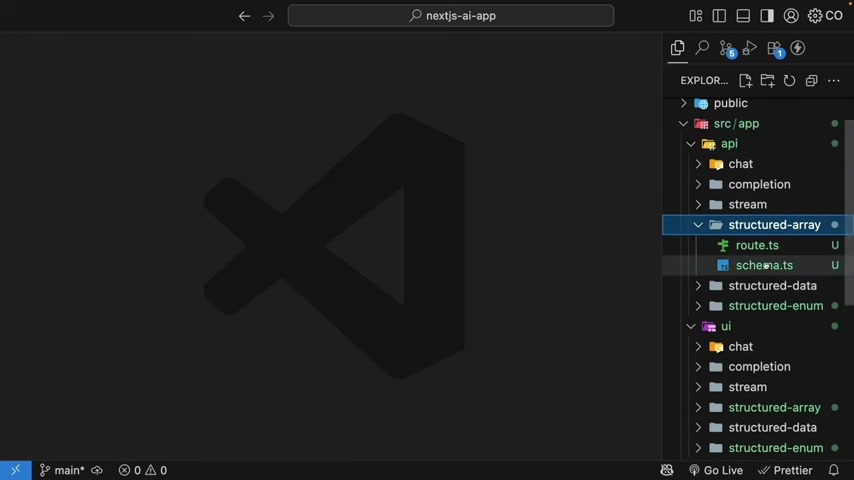
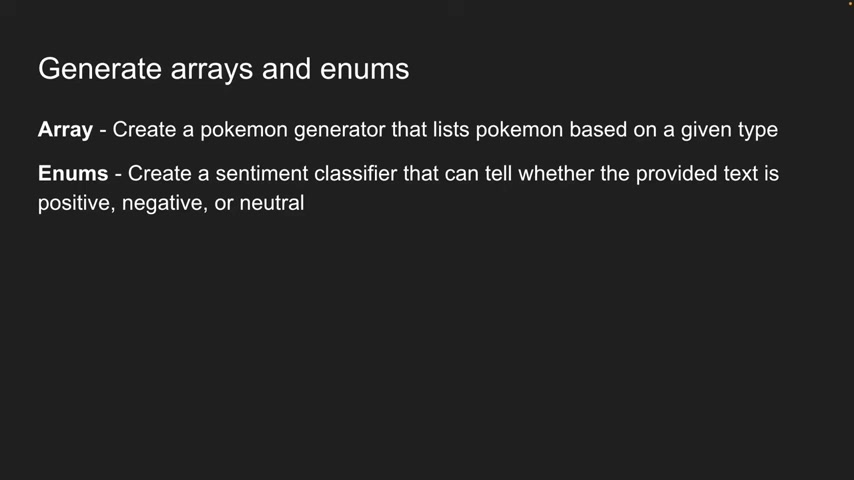
Arrays are essential for managing lists of data. Consider a scenario where you need to generate a list of Pokémon based on a given type, such as 'fire' or 'water'. An AI SDK can be instructed to produce an array of Pokémon names and their associated abilities. This process involves defining a schema for a single Pokémon, specifying fields like 'name' (a string) and 'abilities' (an array of strings). The AI then generates multiple instances of this schema, creating a structured list suitable for use in an application.
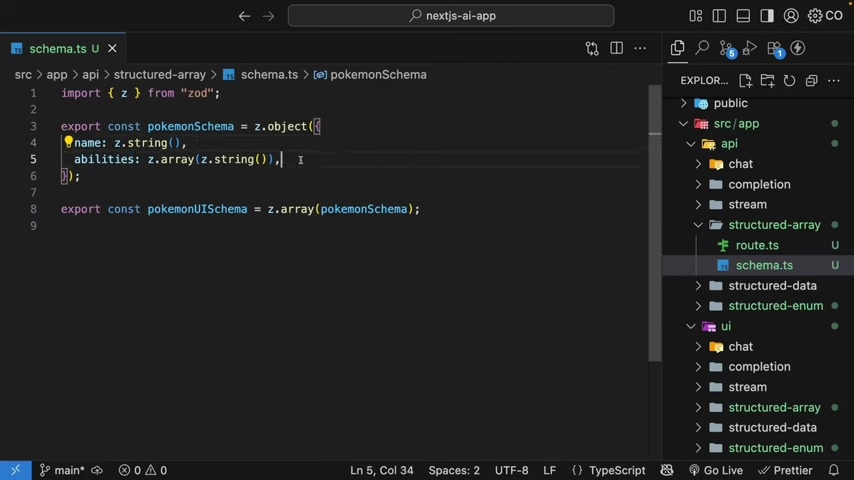
Here’s how the schema is defined using Zod, a TypeScript-first schema declaration and validation library:
import { z } from "zod";

export const pokemonSchema = z.object({
 name: z.string(),
 abilities: z.array(z.string()),
});

export const pokemonUISchema = z.array(pokemonSchema);
In this setup, pokemonSchema defines the structure of a single Pokémon object, including its name and an array of abilities. pokemonUISchema then wraps this in z.array(), indicating that the AI should generate an array of Pokémon objects.
Key elements of this example:
- Schema Definition: Clearly defining what a single Pokémon looks like (name and abilities).
- Array Wrapping: Using
z.arrayto tell the AI SDK that an array of objects is expected. - Output Specification: Setting the
outputproperty toarrayin the route handler to instruct the AI to generate an array.
The Prompt instructs the AI to 'Generate a list of 5 {type} type Pokémon', where {type} is dynamically replaced with the user’s input, such as 'fire' or 'water'. This ensures the generated list corresponds to the user's desired Pokémon type.
This example showcases how arrays can organize and deliver structured lists of data points, perfect for applications requiring collections of similar objects.
Creating a Sentiment Classifier: Harnessing Enums
Enums provide a way to classify data into predefined categories. Let's consider creating a sentiment classifier that analyzes text and determines whether its sentiment is positive, negative, or neutral. An enum is a natural choice here, as there are only three possible sentiment outcomes.
Unlike array generation, enums don’t require a separate schema definition. Instead, the possible enum values are directly provided in the enum property within the route handler.
import { generateObject } from "ai";
import { openAI } from "@ai-sdk/openai";

export async function POST(req: Request) {
 try {
 const { text } = await req.json();

 const result = await generateObject({
 model: openAI("gpt-4.1-mini"),
 output: "enum",
 enum: ["positive", "negative", "neutral"],
 prompt: `Classify the sentiment in this text: ${text}`,
 });

 return result.toJsonResponse();
 } catch (error) {
 console.error("Error generating sentiment", error);
 return new Response("Failed to generate sentiment", { status: 500 });
 }
}
Key elements of this example:
- Using
generateObject: Enums are best used withgenerateObjectrather thanstreamObject. - Defining Enum Values: Listing the possible sentiment values (positive, negative, neutral) directly in the
enumproperty. - Model Selection: Utilizing a more capable model like
gpt-4.1-minifor greater consistency in enum output.
The prompt instructs the AI to Classify the sentiment in this text: ${text}, where ${text} is the user's input. The AI then categorizes the text into one of the predefined enum values.
This approach demonstrates how enums can provide structured, classified outputs, making sentiment analysis, categorization, and decision-making processes more efficient and accurate.
Comparing Array and Enum Generation
Arrays and enums serve different purposes and, therefore, require different setups within an AI SDK. Arrays are ideal for managing lists of objects, while enums are best suited for classification tasks. The key differences in implementation lie in the schema definition, output specification, and the AI SDK functions used.
Here’s a table summarizing the key distinctions:
| Feature | Arrays | Enums |
|---|---|---|
| Data Structure | List of objects | Predefined categories |
| Schema Required | Yes, defines the structure of each object | No, values defined directly in the handler |
| Output Type | array |
enum |
| AI SDK Function | streamObject |
generateObject |
| Use Case | Managing collections of similar objects | Classification and categorization |
| Data Processing | Returns an array of objects | Returns a single, classified value |
Understanding these differences helps developers choose the right data structure and implementation approach for their specific AI application needs.
Customizing AI Data Output with Zod
Enhancing Data Validation with Zod
Zod is a powerful tool for defining and validating schemas in TypeScript. It provides a fluent and type-safe way to ensure that the data generated by your AI models adheres to specific structures and constraints. Beyond the basic examples of arrays and enums, Zod offers a wide range of validation options to further customize and refine your AI data output.
Here are a few ways you can enhance data validation with Zod:
- Complex Object Validation: Zod allows you to define deeply nested object schemas with intricate validation rules. This is useful for ensuring that all components of complex data structures meet specific criteria.
- Custom Validation Functions: Zod supports custom validation functions, enabling you to define validation logic tailored to your specific application requirements. These functions can perform checks that go beyond Zod's built-in validators.
- Transformations: Zod can transform data during validation, allowing you to modify the AI output to better suit your application's needs. This can include converting data types, normalizing values, or extracting specific information.
By combining Zod's validation capabilities with the power of AI data generation, you can ensure that your AI applications handle data robustly and efficiently, leading to improved reliability and a better user experience.


Most people like





































Report
Please select a reason for reporting
- 13 Reasons to Switch from Snapchat to Text Messaging
- 7 Powerful Speech to Text Apps to Boost Productivity
- 10 Best Speech to Text Tools for Effortless Transcription
- 13 Free Tools to Easily Transcribe Audio to Text
- 15 Surprising Ways Google's Speech-to-Text Boosts Productivity
- 7 Best Free Online Audio to Text Transcription Tools
- 9 Tips to Transcribe Speech to Text Faster and Better
- 13 Best Speech to Text Software for Windows 10 in 2023
- 7 Tips for Choosing the Best Transcriber for Audio to Text
- 11 Reasons Why Dragon Speech-to-Text Apps are Game-Changers
- 6 Secrets to Enhance Your Speech to Text Transcription
- 6 Brilliant Ways to Boost Productivity with Talk-to-Text on Your MacBook
- 6 Ways Transcription Software Converts Audio to Text
- 8 Tips to Transcribe Speech to Text Like a Pro
- 6 Reasons IBM Watson Speech to Text is a Game-Changer
- 14 Powerful Ways Talk-to-Text Improves Your Workflow
- 12 Top Windows Speech-to-Text Software for Efficient Transcription
- 12 Game-Changing Benefits of Apple's Speech to Text Technology
- 9 Powerful Use Cases for AWS Speech to Text Technology
- 10 Easy Steps to Transcribe YouTube Videos to Text
- transcription audio en texte
- online audio transcription
- free audio file transcription
- free ai audio transcription
- audio transcription service
- audio transcription online free
- audio transcription free online
- audio to transcription software
- audio and transcript
- ai audio transcription free
- voice recording to text converter
- translate voice recording to text
- record voice to text
- audio recording to text converter
- voice recording and transcription
- chatgpt voice to text
- gmail voice to text
- speech to text reader
- speech to text ai free
- speech to talk
- Meshy AI: How to Create 3D Models from Text and Images
- How SEO and Marketing Dashboards Empower Agencies to Drive Results
- How to Use AI Tools to Find Internal Linking Opportunities Across a Business Website
- Discover Your Perfect Haircut with AI Hairstyle Apps
- Free Reputation Calculator Tools: How They're Adapting to Score AI Visibility, Not Just Rankings
- Design Professional Flyers for Free on Your Phone
- Best Free Flyer Maker Apps for Android: Design Like a Pro
- How to Know If Your Business Is Ready for an AI Customer Service Agent
- Revolutionizing Storytelling: From Novels to Screenplays with AI
- Create Engaging Animated Explainer Videos with a Free AI Tool
- Automate Lead Generation: A Comprehensive Guide with AI Agents
- Revideo.io: The Future of Reverse Video Search Technology
- Revolutionizing Email Marketing Agency with AI
- Breaking the Character Drift Dilemma: A Practical Test of Smart Shot
- Meshy AI: How to Create 3D Models from Text and Images
- ASOMobile Helps Teams Benchmark App Store Screenshots Against Competitors
- How to Match LMS Software With Your Organization's Training Plan
- How to Convert BTC to HNT
- Unleashing the Power of AI: Cognizant's Roadmap for Transformation
- Frame to Video Review: A Practical Look at Turning Two Still Frames Into Motion

Copyright ©2026 toolify