






Table of Contents
- Key Points
- Understanding the Spark Scheduler Architecture
- Deep Dive into the Scheduling Process
- How to Optimize Spark Job Scheduling
- Pros and Cons of Apache Spark Scheduling
- Frequently Asked Questions About Spark Scheduling
- Related Questions About Apache Spark and Scheduling



Understanding the Spark Scheduler Architecture
The Core Components of the Spark Scheduler
The Apache Spark scheduler is comprised of several key components that work together to efficiently execute Spark applications. These components include the SparkContext, SchedulerBackend, TaskScheduler, and DAGScheduler. Understanding how these components interact is essential for optimizing Spark job performance.
- SparkContext:
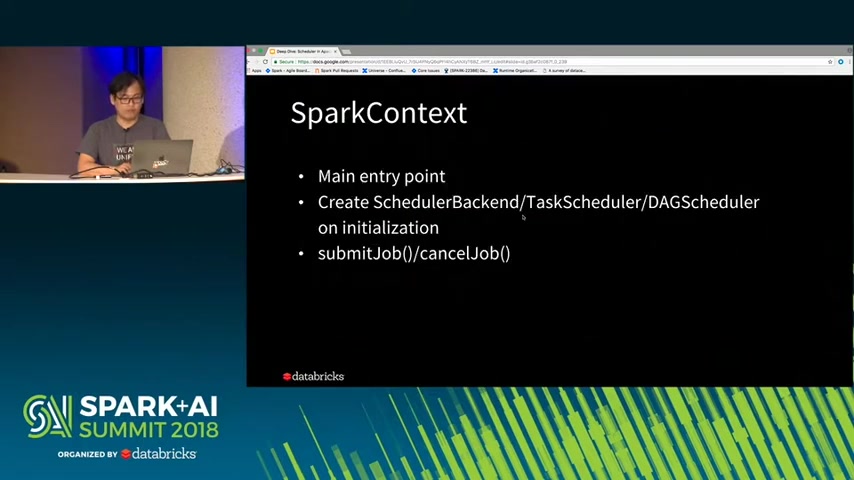
The SparkContext is the entry point for any Spark application. It's responsible for coordinating with the cluster manager and initializing the scheduler. It provides APIs for submitting jobs and canceling them. The SparkContext creates instances of the SchedulerBackend, TaskScheduler, and DAGScheduler during initialization.
- SchedulerBackend: The SchedulerBackend is responsible for communicating with the cluster manager, such as YARN, Mesos, or Spark's standalone cluster manager. It allocates resources and launches executors. There are different types of SchedulerBackend implementations, including CoarseGrainedSchedulerBackend and LocalSchedulerBackend. The CoarseGrainedSchedulerBackend is used for cluster mode, where executors are launched at the beginning of the application and remain active throughout the application's lifecycle. The LocalSchedulerBackend is used for local mode, where the Spark application runs on a single machine.
- TaskScheduler: The TaskScheduler is responsible for Scheduling tasks on the worker nodes. It receives task sets from the DAGScheduler and launches tasks on the executors. The TaskScheduler also manages task retries and handles task failures.
- DAGScheduler: The DAGScheduler is responsible for converting RDD operations into a directed acyclic graph (DAG) of stages and tasks. It analyzes the dependencies between RDDs and determines the optimal execution plan. The DAGScheduler submits stages to the TaskScheduler for execution.
Deep Dive into the Scheduling Process
From RDDs to Task Execution: The Scheduling Workflow
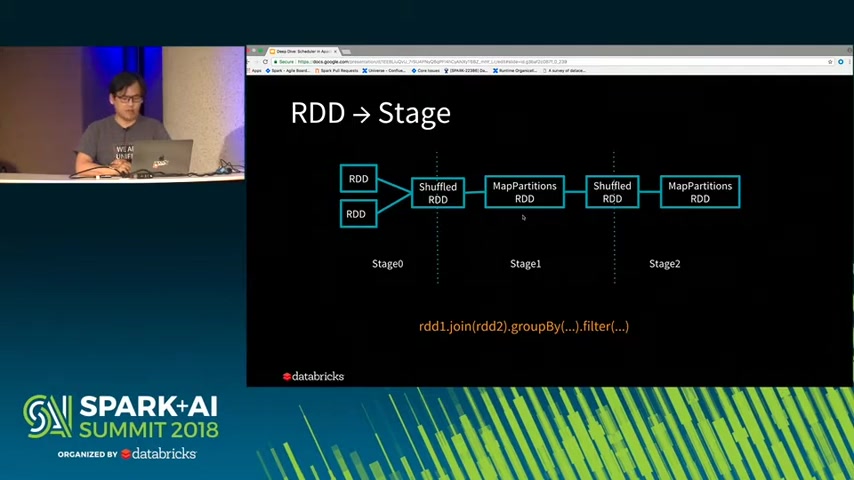
The scheduling process in Apache Spark begins with RDD (Resilient Distributed Dataset) objects. RDDs are the fundamental data structure in Spark, representing an immutable, distributed collection of elements. When you perform operations on RDDs, Spark creates a DAG (Directed Acyclic Graph) to represent the flow of data and transformations.
- DAG Construction: The DAGScheduler transforms RDD operations into a DAG. Each node in the DAG represents an RDD, and each edge represents a transformation. The DAG represents the entire execution plan for the Spark job.
- Stage Creation: The DAGScheduler analyzes the DAG and splits it into stages. A stage is a group of tasks that can be executed together without shuffling data across the network. Shuffle operations, such as
groupByorreduceByKey, introduce dependencies between stages. - TaskSet Creation: For each stage, the DAGScheduler creates a TaskSet. A TaskSet contains a set of tasks that can be executed in Parallel on the executors.
- Task Submission: The DAGScheduler submits the TaskSet to the TaskScheduler. The TaskScheduler launches tasks on the worker nodes, taking into account data locality and resource availability.
- Task Execution: The worker nodes execute the tasks and perform the required transformations on the data. The results are then returned to the driver node.
The entire scheduling process is optimized to minimize data shuffling and maximize parallelism. Spark's scheduler uses various techniques, such as data locality and task speculation, to improve job performance. Data locality ensures that tasks are executed on the nodes where the data resides, reducing the need to transfer data across the network. Task speculation launches redundant tasks to mitigate the impact of slow or failing tasks.
Understanding stages and tasks is crucial for optimizing Spark job performance. A well-designed Spark application will minimize the number of stages and maximize the parallelism within each stage.


Most people like




































Report
Please select a reason for reporting
- 13 Reasons to Switch from Snapchat to Text Messaging
- 7 Powerful Speech to Text Apps to Boost Productivity
- 10 Best Speech to Text Tools for Effortless Transcription
- 13 Free Tools to Easily Transcribe Audio to Text
- 15 Surprising Ways Google's Speech-to-Text Boosts Productivity
- 7 Best Free Online Audio to Text Transcription Tools
- 9 Tips to Transcribe Speech to Text Faster and Better
- 13 Best Speech to Text Software for Windows 10 in 2023
- 7 Tips for Choosing the Best Transcriber for Audio to Text
- 11 Reasons Why Dragon Speech-to-Text Apps are Game-Changers
- 6 Secrets to Enhance Your Speech to Text Transcription
- 6 Brilliant Ways to Boost Productivity with Talk-to-Text on Your MacBook
- 6 Ways Transcription Software Converts Audio to Text
- 8 Tips to Transcribe Speech to Text Like a Pro
- 6 Reasons IBM Watson Speech to Text is a Game-Changer
- 14 Powerful Ways Talk-to-Text Improves Your Workflow
- 12 Top Windows Speech-to-Text Software for Efficient Transcription
- 12 Game-Changing Benefits of Apple's Speech to Text Technology
- 9 Powerful Use Cases for AWS Speech to Text Technology
- 10 Easy Steps to Transcribe YouTube Videos to Text
- transcription audio en texte
- online audio transcription
- free audio file transcription
- free ai audio transcription
- audio transcription service
- audio transcription online free
- audio transcription free online
- audio to transcription software
- audio and transcript
- ai audio transcription free
- voice recording to text converter
- translate voice recording to text
- record voice to text
- audio recording to text converter
- voice recording and transcription
- chatgpt voice to text
- gmail voice to text
- speech to text reader
- speech to text ai free
- speech to talk
- Meshy AI: How to Create 3D Models from Text and Images
- How SEO and Marketing Dashboards Empower Agencies to Drive Results
- How to Use AI Tools to Find Internal Linking Opportunities Across a Business Website
- Discover Your Perfect Haircut with AI Hairstyle Apps
- Free Reputation Calculator Tools: How They're Adapting to Score AI Visibility, Not Just Rankings
- Design Professional Flyers for Free on Your Phone
- Best Free Flyer Maker Apps for Android: Design Like a Pro
- How to Know If Your Business Is Ready for an AI Customer Service Agent
- Revolutionizing Storytelling: From Novels to Screenplays with AI
- Create Engaging Animated Explainer Videos with a Free AI Tool
- Automate Lead Generation: A Comprehensive Guide with AI Agents
- Revideo.io: The Future of Reverse Video Search Technology
- Revolutionizing Email Marketing Agency with AI
- Breaking the Character Drift Dilemma: A Practical Test of Smart Shot
- Meshy AI: How to Create 3D Models from Text and Images
- ASOMobile Helps Teams Benchmark App Store Screenshots Against Competitors
- How to Match LMS Software With Your Organization's Training Plan
- How to Convert BTC to HNT
- Unleashing the Power of AI: Cognizant's Roadmap for Transformation
- Frame to Video Review: A Practical Look at Turning Two Still Frames Into Motion

Copyright ©2026 toolify