































Table of Contents
- Key Points
- Understanding Automated Reasoning
- The Role of AI in Automated Reasoning
- Implementing Automated Reasoning with Amazon Bedrock
- AWS Bedrock Pricing Structure
- Weighing the Advantages and Disadvantages of Automated Reasoning
- Frequently Asked Questions
- Related Questions



Understanding Automated Reasoning
The Core of Automated Reasoning
Automated reasoning, at its heart, is the science of using mathematical logic to rigorously prove the validity of statements. It's not just about checking if the code runs; it's about mathematically ensuring that the code behaves exactly as intended under all circumstances. This is especially crucial in high-stakes environments where errors can lead to catastrophic outcomes. This need for absolute correctness makes it one of the difficult area to write code for, and the cost of getting something wrong within these systems is catastrophic.
Imagine a system that controls air traffic, manages financial transactions, or operates critical infrastructure. In such scenarios, even a small coding error can have severe repercussions, resulting in financial losses, security breaches, or, in the worst cases, loss of life. Automated reasoning provides a method to mathematically verify that the code is free from errors and vulnerabilities, ensuring reliable and safe operation.
The core challenge lies in the complexity of modern software systems. As codebases grow larger and more intricate, manual validation becomes increasingly impractical. testing alone cannot guarantee complete coverage, and human error can lead to oversight. Automated reasoning offers a systematic approach to analyze code, identify potential flaws, and provide mathematical proof of its correctness.
Take the following example

:
- When it rains, the ground gets wet.
- When the ground gets wet, tires have less grip.
- Therefore, when it rains, tires have less grip (Transitive Property).
That is a very simple example to understand, but it can actually be proven, using mathematics. Automated reasoning needs to be perfect. It has to be perfectly precise. It cannot have any ambiguity, because it has to be proven with math.
Mission Critical Applications
The demand for automated reasoning Stems from its ability to address critical needs across diverse sectors. These include:
- Aerospace: Ensuring the reliability of flight control systems.
- Finance: Validating the security and correctness of financial transaction systems.
- Healthcare: Guaranteeing the accuracy of medical devices and patient data management.
- Critical infrastructure: Safeguarding the operation of power grids, water systems, and transportation networks.
These sectors share a common requirement: the absolute minimization of risk. Automated reasoning provides a means to achieve this by offering verifiable proof that software systems function as intended, even under unforeseen circumstances. While the initial investment in automated reasoning may be substantial, the potential returns in terms of reduced risk, enhanced reliability, and improved safety are significant.
| Sector | Application | Risk Mitigated |
|---|---|---|
| Aerospace | Flight Control Systems | System Malfunctions, Navigation Errors |
| Finance | Financial Transaction Systems | Security Breaches, Data Corruption |
| Healthcare | Medical Devices, Patient Data Management | Device Malfunctions, Data Breaches, Misdiagnosis |
| Infrastructure | Power Grids, Water Systems, Transportation Networks | System Failures, Infrastructure Damage, Service Disruptions |
Failure is not an option as it can result in catastrophe.
The Role of AI in Automated Reasoning
AI's Transformation of Coding

Artificial intelligence (AI) has rapidly transformed the landscape of coding, impacting how software is developed, tested, and validated. Large Language Models (LLMs) can write a ton of code whether they are helping you write code or writing the entire code for you.
However, a massive problem presents itself: hallucinations A single hallucination can cause the entire system to fail. In the context of coding, this is a critical concern, as even minor errors introduced by AI-generated code can have substantial consequences.
One promising approach to mitigating the risk of hallucinations is to combine AI with traditional automated reasoning techniques. By using AI to generate code and then employing mathematical logic to rigorously verify its correctness, developers can leverage the speed and efficiency of AI while maintaining the assurance of formal validation. The cost of giving somebody the wrong set of permissions again is catastrophic.
AWS Bedrock's Automated Reasoning Checks
Recognizing the challenges and opportunities presented by AI, Amazon Web Services (AWS) has developed innovative tools designed to enhance automated reasoning within its Bedrock service. This solution aims to tackle the limitations of LLMs by incorporating automated reasoning checks that provide logically accurate and verifiable results. AWS is using AI to create the logical rules for it, extract the different variables, and then convert that all over to a logical language.
Amazon Bedrock Guardrails are a new feature in AI safety by applying safeguards customized to your generative AI application requirements and responsible AI policies. Bedrock's automated reasoning checks are the first and only generative AI safeguard that helps prevent factual errors due to hallucinations using logically accurate and verifiable reasoning that explains why Generative AI responses are correct.
The system ensures that AI-generated code adheres to predefined rules and constraints, reducing the likelihood of errors and improving overall code reliability. These checks ensure that the model is accurate, sound, and transparent:
- Accurate Identifies and suggests corrections for inaccurate factual claims on supported knowledge
- Sound Uses formal logical reasoning to correctly determine accuracy
- Transparent Explains why we believe a claim is accurate or not
As previously Mentioned, AWS has a system called IAM, which is their permissions system. AWS understands that the cost of giving somebody the wrong set of permissions again is catastrophic.
Implementing Automated Reasoning with Amazon Bedrock
Step-by-Step Integration
To leverage Amazon Bedrock's automated reasoning checks, organizations can follow a structured approach
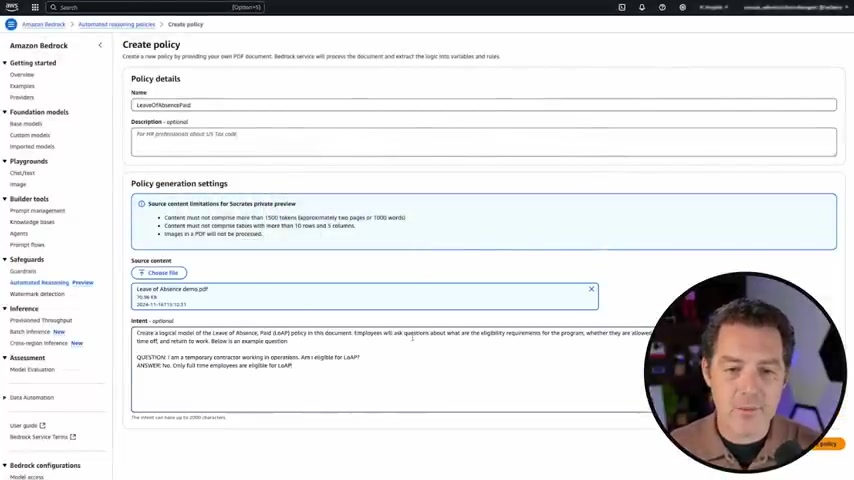
:
- Upload the Relevant document: such as leave of absence policy document, which is written in natural language.
- AI Creates Rules: By using AI, the document uploads and creates logical rules and extracts the document's variables.
- Run automated checks: Integrate AWS's automated reasoning checks into existing CI/CD pipelines or code review processes.
- Analyze the reports: Review the results to identify potential vulnerabilities and verify the correctness of code.
- Ensure that the AI is using 100% Certainty: Get to a level close to perfection, which is significantly better than current RAG (Retrieval Augmented Generation) systems can offer. That will give you that trusted service that you need.
By following these steps, organizations can establish a robust automated reasoning framework, enabling them to build more reliable and secure software systems.



Most people like



































Report
Please select a reason for reporting
- 13 Reasons to Switch from Snapchat to Text Messaging
- 7 Powerful Speech to Text Apps to Boost Productivity
- 10 Best Speech to Text Tools for Effortless Transcription
- 13 Free Tools to Easily Transcribe Audio to Text
- 15 Surprising Ways Google's Speech-to-Text Boosts Productivity
- 7 Best Free Online Audio to Text Transcription Tools
- 9 Tips to Transcribe Speech to Text Faster and Better
- 13 Best Speech to Text Software for Windows 10 in 2023
- 7 Tips for Choosing the Best Transcriber for Audio to Text
- 11 Reasons Why Dragon Speech-to-Text Apps are Game-Changers
- 6 Secrets to Enhance Your Speech to Text Transcription
- 6 Brilliant Ways to Boost Productivity with Talk-to-Text on Your MacBook
- 6 Ways Transcription Software Converts Audio to Text
- 8 Tips to Transcribe Speech to Text Like a Pro
- 6 Reasons IBM Watson Speech to Text is a Game-Changer
- 14 Powerful Ways Talk-to-Text Improves Your Workflow
- 12 Top Windows Speech-to-Text Software for Efficient Transcription
- 12 Game-Changing Benefits of Apple's Speech to Text Technology
- 9 Powerful Use Cases for AWS Speech to Text Technology
- 10 Easy Steps to Transcribe YouTube Videos to Text
- transcription audio en texte
- online audio transcription
- free audio file transcription
- free ai audio transcription
- audio transcription service
- audio transcription online free
- audio transcription free online
- audio to transcription software
- audio and transcript
- ai audio transcription free
- voice recording to text converter
- translate voice recording to text
- record voice to text
- audio recording to text converter
- voice recording and transcription
- chatgpt voice to text
- gmail voice to text
- speech to text reader
- speech to text ai free
- speech to talk
- Meshy AI: How to Create 3D Models from Text and Images
- How SEO and Marketing Dashboards Empower Agencies to Drive Results
- How to Use AI Tools to Find Internal Linking Opportunities Across a Business Website
- Discover Your Perfect Haircut with AI Hairstyle Apps
- Free Reputation Calculator Tools: How They're Adapting to Score AI Visibility, Not Just Rankings
- Design Professional Flyers for Free on Your Phone
- Best Free Flyer Maker Apps for Android: Design Like a Pro
- How to Know If Your Business Is Ready for an AI Customer Service Agent
- Revolutionizing Storytelling: From Novels to Screenplays with AI
- Create Engaging Animated Explainer Videos with a Free AI Tool
- Meshy AI: How to Create 3D Models from Text and Images
- ASOMobile Helps Teams Benchmark App Store Screenshots Against Competitors
- How to Match LMS Software With Your Organization's Training Plan
- Revolutionizing Email Marketing Agency with AI
- How to Convert BTC to HNT
- Unleashing the Power of AI: Cognizant's Roadmap for Transformation
- Frame to Video Review: A Practical Look at Turning Two Still Frames Into Motion
- NVIDIA NIM: Revolutionizing Supply Chain Data Analysis with AI
- Top AI Tools That Help Brands Stand Out Offline (Not Just Online)
- Top 5 Cold Email Software: Maximize Your Outreach in 2025

Copyright ©2026 toolify