































Table of Contents
- Key Points
- Understanding Web Classifier Performance Evaluation
- Delving into Prompt Flow for AI Evaluation
- Step-by-Step Guide: Evaluating a Web Classifier Using Ground Truth Data
- Understanding the Costs Associated with AI Evaluation
- Web Classifier with Prompt Flow: Advantages and Disadvantages
- Key Features of Web Classifier with Prompt Flow
- Real-World Use Cases for Web Classifiers
- FAQ
- Related Questions



Understanding Web Classifier Performance Evaluation
Why Performance Evaluation Matters for Web Classifiers
Web classifiers are the backbone of many online applications, from content filtering and recommendation systems to Search Engine optimization and data analysis. Accurate and reliable web classifiers enable businesses to:
- Enhance user experience by providing relevant and organized content
- Improve search engine rankings by categorizing web pages effectively
- Gain valuable insights from web data through accurate classification
- Automate content moderation and prevent the spread of harmful or inappropriate material
To realize these benefits, web classifiers must undergo rigorous performance evaluation. This process involves measuring the classifier's accuracy, relevance, and coherence to ensure it meets the specific needs of the application. Let's explore each of these metrics in detail.
Key Metrics for Evaluating Web Classifier Performance
When evaluating web classifier performance, several key metrics should be considered to provide a holistic view of its effectiveness:
-
Accuracy: The most fundamental metric, accuracy measures the proportion of correct classifications made by the web classifier. This is often expressed as a percentage or a decimal value between 0 and 1, where 1 indicates perfect accuracy.
-
Relevance: Relevance assesses the degree to which the classifications provided by the web classifier align with the context and user intent. A relevant web classifier categorizes content in a way that is meaningful and useful to the user or application consuming the data.
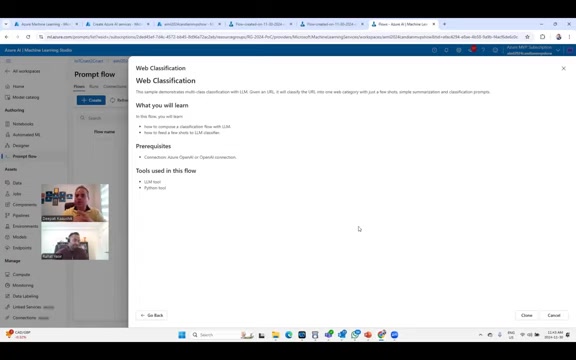
Relevance of evaluation metrics must be carefully considered to avoid misleading or incorrect analysis. Considering groundedness, which is how accurate and grounded models' answers are based on the Rag source, relevance, detect how relevant models' answers are and coherence, the quality of the answer and sentences.
-
Coherence: Coherence evaluates the consistency and logical flow of the classifications provided by the web classifier. A coherent classifier provides a clear and understandable categorization scheme that makes sense within the context of the data. A more coherent response means a better user experience, and higher satisfaction of user questions.
By carefully measuring and analyzing these metrics, you can gain a deep understanding of your web classifier's strengths and weaknesses and identify areas for improvement.
Delving into Prompt Flow for AI Evaluation
Leveraging Prompt Flow for Web Classifier Evaluation
Prompt flow is a comprehensive development tool for streamlining the entire development lifecycle of AI-powered applications. It's more than just a tool; it's an environment to supercharge AI development.
Key benefits of using Prompt Flow:
- Rapid Prototyping: Quickly create and test different web classifier configurations to optimize their performance.
- Streamlined Evaluation: Automate the evaluation process using pre-built metrics and custom evaluation flows.
- Enhanced Collaboration: Facilitate collaboration among data scientists, developers, and domain experts to improve the quality of web classifiers.
- Deployment Ready: It helps with the deployment process in a web app.
Deploy your flows to the serving platform you choose, or integrate into your app’s code base readily. Easily evaluate the entire operation. A large amount of work has been simplified with the new program.
Practical Application: Building a Web Classifier with Prompt Flow
Here's how you can leverage prompt flow to build and evaluate a web classifier for categorizing online content:
-
Data Preparation: Acquire and prepare a labeled dataset of web pages or URLs, where each item is categorized into a specific class. This dataset will serve as the ground truth for evaluating your web classifier.
-
Web Classifier Construction: Utilize prompt flow to build a web classifier that uses a large language model (LLM) to categorize web pages or URLs based on their content.
-
Evaluation Flow Creation: Design an evaluation flow within prompt flow to automatically measure the accuracy, relevance, and coherence of the web classifier's classifications. This flow can leverage pre-built metrics or custom evaluation logic.
-
Performance Optimization: Analyze the evaluation results and fine-tune the web classifier's parameters, prompts, or training data to improve its performance. Prompt flow's capabilities make it easy to iterate and optimize your AI application.
By following these steps, you can create a high-performing web classifier that accurately categorizes online content and provides valuable insights.
Content Moderation and Mitigation
Content moderation is another essential aspect of performance evaluation, especially when dealing with user-generated content or online communities. Content moderation aims to prevent the spread of harmful, offensive, or irrelevant material.
Key aspects of content moderation include:
- Identifying and filtering inappropriate content, such as hate speech, violence, or misinformation
- Ensuring that the web classifier handles irrelevant queries or topics gracefully
- Providing clear and informative error messages or alternative content when necessary
Content moderation is not just about filtering out negative content; it's also about creating a positive and inclusive online environment.
Careful content moderation is a process where irrelevant material, such as hate speech, should be carefully removed, and it requires clear error messages.
Key Features of Web Classifier with Prompt Flow
Highlights of Developing With Prompt Flow
When developing your model, you will find this tool especially useful.
Here are the highlights:
- Automated evaluation: Automate prompt tests and experiments, using pre-built metrics such as the three mentioned:
- Easy Deployment
- Model Validation: Validate the result in an orderly system of information. Is the content valid? Are you able to use this information or not?





Most people like





































Report
Please select a reason for reporting
- 13 Reasons to Switch from Snapchat to Text Messaging
- 7 Powerful Speech to Text Apps to Boost Productivity
- 10 Best Speech to Text Tools for Effortless Transcription
- 13 Free Tools to Easily Transcribe Audio to Text
- 15 Surprising Ways Google's Speech-to-Text Boosts Productivity
- 7 Best Free Online Audio to Text Transcription Tools
- 9 Tips to Transcribe Speech to Text Faster and Better
- 13 Best Speech to Text Software for Windows 10 in 2023
- 7 Tips for Choosing the Best Transcriber for Audio to Text
- 11 Reasons Why Dragon Speech-to-Text Apps are Game-Changers
- 6 Secrets to Enhance Your Speech to Text Transcription
- 6 Brilliant Ways to Boost Productivity with Talk-to-Text on Your MacBook
- 6 Ways Transcription Software Converts Audio to Text
- 8 Tips to Transcribe Speech to Text Like a Pro
- 6 Reasons IBM Watson Speech to Text is a Game-Changer
- 14 Powerful Ways Talk-to-Text Improves Your Workflow
- 12 Top Windows Speech-to-Text Software for Efficient Transcription
- 12 Game-Changing Benefits of Apple's Speech to Text Technology
- 9 Powerful Use Cases for AWS Speech to Text Technology
- 10 Easy Steps to Transcribe YouTube Videos to Text
- transcription audio en texte
- online audio transcription
- free audio file transcription
- free ai audio transcription
- audio transcription service
- audio transcription online free
- audio transcription free online
- audio to transcription software
- audio and transcript
- ai audio transcription free
- voice recording to text converter
- translate voice recording to text
- record voice to text
- audio recording to text converter
- voice recording and transcription
- chatgpt voice to text
- gmail voice to text
- speech to text reader
- speech to text ai free
- speech to talk
- Meshy AI: How to Create 3D Models from Text and Images
- How SEO and Marketing Dashboards Empower Agencies to Drive Results
- How to Use AI Tools to Find Internal Linking Opportunities Across a Business Website
- Discover Your Perfect Haircut with AI Hairstyle Apps
- Free Reputation Calculator Tools: How They're Adapting to Score AI Visibility, Not Just Rankings
- Design Professional Flyers for Free on Your Phone
- Best Free Flyer Maker Apps for Android: Design Like a Pro
- How to Know If Your Business Is Ready for an AI Customer Service Agent
- Revolutionizing Storytelling: From Novels to Screenplays with AI
- Create Engaging Animated Explainer Videos with a Free AI Tool
- Meshy AI: How to Create 3D Models from Text and Images
- ASOMobile Helps Teams Benchmark App Store Screenshots Against Competitors
- How to Match LMS Software With Your Organization's Training Plan
- Revolutionizing Email Marketing Agency with AI
- How to Convert BTC to HNT
- Unleashing the Power of AI: Cognizant's Roadmap for Transformation
- Frame to Video Review: A Practical Look at Turning Two Still Frames Into Motion
- NVIDIA NIM: Revolutionizing Supply Chain Data Analysis with AI
- Top AI Tools That Help Brands Stand Out Offline (Not Just Online)
- Top 5 Cold Email Software: Maximize Your Outreach in 2025

Copyright ©2026 toolify