






Table of Contents
- Key Points
- Claude 3.7 Sonnet: A Deep Dive into Coding Capabilities
- A Closer Look at Code Quality and Customization
- The Verdict: Claude 3.7 Strengths, Weaknesses, and Real-World Relevance
- FAQ
- Related Questions



Claude 3.7 Sonnet: A Deep Dive into Coding Capabilities
Introducing Claude 3.7 Sonnet and its Ambitious Claims
Anthropic AI recently launched the Claude 3.7 Sonnet model, boldly asserting its superiority in the realm of programming.
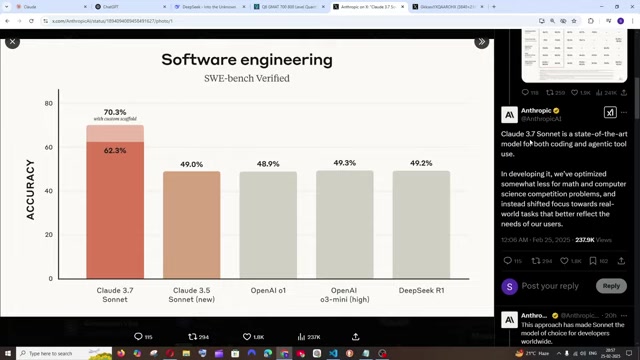
The company provides a chart showcasing Software Engineering (SWE) benchmark results, where Claude 3.7 Sonnet achieved a 62.3% accuracy, significantly outperforming other models. OpenAI's offerings, including O1 and O3-mini, hover around 49%, while DeepSeek R1 mirrors that performance. These numbers suggest a marked advantage for Claude 3.7 in handling complex software engineering challenges. This analysis seeks to validate or challenge these claims by subjecting Claude 3.7 Sonnet, OpenAI’s O3 mini, and DeepSeek’s R1 to a series of tests. This comparison will help determine if Claude 3.7 Sonnet lives up to the hype or if other models hold their own under pressure.
Setting the Stage: Testing Methodology
The testing methodology is designed to cover a diverse set of problems. These include:
- Word-based math problems demanding logical reasoning and analytical skills. This will test the AI models' ability to convert wordy statements into mathematical expressions.
- LeetCode hard problems assessing the AI models' capabilities in tackling complex algorithmic and data structure challenges.
- Real-world programming tasks, particularly HTML, CSS, and Javascript animation code generation, to evaluate the practical coding skills of these models.
For each challenge, the performance is evaluated based on the accuracy of the generated solution, the response time of the AI model, and how well the response adheres to the original Prompt. Each AI was tested using a limited free plan, and the thinking mode is set to Normal for Claude 3.7 to create a fair testing enviroment. OpenAI is activated to Reasoning mode to enable the O3 mini model and DeepSeek R1 is set to deepthink mode.
The Math Problem Showdown: Claude 3.7 vs. The Competition
The first challenge involves a GMAT-style WORD problem focusing on rates, work, and time.
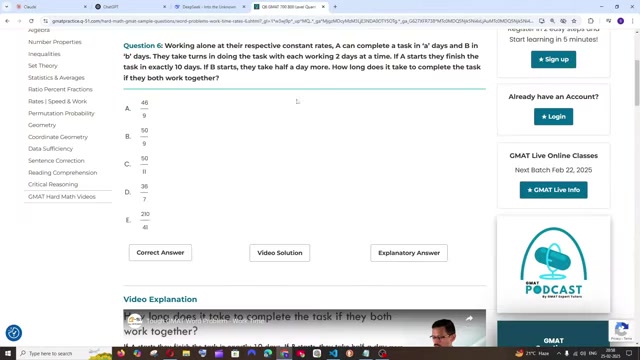
The problem statement requires understanding of variables, rates, and combined efforts, demanding the model to Translate information effectively.
The question reads:
Working alone at their respective constant rates, A can complete a task in 'a' days and B in 'b' days. They take turns in doing the task with each working 2 days at a time. If A starts they finish the task in exactly 10 days. If B starts, they take half a day more. How long does it take to complete the task if they both work together?
The correct answer is 36/7 days. Interestingly, all AI models managed to get the solution right, but the time it took each one to arrive at the solution varied greatly. Claude 3.7 responded almost immediately, showcasing remarkable speed. OpenAI's O3 Mini took 39 seconds, while DeepSeek R1 took nearly 2 minutes. This result suggests Claude 3.7 is particularly adept at rapid problem assessment and deployment of a mathematical model. The speed can be a Game-changer in time sensitive applications. Even with the models arriving at the correct conclusion, speed is a critical factor to consider.
Code Generation Face-Off: The Bouncing Ball Challenge
Next in line was a code-generation challenge requiring the AI models to produce HTML, CSS, and JavaScript code for a ball bouncing inside a spinning rectangle. The prompt emphasized gravity, friction, and realistic behavior.
All models generated code, but, OpenAI’s O3 mini performed the best and generated the best code out of all. For a detailed comparison of the generated code, see the table below:
| Model | Code Accuracy | Physics Implementation | Performance | Additional Notes |
|---|---|---|---|---|
| Claude 3.7 Sonnet | Good | Basic | Adequate | Created a controller interface to adjust physics parameters. |
| OpenAI O3 Mini | Excellent | Realistic | Excellent | Good |
| DeepSeek R1 | Poor | Basic | Poor | Not good enough for generating animation. |
The speed of Claude 3.7 again stood out, providing results faster than OpenAI and DeepSeek.
This advantage was in speed, not necessarily accuracy. O3 Mini performed with much better performance than Claude 3.7.
A Closer Look at Code Quality and Customization
The Unexpected UI: Claude 3.7's Unique Interpretation
Claude 3.7's take on the bouncing ball task was particularly interesting because it automatically provided an interactive UI with controls for gravity, friction, elasticity, and rotation speed.
It’s important to note that the original prompt did not request such a feature. It is a testament to its analytical capabilities. This suggests Claude 3.7 may incorporate a level of creativity, or at least a proactive approach. These aspects offer enhanced user control and real-time manipulation of these parameters. It's the out-of-the-box approach that sets Claude 3.7 apart from the other models.
While DeepSeek R1 generated rain animation, it looked more like white lines falling on a black background and was not impressive. This demonstrates the potential performance variations, emphasizing that not all models are equally effective in different scenarios.
LeetCode Hard Problem: A Battle of Algorithmic Acumen
To evaluate the models' abilities to solve intricate algorithmic problems, they were tasked with the LeetCode's “Longest Valid Parentheses” challenge. Claude 3.7 produced a solution that outperformed in runtime as well as memory compared to other users. These scores highlight the optimization and efficiency Claude 3.7 brings to complex coding tasks. On the other hand, OpenAI’s O3 Mini only beat 25% in runtime. Even the DeepSeek R1 could not complete this task.
Here are some factors that can be attributed to this:
- Efficient Algorithms: Claude 3.7 used optimized dynamic programming techniques, leading to the better results in the test.
- Resource Management: Due to efficiency, Claude 3.7 is able to utilize and allocate fewer resources than the competition. This leads to superior runtimes and memory usage.
By evaluating such problems, users can decide whether they will use Claude 3.7 Sonnet for real-world application.




Most people like

































Report
Please select a reason for reporting
- 13 Reasons to Switch from Snapchat to Text Messaging
- 7 Powerful Speech to Text Apps to Boost Productivity
- 10 Best Speech to Text Tools for Effortless Transcription
- 13 Free Tools to Easily Transcribe Audio to Text
- 15 Surprising Ways Google's Speech-to-Text Boosts Productivity
- 7 Best Free Online Audio to Text Transcription Tools
- 9 Tips to Transcribe Speech to Text Faster and Better
- 13 Best Speech to Text Software for Windows 10 in 2023
- 7 Tips for Choosing the Best Transcriber for Audio to Text
- 11 Reasons Why Dragon Speech-to-Text Apps are Game-Changers
- 6 Secrets to Enhance Your Speech to Text Transcription
- 6 Brilliant Ways to Boost Productivity with Talk-to-Text on Your MacBook
- 6 Ways Transcription Software Converts Audio to Text
- 8 Tips to Transcribe Speech to Text Like a Pro
- 6 Reasons IBM Watson Speech to Text is a Game-Changer
- 14 Powerful Ways Talk-to-Text Improves Your Workflow
- 12 Top Windows Speech-to-Text Software for Efficient Transcription
- 12 Game-Changing Benefits of Apple's Speech to Text Technology
- 9 Powerful Use Cases for AWS Speech to Text Technology
- 10 Easy Steps to Transcribe YouTube Videos to Text
- transcription audio en texte
- online audio transcription
- free audio file transcription
- free ai audio transcription
- audio transcription service
- audio transcription online free
- audio transcription free online
- audio to transcription software
- audio and transcript
- ai audio transcription free
- voice recording to text converter
- translate voice recording to text
- record voice to text
- audio recording to text converter
- voice recording and transcription
- chatgpt voice to text
- gmail voice to text
- speech to text reader
- speech to text ai free
- speech to talk
- Meshy AI: How to Create 3D Models from Text and Images
- How SEO and Marketing Dashboards Empower Agencies to Drive Results
- How to Use AI Tools to Find Internal Linking Opportunities Across a Business Website
- Discover Your Perfect Haircut with AI Hairstyle Apps
- Free Reputation Calculator Tools: How They're Adapting to Score AI Visibility, Not Just Rankings
- Design Professional Flyers for Free on Your Phone
- Best Free Flyer Maker Apps for Android: Design Like a Pro
- How to Know If Your Business Is Ready for an AI Customer Service Agent
- Revolutionizing Storytelling: From Novels to Screenplays with AI
- Create Engaging Animated Explainer Videos with a Free AI Tool
- Meshy AI: How to Create 3D Models from Text and Images
- ASOMobile Helps Teams Benchmark App Store Screenshots Against Competitors
- How to Match LMS Software With Your Organization's Training Plan
- Revolutionizing Email Marketing Agency with AI
- How to Convert BTC to HNT
- Unleashing the Power of AI: Cognizant's Roadmap for Transformation
- Frame to Video Review: A Practical Look at Turning Two Still Frames Into Motion
- NVIDIA NIM: Revolutionizing Supply Chain Data Analysis with AI
- Top AI Tools That Help Brands Stand Out Offline (Not Just Online)
- Top 5 Cold Email Software: Maximize Your Outreach in 2025

Copyright ©2026 toolify