































Table of Contents
- Key Points
- CLIP Image Captioning: A Deep Dive
- Navigating CLIP's Nuances
- The Pros and Cons of the CLIP Image Captioning
- Frequently Asked Questions about CLIP and Image Captioning
- Related Questions About CLIP Image Captioning



CLIP Image Captioning: A Deep Dive
Understanding CLIP and Image Captioning
Image captioning, at its core, is about bridging the gap between visual data and human language. Imagine showing a picture to a computer and having it describe what it sees. This is precisely what image captioning aims to achieve.

The model that many are using is called CLIP, or Contrastive Language-Image Pre-training, which does not require labels to help create useful descriptions.
How Does CLIP Work?
CLIP functions using a contrastive learning approach, trained on a massive dataset of image-text pairs. This dataset allows the model to learn associations between visual elements and their corresponding textual descriptions. In essence, CLIP seeks to maximize the similarity between the embeddings of matching images and text, while minimizing the similarity between embeddings of non-matching pairs. This contrastive objective enables CLIP to understand and relate images to a broad range of textual concepts. The ultimate goal is for the model to learn visual concepts, helping interpret images with more understanding, even without explicitly labeled data. It is important to note that this model does not label the images, it understands what the image is.
Image Captioning: More Than Just Describing Pictures
While the primary goal of image captioning is to generate descriptions, its applications extend far beyond simple image labeling. Image captioning is used in a variety of areas:
- Accessibility: Providing descriptions for visually impaired users, making visual content more accessible.
- Search Engines: Improving image search by allowing users to search using textual queries, rather than relying solely on tags or filenames.
- Robotics: Helping robots understand their environment and interact with it more effectively.
- Content Creation: Assisting writers and marketers in generating engaging Captions for social media or blog posts.
As artificial intelligence capabilities continue to advance, image captioning is poised to become even more sophisticated and pervasive, finding new applications across many other industries and areas.
Experimenting with CLIP: Student's Learning Review
To gain a practical understanding of CLIP's capabilities, students embarked on image captioning experiments. The challenge involved sharing 10 images and generating at least three captions for each, and then share their experience
.
Iteration Is Key
As some students have noticed, the initial captions generated by the CLIP model were not always accurate or relevant. One student noted that in the early iterations, it looked like the 'machine doesn't know anything about it.' Through repeated iterations, the model gradually refines its understanding and generates more Relevant and descriptive captions.
CLIP's ability to identify Architectural Styles
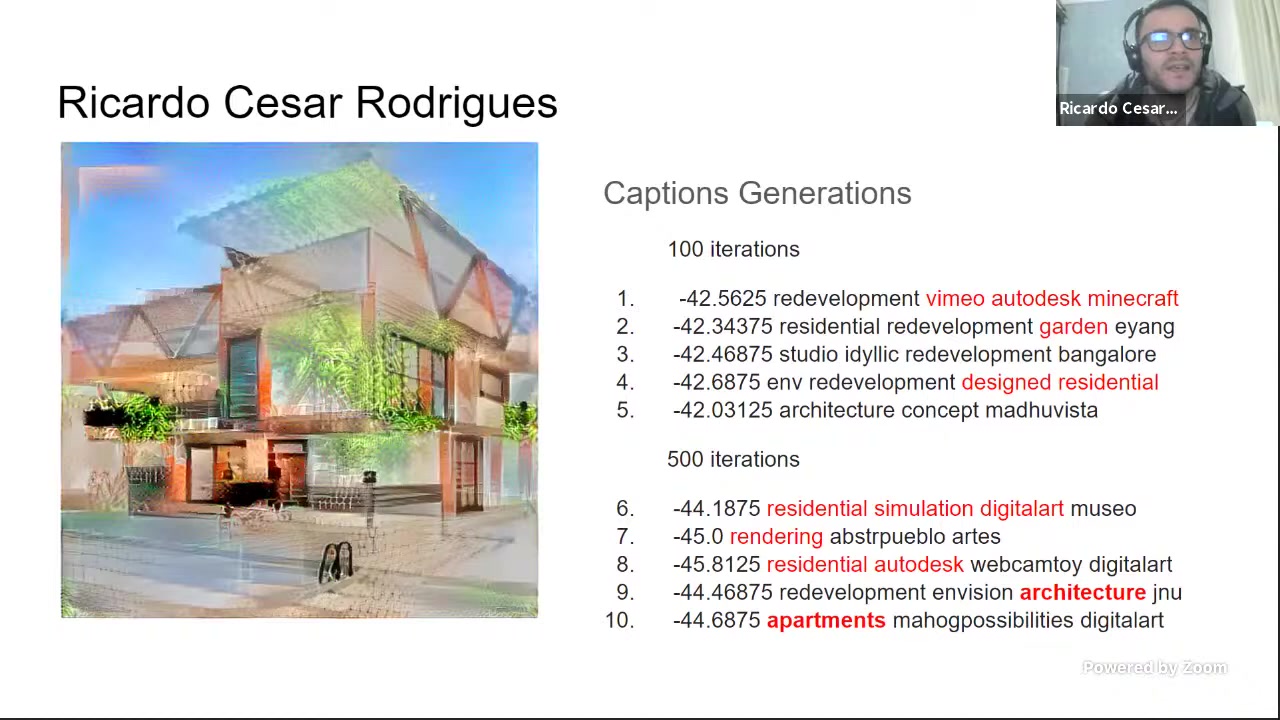
The image was of the type of the building or building interior was a topic that came up in several students' reports. CLIP demonstrates an impressive ability to discern architectural styles and elements. For example, when presented with a photo of a unique building structure, it generated captions like "architecture beirut concrete chateau," revealing its understanding of architectural components .
Another instance highlighted the model's precision in identifying a staircase with captions like "newcastle nordstrom staircase spiral.” This demonstrated the AI's capacity to even search examples with accuracy.
In addition, CLIP demonstrated its ability to identify a house, like the "Bali modernist house" was another example from the projects.
CLIP Recognizes Art and its Relation to Other Domains
Some experiments revealed CLIP's impressive ability to connect images to seemingly unrelated domains. As seen in one image Caption generation it started with ‘Vimeo autodesk minecraft garden’ it was relating to designs. A style-transferred image of a building was interpreted as having "terraccota palace reflecting digitalart." This connection showcases CLIP's ability to go beyond simple object recognition and associate images with abstract concepts and artistic styles. It understood that the image was a rendering or digital artwork. In addition to knowing the art, it Mentioned rendering as well! [t: 240]
To highlight the model's awareness, it identifies ‘Zaha’ building in the generated descriptions. [t: 56] While the model is not always correct it does seem to have some degree of ability to discern details and styles. This highlights a very important point. As more models get access to more information, they can take these details from the internet. This requires us to be vigilant in our labeling and tracking of data as it has the ability to perpetuate harmful stereotypes.
Students testing CLIP discovered very diverse results. To help summarize what was tested, here is a table outlining the types of projects:
| Type | Details |
|---|---|
| Architecture | CLIP identifies architectural styles and building components. Demonstrates an understanding of design concepts. |
| Style Transfer | Associates images with abstract concepts and artistic styles. Identifies the use of specific software like Autodesk and rendering. |
| Image | Recognizes key elements, relates objects, and generates related keywords |
Navigating CLIP's Nuances
The Intersection of Image Captioning and Data Bias
It's important to acknowledge the potential for bias in AI models like CLIP. The model's understanding of the world is derived from the data it is trained on, and if that data reflects existing societal biases, the model may perpetuate them. This is the main reason that CLIP recognized Brazilian houses with some Balinese relation from datasets!
One could help the model become less biased by making sure a diverse dataset is being fed to the model to train it.
For instance, the model also mentioned Zionism! Although a religious term, it has several negative and inappropriate overtones, depending on the Scenario. As researchers, we need to be careful when it comes to using particular models.
Therefore, it's crucial to be mindful of potential biases and to critically evaluate the captions generated by AI models. While image captioning offers incredible potential, we must remain aware of its limitations and potential pitfalls. If it is not fed correct information or has data biases, it is important to ensure its correct behavior in the product or area it is deployed.
The AI Black Box: Understanding Model Interpretability
The inner workings of complex AI models can often seem like a 'black box'. While we can observe the inputs and outputs, understanding exactly why the model generates a particular caption can be challenging. This lack of interpretability raises concerns about accountability and trustworthiness.
However, some researchers argue that these models are not entirely black boxes. By using various techniques, such as visualizing feature maps or analyzing attention mechanisms, we can gain some insight into how the model is processing information. More research on explainable AI is required, the current understanding is that there can be an understanding of how they work. [t: 300]
Improving model interpretability is crucial for building trust and ensuring that AI systems are used responsibly. For example, if you can see the data that the model is pulling from, or know which area of the model to avoid for some reason, the product is ultimately better. By carefully examining what kind of information goes in and which area is giving information out we can better determine if we are creating a fair model.






Most people like





































Report
Please select a reason for reporting
- 13 Reasons to Switch from Snapchat to Text Messaging
- 7 Powerful Speech to Text Apps to Boost Productivity
- 10 Best Speech to Text Tools for Effortless Transcription
- 13 Free Tools to Easily Transcribe Audio to Text
- 15 Surprising Ways Google's Speech-to-Text Boosts Productivity
- 7 Best Free Online Audio to Text Transcription Tools
- 9 Tips to Transcribe Speech to Text Faster and Better
- 13 Best Speech to Text Software for Windows 10 in 2023
- 7 Tips for Choosing the Best Transcriber for Audio to Text
- 11 Reasons Why Dragon Speech-to-Text Apps are Game-Changers
- 6 Secrets to Enhance Your Speech to Text Transcription
- 6 Brilliant Ways to Boost Productivity with Talk-to-Text on Your MacBook
- 6 Ways Transcription Software Converts Audio to Text
- 8 Tips to Transcribe Speech to Text Like a Pro
- 6 Reasons IBM Watson Speech to Text is a Game-Changer
- 14 Powerful Ways Talk-to-Text Improves Your Workflow
- 12 Top Windows Speech-to-Text Software for Efficient Transcription
- 12 Game-Changing Benefits of Apple's Speech to Text Technology
- 9 Powerful Use Cases for AWS Speech to Text Technology
- 10 Easy Steps to Transcribe YouTube Videos to Text
- transcription audio en texte
- online audio transcription
- free audio file transcription
- free ai audio transcription
- audio transcription service
- audio transcription online free
- audio transcription free online
- audio to transcription software
- audio and transcript
- ai audio transcription free
- voice recording to text converter
- translate voice recording to text
- record voice to text
- audio recording to text converter
- voice recording and transcription
- chatgpt voice to text
- gmail voice to text
- speech to text reader
- speech to text ai free
- speech to talk
- How SEO and Marketing Dashboards Empower Agencies to Drive Results
- How to Use AI Tools to Find Internal Linking Opportunities Across a Business Website
- Discover Your Perfect Haircut with AI Hairstyle Apps
- Free Reputation Calculator Tools: How They're Adapting to Score AI Visibility, Not Just Rankings
- Design Professional Flyers for Free on Your Phone
- Best Free Flyer Maker Apps for Android: Design Like a Pro
- How to Know If Your Business Is Ready for an AI Customer Service Agent
- Revolutionizing Storytelling: From Novels to Screenplays with AI
- Create Engaging Animated Explainer Videos with a Free AI Tool
- Stop Multi-Subscribing: Benchmark Top AI Visual Models in One Canvas
- AI & Elections: Defending Democracy Against Misinformation
- Navigating Political Discourse: AI, Deepfakes, and Reality Checks
- Detecting Political Bias in News Articles: A Powerful AI Algorithm
- AI Bias Unveiled: Political Leanings in ChatGPT & Beyond
- Revolutionize Learning: Discover Quizzes AI for Engaging Interactive Quizzes
- From AI-Generated to Audience-Ready: How Quillbot Humanize AI Is Changing the Content Editing Process
- Building an AI Writing Stack in 2026: LLMs, Detectors, and Humanizers
- 7 Top AI-Powered Database Assistant Platforms
- An Objective Look at Modern Web-Based Visual Modifications
- My Honest Experience with VideoAI: The Secret Weapon for Creators Who Need Character Voices

Copyright ©2026 toolify