































Table of Contents
- Key Points
- Understanding the Challenging Cliffs Problem
- Developing a Strategic Algorithmic Approach
- Optimizing for Uphill Difficulty
- Pros and Cons of the Approach
- Frequently Asked Questions
- Advanced Considerations and Related Questions


Understanding the Challenging Cliffs Problem
Problem Statement and Objectives
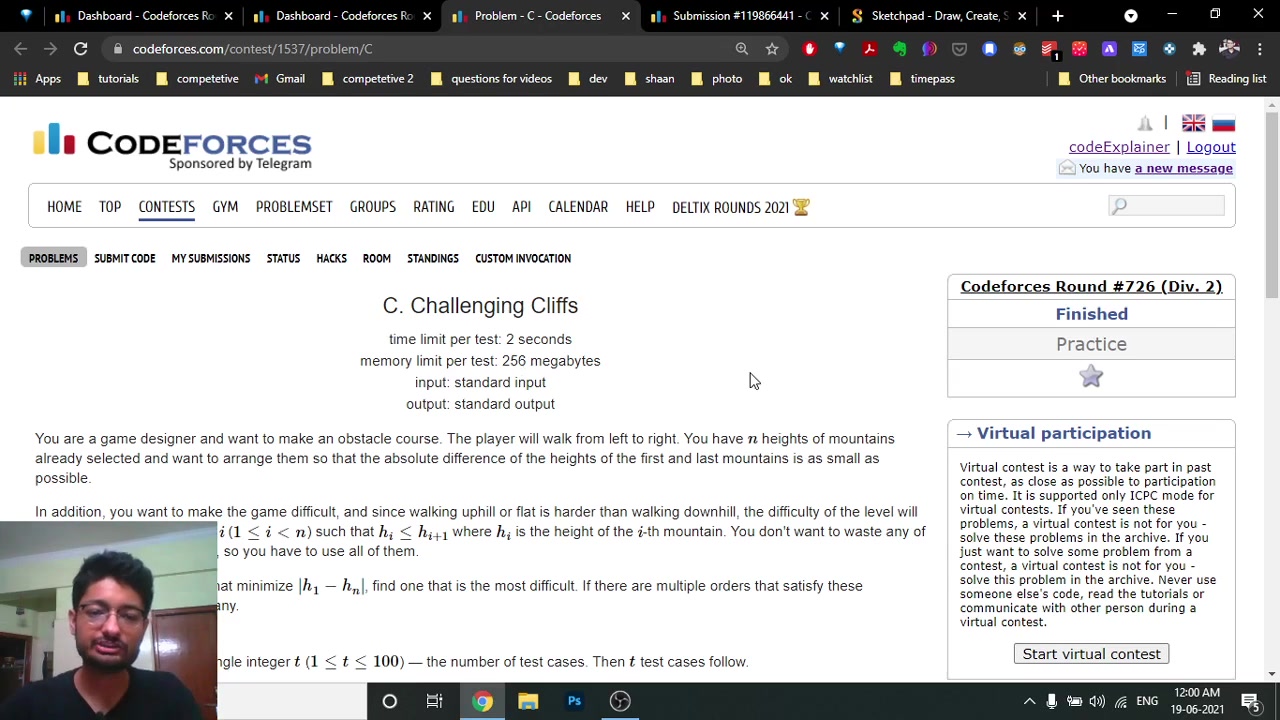
The 'Challenging Cliffs' problem presents you with a set of mountains (or cliffs), each having a specific height. The task is to arrange these mountains in a sequence such that two primary objectives are met. The first objective is to minimize the absolute height difference between the first and last mountain in your arrangement. The second, and arguably more nuanced objective, centers around the concept of uphill difficulty in an obstacle Course.
Defining Uphill Difficulty: Walking uphill is considered more difficult than walking downhill or on a flat surface. Thus, the challenge lies in maximizing the instances where a mountain is followed by a taller mountain (an 'uphill' move). This adds a strategic dimension; you must not only minimize the height difference between the start and end but also arrange the intermediate mountains to make the course as challenging as possible. The problem implies that the game's difficulty is tied to the number of uphill moves.
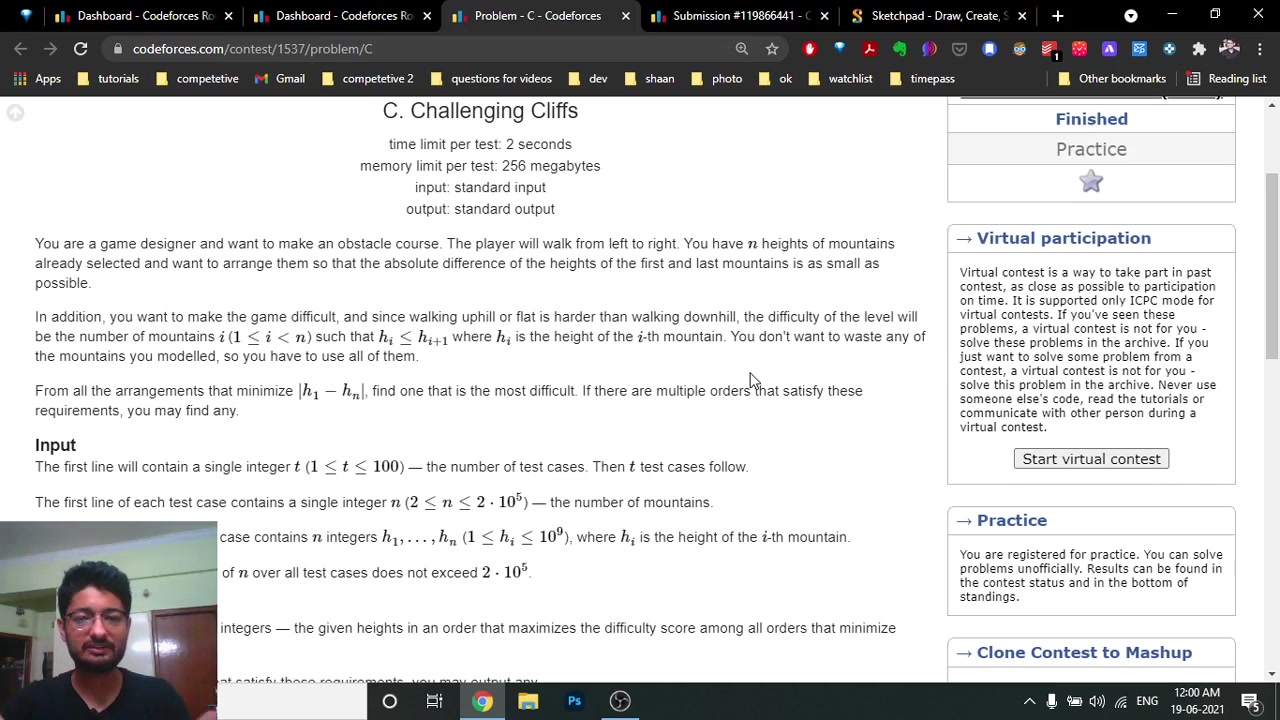
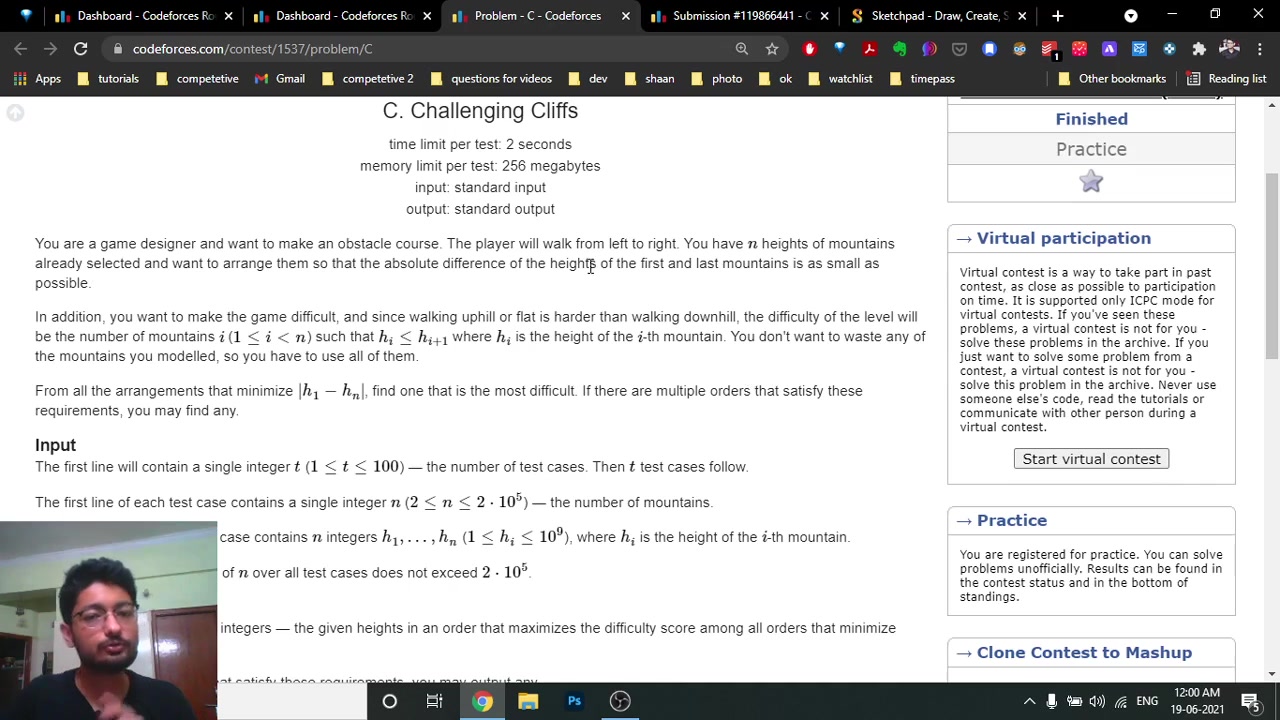
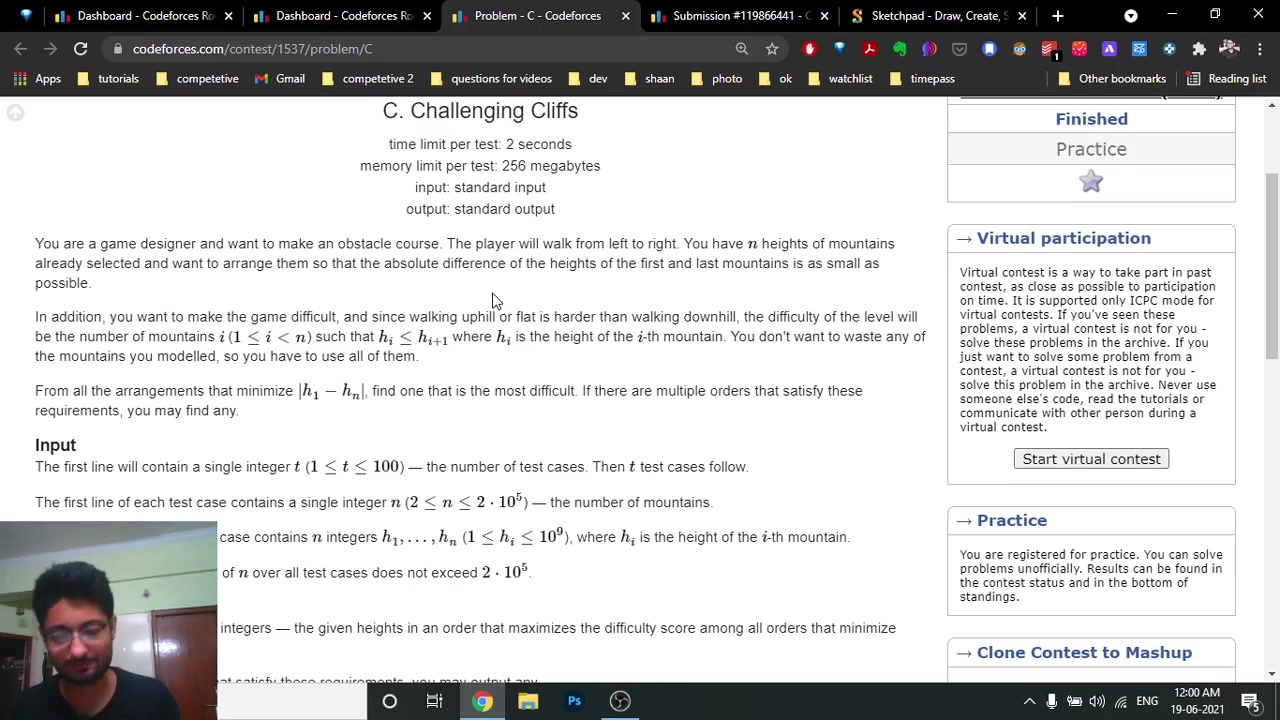
Constraints and Considerations: You have 'n' mountains, each having a height denoted as 'h_i'. The goal is to find an arrangement that maximizes the number of times 'h_i+1' > 'h_i'. This implicitly means downhill moves (where 'h_i+1' < 'h_i') are less desirable. In situations where multiple arrangements satisfy the minimal height difference condition, you must find the one that maximizes uphill moves. This makes it a multi-objective optimization problem. To make an obstacle course. Walking uphill or flat is harder to walk downhill, so you want to maximize the number of uphills, however, the absolute difference of the first and last mountains need to be as small as possible.
Core Concepts: Sorting and Optimization
The solution to the 'Challenging Cliffs' problem hinges on several core concepts.
1. Sorting: The heights of the mountains need to be sorted as a preliminary step. Sorting allows you to quickly identify mountains with minimal height differences and arrange them in ascending order. While sorting alone won't solve the problem, it organizes the data for further strategic manipulation.
2. Identifying Minimal Height Differences: The problem's primary objective is to minimize the height difference between the first and last mountain. This implies searching for two mountains within the sorted array that are adjacent or have a height difference that is the smallest among all pairs.
3. Maximizing Uphill Moves: Uphill moves contribute to the difficulty score of the arrangement. Given mountains of varying heights, arranging them strategically to maximize uphill transitions is crucial. This aspect introduces a combinatorial element, as different arrangements can drastically change the number of uphill moves.
4. Balancing Multiple Objectives: The core challenge lies in balancing these two objectives. You need to find an arrangement that satisfies both conditions, with prioritization given to minimizing the height difference. This often involves backtracking or greedy strategies.
5. Edge Case Handling: Certain edge cases, such as mountains with identical heights or small input sizes, can significantly impact the solution. Handling these requires careful consideration and potentially adding extra checks within your algorithm.
Developing a Strategic Algorithmic Approach
Pseudocode and Strategic Considerations
Before diving into the C++ code, let's outline a strategic approach using pseudocode.
1. Input mountain heights (h1, h2, ..., hn)
2. Sort the heights in ascending order
3. Find two adjacent mountains (h[i], h[i+1]) with the smallest height difference
4. Let h[i] be the 'start_mountain' and h[i+1] be the 'end_mountain'
5. Arrange remaining mountains in a way that maximizes uphill moves:
   - Divide the remaining mountains into two groups: smaller and larger than 'start_mountain'
   - Sort each group
   - Arrange the mountains such that uphill moves are maximized with start and end mountains at appropriate location
6. If multiple arrangements satisfy the condition, choose the one with more uphill moves
7. Output the final arrangement
Strategic Considerations:
- Greedy vs. Exhaustive: Exhaustive searching (trying all possible permutations) can be computationally expensive for larger inputs. A greedy approach, which focuses on locally optimal choices, is more practical.
- Prioritization: Minimizing the height difference is the primary goal. In cases where height differences are tied, maximizing uphill moves acts as a tie-breaker. To clarify, the absolute difference between the height of the first and the last building needs to be minimized. After doing that, we want to maximize the uphills.
Code Implementation: C++
Now, let's convert our strategy into a C++ implementation.
#include <iostream>
#include <vector>
#include <algorithm>
#include <cmath>

using namespace std;

int main() {
    int n;
    cin >> n;

    vector<int> heights(n);
    for (int i = 0; i < n; ++i) {
        cin >> heights[i];
    }

    sort(heights.begin(), heights.end());

    int min_diff = INT_MAX;
    int start_index = -1;

    // Find the smallest height difference and its starting index
    for (int i = 0; i < n - 1; ++i) {
        int diff = abs(heights[i] - heights[i + 1]);
        if (diff < min_diff) {
            min_diff = diff;
            start_index = i;
        }
    }

    // Arrange mountains based on smallest diff
    cout << heights[start_index] << " ";

    // Print elements after the starting index
    for (int i = start_index + 2; i < n; ++i) {
        cout << heights[i] << " ";
    }

    // Print elements before the starting index
    for (int i = 0; i < start_index; ++i) {
        cout << heights[i] << " ";
    }
    cout << heights[start_index + 1] << endl;

    return 0;
}Explanation:
- Input: The code takes the number of mountains 'n' and their respective heights as input.
- Sorting: The heights are sorted in ascending order using
std::sort. - Minimum Difference: The code iterates through the sorted array to find the smallest height difference between adjacent mountains.
-
Arrangement: The elements will be arranged in such a way that, it causes a height drop of 1 which would make the Game very difficult to play.
Moving Uphill is the difficult part in the game. To minimize this we need to have the biggest difference at the front and end of an array of sorted numbers.





Most people like































Report
Please select a reason for reporting
- 13 Reasons to Switch from Snapchat to Text Messaging
- 7 Powerful Speech to Text Apps to Boost Productivity
- 10 Best Speech to Text Tools for Effortless Transcription
- 13 Free Tools to Easily Transcribe Audio to Text
- 15 Surprising Ways Google's Speech-to-Text Boosts Productivity
- 7 Best Free Online Audio to Text Transcription Tools
- 9 Tips to Transcribe Speech to Text Faster and Better
- 13 Best Speech to Text Software for Windows 10 in 2023
- 7 Tips for Choosing the Best Transcriber for Audio to Text
- 11 Reasons Why Dragon Speech-to-Text Apps are Game-Changers
- 6 Secrets to Enhance Your Speech to Text Transcription
- 6 Brilliant Ways to Boost Productivity with Talk-to-Text on Your MacBook
- 6 Ways Transcription Software Converts Audio to Text
- 8 Tips to Transcribe Speech to Text Like a Pro
- 6 Reasons IBM Watson Speech to Text is a Game-Changer
- 14 Powerful Ways Talk-to-Text Improves Your Workflow
- 12 Top Windows Speech-to-Text Software for Efficient Transcription
- 12 Game-Changing Benefits of Apple's Speech to Text Technology
- 9 Powerful Use Cases for AWS Speech to Text Technology
- 10 Easy Steps to Transcribe YouTube Videos to Text
- transcription audio en texte
- online audio transcription
- free audio file transcription
- free ai audio transcription
- audio transcription service
- audio transcription online free
- audio transcription free online
- audio to transcription software
- audio and transcript
- ai audio transcription free
- voice recording to text converter
- translate voice recording to text
- record voice to text
- audio recording to text converter
- voice recording and transcription
- chatgpt voice to text
- gmail voice to text
- speech to text reader
- speech to text ai free
- speech to talk
- Revolutionizing Storytelling: From Novels to Screenplays with AI
- Create Engaging Animated Explainer Videos with a Free AI Tool
- Stop Multi-Subscribing: Benchmark Top AI Visual Models in One Canvas
- Best Seedance 2.5 API Provider: Every Price on the Market, Checked at Source
- AI OnlyFans: How to Generate $30,000/Month (Legally)
- Transform Your Script into an Engaging Video with AI Video Maker!
- AI Marketing Automation: A Comprehensive Guide for Small Businesses
- Midjourney Alternative for Anime Art Creators: Why PixAI May Be Better for Character Workflows
- 10 Things Most People Get Wrong About AI Image Search
- AI Girlfriend Apps: Top Choices Redefining Relationships 2025
- Top 4 AI Platforms to Extend Video: The Ultimate Comparison for Creators
- Top 8 Best AI Image Editor Tools for Creative Professionals in 2026
- Experience the Future of Virtual Assistants with F.R.I.D.A.Y. AI
- Learn How to Train an AI to Play Snake with Reinforcement Learning
- Creating a Unique AI Game Environment with Pygame
- Mastering the Classic Java Snake Game
- Discover the Power of Codex: Snake Game Created in Python
- Building an AI to Master Snake Game
- Revolutionize the Classic Snake Game with AI
- Websim AI: Create Games and Apps with Just a Few Prompts

Copyright ©2026 toolify