

























Table of Contents
- Key Points
- Understanding FOL to CNF Conversion
- Real-World Application: Knowledge Representation in AI
- Step-by-Step Guide to Converting FOL to CNF
- Pros and Cons of FOL to CNF Conversion
- Frequently Asked Questions (FAQ)
- Related Questions



Understanding FOL to CNF Conversion
What is First-Order Logic (FOL)?
First-Order Logic (FOL), also known as predicate logic, is a formal system used in mathematics, philosophy, linguistics, and computer science to represent quantified statements more accurately than propositional logic. FOL extends propositional logic by adding quantifiers and predicates, allowing for more expressive and detailed knowledge representation.
Key Components of FOL:
- Objects: Entities in the domain of discourse.
- Predicates: Properties of objects or relationships between objects.
- Functions: Mappings from objects to objects.
- Variables: Symbols that represent objects.
- Quantifiers: Symbols that specify the quantity of objects satisfying a given predicate. Two main quantifiers exist:
- Universal Quantifier (∀): “For all” – indicates that a statement is true for all objects in the domain.
- Existential Quantifier (∃): “There exists” – indicates that a statement is true for at least one object in the domain.
FOL is used extensively in AI for knowledge representation, reasoning, and automated theorem proving, enabling systems to handle more complex and nuanced information than propositional logic allows.
Common Applications of FOL in AI:
- Knowledge Representation: Representing facts and rules about the world.
- Automated Reasoning: Deriving new conclusions from existing knowledge.
- Natural Language Processing: Understanding and generating human language.
- Database Systems: Querying and managing complex data.
Understanding the fundamentals of FOL is critical for any AI practitioner or student looking to delve deeper into advanced reasoning and knowledge representation techniques.
What is Conjunctive Normal Form (CNF)?
Conjunctive Normal Form (CNF) is a standardized format for representing logical formulas. It is particularly important in automated theorem proving and various AI applications.

CNF is a conjunction (AND) of clauses, where each clause is a disjunction (OR) of literals. A literal is either a variable or its negation.
Key Characteristics of CNF:
- Conjunction of Clauses: A CNF formula consists of multiple clauses combined with AND operators (∧).
- Disjunction of Literals: Each clause is a combination of literals connected by OR operators (∨).
- Literals: A literal is either a variable or the negation of a variable.
Converting logical formulas into CNF simplifies the implementation of resolution algorithms and makes reasoning processes more efficient. CNF allows for a systematic approach to automated theorem proving, making it easier to determine the validity of logical statements.
Why is CNF Important in AI?
- Simplification of Logical Formulas: CNF standardizes complex logical expressions, making them easier to process.
- Efficient Automated Reasoning: Facilitates the implementation of resolution algorithms.
- Standardization for AI Systems: Provides a uniform format for AI systems that perform logical reasoning.
- Automated Theorem Proving: Simplifies the process of verifying the validity of logical statements.
Step-by-Step Guide to Converting FOL to CNF
Step 1: Eliminate Implications
Implications must be removed first to simplify the expression.
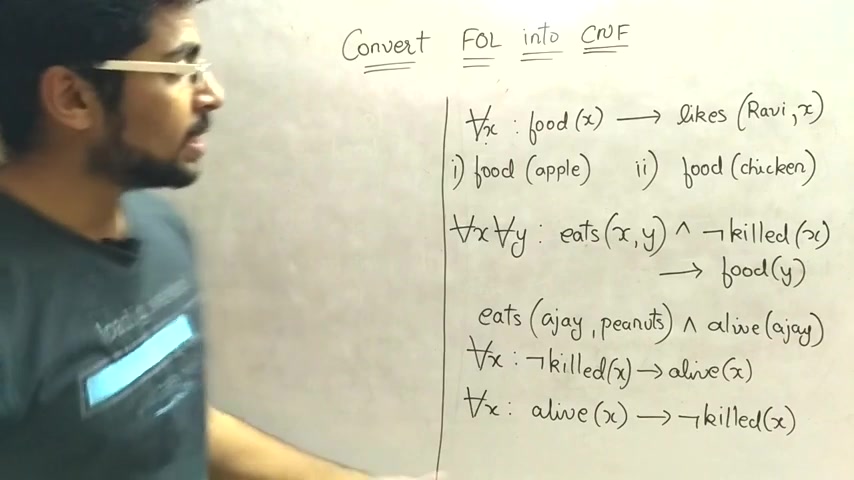
Convert expressions of the form A → B into ¬A ∨ B.
Example:
∀x: food(x) → likes(Ravi, x)
Becomes:
∀x: ¬food(x) ∨ likes(Ravi, x)
Step 2: Reduce the Scope of Negations
Apply DeMorgan’s Laws to move negations inward. This involves converting ¬(A ∨ B) into (¬A ∧ ¬B) and ¬(A ∧ B) into (¬A ∨ ¬B).
Example:
¬(eats(x, y) ∧ ¬killed(x))
Becomes:
(¬eats(x, y) ∨ killed(x))
Step 3: Standardize Variables
Ensure that each quantifier binds a unique variable. If multiple quantifiers use the same variable name, rename them to avoid confusion.
Example:
∀x ∃x food(x) → likes(Ravi, x)
Becomes:
∀x ∃y food(x) → likes(Ravi, y)
Step 4: Remove Existential Quantifiers
Use Skolemization to eliminate Existential quantifiers. Replace existentially quantified variables with Skolem functions or constants.
Example:
∃x: alive(x)
Becomes:
alive(A) (where A is a Skolem constant)
Step 5: Drop Universal Quantifiers
Remove all universal quantifiers. At this stage, all variables are implicitly Universally quantified, so the quantifiers can be dropped.
Example:
∀x: ¬killed(x) ∨ alive(x)
Becomes:
¬killed(x) ∨ alive(x)
Step 6: Distribute AND over OR
Apply the distributive law to convert the expression into CNF. Convert expressions of the form A ∨ (B ∧ C) into (A ∨ B) ∧ (A ∨ C).
Example:
(¬eats(x, y) ∨ (killed(x) ∧ food(y)))
Becomes:
(¬eats(x, y) ∨ killed(x)) ∧ (¬eats(x, y) ∨ food(y))
Step 7: Flatten Nesting
Remove any nesting in the expression
Example:
(((Killed(x)) ∨ (alive(x)))
Becomes:
(Killed(x)) ∨ (alive(x))


Most people like




































Report
Please select a reason for reporting
- 13 Reasons to Switch from Snapchat to Text Messaging
- 7 Powerful Speech to Text Apps to Boost Productivity
- 10 Best Speech to Text Tools for Effortless Transcription
- 13 Free Tools to Easily Transcribe Audio to Text
- 15 Surprising Ways Google's Speech-to-Text Boosts Productivity
- 7 Best Free Online Audio to Text Transcription Tools
- 9 Tips to Transcribe Speech to Text Faster and Better
- 13 Best Speech to Text Software for Windows 10 in 2023
- 7 Tips for Choosing the Best Transcriber for Audio to Text
- 11 Reasons Why Dragon Speech-to-Text Apps are Game-Changers
- 6 Secrets to Enhance Your Speech to Text Transcription
- 6 Brilliant Ways to Boost Productivity with Talk-to-Text on Your MacBook
- 6 Ways Transcription Software Converts Audio to Text
- 8 Tips to Transcribe Speech to Text Like a Pro
- 6 Reasons IBM Watson Speech to Text is a Game-Changer
- 14 Powerful Ways Talk-to-Text Improves Your Workflow
- 12 Top Windows Speech-to-Text Software for Efficient Transcription
- 12 Game-Changing Benefits of Apple's Speech to Text Technology
- 9 Powerful Use Cases for AWS Speech to Text Technology
- 10 Easy Steps to Transcribe YouTube Videos to Text
- transcription audio en texte
- online audio transcription
- free audio file transcription
- free ai audio transcription
- audio transcription service
- audio transcription online free
- audio transcription free online
- audio to transcription software
- audio and transcript
- ai audio transcription free
- voice recording to text converter
- translate voice recording to text
- record voice to text
- audio recording to text converter
- voice recording and transcription
- chatgpt voice to text
- gmail voice to text
- speech to text reader
- speech to text ai free
- speech to talk
- ChatGPT Knows Ford. It Just Doesn't Quote Ford
- Meshy AI: How to Create 3D Models from Text and Images
- How SEO and Marketing Dashboards Empower Agencies to Drive Results
- How to Use AI Tools to Find Internal Linking Opportunities Across a Business Website
- Discover Your Perfect Haircut with AI Hairstyle Apps
- Free Reputation Calculator Tools: How They're Adapting to Score AI Visibility, Not Just Rankings
- Design Professional Flyers for Free on Your Phone
- Best Free Flyer Maker Apps for Android: Design Like a Pro
- How to Know If Your Business Is Ready for an AI Customer Service Agent
- Revolutionizing Storytelling: From Novels to Screenplays with AI
- ProxyWing DuckDuckGo Proxy Review: Plans, Setup and Who It Is For
- ChatGPT Knows Ford. It Just Doesn't Quote Ford
- Automate Lead Generation: A Comprehensive Guide with AI Agents
- Revideo.io: The Future of Reverse Video Search Technology
- Revolutionizing Email Marketing Agency with AI
- Breaking the Character Drift Dilemma: A Practical Test of Smart Shot
- Meshy AI: How to Create 3D Models from Text and Images
- ASOMobile Helps Teams Benchmark App Store Screenshots Against Competitors
- How to Match LMS Software With Your Organization's Training Plan
- How to Convert BTC to HNT

Copyright ©2026 toolify