































Table of Contents
- Key Points
- Building Your SEO Analyzer
- Understanding the Importance of Keywords
- How to Best Utilize Keywords for SEO
- Benefits and Drawbacks of Creating Your Own Analyzer
- FAQ
- Related Questions



Building Your SEO Analyzer
Setting Up the Environment and Libraries
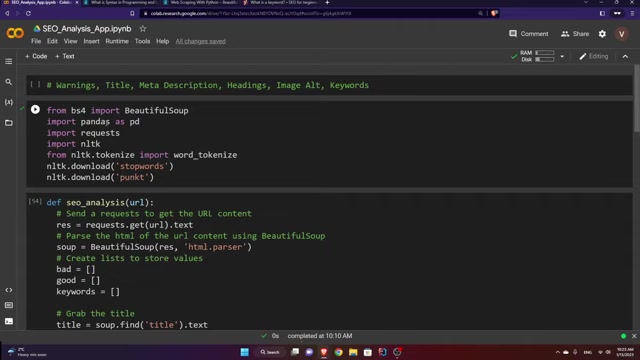
To begin, ensure that you have a Python environment set up. The following libraries are essential for our SEO analyzer. You will need to import the following libraries to get started. These are the libraries you will need:
-
Beautiful Soup (bs4): For parsing HTML content.
-
Pandas: For data manipulation (imported as
pd). -
Requests: To fetch URL content.
-
NLTK: For natural language processing. Be sure to tokenize and import stop words.
If you are using an Integrated Development Environment (IDE) on your local machine, use pip install to ensure all libraries can be properly used.
Defining the SEO Analysis Function
First, we'll create a function called seo_analysis that accepts a URL as a parameter. This function will orchestrate the entire SEO analysis process.
To start, the presenter creates the following function to start analyzing SEO elements.
def seo_analysis(url):
    # Send a request to get the URL content
    res = requests.get(url).text
    # Parse the HTML of the URL content using BeautifulSoup
    soup = BeautifulSoup(res, 'html.parser')
    # Create lists to store values
    bad = []
    good = []
    keywords = []
We're initializing three lists here: bad, good, and keywords. These will help us organize our findings. This is important to measure key metrics.
Grabbing Key Elements from the Webpage
Now let's focus on extracting essential SEO elements. Here's how you can grab the page title, meta description, and headings:
# Grab the title
title = soup.find('title').text
if title:
    good.append(f"Title Exists: {title}")
else:
    bad.append("No Title!")
This code snippet uses Beautiful Soup to find the title tag and appends a message to either the good or bad list, depending on whether a title exists. It is important to grab elements related to key SEO metrics.
# Grab the Meta Description
meta_d = soup.find('meta', attrs={'name': 'description'})['content']
if meta_d:
    good.append(f"Meta Description Exists: {meta_d}")
else:
    bad.append("No Meta Description!")
This focuses on if a meta description exists.
# Grab the Headings
hs = ['h1', 'h2', 'h3']
h_tags = []

for h in soup.find_all(hs):
    good.append(h.name)
    h_tags.append(h.name)

if 'h1' not in h_tags:
    bad.append("No H1 found!")
The h1 tags are scraped and reported on in this code segment.
Analyzing Image Alt Text
Images are important for SEO, and alt text is crucial for accessibility and Search Engine understanding. Use this code snippet to analyze images without alt text:
# Grab the Images without Alt
for i in soup.find_all('img', alt=''):
    bad.append(f"No Alt: {i}")
This code searches for all img tags lacking the alt attribute, which is important for accessibility and SEO. Images without alt text should be improved.
Extracting and Analyzing Keywords with NLTK
Now, let's shift our focus to keyword extraction. NLTK (Natural Language Toolkit) is a powerful library for text processing. First, we grab the body of the text by implementing:
bod = soup.find('body').textTo improve keyword analysis, we need to tokenize the text, remove stop words, and count keyword frequency. Natural Language Tool Kit will help the program more effectively identify keywords.
from nltk.tokenize import word_tokenize
from nltk.corpus import stopwords

#Convert text to words
words = [i.lower() for i in word_tokenize(bod)]

#List of stop words in english
sw = nltk.corpus.stopwords.words('english')
new_words = []

for i in words:
    #Remove Stopwords and characters from
    if i not in sw and i.isalpha():
        new_words.append(i)

freq = nltk.FreqDist(new_words)
freq.most_common(10)
Here is a description of what each command does:
- Converts the text to a lower case, so the program recognizes capitalized words
- Create a list of English stop words
- Removes stop words and characters to analyze the text more effectively
Now it's important to recognize why analyzing keywords is important in SEO
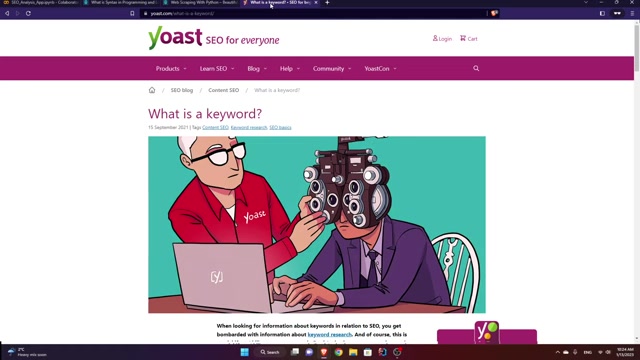
. Keywords help search engines like Google understand what your content is about, allowing them to rank your page accordingly.
Understanding the Importance of Keywords
Defining Keywords
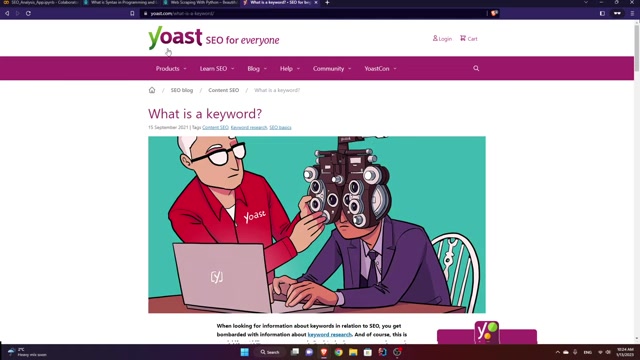
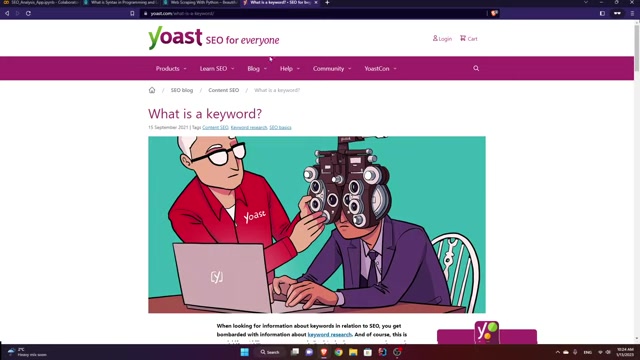
Keywords, or keyphrases, are specific words that define the content on a web page. They are used by search engines to understand what the page is about, and by users when searching for information. It is important to understand what a keyword is to properly use it.
Yoast SEO Plugin’s Keyword Philosophy
Yoast is a commonly used Wordpress plugin for SEO. It can make websites SEO friendly by giving advice on things like use of keywords. Yoast emphasizes that effective keyword usage is more than just sprinkling keywords throughout the content. Instead they propose that they should also be present in the page title, subheadings, introduction, image alt text, meta description and URL slug.








Most people like


































Report
Please select a reason for reporting
- 13 Reasons to Switch from Snapchat to Text Messaging
- 7 Powerful Speech to Text Apps to Boost Productivity
- 10 Best Speech to Text Tools for Effortless Transcription
- 13 Free Tools to Easily Transcribe Audio to Text
- 15 Surprising Ways Google's Speech-to-Text Boosts Productivity
- 7 Best Free Online Audio to Text Transcription Tools
- 9 Tips to Transcribe Speech to Text Faster and Better
- 13 Best Speech to Text Software for Windows 10 in 2023
- 7 Tips for Choosing the Best Transcriber for Audio to Text
- 11 Reasons Why Dragon Speech-to-Text Apps are Game-Changers
- 6 Secrets to Enhance Your Speech to Text Transcription
- 6 Brilliant Ways to Boost Productivity with Talk-to-Text on Your MacBook
- 6 Ways Transcription Software Converts Audio to Text
- 8 Tips to Transcribe Speech to Text Like a Pro
- 6 Reasons IBM Watson Speech to Text is a Game-Changer
- 14 Powerful Ways Talk-to-Text Improves Your Workflow
- 12 Top Windows Speech-to-Text Software for Efficient Transcription
- 12 Game-Changing Benefits of Apple's Speech to Text Technology
- 9 Powerful Use Cases for AWS Speech to Text Technology
- 10 Easy Steps to Transcribe YouTube Videos to Text
- transcription audio en texte
- online audio transcription
- free audio file transcription
- free ai audio transcription
- audio transcription service
- audio transcription online free
- audio transcription free online
- audio to transcription software
- audio and transcript
- ai audio transcription free
- voice recording to text converter
- translate voice recording to text
- record voice to text
- audio recording to text converter
- voice recording and transcription
- chatgpt voice to text
- gmail voice to text
- speech to text reader
- speech to text ai free
- speech to talk
- How SEO and Marketing Dashboards Empower Agencies to Drive Results
- How to Use AI Tools to Find Internal Linking Opportunities Across a Business Website
- Discover Your Perfect Haircut with AI Hairstyle Apps
- Free Reputation Calculator Tools: How They're Adapting to Score AI Visibility, Not Just Rankings
- Design Professional Flyers for Free on Your Phone
- Best Free Flyer Maker Apps for Android: Design Like a Pro
- How to Know If Your Business Is Ready for an AI Customer Service Agent
- Revolutionizing Storytelling: From Novels to Screenplays with AI
- Create Engaging Animated Explainer Videos with a Free AI Tool
- Stop Multi-Subscribing: Benchmark Top AI Visual Models in One Canvas
- DeepL Translator: The AI-Powered Translation Tool
- AI Video Upscaling: Top Tools Compared for Enhanced Quality
- Bridging the Gap: How One Indie Developer Solved the "Art Asset Nightmare" Using AI Style Transfer
- How I Direct Consistent AI Clips: A Hands-On Guide to Multi-Model Generation
- My Honest Review of VideoAI: The Ultimate Character Voice Generator I've Been Using Lately
- Why do so many AI tools underdeliver for online stores?
- My Brand New Logo: AI-Powered Logo Design for Startups
- Create Stunning Logos with Free AI Logo Generator!
- AI Logo Maker: Design a Stunning Logo in Minutes
- Elevate Your Zoom Experience with Enhanced Name Tags by Warmly

Copyright ©2026 toolify