































Table of Contents
- Key Points
- Fundamentals of Generator Matrices in Linear Codes
- Generating Code Words: A Step-by-Step Example
- Pros and Cons
- Frequently Asked Questions
- Related Questions


Fundamentals of Generator Matrices in Linear Codes
What is a Generator Matrix?
A generator matrix (G) is frequently formatted using a structured approach by combining two sub-matrices: the identity matrix (I) and the parity matrix (P). Understanding this composition clarifies the generation process:
- Identity Matrix (I): An identity matrix (Ik) is a square matrix of size k x k, where k represents the length of the message
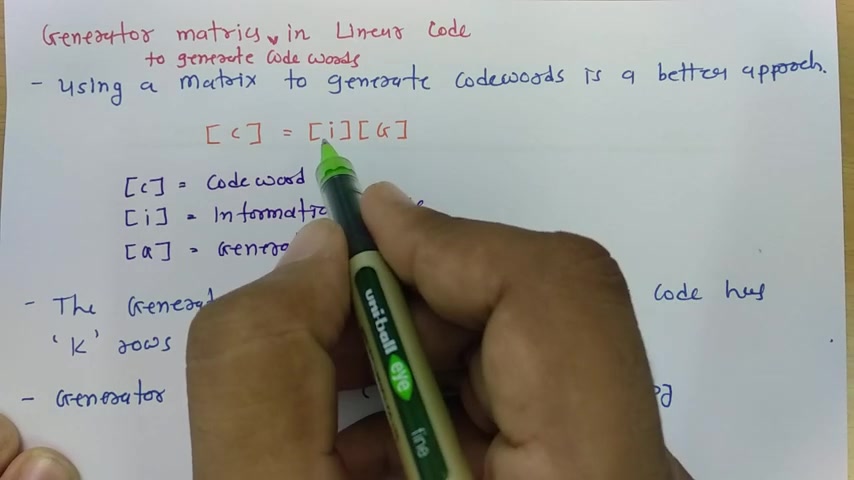
. The main diagonal has only 1s, with zeros everywhere else. Placing Ik into G, directly inserts the original message into the code WORD.
- Parity Matrix (P): The parity matrix P helps calculate and append parity bits to the message bits. Using linear algebra, it makes the code more fault-tolerant. P has a size of k x (n-k) such that P ensures that error detection/correction requirements can be met for the given code. These two matrix combined is the generator matrix given as per identity matrix and parity matrix.
In this arrangement, the generator matrix appears as G = [I : P]. During encoding, when the information word is multiplied by G, the data portion of the resulting codeword corresponds to the original message. So the identity matrix I provides a clear method to retrieve your information quickly and directly from the code. The parity P, on the other hand, makes it easier to verify or correct bits that may have been damaged.
An example format of matrix can be: [ I : P ]
By structuring codewords systematically, the design simplifies decoding and enables the code to perform efficiently with less powerful hardware.
Table 2: Generator Matrix Components
| Matrix | Description | Function |
|---|---|---|
| Identity (I) | k x k square matrix with diagonal 1s and zeros elsewhere | Embeds the original message directly into the codeword |
| Parity (P) | k x (n-k) matrix | Generates parity bits for error detection and correction |
Generating Code Words: A Step-by-Step Example
Example: Code Word Generation
Let’s consider a systematic (7, 4) linear block code to see how we can use the generator matrix
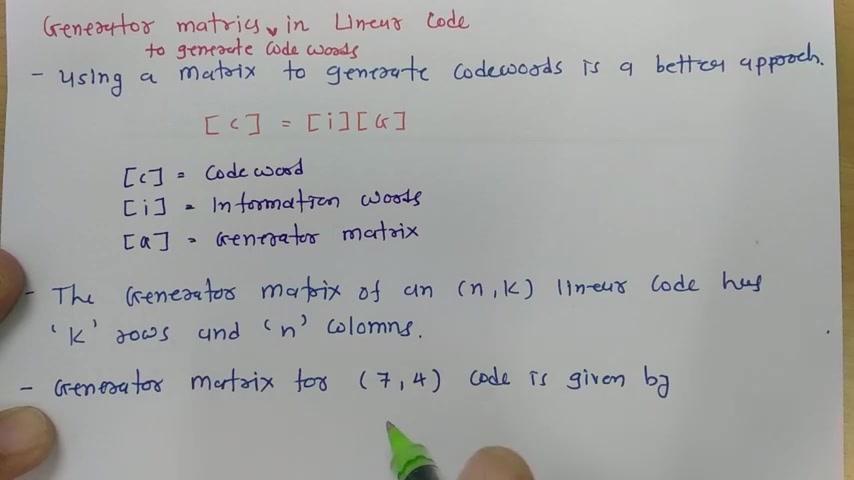
. In this code, we want to transform a 4-bit message into a 7-bit codeword by using a generator matrix, let's call it G. So suppose the G matrix follows the pattern described and consists of an identity matrix, as well as parity matrices. Now, imagine our source data (message) is i = (1 1 1 0).
The systematic generation of a code word involves the following steps:
- Start with your information sequence: i = (1 1 1 0)
- Determine the generator matrix G: G = [ I | P ] G is the matrix of the given combination, first write identity matrix, then calculate parity. With the example generator, you’ll see
G =   1 0 0 0 | 1 0 1
      0 1 0 0 | 1 1 1
      0 0 1 0 | 1 1 0
0 0 0 1 | 0 1 1- Calculate codeword:
c = i
-
G
Substitute our info, then:
c = (1 1 1 0) x GPerform matrix multiplication according to mod-2 arithmetic, which yields our codeword: (1 1 1 0 1 1 0).
By using the G generator matrix, message bits are now turned into reliable code words. It makes transmission reliable by guarding information. If there are any errors, the parity bit makes detection quick.









Most people like


































Report
Please select a reason for reporting
- 13 Reasons to Switch from Snapchat to Text Messaging
- 7 Powerful Speech to Text Apps to Boost Productivity
- 10 Best Speech to Text Tools for Effortless Transcription
- 13 Free Tools to Easily Transcribe Audio to Text
- 15 Surprising Ways Google's Speech-to-Text Boosts Productivity
- 7 Best Free Online Audio to Text Transcription Tools
- 9 Tips to Transcribe Speech to Text Faster and Better
- 13 Best Speech to Text Software for Windows 10 in 2023
- 7 Tips for Choosing the Best Transcriber for Audio to Text
- 11 Reasons Why Dragon Speech-to-Text Apps are Game-Changers
- 6 Secrets to Enhance Your Speech to Text Transcription
- 6 Brilliant Ways to Boost Productivity with Talk-to-Text on Your MacBook
- 6 Ways Transcription Software Converts Audio to Text
- 8 Tips to Transcribe Speech to Text Like a Pro
- 6 Reasons IBM Watson Speech to Text is a Game-Changer
- 14 Powerful Ways Talk-to-Text Improves Your Workflow
- 12 Top Windows Speech-to-Text Software for Efficient Transcription
- 12 Game-Changing Benefits of Apple's Speech to Text Technology
- 9 Powerful Use Cases for AWS Speech to Text Technology
- 10 Easy Steps to Transcribe YouTube Videos to Text
- transcription audio en texte
- online audio transcription
- free audio file transcription
- free ai audio transcription
- audio transcription service
- audio transcription online free
- audio transcription free online
- audio to transcription software
- audio and transcript
- ai audio transcription free
- voice recording to text converter
- translate voice recording to text
- record voice to text
- audio recording to text converter
- voice recording and transcription
- chatgpt voice to text
- gmail voice to text
- speech to text reader
- speech to text ai free
- speech to talk
- How SEO and Marketing Dashboards Empower Agencies to Drive Results
- How to Use AI Tools to Find Internal Linking Opportunities Across a Business Website
- Discover Your Perfect Haircut with AI Hairstyle Apps
- Free Reputation Calculator Tools: How They're Adapting to Score AI Visibility, Not Just Rankings
- Design Professional Flyers for Free on Your Phone
- Best Free Flyer Maker Apps for Android: Design Like a Pro
- How to Know If Your Business Is Ready for an AI Customer Service Agent
- Revolutionizing Storytelling: From Novels to Screenplays with AI
- Create Engaging Animated Explainer Videos with a Free AI Tool
- Stop Multi-Subscribing: Benchmark Top AI Visual Models in One Canvas
- My Brand New Logo: AI-Powered Logo Design for Startups
- Create Stunning Logos with Free AI Logo Generator!
- AI Logo Maker: Design a Stunning Logo in Minutes
- Elevate Your Zoom Experience with Enhanced Name Tags by Warmly
- Top 5 AI Logo Makers in 2025: Design a Stunning Brand
- Creative Fabrica's AI Tools: Flow, Studio, and Font Generator
- Create Stunning Logos with Canva's Free AI Logo Generator
- Create Professional and Memorable Logos with LogoMaker.ai
- Design Your Own Font: A Step-by-Step Guide with Vectornator Pro
- AI Font Generator: Revolutionizing Typeface Design with AI

Copyright ©2026 toolify