































Table of Contents
- Key Points
- Understanding DeepSeek OCR and Contextual Optical Compression
- Benefits of DeepSeek OCR's Optical Compression for Language Models
- Implementing DeepSeek OCR in AI Systems
- Accessing and Utilizing DeepSeek OCR
- Advantages and Disadvantages of DeepSeek OCR
- Key Features and Capabilities
- Potential Use Cases
- Frequently Asked Questions
- Related Questions


Understanding DeepSeek OCR and Contextual Optical Compression
What is DeepSeek OCR?
DeepSeek OCR is not merely another optical character recognition tool; it represents a paradigm shift in how AI systems handle and process information. Traditional OCR focuses on converting images of text into machine-readable text.
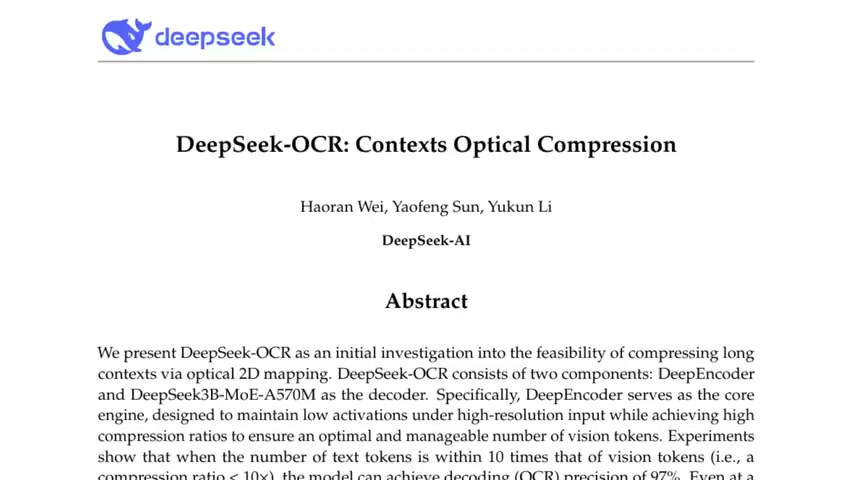
However, DeepSeek takes this a step further by using vision as a compression algorithm for text. This approach is known as contextual optical compression, where long contexts are compressed into single images, and the model can read these images back with high accuracy. This model has potential to revolutionize how AI approaches memory. Rather than simply recognize the text, it optimizes and intelligently compresses it.
The model is not about the OCR itself. It's about using the image as a place to store information, and the model perfectly reads it back. The implications of DeepSeek OCR extend beyond basic document reading and into the realm of AI memory and long-context processing. The technology opens up the possibility of storing vast amounts of textual information in a compressed visual format, thereby making AI systems more efficient and capable. DeepSeek OCR offers a method for condensing extensive textual data into a compact visual format. By using visual elements to represent textual information, the model significantly reduces the number of tokens needed, thus optimizing memory usage and improving processing speeds. This Novel approach ensures efficient handling of information, allowing AI to process larger volumes of data more effectively.
By leveraging contextual optical compression, DeepSeek OCR achieves significant compression ratios while maintaining high levels of accuracy. The compression not only helps reduce memory consumption but also enhances the model's ability to process data. Vision, the core of the approach, serves as a compression algorithm. That means storing text or tokens in images rather than the standard way, which then can be perfectly read back. This model brings new potential to AI and offers a new method of approaching context windows.
DeepSeek OCR’s approach introduces new paradigms in AI that could allow AI to do the following:
- Significantly reduce token count.
- Optimize AI memory and resources.
- Enhance long-term context processing.
The Core Idea: Storing Text in Images
The underlying principle of DeepSeek OCR is to store text within images, turning the image itself into a form of compressed data storage. In essence, a single image encapsulates the equivalent of a thousand words, which the model can then perfectly decode. This concept of encoding text within images offers several advantages:
- Reduced Memory Footprint: By compressing large amounts of text into a single image, the memory footprint is drastically reduced.
- Efficient Data Processing: With less data to process, AI systems can operate more efficiently and faster.
- Enhanced Contextual Understanding: The model gains a more holistic understanding of the text's context.
This is a 10x compression with almost perfect fidelity, and it may be up to 20x. This technology changes how we think about AI memory and long context processing. The shift from storing text as a sequence of tokens to encoding it within a visual medium marks a fundamental change in how AI systems can manage data, enabling significant advancements in AI capabilities.
Let's take a more technical look at how transformers handle images.
The process starts with an image, where the image is cut into little patches. The images become tokens to represent the image. The deep encoder has a two-stage solution, where the first step is using an SAM model with 80 million parameters. Before they get to stage two, they compress images with CNN, or a convolutional neural network. In step two, they pass it to a CLIP model to take the compressed pieces of information and use global attention to relate the images to one another.
Vision is used in the model as a text compressor, offering a new way of memory compression for AI systems.
Benefits of DeepSeek OCR's Optical Compression for Language Models
Vision as Text Compression and Reduced Token Count
Large Language Models (LLMs) often grapple with significant computational challenges when processing extensive textual content. The resources it requires scales quadratically with sequence length. DeepSeek OCR addresses this by leveraging visual modality as an efficient compression medium for textual information. In simpler terms, it takes advantage of how images can hold a lot of information, allowing document text to represent rich information with substantially fewer tokens than the equivalent digital text.
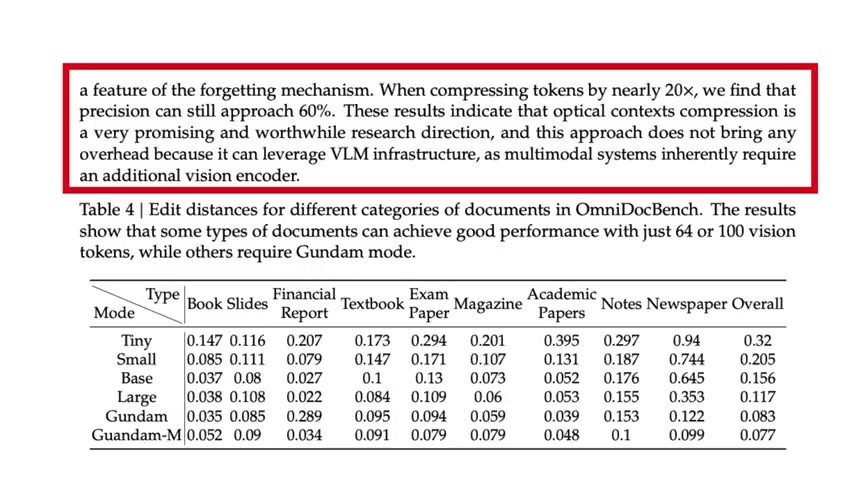
The fact that a single image containing document text can represent rich information using substantially fewer tokens than the equivalent digital text suggests optical compression through vision tokens could achieve much higher compression ratios. The potential is clear, so researchers are motivated to reexamine vision-language models from an LLM-centric perspective.
Instead of converting a text image to tokens, why not store tokens, or text in images? This single fact has the potential to upend how vision and language models process information. This means leveraging vision modalities as an efficient compression medium for contextual information. This compression insight means compact language models can learn to decode compressed visual representations effectively. That means larger LLMs could readily acquire similar capabilities.



Most people like



































Report
Please select a reason for reporting
- 13 Reasons to Switch from Snapchat to Text Messaging
- 7 Powerful Speech to Text Apps to Boost Productivity
- 10 Best Speech to Text Tools for Effortless Transcription
- 13 Free Tools to Easily Transcribe Audio to Text
- 15 Surprising Ways Google's Speech-to-Text Boosts Productivity
- 7 Best Free Online Audio to Text Transcription Tools
- 9 Tips to Transcribe Speech to Text Faster and Better
- 13 Best Speech to Text Software for Windows 10 in 2023
- 7 Tips for Choosing the Best Transcriber for Audio to Text
- 11 Reasons Why Dragon Speech-to-Text Apps are Game-Changers
- 6 Secrets to Enhance Your Speech to Text Transcription
- 6 Brilliant Ways to Boost Productivity with Talk-to-Text on Your MacBook
- 6 Ways Transcription Software Converts Audio to Text
- 8 Tips to Transcribe Speech to Text Like a Pro
- 6 Reasons IBM Watson Speech to Text is a Game-Changer
- 14 Powerful Ways Talk-to-Text Improves Your Workflow
- 12 Top Windows Speech-to-Text Software for Efficient Transcription
- 12 Game-Changing Benefits of Apple's Speech to Text Technology
- 9 Powerful Use Cases for AWS Speech to Text Technology
- 10 Easy Steps to Transcribe YouTube Videos to Text
- transcription audio en texte
- online audio transcription
- free audio file transcription
- free ai audio transcription
- audio transcription service
- audio transcription online free
- audio transcription free online
- audio to transcription software
- audio and transcript
- ai audio transcription free
- voice recording to text converter
- translate voice recording to text
- record voice to text
- audio recording to text converter
- voice recording and transcription
- chatgpt voice to text
- gmail voice to text
- speech to text reader
- speech to text ai free
- speech to talk
- Meshy AI: How to Create 3D Models from Text and Images
- How SEO and Marketing Dashboards Empower Agencies to Drive Results
- How to Use AI Tools to Find Internal Linking Opportunities Across a Business Website
- Discover Your Perfect Haircut with AI Hairstyle Apps
- Free Reputation Calculator Tools: How They're Adapting to Score AI Visibility, Not Just Rankings
- Design Professional Flyers for Free on Your Phone
- Best Free Flyer Maker Apps for Android: Design Like a Pro
- How to Know If Your Business Is Ready for an AI Customer Service Agent
- Revolutionizing Storytelling: From Novels to Screenplays with AI
- Create Engaging Animated Explainer Videos with a Free AI Tool
- Meshy AI: How to Create 3D Models from Text and Images
- ASOMobile Helps Teams Benchmark App Store Screenshots Against Competitors
- How to Match LMS Software With Your Organization's Training Plan
- Revolutionizing Email Marketing Agency with AI
- How to Convert BTC to HNT
- Unleashing the Power of AI: Cognizant's Roadmap for Transformation
- Frame to Video Review: A Practical Look at Turning Two Still Frames Into Motion
- NVIDIA NIM: Revolutionizing Supply Chain Data Analysis with AI
- Top AI Tools That Help Brands Stand Out Offline (Not Just Online)
- Top 5 Cold Email Software: Maximize Your Outreach in 2025

Copyright ©2026 toolify