































Table of Contents
- Key Points
- Introduction to EfficientRAG
- Empirical Study of LLM Performance
- Leveraging EfficientRAG for Optimal Results
- Pricing Information
- Evaluating EfficientRAG: Weighing the Advantages and Disadvantages
- Key Features of EfficientRAG
- Use Cases
- Frequently Asked Questions
- Related Questions



Introduction to EfficientRAG
The Challenges in Multi-Hop Question Answering
Answering complex questions often requires synthesizing information from multiple sources, a task known as multi-hop question answering.
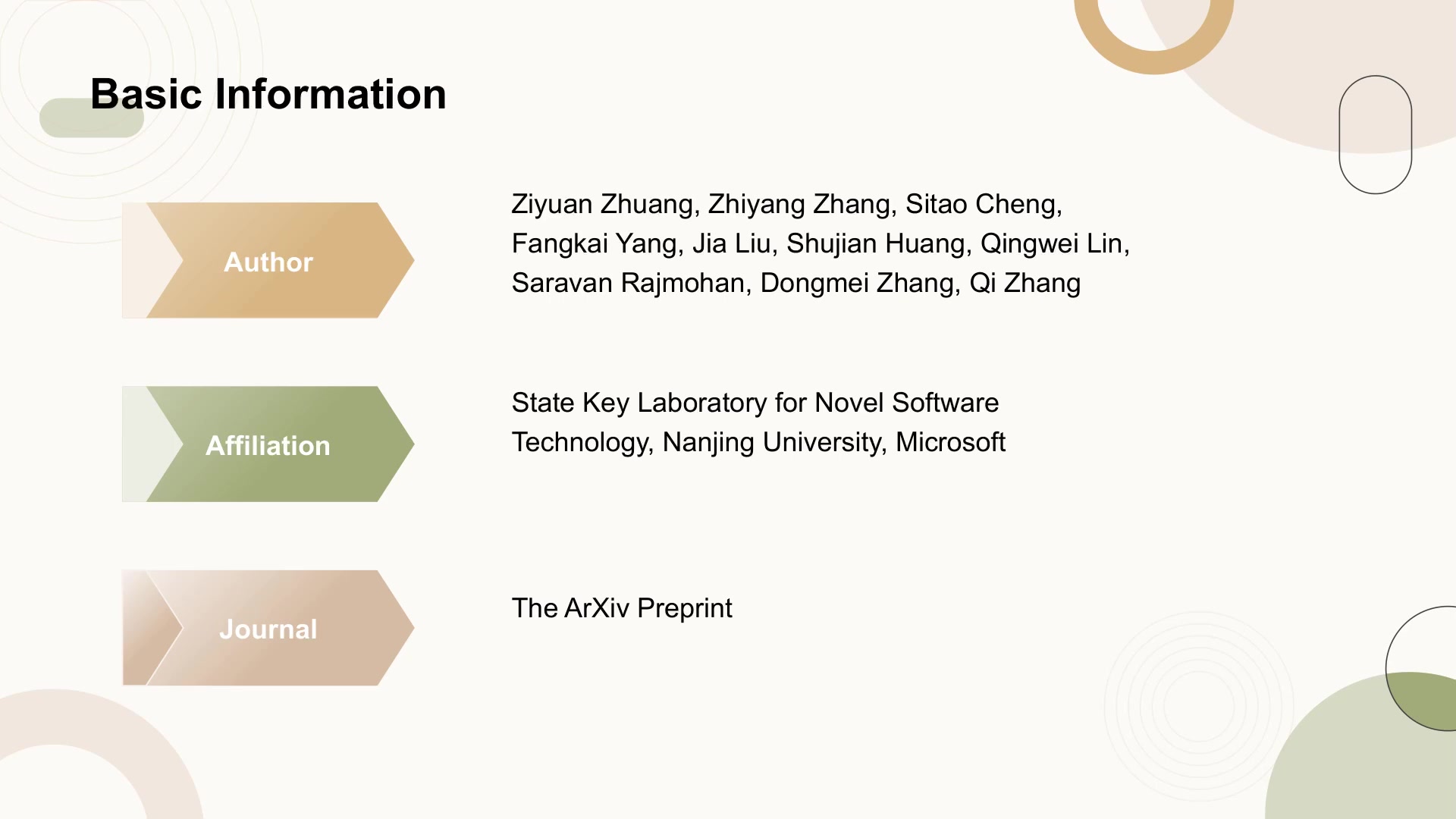
Traditional retrieval augmented generation (RAG) methods, while effective to a degree, face several challenges in this domain:
- Multi-hop Queries: These queries require multiple steps of reasoning and information retrieval, exceeding the capabilities of single-step retrieval methods.
- Iterative Retrieval: Effective retrieval often necessitates iterative query refinement, which can be computationally expensive.
- Multiple LLM Calls: Current iterative methods frequently rely on numerous calls to Large Language Models (LLMs), significantly impacting efficiency and cost.
EfficientRAG tackles these challenges through innovative techniques, aiming to streamline the retrieval process and minimize reliance on computationally intensive LLM operations, resulting in the improvement of RAG architecture.
How EfficientRAG Enhances RAG Architectures
EfficientRAG introduces a Novel approach designed to mitigate the inefficiencies of existing RAG (Retrieval-Augmented Generation) methods. The core features of EfficientRAG focus on optimizing the query generation and retrieval process to minimize computational overhead and improve accuracy.
- Iterative Query Generation: EfficientRAG generates new queries iteratively,
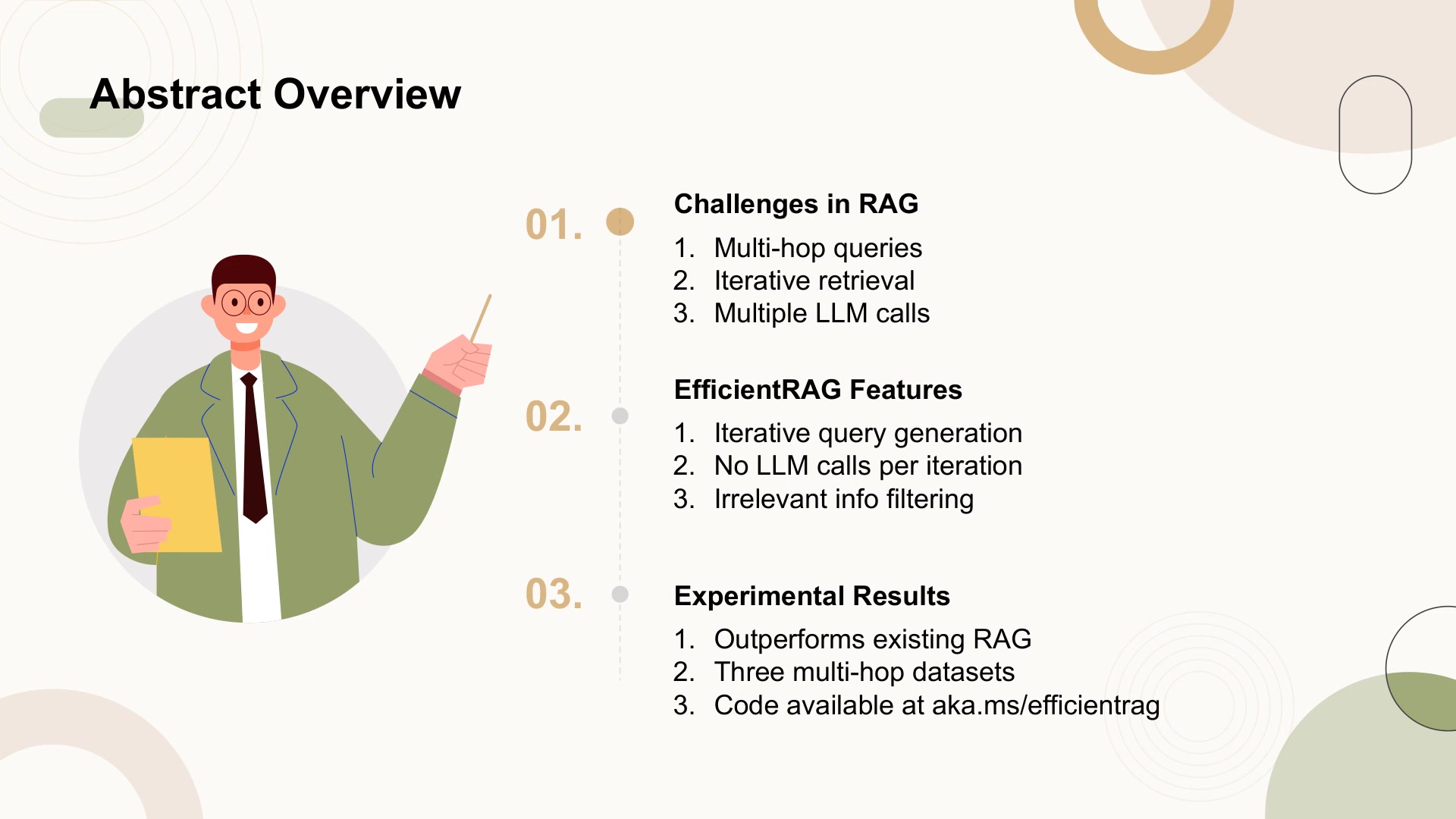
but crucially, does so without requiring a call to a Large Language Model (LLM) for each iteration. This is a departure from traditional methods, which often rely on LLMs to refine queries at every step, leading to increased computational costs. By decoupling query generation from LLM calls, EfficientRAG significantly reduces the number of LLM operations, making the process more efficient.
- No LLM Calls Per Iteration: This feature is a direct consequence of the iterative query generation process. The design of EfficientRAG minimizes the necessity for LLM involvement at each iteration. This leads to a substantial reduction in computational resources required for question answering tasks, making it more scalable and cost-effective.
- Irrelevant Information Filtering: EfficientRAG incorporates mechanisms to filter out irrelevant information, ensuring that only the most pertinent data is used in generating answers. This filtering process enhances the precision of the answers and reduces the cognitive load on the LLM, further improving efficiency. It helps in focusing on relevant chunks for information synthesis.
EfficientRAG Proposal
Large language models (LLMs) have shown great skills but lack domain-specific knowledge and sometimes hallucinate. Retrieval-augmented generation (RAG) helps by retrieving outside information, but regular one-round RAG isn't enough for tricky multi-hop questions.
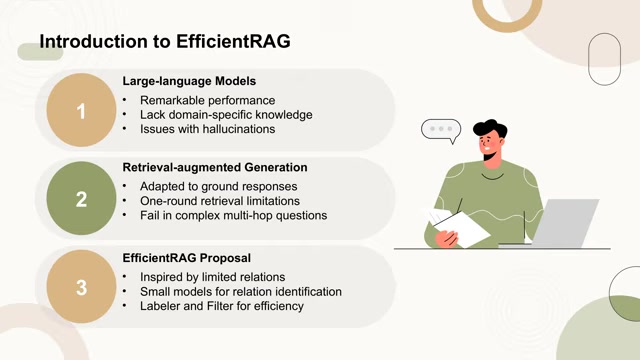
EfficientRAG uses the idea that relationships in multi-hop questions are limited. It uses small models to spot relationships and links, plus a labeler and filter to make new queries and keep relevant info, boosting efficiency compared to regular RAG methods.
Empirical Study of LLM Performance
LLM Generator Capability
The capability of LLM-based generators in EfficientRAG was evaluated across three distinct settings to comprehensively understand their performance under varying conditions. This multi-faceted approach allowed for a nuanced understanding of how well LLMs can generate relevant and coherent information when integrated into the EfficientRAG framework.
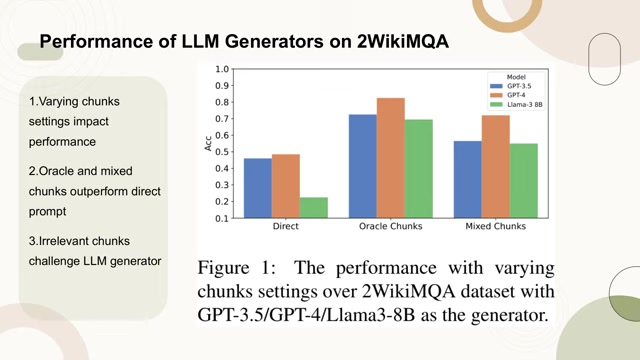
The generators were tested in three different settings:
- Direct Prompt: LLMs were directly prompted to answer questions without any additional context or retrieval augmentation. This served as a baseline to measure the inherent knowledge and reasoning capabilities of the LLMs.
- Oracle Chunks: LLMs were provided with perfect, pre-selected chunks of information relevant to the question. This setting aimed to assess the LLMs' ability to synthesize information effectively when given ideal source material.
- Mixed Chunks: LLMs were given a mix of relevant and irrelevant information chunks, simulating real-world scenarios where retrieval systems may not always provide perfectly curated data. This setting tested the LLMs' robustness and ability to discern useful information from noise.
To ensure a thorough evaluation, the tests were conducted using three datasets:
- HotpotQA: A dataset designed for multi-hop question answering, requiring the synthesis of information from multiple documents.
- 2WikiMQA: A dataset focused on question answering using information from Wikipedia articles.
- MuSiQue: A dataset that tests the ability of models to answer questions about Music using structured knowledge.
The evaluation included various LLMs to gauge the impact of model architecture on performance, encompassing GPT-3.5, GPT-4, and Llama-3-8B.
Retrieval Impact
The study revealed key insights into how retrieval settings influence the performance of LLMs. When LLMs were provided with oracle chunks, meaning perfectly relevant information, their performance generally outperformed that of direct answering methods.
The performance decreases, when irrelevant chunks are added, and it is thus very important to have precise retrieval methods.
| Retrieval Setting | Impact on LLM Performance |
|---|---|
| Direct Answering | Serves as a baseline, reflecting the LLM's inherent knowledge and reasoning skills. |
| Oracle Chunks | Demonstrates the LLM's ability to synthesize information when given ideal source material. |
| Mixed Chunks | Tests the LLM's robustness and ability to discern useful information from irrelevant data. |
The retrieval impact assessment underscores the necessity for precise information retrieval and careful chunk selection to optimize the effectiveness of LLMs in question answering tasks. Precise recall is needed.
Query Decomposition
Query decomposition techniques divide complex questions into smaller, more manageable sub-questions, potentially improving retrieval accuracy and answer quality. The study explored two primary decomposition strategies:
- One-Time Decomposition: Involves decomposing the original question into sub-questions only once at the beginning of the retrieval process.
- Iterative Decomposition: Decomposes the question iteratively, refining the sub-questions based on the information retrieved in previous steps.
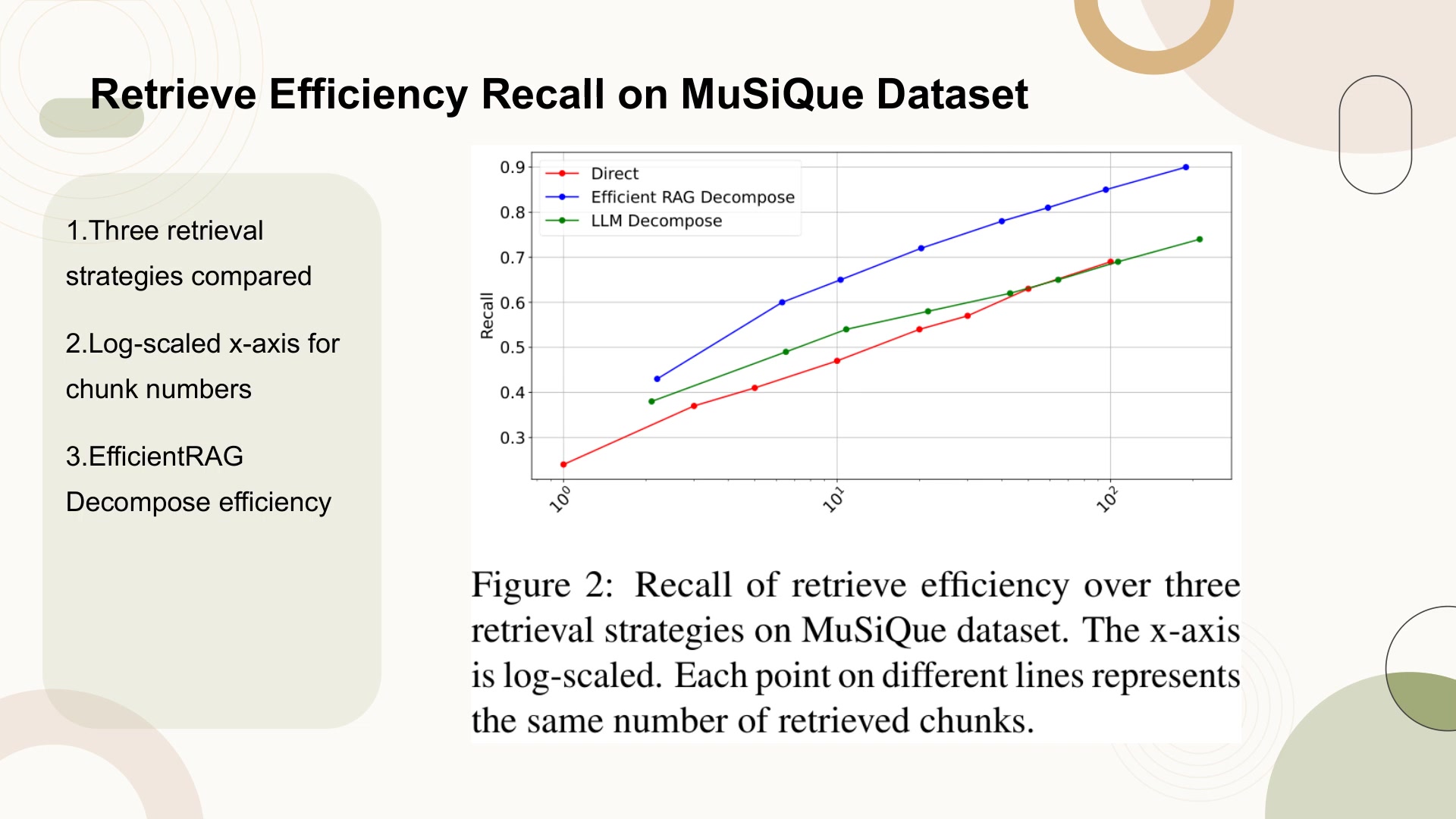
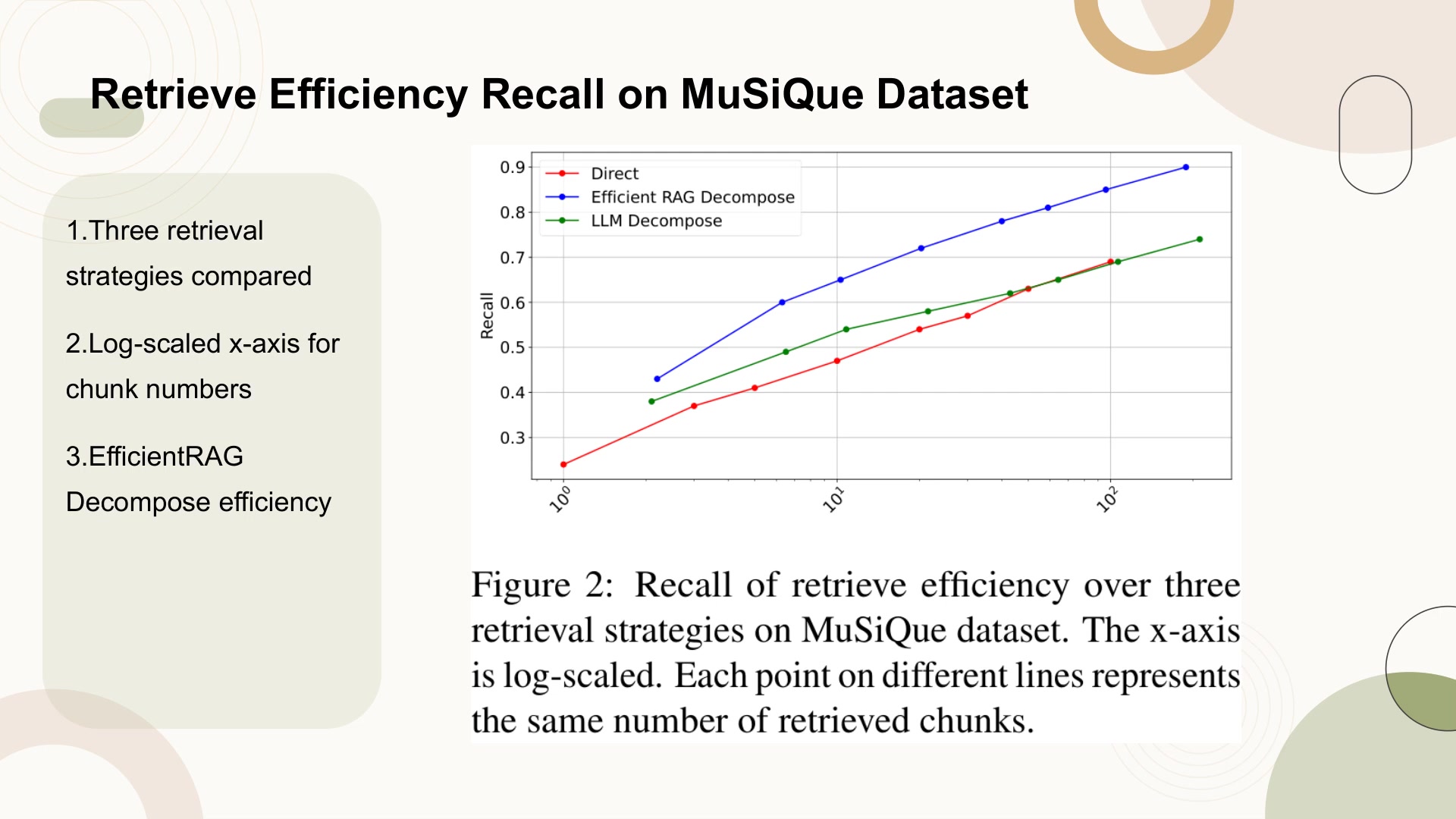
Evaluation of the models was conducted on the MuSiQue dataset, which is well-suited for assessing query decomposition due to its complex, multi-faceted questions about music. One-time decomposition outperformed direct retrieval, while EfficientRAG decompose showed better recall. Iterative query decomposition could be the future.
Leveraging EfficientRAG for Optimal Results
Understanding and Implementing the Methodology Overview
To effectively implement and utilize EfficientRAG, it's essential to grasp the methodology overview, which covers the key components of the framework, synthetic data construction, and the training process.
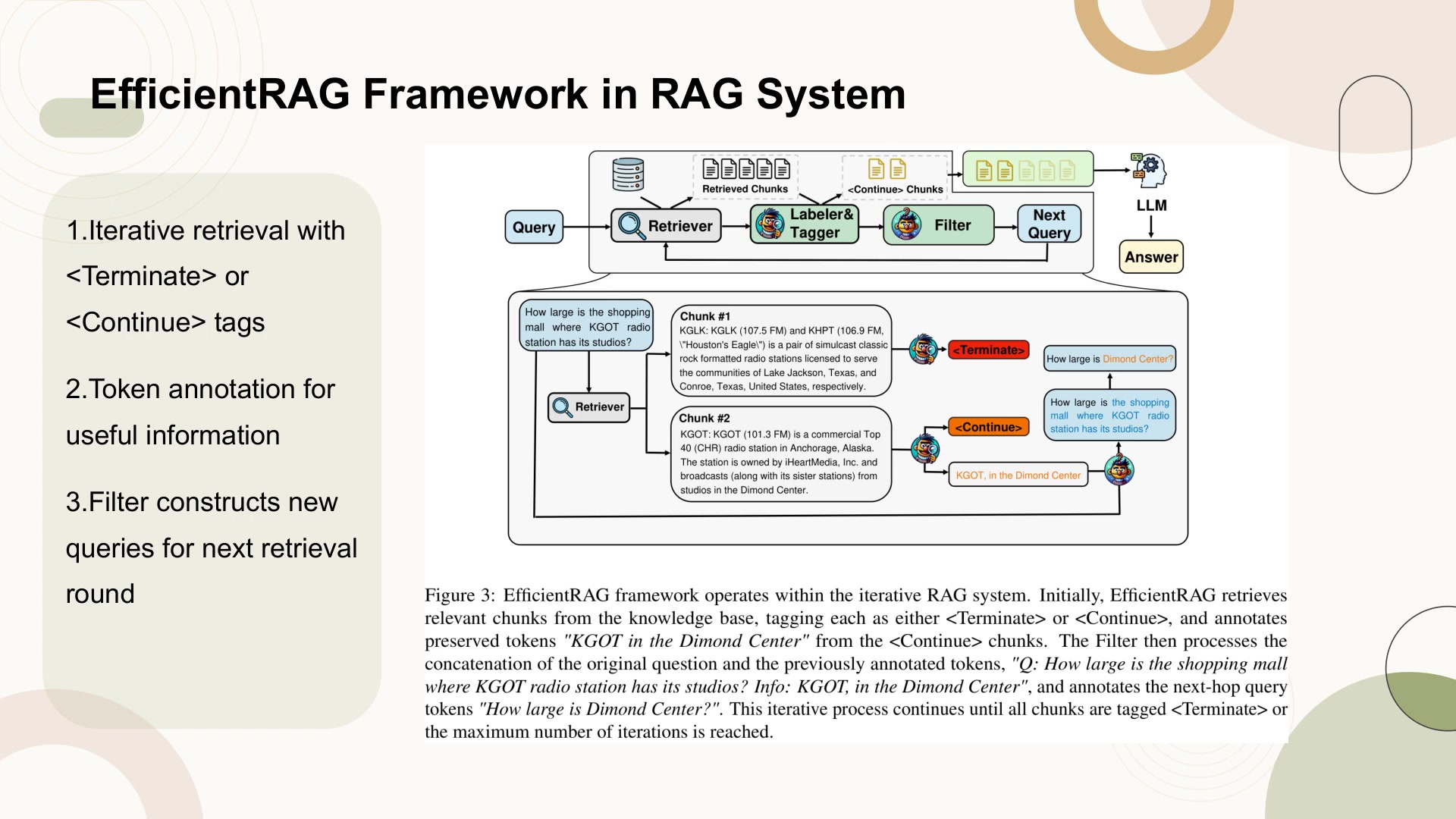
- EfficientRAG Framework: The core components of EfficientRAG include a Labeler & Tagger and a Filter. These token-level classifiers determine the relevance of tokens for query enrichment iteratively.
- Synthetic Data Construction: Large language models (LLMs) are used for multi-hop question decomposition, token labeling, and next-hop question filtering. The toolkit is Spacy.
- Training Process: The training phase involves training the labeler for token labeling and chunk filtering, employing an auto-encoder model for token embeddings, and using fully connected layers for chunk tagging.
Pricing Information
Public Availability and Accessibility
The code for EfficientRAG is publicly available,
fostering transparency, collaboration, and further development within the AI community. Access to the code allows researchers, developers, and practitioners to explore, experiment, and build upon the innovations presented in the paper, accelerating progress in retrieval-augmented generation and question answering systems. The code is available at aka.ms/efficientrag. There is no pricing.





Most people like







































Report
Please select a reason for reporting
- 13 Reasons to Switch from Snapchat to Text Messaging
- 7 Powerful Speech to Text Apps to Boost Productivity
- 10 Best Speech to Text Tools for Effortless Transcription
- 13 Free Tools to Easily Transcribe Audio to Text
- 15 Surprising Ways Google's Speech-to-Text Boosts Productivity
- 7 Best Free Online Audio to Text Transcription Tools
- 9 Tips to Transcribe Speech to Text Faster and Better
- 13 Best Speech to Text Software for Windows 10 in 2023
- 7 Tips for Choosing the Best Transcriber for Audio to Text
- 11 Reasons Why Dragon Speech-to-Text Apps are Game-Changers
- 6 Secrets to Enhance Your Speech to Text Transcription
- 6 Brilliant Ways to Boost Productivity with Talk-to-Text on Your MacBook
- 6 Ways Transcription Software Converts Audio to Text
- 8 Tips to Transcribe Speech to Text Like a Pro
- 6 Reasons IBM Watson Speech to Text is a Game-Changer
- 14 Powerful Ways Talk-to-Text Improves Your Workflow
- 12 Top Windows Speech-to-Text Software for Efficient Transcription
- 12 Game-Changing Benefits of Apple's Speech to Text Technology
- 9 Powerful Use Cases for AWS Speech to Text Technology
- 10 Easy Steps to Transcribe YouTube Videos to Text
- transcription audio en texte
- online audio transcription
- free audio file transcription
- free ai audio transcription
- audio transcription service
- audio transcription online free
- audio transcription free online
- audio to transcription software
- audio and transcript
- ai audio transcription free
- voice recording to text converter
- translate voice recording to text
- record voice to text
- audio recording to text converter
- voice recording and transcription
- chatgpt voice to text
- gmail voice to text
- speech to text reader
- speech to text ai free
- speech to talk
- How SEO and Marketing Dashboards Empower Agencies to Drive Results
- How to Use AI Tools to Find Internal Linking Opportunities Across a Business Website
- Discover Your Perfect Haircut with AI Hairstyle Apps
- Free Reputation Calculator Tools: How They're Adapting to Score AI Visibility, Not Just Rankings
- Design Professional Flyers for Free on Your Phone
- Best Free Flyer Maker Apps for Android: Design Like a Pro
- How to Know If Your Business Is Ready for an AI Customer Service Agent
- Revolutionizing Storytelling: From Novels to Screenplays with AI
- Create Engaging Animated Explainer Videos with a Free AI Tool
- Stop Multi-Subscribing: Benchmark Top AI Visual Models in One Canvas
- Revolutionize Learning: Discover Quizzes AI for Engaging Interactive Quizzes
- From AI-Generated to Audience-Ready: How Quillbot Humanize AI Is Changing the Content Editing Process
- Building an AI Writing Stack in 2026: LLMs, Detectors, and Humanizers
- 7 Top AI-Powered Database Assistant Platforms
- An Objective Look at Modern Web-Based Visual Modifications
- My Honest Experience with VideoAI: The Secret Weapon for Creators Who Need Character Voices
- 5 Data Problems That Stall AI Projects in Financial Compliance
- The Future of Smart Glasses: Explained & Assembling Guide
- DeepL Translator: The AI-Powered Translation Tool
- AI Video Upscaling: Top Tools Compared for Enhanced Quality

Copyright ©2026 toolify