






Table of Contents
- Key Points
- Understanding Knowledge Retrieval Limitations [t:10]
- Optimizing Search Queries with LLMs
- Step-by-Step Guide: Improving Knowledge Retrieval
- Pricing Models for AI Tool Builders
- Pros and Cons of Using LLMs for Knowledge Retrieval Refinement
- Core Features of Advanced AI Tool Builders
- Real-World Use Cases for Enhanced Knowledge Retrieval
- Frequently Asked Questions
- Related Questions



Understanding Knowledge Retrieval Limitations [t:10]
The Cost of Abstraction
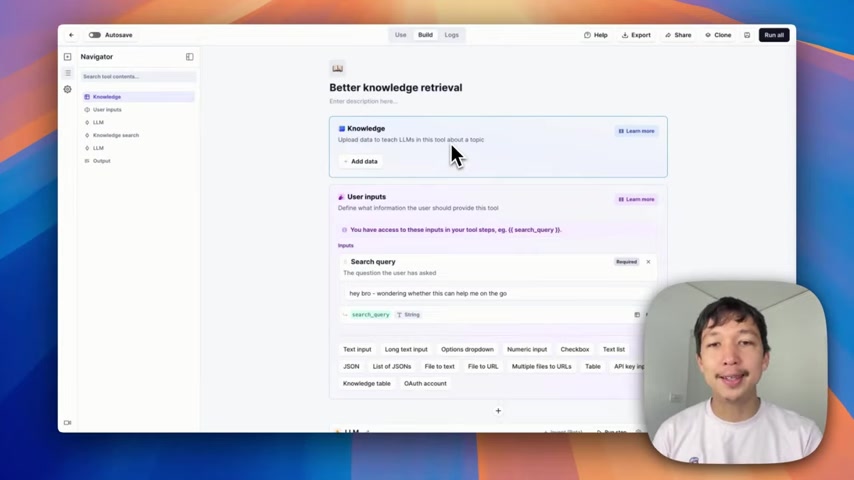
While simplified tool builders offer convenience, they often come at the cost of control. The abstraction layers, while user-friendly, limit the ability to fine-tune the knowledge retrieval process. For basic tasks, these tools suffice, but for more complex scenarios requiring nuanced understanding and accuracy, more advanced techniques are necessary. This is especially true when dealing with agents that require access to highly specific and detailed information to serve customers effectively. The knowledge retrieval abstraction provides a quick solution for LLMs to access knowledge, at the cost of less control over the retrieval process.
The Need for Fine-Grained Control
When dealing with customer support agents, for instance, accuracy is paramount. Agents need to provide precise and relevant answers to customer queries. In such cases, fine-grained control over the knowledge retrieval process becomes essential. This control allows for the tailoring of search queries, the refinement of search algorithms, and the implementation of quality assurance measures to ensure that the retrieved information is both accurate and relevant. Knowledge retrieval is the goal, but the method matters. This is when bypassing the quick and easy solutions, will provide a better experience for your users.
Optimizing Search Queries with LLMs
From Free-Form Text to Effective Queries
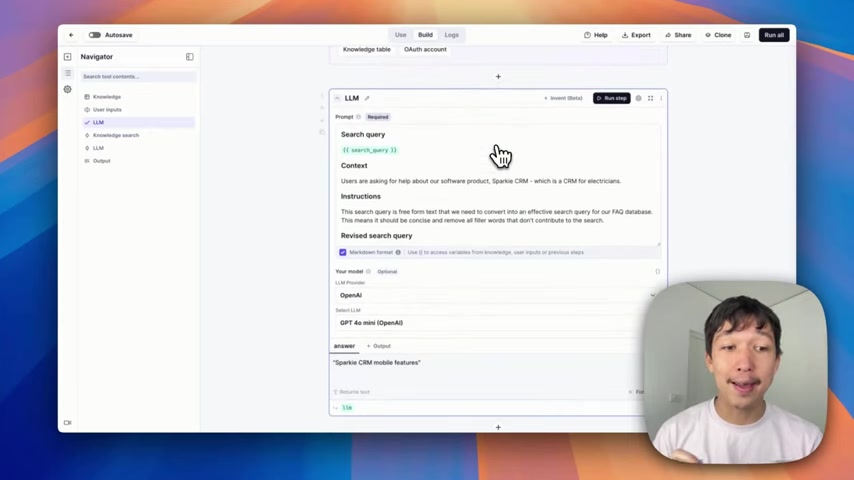
User queries often come in the form of free-form text, which can be verbose, ambiguous, and full of filler words that don't contribute to the search. This type of text makes for a poor search query and can lead to inaccurate results. To combat this, we can leverage Large Language Models (LLMs) to transform free-form text into effective search queries that are optimized for database searches. The LLM does this in a series of steps:
- Context injection: The LLM must have a deep understanding of what the user is searching for.
- Conciseness: Cutting out all the filler, so the query is easily understood by all knowledge retrieval sources.
- Fill in the blanks: It is important to guide the LLM to generate a search query.
Crafting Effective Prompts
The key to successful LLM-based query optimization lies in crafting effective prompts. A well-designed prompt provides the LLM with the necessary context, instructions, and constraints to generate a refined search query. Here's a breakdown of the elements of an effective Prompt:
- Search Query: You need to pass the search query into the LLM.
- Context: It is important to provide a little context for the LLM. You have to inject into it, so that it has some idea of what the search query is being used for. For example, users are asking for help about our software product.
- Instructions: You also have to tell it how to change from one type of string to another string type. You need to tell it how it should concise, and remove all filler words that don't contribute to the search.
- Marking: There must be a header, to tell the LLM where to put the new string.
Structured Prompt Format
Structuring your prompts using a consistent format can significantly improve the LLM's performance. One effective approach is to use triple hashtags to create clear headers for different sections of the prompt, such as the search query, context, and instructions. This structured format helps the LLM to parse the prompt effectively and generate a more accurate and relevant search query. All the instruction and context to make the LLM operate as best as possible.
System Prompts: Reinforcing the LLM's Persona
To further enhance the LLM's performance, consider using system prompts to define the LLM's persona and role. By assigning a specific persona, such as an "intelligent millennial who is an expert at finding things on the internet," you can guide the LLM to adopt a particular style and approach to generating search queries. This technique can be particularly effective in tailoring the LLM's output to specific user demographics or scenarios. All good knowledge retrieval applications require a persona.




Most people like


































Report
Please select a reason for reporting
- 13 Reasons to Switch from Snapchat to Text Messaging
- 7 Powerful Speech to Text Apps to Boost Productivity
- 10 Best Speech to Text Tools for Effortless Transcription
- 13 Free Tools to Easily Transcribe Audio to Text
- 15 Surprising Ways Google's Speech-to-Text Boosts Productivity
- 7 Best Free Online Audio to Text Transcription Tools
- 9 Tips to Transcribe Speech to Text Faster and Better
- 13 Best Speech to Text Software for Windows 10 in 2023
- 7 Tips for Choosing the Best Transcriber for Audio to Text
- 11 Reasons Why Dragon Speech-to-Text Apps are Game-Changers
- 6 Secrets to Enhance Your Speech to Text Transcription
- 6 Brilliant Ways to Boost Productivity with Talk-to-Text on Your MacBook
- 6 Ways Transcription Software Converts Audio to Text
- 8 Tips to Transcribe Speech to Text Like a Pro
- 6 Reasons IBM Watson Speech to Text is a Game-Changer
- 14 Powerful Ways Talk-to-Text Improves Your Workflow
- 12 Top Windows Speech-to-Text Software for Efficient Transcription
- 12 Game-Changing Benefits of Apple's Speech to Text Technology
- 9 Powerful Use Cases for AWS Speech to Text Technology
- 10 Easy Steps to Transcribe YouTube Videos to Text
- transcription audio en texte
- online audio transcription
- free audio file transcription
- free ai audio transcription
- audio transcription service
- audio transcription online free
- audio transcription free online
- audio to transcription software
- audio and transcript
- ai audio transcription free
- voice recording to text converter
- translate voice recording to text
- record voice to text
- audio recording to text converter
- voice recording and transcription
- chatgpt voice to text
- gmail voice to text
- speech to text reader
- speech to text ai free
- speech to talk
- Meshy AI: How to Create 3D Models from Text and Images
- How SEO and Marketing Dashboards Empower Agencies to Drive Results
- How to Use AI Tools to Find Internal Linking Opportunities Across a Business Website
- Discover Your Perfect Haircut with AI Hairstyle Apps
- Free Reputation Calculator Tools: How They're Adapting to Score AI Visibility, Not Just Rankings
- Design Professional Flyers for Free on Your Phone
- Best Free Flyer Maker Apps for Android: Design Like a Pro
- How to Know If Your Business Is Ready for an AI Customer Service Agent
- Revolutionizing Storytelling: From Novels to Screenplays with AI
- Create Engaging Animated Explainer Videos with a Free AI Tool
- Automate Lead Generation: A Comprehensive Guide with AI Agents
- Revideo.io: The Future of Reverse Video Search Technology
- Revolutionizing Email Marketing Agency with AI
- Breaking the Character Drift Dilemma: A Practical Test of Smart Shot
- Meshy AI: How to Create 3D Models from Text and Images
- ASOMobile Helps Teams Benchmark App Store Screenshots Against Competitors
- How to Match LMS Software With Your Organization's Training Plan
- How to Convert BTC to HNT
- Unleashing the Power of AI: Cognizant's Roadmap for Transformation
- Frame to Video Review: A Practical Look at Turning Two Still Frames Into Motion

Copyright ©2026 toolify