































Table of Contents
- Key Points
- Understanding Generative Models and Naive Bayes
- Challenges and Datasets in Text Classification
- Steps to Text Classification Using Generative Models
- How to Find Generative Models
- Naive Bayes
- What are Core features for Text Calssification
- Use Cases for Generative Models
- FAQ
- Related Questions


Understanding Generative Models and Naive Bayes
What are Generative Models?
Generative models represent a cornerstone in machine learning, particularly when dealing with classification tasks. These models differentiate themselves by aiming to understand the underlying process that generates data. Instead of merely focusing on distinguishing between classes, they seek to model how each class's data is produced. This approach is critical because it allows for a deeper understanding of the data, enabling the algorithm to generate new samples and manage missing information more effectively.
Key Concepts of Generative Models:
- Joint Distribution: At the heart of generative models lies the concept of the joint distribution of inputs and labels. The model learns how inputs (features) and their corresponding labels are jointly distributed. Estimating this distribution enables the model to classify new data points by determining which class is most likely to have generated the observed features.
- Data Generation: Unlike discriminative models, generative models attempt to simulate the process that created the data. This capability allows for more robust classifications, especially in scenarios where data is sparse or incomplete.
-
Applications: Generative models excel in various applications, including:
- Spam Filtering: Identifying and categorizing emails as spam based on patterns learned from existing data.
- Fraud Detection: Detecting fraudulent transactions by modeling normal and anomalous behavioral patterns.
- Medical Record Classification: Sorting medical records based on symptoms, diagnoses, and treatments to improve Healthcare management.
Generative models, therefore, provide a robust and insightful approach to machine learning, with a focus on understanding and simulating the processes that create data.
Naive Bayes: A Probabilistic Text Classifier
Naive Bayes is a classic algorithm in machine learning, particularly renowned for its application in text classification. It's a probabilistic classifier based on Bayes' theorem with a "naive" assumption of independence among features. Despite its simplicity, Naive Bayes often performs surprisingly well in complex real-world scenarios.
Understanding Naive Bayes:
- Bayes' Theorem: Naive Bayes is grounded in Bayes' theorem, which describes the probability of an event based on prior knowledge of conditions related to the event.
- Naive Assumption of Independence: The algorithm assumes that the presence or absence of a particular feature (e.g., a WORD) in a document is unrelated to the presence or absence of any other feature, given the class label. While this assumption is often violated in real-world scenarios, it simplifies the calculations and makes the model computationally efficient.
- Text Classification: Naive Bayes is used to classify text into various categories. A primary application is spam filtering, where emails are sorted into spam or non-spam categories based on the likelihood of certain words or phrases appearing.
The Naive Bayes is highly scalable, requiring a number of parameters linear in the number of variables (features) in a learning problem. Maximum-likelihood training can be done by evaluating a closed-form expression, which takes linear time, rather than by expensive iterative approximation as used for many other types of classifiers.
In the next sections, we will explore in detail how Naive Bayes is derived, how it is practically applied, and its effectiveness in solving real-world classification problems.
Challenges and Datasets in Text Classification
Challenges in Text Classification
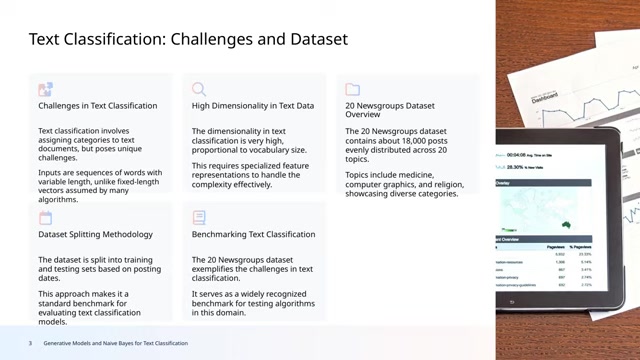
Text classification involves assigning predefined categories to text documents, a task that poses several unique challenges:
- High Dimensionality of Text Data: Text data is inherently high-dimensional. The number of features or dimensions is proportional to the vocabulary size, which can be enormous.
- Variable Length Inputs: Text documents can vary in length, unlike fixed-length vectors assumed by many algorithms.
- Specialized Feature Representations: Text complexity requires specialized feature representations, such as TF-IDF or word embeddings, to handle text complexity effectively.
- Semantic Understanding: It is hard to let machines understand text's semantic accurately. Machines require assistance in learning the context of a phrase. Addressing these challenges effectively is essential for building successful text classification models. By employing methods such as feature selection, dimension reduction, and utilizing advanced techniques like word embeddings, we can mitigate these challenges and enhance classification performance.
The 20 Newsgroups Dataset: A Benchmark
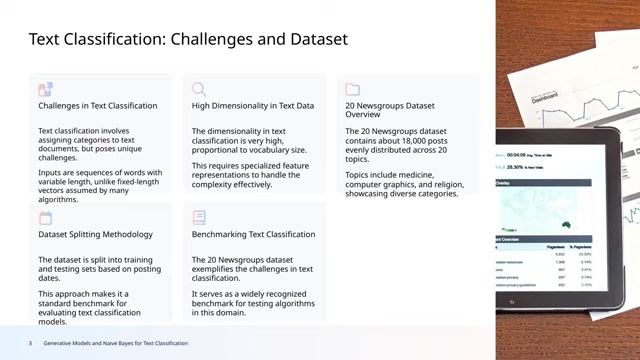
The 20 Newsgroups dataset is a widely used benchmark for text classification, offering a diverse collection of approximately 18,000 posts evenly distributed across 20 different newsgroups or topics. These topics span a broad range of subjects, including:
- Medicine
- Computer Graphics
- Religion
Dataset Characteristics:
- Diversity: The dataset’s broad coverage enables researchers to evaluate the robustness and generalizability of text classification algorithms.
- Size: With thousands of posts, the dataset provides ample data for training and testing models effectively.
- Benchmark Status: Serving as a recognized benchmark makes it possible to compare the performance of different algorithms in a standardized way.
- Splitting Methodology: Splitting the dataset into training and testing sets based on posting dates ensures that models are evaluated on unseen, future data.
The 20 Newsgroups dataset is pivotal for text classification, offering a rich and diverse collection for validating the effectiveness of machine learning models in real-world scenarios.





Most people like





































Report
Please select a reason for reporting
- 13 Reasons to Switch from Snapchat to Text Messaging
- 7 Powerful Speech to Text Apps to Boost Productivity
- 10 Best Speech to Text Tools for Effortless Transcription
- 13 Free Tools to Easily Transcribe Audio to Text
- 15 Surprising Ways Google's Speech-to-Text Boosts Productivity
- 7 Best Free Online Audio to Text Transcription Tools
- 9 Tips to Transcribe Speech to Text Faster and Better
- 13 Best Speech to Text Software for Windows 10 in 2023
- 7 Tips for Choosing the Best Transcriber for Audio to Text
- 11 Reasons Why Dragon Speech-to-Text Apps are Game-Changers
- 6 Secrets to Enhance Your Speech to Text Transcription
- 6 Brilliant Ways to Boost Productivity with Talk-to-Text on Your MacBook
- 6 Ways Transcription Software Converts Audio to Text
- 8 Tips to Transcribe Speech to Text Like a Pro
- 6 Reasons IBM Watson Speech to Text is a Game-Changer
- 14 Powerful Ways Talk-to-Text Improves Your Workflow
- 12 Top Windows Speech-to-Text Software for Efficient Transcription
- 12 Game-Changing Benefits of Apple's Speech to Text Technology
- 9 Powerful Use Cases for AWS Speech to Text Technology
- 10 Easy Steps to Transcribe YouTube Videos to Text
- transcription audio en texte
- online audio transcription
- free audio file transcription
- free ai audio transcription
- audio transcription service
- audio transcription online free
- audio transcription free online
- audio to transcription software
- audio and transcript
- ai audio transcription free
- voice recording to text converter
- translate voice recording to text
- record voice to text
- audio recording to text converter
- voice recording and transcription
- chatgpt voice to text
- gmail voice to text
- speech to text reader
- speech to text ai free
- speech to talk
- Meshy AI: How to Create 3D Models from Text and Images
- How SEO and Marketing Dashboards Empower Agencies to Drive Results
- How to Use AI Tools to Find Internal Linking Opportunities Across a Business Website
- Discover Your Perfect Haircut with AI Hairstyle Apps
- Free Reputation Calculator Tools: How They're Adapting to Score AI Visibility, Not Just Rankings
- Design Professional Flyers for Free on Your Phone
- Best Free Flyer Maker Apps for Android: Design Like a Pro
- How to Know If Your Business Is Ready for an AI Customer Service Agent
- Revolutionizing Storytelling: From Novels to Screenplays with AI
- Create Engaging Animated Explainer Videos with a Free AI Tool
- Meshy AI: How to Create 3D Models from Text and Images
- ASOMobile Helps Teams Benchmark App Store Screenshots Against Competitors
- How to Match LMS Software With Your Organization's Training Plan
- Revolutionizing Email Marketing Agency with AI
- How to Convert BTC to HNT
- Unleashing the Power of AI: Cognizant's Roadmap for Transformation
- Frame to Video Review: A Practical Look at Turning Two Still Frames Into Motion
- NVIDIA NIM: Revolutionizing Supply Chain Data Analysis with AI
- Top AI Tools That Help Brands Stand Out Offline (Not Just Online)
- Top 5 Cold Email Software: Maximize Your Outreach in 2025

Copyright ©2026 toolify