































Table of Contents
- Key Points
- Understanding the Incident Command System
- Benefits of Using the Incident Command System
- Advantages and Disadvantages of Using ICS
- Frequently Asked Questions About Incident Command System (ICS)
- Related Questions about Incident Command


Understanding the Incident Command System
What is ICS?
The Incident Command System (ICS) is a standardized approach to incident management
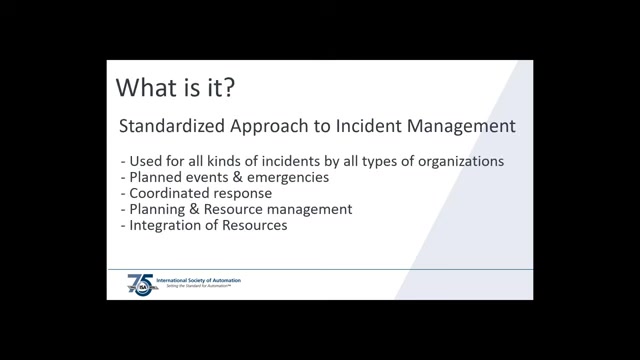
. It's designed to be used for all kinds of incidents, by all types of organizations, making it universally applicable across different sectors and emergencies. ICS is utilized by various organizations, planned events, and coordinated responses for planning and resource management, integrating resources effectively across jurisdictions and agencies.
Key characteristics of ICS include its:
- Applicability across all incident types (small or large, simple or complex).
- Adaptability for emergencies and planned events.
- Enablement of coordinated responses across different departments and jurisdictions.
- Establishment of common processes for planning and resource management.
- Integration of diverse resources into a unified organizational structure.
In essence, the Incident Command System (ICS) serves as a foundational framework, ensuring that responses to incidents, whether anticipated or unforeseen, are coordinated, efficient, and adaptable. Its widespread adoption across industries and governmental levels is a testament to its effectiveness in mitigating chaos and promoting structured problem-solving during critical events.
The Origins of ICS: Learning from Disaster
The development of the Incident Command System (ICS) wasn't a theoretical exercise; it was born out of necessity following the catastrophic 1970 Southern California fire season
. This period was marked by:
- 13 days of unrelenting fires.
- Loss of 16 lives.
- Destruction of over 700 structures.
- Burning of over 500,000 acres.
- $234 million in damages (equivalent to $1.67 billion in 2021).
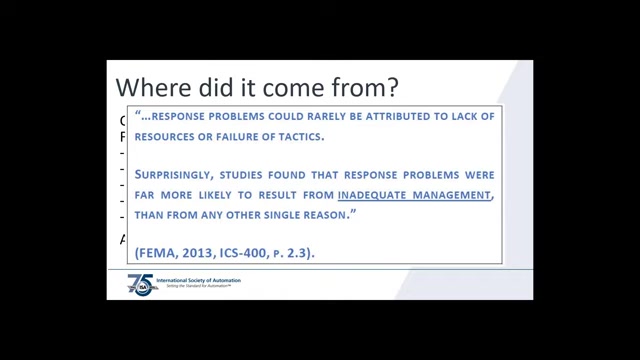
The After-Action Report (AAR) following this disastrous fire season revealed a stark truth: Response problems could rarely be attributed to a lack of resources or failure of tactics. Instead, studies found that the underlying issue was inadequate management, highlighting the need for a standardized, scalable, and coordinated approach to incident response.
This realization led to the development of FIRESCOPE (Firefighting Resources of Southern California Organized for Potential Emergencies), an interagency group that pioneered the concepts of ICS. FIRESCOPE's goal was to create a system that would ensure effective resource allocation, clear communication, and unified command during wildland fires. However, it soon became evident that the principles of ICS could be applied to a much broader range of incidents, beyond just firefighting.
Thus, ICS evolved into the versatile and widely adopted framework we know today, a testament to the power of learning from past mistakes and building a system that prioritizes management excellence.
National Incident Management System (NIMS): Embracing ICS
To further standardize and enhance incident management across the United States, the National Incident Management System (NIMS) was established
. NIMS, mandated by Homeland Security Presidential Directive 5 (HSPD-5) on February 28, 2003, provides a systematic and proactive approach to incident management. NIMS is composed of three major components:
- Resource Management: Developing standard mechanisms to systematically manage resources.
- Command and Coordination (including ICS): Defining leadership roles, processes, and organizational structures for incident management.
- Communications and Information Management: Ensuring that incident personnel have the means and information needed to make decisions.
NIMS establishes a consistent foundation for all incidents, ranging from daily occurrences to incidents requiring a coordinated federal response. It's a comprehensive system designed to guide all levels of government, non-governmental organizations, and the private sector in working together effectively to prevent, protect against, mitigate, respond to, and recover from the effects of incidents.
ICS is an important element of NIMS, which is used by all levels of organization in all sectors, all incidents, and all emergencies.
This way everyone can use a set of common process for resources allocation.
Key Principles Behind ICS
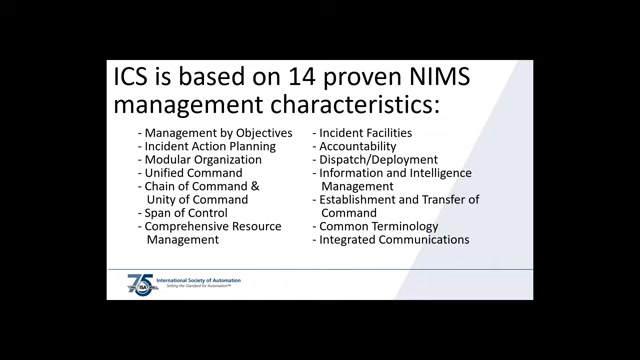
ICS functions based on 14 proven NIMS management characteristics which provides responders common processes for planning and managing resources:
| ICS Principles | Description |
|---|---|
| Management by Objectives | Directs all actions to focus on the common incident objectives |
| Incident Action Planning | Planning is done according to something specific specific we want to accomplish |
| Modular Organization | Build a command structure, depending on the incident. |
| Unified Command | Establishes a single command authorized to act. |
| Chain of Command & Unity of Command | Establishes a clear hierarchy of reporting and a single point of contact for each individual. |
| Span of Control | Maintain a manageable number of subordinates per supervisor. |
| Comprehensive Resource Management | Systematically manage resources including personnel, teams, facilities, equipment and supplies. |
| Incident Facilities | Incident facilites have accountability |
| Accountability | There are established organizational practices that hold individuals accountable and maintain a high level of professional responsibility. |
| Dispatch/Deployment | Is a prearranged level, depending on the incident level. |
| Information and Intelligence Management | Provide decision-makers with timely and accurate information. |
| Establishment and Transfer of Command | Clear guidelines and procedures for establishing, transferring, and managing command. |
| Common Terminology | Common terminology is use for clear coordination |
| Integrated Communications | Effective communication is maintained with all parts and positions of the command structure. |
These 14 proven NIMS management characteristics ensure that the Incident Command System (ICS) provides a clear and effective framework for incident response.






Most people like




































Report
Please select a reason for reporting
- 13 Reasons to Switch from Snapchat to Text Messaging
- 7 Powerful Speech to Text Apps to Boost Productivity
- 10 Best Speech to Text Tools for Effortless Transcription
- 13 Free Tools to Easily Transcribe Audio to Text
- 15 Surprising Ways Google's Speech-to-Text Boosts Productivity
- 7 Best Free Online Audio to Text Transcription Tools
- 9 Tips to Transcribe Speech to Text Faster and Better
- 13 Best Speech to Text Software for Windows 10 in 2023
- 7 Tips for Choosing the Best Transcriber for Audio to Text
- 11 Reasons Why Dragon Speech-to-Text Apps are Game-Changers
- 6 Secrets to Enhance Your Speech to Text Transcription
- 6 Brilliant Ways to Boost Productivity with Talk-to-Text on Your MacBook
- 6 Ways Transcription Software Converts Audio to Text
- 8 Tips to Transcribe Speech to Text Like a Pro
- 6 Reasons IBM Watson Speech to Text is a Game-Changer
- 14 Powerful Ways Talk-to-Text Improves Your Workflow
- 12 Top Windows Speech-to-Text Software for Efficient Transcription
- 12 Game-Changing Benefits of Apple's Speech to Text Technology
- 9 Powerful Use Cases for AWS Speech to Text Technology
- 10 Easy Steps to Transcribe YouTube Videos to Text
- transcription audio en texte
- online audio transcription
- free audio file transcription
- free ai audio transcription
- audio transcription service
- audio transcription online free
- audio transcription free online
- audio to transcription software
- audio and transcript
- ai audio transcription free
- voice recording to text converter
- translate voice recording to text
- record voice to text
- audio recording to text converter
- voice recording and transcription
- chatgpt voice to text
- gmail voice to text
- speech to text reader
- speech to text ai free
- speech to talk
- How SEO and Marketing Dashboards Empower Agencies to Drive Results
- How to Use AI Tools to Find Internal Linking Opportunities Across a Business Website
- Discover Your Perfect Haircut with AI Hairstyle Apps
- Free Reputation Calculator Tools: How They're Adapting to Score AI Visibility, Not Just Rankings
- Design Professional Flyers for Free on Your Phone
- Best Free Flyer Maker Apps for Android: Design Like a Pro
- How to Know If Your Business Is Ready for an AI Customer Service Agent
- Revolutionizing Storytelling: From Novels to Screenplays with AI
- Create Engaging Animated Explainer Videos with a Free AI Tool
- Stop Multi-Subscribing: Benchmark Top AI Visual Models in One Canvas
- AI & Elections: Defending Democracy Against Misinformation
- Navigating Political Discourse: AI, Deepfakes, and Reality Checks
- Detecting Political Bias in News Articles: A Powerful AI Algorithm
- AI Bias Unveiled: Political Leanings in ChatGPT & Beyond
- Revolutionize Learning: Discover Quizzes AI for Engaging Interactive Quizzes
- From AI-Generated to Audience-Ready: How Quillbot Humanize AI Is Changing the Content Editing Process
- Building an AI Writing Stack in 2026: LLMs, Detectors, and Humanizers
- 7 Top AI-Powered Database Assistant Platforms
- An Objective Look at Modern Web-Based Visual Modifications
- My Honest Experience with VideoAI: The Secret Weapon for Creators Who Need Character Voices

Copyright ©2026 toolify