































Table of Contents
- Key Points
- LeetCode Weekly Contest 248 Problem Solutions
- How to Use LeetCode Solutions
- LeetCode Pricing Plans
- Build Array from Permutation: Advantages and Disadvantages
- Key Features of the LeetCode Platform
- Use Cases: LeetCode in Action
- Frequently Asked Questions
- Related Questions



LeetCode Weekly Contest 248 Problem Solutions
Build Array from Permutation: Detailed Solution
The 'Build Array from Permutation' problem requires constructing a new array from a given zero-based permutation array. This means creating an array 'ans' of the same length as 'nums', where 'ans[i]' is 'nums[nums[i]]' for each 'i'. The goal is to apply the given permutation to create a new array based on the original array's indices.
Understanding the Problem Statement
Given a zero-based permutation 'nums' (0-indexed), the task is to build an array 'ans' of the same length where each element 'ans[i]' is equal to 'nums[nums[i]]'. This effectively involves rearranging the elements of 'nums' based on the values at each index. This can be visualized through Example 1 below:
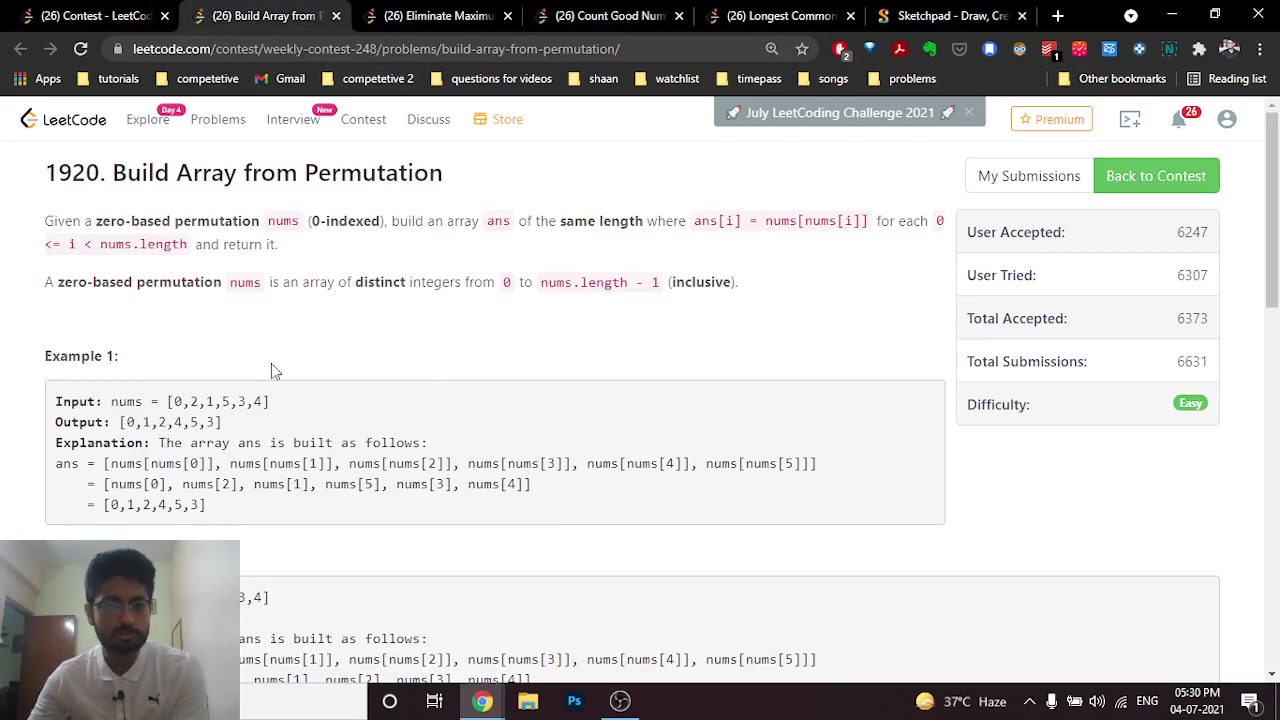
Input: nums = [0,2,1,5,3,4]
Output: [0,1,2,4,5,3]
In this example, the new 'ans' array is constructed by following the rule 'ans[i] = nums[nums[i]]'. So, 'ans[0] = nums[nums[0]] = nums[0] = 0', 'ans[1] = nums[nums[1]] = nums[2] = 1', and so on.
Algorithmic Approach
The problem can be solved using a simple iteration:
- Initialize a new array, 'ans', of the same size as 'nums'.
- Iterate through 'nums', computing each 'ans[i]' as 'nums[nums[i]]'.
-
Return the resulting 'ans' array.
This method ensures the construction of 'ans' according to the permutation mapping. The key is to correctly apply the index mapping as defined in the problem.
C++ Implementation
Here's the C++ code to implement the solution:
#include <vector>
using namespace std;

class Solution {
public:
    vector<int> buildArray(vector<int>& nums) {
        int n = nums.size();
        vector<int> ans(n);
        for (int i = 0; i < n; i++) {
            ans[i] = nums[nums[i]];
        }
        return ans;
    }
};
This code initializes 'ans' and then uses a loop to correctly map each element from 'nums' to its corresponding position in 'ans'.
Complexity Analysis
- Time Complexity: O(n), as it iterates once through the entire array.
- Space Complexity: O(n), due to the creation of a new array of the same size.
The simplicity of the algorithm ensures both efficiency and readability.
Using this method, you can build the array as requested efficiently, correctly rearranging the numbers according to the provided rules.
Eliminate Maximum Number of Monsters: Strategy and Code
The problem 'Eliminate Maximum Number of Monsters' involves a scenario where monsters are approaching a city at varying speeds and distances. The goal is to maximize the number of monsters eliminated before any monster reaches the city.
Problem Overview
Given two arrays, 'dist' and 'speed', representing the initial distances of 'n' monsters from the city and their respective speeds, the task is to eliminate as many monsters as possible. Each minute, you can eliminate one monster. If a monster reaches the city exactly at the start of a minute, it counts as a loss.
Example Scenario:
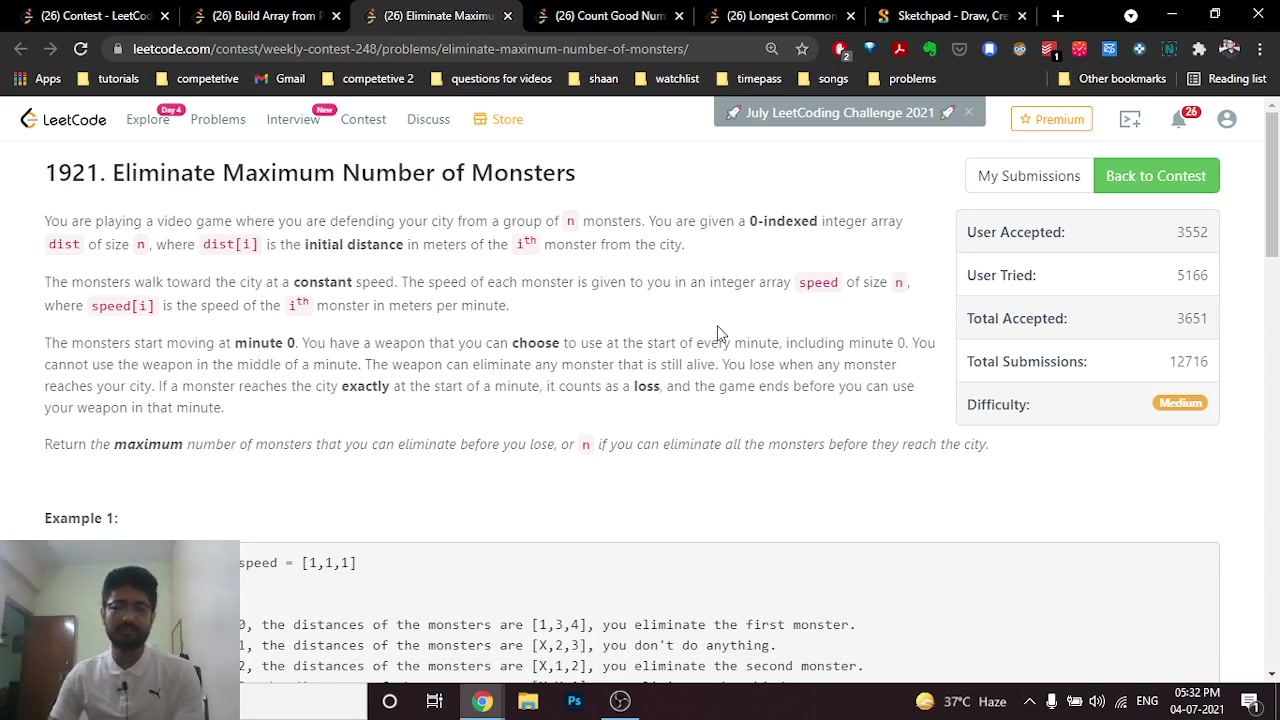
Input: dist = [1,3,4], speed = [1,1,1]
Output: 3
In this example, you can eliminate all three monsters. At the start of minute 0, you eliminate the first monster. At the start of minute 1, you eliminate the second monster, and so on.
Algorithmic Strategy
- Calculate Arrival Times: Determine the time at which each monster will reach the city by dividing its initial distance by its speed.
- Sort Arrival Times: Sort the arrival times in ascending order. This helps in prioritizing the monsters that will reach the city earliest.
- Simulate Elimination: Iterate through the sorted arrival times. If you can eliminate a monster before it arrives, increment the count of eliminated monsters and proceed to the next. If a monster reaches the city at the same time you are trying to eliminate it, you lose, and the process stops.
This approach ensures that you are always dealing with the most immediate threat first.
C++ Code Implementation
Here's a C++ implementation of this strategy:
#include <vector>
#include <algorithm>

using namespace std;

class Solution {
public:
    int eliminateMaximum(vector<int>& dist, vector<int>& speed) {
        int n = dist.size();
        vector<double> arrivalTimes(n);

        for (int i = 0; i < n; ++i) {
            arrivalTimes[i] = (double)dist[i] / speed[i];
        }

        sort(arrivalTimes.begin(), arrivalTimes.end());

        int eliminated = 0;
        for (int i = 0; i < n; ++i) {
            if (arrivalTimes[i] > i) {
                eliminated++;
            } else {
                break;
            }
        }

        return eliminated;
    }
};
This code calculates arrival times, sorts them, and then simulates the elimination process. The loop breaks as soon as a monster arrives at the city at or before the elimination attempt.
Time and Space Complexity
- Time Complexity: O(n log n), dominated by the sorting step.
- Space Complexity: O(n), due to the creation of the 'arrivalTimes' vector.
The efficient sorting and subsequent linear scanning offer a balance between speed and resource usage.
By calculating, sorting, and simulating, you can effectively maximize the number of monsters eliminated, thereby defending your city successfully.
Understanding the nuances of this simulation can help in other similar resource management problems.
Count Good Numbers: Detailed Analysis and C++ Implementation
The 'Count Good Numbers' problem challenges us to find how many digit strings of length 'n' can be formed under specific constraints. A digit string is considered 'good' if the digits at even indices are even and the digits at odd indices are prime.
Understanding Good Numbers
As the zero-based indexing shows, there are specific numbers at even positions, which are even digits and there should be prime numbers for any odd positions to be deemed good. The goal is to determine the count of such good digit strings.
The rules defining a 'good' string are:
- Digits at even indices (0, 2, 4, ...) must be even (0, 2, 4, 6, 8).
- Digits at odd indices (1, 3, 5, ...) must be prime (2, 3, 5, 7).
For example:
- '2582' is good because the digits at even indices (2 and 8) are even and the digits at odd indices (5 and 2) are prime.
- '3245' is not good because 3 is at an even index but is not even.
Prime and Even Number Counts
- There are 5 even digits: 0, 2, 4, 6, and 8.
- There are 4 prime digits: 2, 3, 5, and 7.
Modular Exponentiation
Since the answer may be very large, it should be returned modulo 10^9 + 7. Modular exponentiation can be used to compute large exponents under modulo.
Mathematical Approach
Given these constraints, here’s the mathematical formulation to solve the problem:
If the string length is 'n',
- The number of even positions is 'ceil(n/2)'.
- The number of odd positions is 'floor(n/2)'.
Thus, the number of 'good' strings is '5ceil(n/2) * 4floor(n/2)'.
C++ Code Implementation
Here's the C++ code that reflects this approach:
#define ll long long
const int M = 1e9+7;

ll mod(ll x){
    return ((x%M) + M) %M;
}

ll mul(ll a, ll b){
    return mod(mod(a) * mod(b));
}

ll modPow(ll a, ll b) {
    ll result = 1;
    while (b > 0) {
        if (b % 2 == 1)
            result = mul(result, a);

        a = mul(a, a);
        b /= 2;
    }
    return result;
}

int countGoodNumbers(long long n) {
    ll evenCount = (n + 1) / 2;
    ll oddCount = n / 2;

    ll evenPower = modPow(5, evenCount);
    ll oddPower = modPow(4, oddCount);

    return mul(evenPower, oddPower);
}
This code calculates the number of even and odd positions and uses modular exponentiation to compute '5evenCount * 4oddCount' modulo 'M'.
Complexity Analysis
- Time Complexity: O(log n), due to the use of modular exponentiation.
- Space Complexity: O(1), as it uses only a constant amount of extra space.
This log-time solution enables efficient computation, even for very large values of 'n'. The use of predefined mod power and multiplication functions streamlines the modular arithmetic. This code addresses each part of the issue in a clear and succinct manner.





Most people like

































Report
Please select a reason for reporting
- 13 Reasons to Switch from Snapchat to Text Messaging
- 7 Powerful Speech to Text Apps to Boost Productivity
- 10 Best Speech to Text Tools for Effortless Transcription
- 13 Free Tools to Easily Transcribe Audio to Text
- 15 Surprising Ways Google's Speech-to-Text Boosts Productivity
- 7 Best Free Online Audio to Text Transcription Tools
- 9 Tips to Transcribe Speech to Text Faster and Better
- 13 Best Speech to Text Software for Windows 10 in 2023
- 7 Tips for Choosing the Best Transcriber for Audio to Text
- 11 Reasons Why Dragon Speech-to-Text Apps are Game-Changers
- 6 Secrets to Enhance Your Speech to Text Transcription
- 6 Brilliant Ways to Boost Productivity with Talk-to-Text on Your MacBook
- 6 Ways Transcription Software Converts Audio to Text
- 8 Tips to Transcribe Speech to Text Like a Pro
- 6 Reasons IBM Watson Speech to Text is a Game-Changer
- 14 Powerful Ways Talk-to-Text Improves Your Workflow
- 12 Top Windows Speech-to-Text Software for Efficient Transcription
- 12 Game-Changing Benefits of Apple's Speech to Text Technology
- 9 Powerful Use Cases for AWS Speech to Text Technology
- 10 Easy Steps to Transcribe YouTube Videos to Text
- transcription audio en texte
- online audio transcription
- free audio file transcription
- free ai audio transcription
- audio transcription service
- audio transcription online free
- audio transcription free online
- audio to transcription software
- audio and transcript
- ai audio transcription free
- voice recording to text converter
- translate voice recording to text
- record voice to text
- audio recording to text converter
- voice recording and transcription
- chatgpt voice to text
- gmail voice to text
- speech to text reader
- speech to text ai free
- speech to talk
- Meshy AI: How to Create 3D Models from Text and Images
- How SEO and Marketing Dashboards Empower Agencies to Drive Results
- How to Use AI Tools to Find Internal Linking Opportunities Across a Business Website
- Discover Your Perfect Haircut with AI Hairstyle Apps
- Free Reputation Calculator Tools: How They're Adapting to Score AI Visibility, Not Just Rankings
- Design Professional Flyers for Free on Your Phone
- Best Free Flyer Maker Apps for Android: Design Like a Pro
- How to Know If Your Business Is Ready for an AI Customer Service Agent
- Revolutionizing Storytelling: From Novels to Screenplays with AI
- Create Engaging Animated Explainer Videos with a Free AI Tool
- Meshy AI: How to Create 3D Models from Text and Images
- ASOMobile Helps Teams Benchmark App Store Screenshots Against Competitors
- How to Match LMS Software With Your Organization's Training Plan
- Revolutionizing Email Marketing Agency with AI
- How to Convert BTC to HNT
- Unleashing the Power of AI: Cognizant's Roadmap for Transformation
- Frame to Video Review: A Practical Look at Turning Two Still Frames Into Motion
- NVIDIA NIM: Revolutionizing Supply Chain Data Analysis with AI
- Top AI Tools That Help Brands Stand Out Offline (Not Just Online)
- Top 5 Cold Email Software: Maximize Your Outreach in 2025

Copyright ©2026 toolify