






Table of Contents
- Key Points
- Understanding Mask2Former: An Architecture Overview
- Advanced Techniques: Masked Attention and Deformable Attention Transformers
- Experimenting with Mask2Former: A Practical Guide
- Cost-Effectiveness: Mask2Former on Free Platforms
- Pros and Cons of Using Mask2Former
- Key Capabilities: Performing Semantic Tasks
- Applications: Where Mask2Former Shines
- Frequently Asked Questions
- Related Questions



Understanding Mask2Former: An Architecture Overview
The Foundations: Transformers and Attention Mechanisms
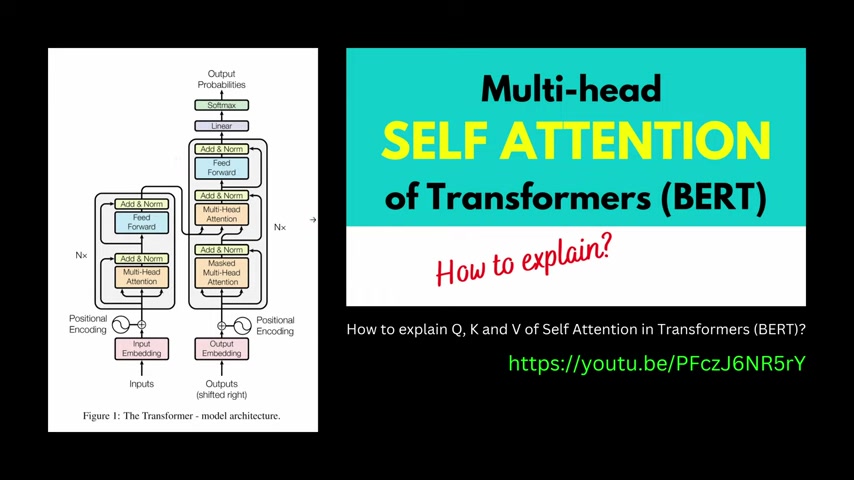
At its core, Mask2Former builds upon the principles of transformer networks, particularly the attention mechanism, which allows the model to focus on the most relevant parts of an image when making predictions. The original Google Transformer model architecture, a foundational piece in the field, provides the basis for understanding how these mechanisms operate.
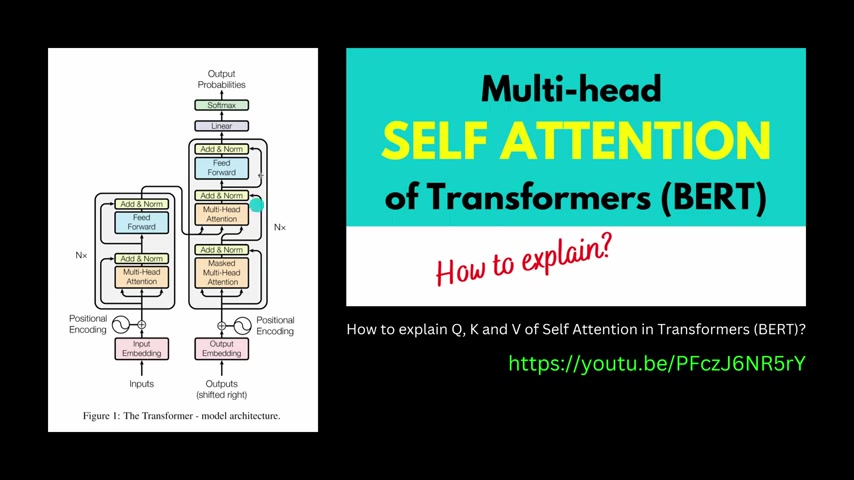
Multi-head self-attention, a key component of transformers, allows the model to attend to different parts of the input image in parallel, capturing intricate relationships between pixels. The video highlights a specific video, providing a deep dive into explaining 'Q', 'K', and 'V' of self-attention in Transformers (BERT), offering a comprehensive guide to understanding the attention mechanism.
In the decoder stack, the original Transformer model uses a multi-head attention mechanism, whereas Mask2Former employs masked attention. Masked attention restricts the attention to localized features centered around predicted segments.
The Pixel Decoder: Upsampling for Precise Segmentation
One of the distinguishing features of Mask2Former is its use of a pixel decoder.
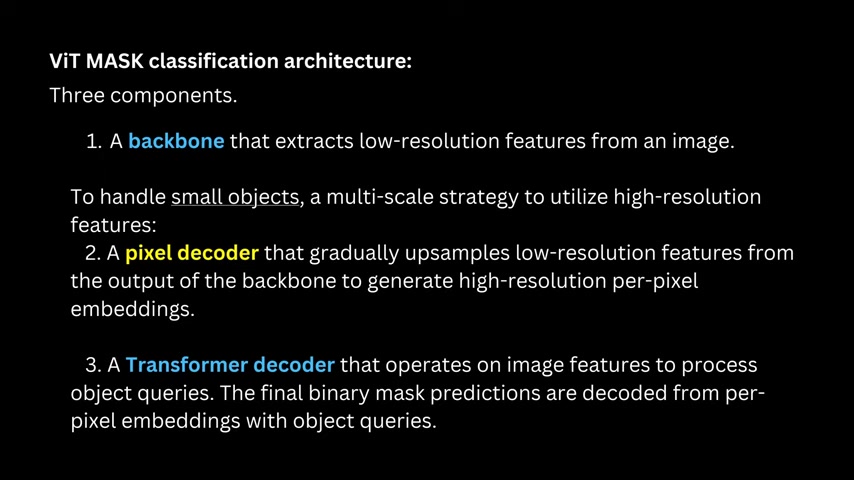
This module is responsible for upsampling low-resolution feature maps generated by the backbone network into high-resolution per-pixel embeddings. This upsampling process is critical for producing accurate and detailed segmentation masks, allowing the model to delineate object boundaries with precision. A multi-scale strategy, crucial for handling small objects, is integrated with Pixel Decoder to utilize high-resolution features.
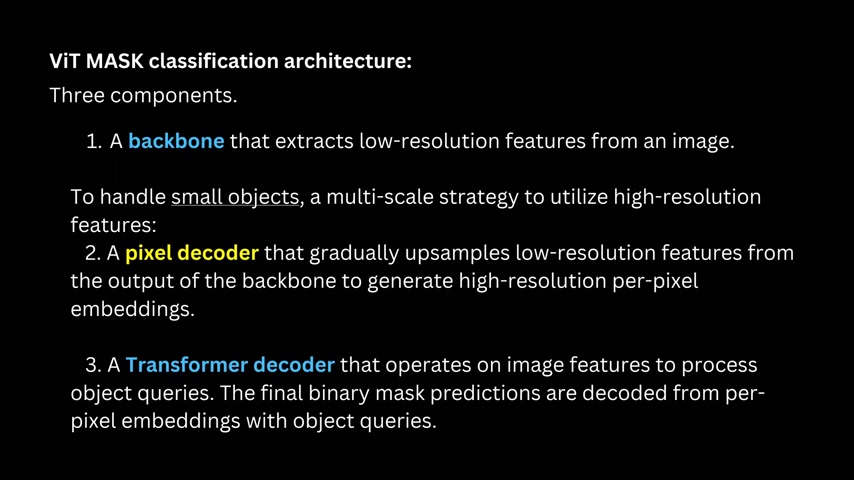
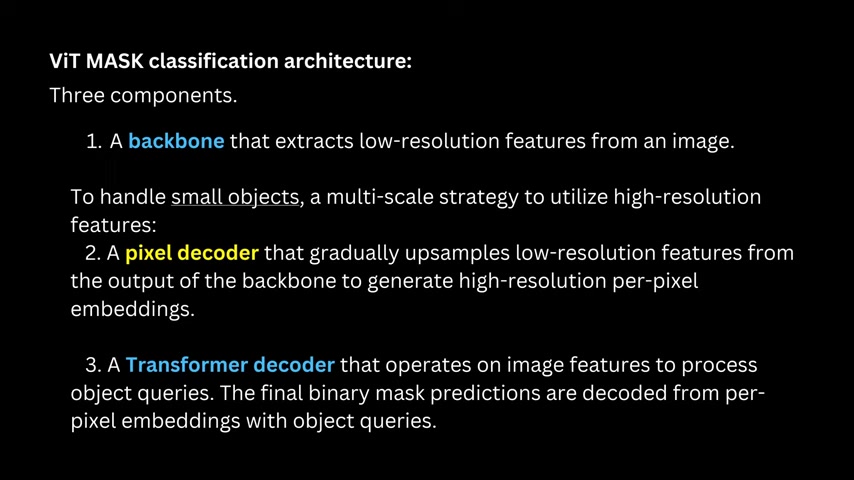
Specifically, the VIT MASK classification architecture consists of three essential components:
- A backbone that extracts low-resolution features from an image.
- A pixel decoder that gradually upsamples low-resolution features from the output of the backbone to generate high-resolution per-pixel embeddings.
- A Transformer decoder that operates on image features to process object queries. The final binary mask predictions are decoded from per-pixel embeddings with object queries.
The Swin Transformer: A Backbone for Feature Extraction
The video mentions that the backbone network is typically a Swin Transformer.
The Swin Transformer, short for Shifted Window Transformer, is a hierarchical vision transformer that offers several advantages over traditional convolutional neural networks. Specifically, Swin Transformer is known for its efficiency and ability to capture long-range dependencies in images. The Swin Transformer, through shifted windows, allows for more effective interaction between local and global features, which leads to a stronger performance on various segmentation tasks. A major advantage is that it restricts the attention to localized features centered around predicted segments. Feature Pyramid Networks is often chosen as the default for simplicity.
Table: The Swin Transformer Architecture:
| Feature | Description |
|---|---|
| Hierarchical | Multi-scale strategy to handle objects of varying sizes. |
| Shifted Window | Efficient interaction between local and global image features. |
| Transformer | Captures long-range dependencies essential for contextual understanding. |
| Efficiency | Designed for computational efficiency, especially important for high-resolution images. |
Advanced Techniques: Masked Attention and Deformable Attention Transformers
Masked Attention: Focusing on Relevant Features
While traditional attention mechanisms allow the model to attend to any part of the image, masked attention restricts this focus to more localized regions. Masked attention helps the model concentrate on the most relevant features, centered around predicted segments. This targeted attention is particularly beneficial for improving segmentation accuracy and reducing computational cost. There are other variants of cross-attention. Most recently, the K-Net has replaced cross-attention with a mask pooling operation that averages features within mask regions.
Moving Beyond: Deformable Attention Transformers
Advancements in pixel decoder design, the mask to format architecture can use advanced multi-scale deformable attention Transformers in conjunction with feature pyramid networks,
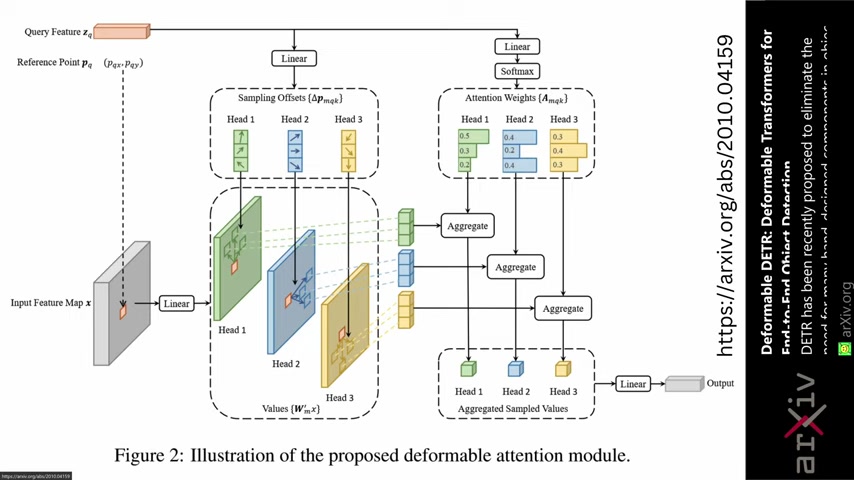
this approach, which learns transformation offsets of pixels to contextualize unsampled higher-level features and another feature section module to emphasize the lower-level features with rich spatial details, has been shown to improve performance in various segmentation tasks by learning transformation offsets of pixels to contextualize unsampled higher-level features, and also providing another feature selection module to emphasize the lower-level features with rich spatial details.
Experimenting with Mask2Former: A Practical Guide
Understanding Configuration Parameters
Before diving into practical experimentation, take time to familiarize yourself with the configuration parameters of Mask2Former. These parameters control various aspects of the model's architecture and training process, including the size of the backbone network, the number of decoder layers, and the learning rate. Understanding these parameters is crucial for tailoring the model to specific segmentation tasks and datasets.
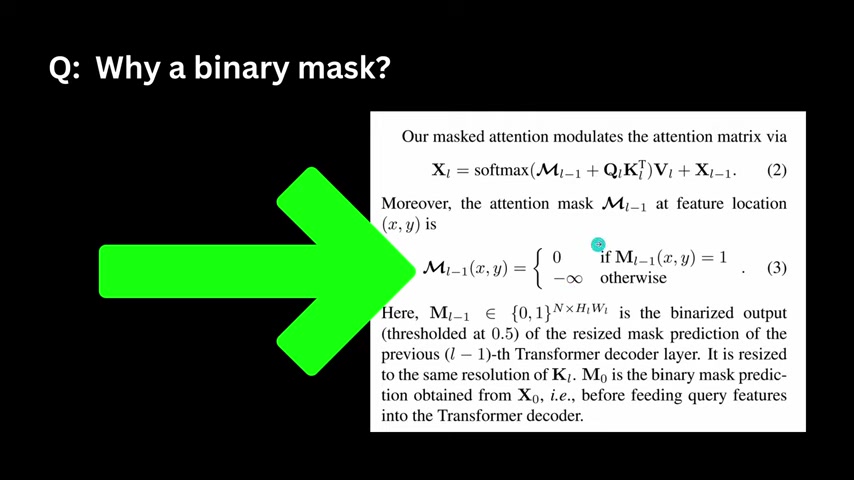
Table: Key Configuration Parameters for Mask2Former
| Parameter | Description |
|---|---|
backbone_config |
Specifies the configuration of the feature extraction backbone (e.g., Swin-Base, ResNet). |
decoder_layers |
Controls the number of layers in the Transformer decoder. |
attention_probs_dropout_prob |
Specifies the dropout probability for attention weights, preventing overfitting. |
decoder_feedforward_dim |
Sets the dimensionality of the feedforward network in the decoder layers. |
batch_size |
Determines the number of images processed in each batch during training. |
learning_rate |
Controls the step size during optimization. |
weight_decay |
Regularization parameter to prevent overfitting by penalizing large weights. |
Step-by-step Instructions to Installing and Validating the Model
To begin working with Mask2Former, there are a few steps to follow for a successful deployment of the model:
-
Install the PyTorch, TorchVision, and TorchAudio. Pip Installation is as follows:
pip install torch torchvision torchaudio --extra-index-url https://download.pytorch.org/whl/cu116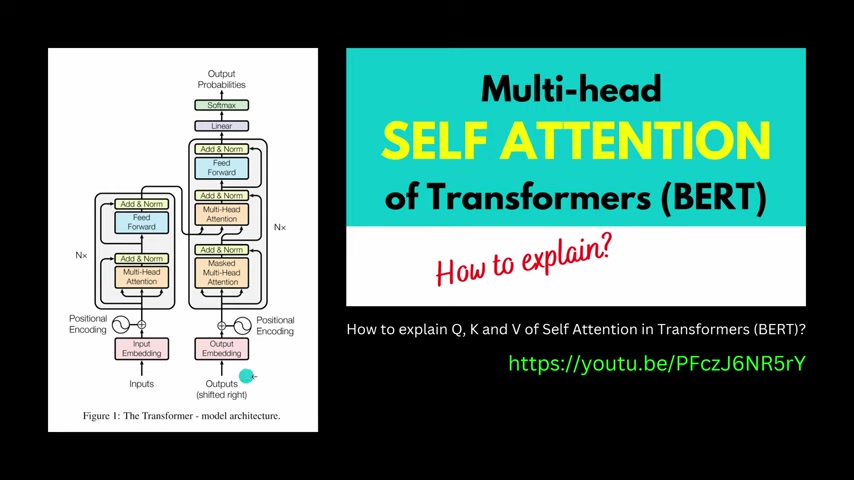
-
Clone the detectron2 Framework. This may involve a git installation from Facebook Research with the code
pip install git+https://github.com/facebookresearch/detectron2.git. -
Install other dependencies.
pip install gradio opencv-python scipy -
Validate the Importance of Each Component. To ensure optimal performance, test each component of Mask2Former individually, to know for yourself whether each one is functioning as intended. Validating each component involves analyzing Table 4a to lead to the biggest improvement across all tasks, specifically the efficient multi-scale strategy. Remember, this is all experimental data.
Cost-Effectiveness: Mask2Former on Free Platforms
Leveraging Free Resources
One of the significant advantages highlighted in the video is the ability to run Mask2Former on free platforms like Google Colab.
This accessibility dramatically lowers the barrier to entry for researchers, students, and hobbyists, enabling them to experiment with state-of-the-art Image Segmentation techniques without incurring substantial computational costs. The video emphasizes a reminder to its listeners to remain calm if understanding these deep technicals is difficult, because understanding is only accomplished through countless hours of expert level work. To have success you can't just look at them once!
Key Capabilities: Performing Semantic Tasks
Exploring Mask2Former's Segmentation Mastery
-
Panoptic Segmentation: A unified approach that segments an image into both thing (countable objects) and stuff (background) classes.
-
Semantic Segmentation: Assigning a semantic label to each pixel, classifying the image into meaningful regions.
-
Instance Segmentation: Identifying each instance of a particular object class within the image.
These features, combined with the models backbone network and pixel decoder, facilitate detailed and comprehensive image understanding, enabling a wide range of computer vision applications.


Most people like



































Report
Please select a reason for reporting
- 13 Reasons to Switch from Snapchat to Text Messaging
- 7 Powerful Speech to Text Apps to Boost Productivity
- 10 Best Speech to Text Tools for Effortless Transcription
- 13 Free Tools to Easily Transcribe Audio to Text
- 15 Surprising Ways Google's Speech-to-Text Boosts Productivity
- 7 Best Free Online Audio to Text Transcription Tools
- 9 Tips to Transcribe Speech to Text Faster and Better
- 13 Best Speech to Text Software for Windows 10 in 2023
- 7 Tips for Choosing the Best Transcriber for Audio to Text
- 11 Reasons Why Dragon Speech-to-Text Apps are Game-Changers
- 6 Secrets to Enhance Your Speech to Text Transcription
- 6 Brilliant Ways to Boost Productivity with Talk-to-Text on Your MacBook
- 6 Ways Transcription Software Converts Audio to Text
- 8 Tips to Transcribe Speech to Text Like a Pro
- 6 Reasons IBM Watson Speech to Text is a Game-Changer
- 14 Powerful Ways Talk-to-Text Improves Your Workflow
- 12 Top Windows Speech-to-Text Software for Efficient Transcription
- 12 Game-Changing Benefits of Apple's Speech to Text Technology
- 9 Powerful Use Cases for AWS Speech to Text Technology
- 10 Easy Steps to Transcribe YouTube Videos to Text
- transcription audio en texte
- online audio transcription
- free audio file transcription
- free ai audio transcription
- audio transcription service
- audio transcription online free
- audio transcription free online
- audio to transcription software
- audio and transcript
- ai audio transcription free
- voice recording to text converter
- translate voice recording to text
- record voice to text
- audio recording to text converter
- voice recording and transcription
- chatgpt voice to text
- gmail voice to text
- speech to text reader
- speech to text ai free
- speech to talk
- ChatGPT Knows Ford. It Just Doesn't Quote Ford
- Meshy AI: How to Create 3D Models from Text and Images
- How SEO and Marketing Dashboards Empower Agencies to Drive Results
- How to Use AI Tools to Find Internal Linking Opportunities Across a Business Website
- Discover Your Perfect Haircut with AI Hairstyle Apps
- Free Reputation Calculator Tools: How They're Adapting to Score AI Visibility, Not Just Rankings
- Design Professional Flyers for Free on Your Phone
- Best Free Flyer Maker Apps for Android: Design Like a Pro
- How to Know If Your Business Is Ready for an AI Customer Service Agent
- Revolutionizing Storytelling: From Novels to Screenplays with AI
- Can an eSIM Plan Save You Time During Travel Setup?
- AI Video Editor Review: A Hands-On Look at Prompt-Based Video Editing
- Keep Characters Consistent Across Scenes With Image-to-Video AI
- How to Convert BTC to HNT
- ProxyWing DuckDuckGo Proxy Review: Plans, Setup and Who It Is For
- ChatGPT Knows Ford. It Just Doesn't Quote Ford
- Automate Lead Generation: A Comprehensive Guide with AI Agents
- Revideo.io: The Future of Reverse Video Search Technology
- Revolutionizing Email Marketing Agency with AI
- Breaking the Character Drift Dilemma: A Practical Test of Smart Shot

Copyright ©2026 toolify