






Table of Contents
- Key Points
- Foundation for Effective Commander Deck Building
- Putting it All Together
- How to Implement These Concepts
- Balancing a Commander Deck
- FAQ
- Related Questions



Foundation for Effective Commander Deck Building
Starting with the Commander
The cornerstone of any Commander deck is, unsurprisingly, the Commander itself. This legendary creature dictates the color identity of your deck and heavily influences your overall strategy.
Many players find a Commander that excites them and then build around its unique abilities. The Commander informs many of the card choices you'll make, so it's vital to select one that aligns with your preferred play style.
Consider the following when choosing your Commander:
- Color Identity: Your Commander's colors restrict the cards you can include in your deck. For example, if your Commander is Boros (Red/White), you can only use Red, White, and colorless cards.
- Abilities: The Commander's abilities offer a direction for your deck. Is it a Voltron commander, meant to be buffed with auras and equipment? Is it a value engine, generating card advantage or mana? Understanding the Commander’s primary function will help you focus your deck-building efforts.
- Synergy: Consider how the Commander interacts with other cards in the Game. Does it synergize with specific card types, strategies, or keywords? Synergistic Commanders will lead to a more powerful and consistent deck.
While some advise against building entirely around your Commander, it's a common (and often effective) strategy. As you gain more experience with Commander, you'll find yourself capable of experimenting with decks that are less reliant on the Commander. For now, focus on leveraging your Commander's strengths.
Consider commanders like:
- Kuja, Genome Sorcerer: A legendary creature perfect for a black wizard deck build around controlling the flow of the game and disrupting your opponents.
- Selvala, Explorer Returned: An elf scout built to provide mana ramping capabilities that is perfectly suited for green-white decks that intend to ramp into late game plays.
Read the Card Text Carefully
Reading and understanding your commander's card text is vital. This might seem obvious, but many players jump straight into card selection without fully grasping the nuances of their Commander's abilities. Every WORD matters in Magic: The Gathering, and missing a detail can significantly impact your deck's performance. Pay close attention to keywords, triggered abilities, and any specific conditions that must be met.
Let's take Ragost, Deft Gastronaut as an example
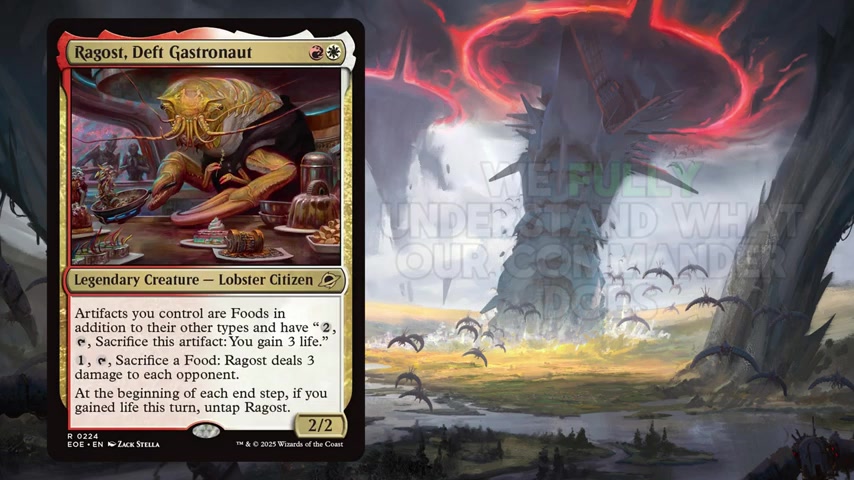
. A quick glance might lead you to focus solely on the food synergies. However, a closer reading reveals that:
- All artifacts become food: This opens up a wide array of artifact synergies beyond just dedicated food tokens.
- The ability to pay mana and deal damage: He can deal 3 damage to each opponent at the cost of a food.
- Untapping: You can uptap him every end step if you gained life this turn, whether or not it came from one of your cards.
Understanding the finer points of your commander's card text can transform your deckbuilding strategy. It's important to really dig in, understand that card, and figure out how you can leverage it for maximum value.
Taking the time to truly understand your commander will guide how you approach that card.
Understanding Color Identity
In Commander, color identity is more restrictive than color. While a card's mana cost and effects might contain certain colors, its color identity includes any mana symbols present anywhere on the card, including reminder text. This significantly impacts deck construction as it controls which colors you can have in your deck.
The color pie dictates what each color typically excels at. Red and White, for example, can provide artifact and burn synergies. White is usually associated with life-gain and untapping effects
. Understanding these typical roles allows you to fill gaps where a deck may be missing something.
For instance, in a red/white deck like Ragost, Deft Gastronaut, red could be the artifacts and burn strategies and white could provide life gain and uptapping. Knowing the functions helps understand what will and won't work in any particular type of deck.
Payoff or Engine
Consider what role your commander plays in your deck. Is your Commander the payoff or the engine? Payoff commanders are meant to win you the game through their unique abilities. Engine commanders generate advantage or create opportunities for other cards to shine. Identifying this fundamental aspect will determine your emphasis on a deck build.
- Payoff: Commander is the main component needed to get a strategy going. Often times they are versatile and will often win by themselves.
- Engine: Commander is used in conjunction with a variety of cards. It is important to include these cards to compliment the commander to ensure the win conditions are being met.
A commander like [[Atraxa, Praetors' Voice]] can be used in a variety of ways. You can use it to push planeswalkers and proliferate. Because of this it is seen as both an engine and a payoff
.
If your commander is a payoff, then it is important that you balance your deck with engine cards to ensure you are getting your commander onto the board. If your commander is an engine then you need to balance the deck to ensure that the engine is well supported.
Managing Mana
In all decks, mana is the key to success in Commander. Mana can be a problem if you don't dedicate enough effort into it. It's no use having an amazing strategy in your deck if you never have the mana to execute it. This makes mana production key, therefore, a significant portion of your deck should focus on mana and ramp.
Prioritize the following to ensure you have enough mana to succeed:
- Land Count: Aim for approximately 35 lands to ensure you consistently hit your land drops.
- Ramp Spells: The more ramp you have, the better, however it is recommended 15-20 pieces of ramp.
It can vary depending on preference, however, it is important that you ensure your deck has what you need.
With these suggestions your deck will be properly suited to reach the late game in the game.


Most people like






































Report
Please select a reason for reporting
- 13 Reasons to Switch from Snapchat to Text Messaging
- 7 Powerful Speech to Text Apps to Boost Productivity
- 10 Best Speech to Text Tools for Effortless Transcription
- 13 Free Tools to Easily Transcribe Audio to Text
- 15 Surprising Ways Google's Speech-to-Text Boosts Productivity
- 7 Best Free Online Audio to Text Transcription Tools
- 9 Tips to Transcribe Speech to Text Faster and Better
- 13 Best Speech to Text Software for Windows 10 in 2023
- 7 Tips for Choosing the Best Transcriber for Audio to Text
- 11 Reasons Why Dragon Speech-to-Text Apps are Game-Changers
- 6 Secrets to Enhance Your Speech to Text Transcription
- 6 Brilliant Ways to Boost Productivity with Talk-to-Text on Your MacBook
- 6 Ways Transcription Software Converts Audio to Text
- 8 Tips to Transcribe Speech to Text Like a Pro
- 6 Reasons IBM Watson Speech to Text is a Game-Changer
- 14 Powerful Ways Talk-to-Text Improves Your Workflow
- 12 Top Windows Speech-to-Text Software for Efficient Transcription
- 12 Game-Changing Benefits of Apple's Speech to Text Technology
- 9 Powerful Use Cases for AWS Speech to Text Technology
- 10 Easy Steps to Transcribe YouTube Videos to Text
- transcription audio en texte
- online audio transcription
- free audio file transcription
- free ai audio transcription
- audio transcription service
- audio transcription online free
- audio transcription free online
- audio to transcription software
- audio and transcript
- ai audio transcription free
- voice recording to text converter
- translate voice recording to text
- record voice to text
- audio recording to text converter
- voice recording and transcription
- chatgpt voice to text
- gmail voice to text
- speech to text reader
- speech to text ai free
- speech to talk
- ChatGPT Knows Ford. It Just Doesn't Quote Ford
- Meshy AI: How to Create 3D Models from Text and Images
- How SEO and Marketing Dashboards Empower Agencies to Drive Results
- How to Use AI Tools to Find Internal Linking Opportunities Across a Business Website
- Discover Your Perfect Haircut with AI Hairstyle Apps
- Free Reputation Calculator Tools: How They're Adapting to Score AI Visibility, Not Just Rankings
- Design Professional Flyers for Free on Your Phone
- Best Free Flyer Maker Apps for Android: Design Like a Pro
- How to Know If Your Business Is Ready for an AI Customer Service Agent
- Revolutionizing Storytelling: From Novels to Screenplays with AI
- Your Business Data Could Be Worth Up to $4M. Find Out Without Uploading a Single File.
- Can an eSIM Plan Save You Time During Travel Setup?
- AI Video Editor Review: A Hands-On Look at Prompt-Based Video Editing
- Keep Characters Consistent Across Scenes With Image-to-Video AI
- How to Convert BTC to HNT
- ProxyWing DuckDuckGo Proxy Review: Plans, Setup and Who It Is For
- ChatGPT Knows Ford. It Just Doesn't Quote Ford
- Automate Lead Generation: A Comprehensive Guide with AI Agents
- Revideo.io: The Future of Reverse Video Search Technology
- Revolutionizing Email Marketing Agency with AI

Copyright ©2026 toolify