






Table of Contents
- Key Points for Effective Math Homework
- Tackling Geometry Homework with Precision
- Solving Multi-Step Word Problems: A Strategic Approach
- Practical Tips for Mastering Math Homework
- Advantages and Disadvantages of Different Math Problem-Solving Techniques
- Frequently Asked Questions About Math Homework
- Related Questions for Further Exploration



Tackling Geometry Homework with Precision
Understanding Quadrilaterals and Measurements
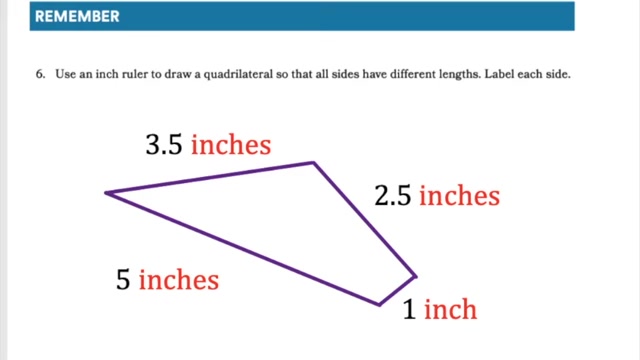
Geometry, at its core, is the study of shapes, sizes, and spatial relationships. When it comes to geometry Homework, accuracy is paramount. A common type of problem involves drawing specific shapes using precise measurements. One example is the task of drawing a quadrilateral where each side has a different length. This type of assignment tests not only your ability to use a ruler accurately but also your understanding of what defines a quadrilateral—a four-sided polygon.
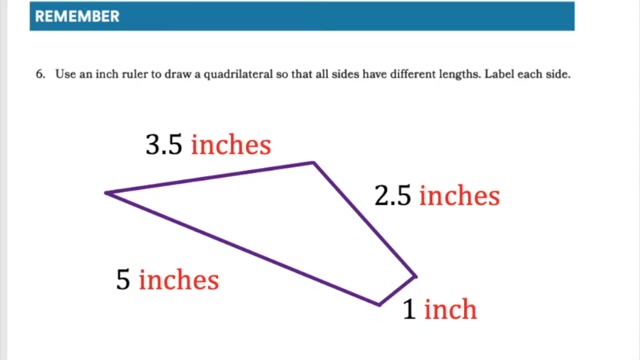
To approach this type of problem effectively, follow these steps:
- Gather Your Tools: Ensure you have a ruler, a pencil, and a clean sheet of paper. An eraser is also handy for making corrections.
- Plan Your Quadrilateral: Before you start drawing, decide on the lengths you want each side to be. For instance, you might choose lengths of 2 inches, 3.5 inches, 4.25 inches, and 5 inches. Make sure these lengths are different to meet the problem's requirements.
- Draw the First Side: Use your ruler to draw the first side to your chosen length. Place the ruler carefully and draw a straight line along the edge.
- Draw the Second Side: Position your ruler at one end of the first line and draw the second side at an angle. Again, ensure the length matches your plan.
- Draw the Third and Fourth Sides: Continue drawing the remaining sides, connecting them to form a closed shape. Each side should have a different length, and the shape should be a quadrilateral.
-
Label Each Side: Once you've completed the drawing, use your pencil to label each side with its corresponding length. This is an important step to show that you've measured each side and followed the instructions correctly.
Remember, the key to success with geometry homework is precision. Take your time, measure carefully, and double-check your work. By following these steps, you'll be well on your way to mastering geometry and acing your assignments.
Keywords: Geometry, quadrilateral, measurements, ruler, accuracy, drawing, shapes
Solving Multi-Step Word Problems: A Strategic Approach
Breaking Down Complex Problems Step-by-Step
Many math assignments include complex WORD problems that require multiple steps to solve. These problems often present a scenario and ask you to find a solution using a combination of mathematical operations. The key to tackling these problems is to break them down into smaller, more manageable steps.
One effective strategy for solving multi-step word problems is the Read-Draw-Write process. This method helps you organize your thoughts and approach the problem systematically:
- Read: Carefully read the problem to understand the scenario and what you're being asked to find. Identify any key information, such as numbers and relationships between them.
- Draw: Create a visual representation of the problem. This could be a diagram, chart, or any other type of visual that helps you understand the relationships between the different elements of the problem.
-
Write: Write down the steps you need to take to solve the problem. This could include identifying the operations you need to perform (addition, subtraction, multiplication, division) and the order in which you need to perform them.
Let's look at an example. Imagine a problem where a book company sells 342,380 copies of a book in the first week and 361,419 copies in the second week. After three weeks, the company has sold 923,468 copies total. The question is: how many copies did they sell in the third week?
Here’s how the read, draw, write strategy would work:
- Read: Identify the important numbers: Week 1: 342,380; Week 2: 361,419; Total after 3 weeks: 923,468
- Draw: You might draw a bar representing the total copies sold and divide it into three sections representing each week.
-
Write: First, add the number of copies sold in week one and week two. Then, subtract that sum from the total number of copies sold after three weeks to find the number of copies sold in the third week.
This organized approach not only simplifies the problem but also reduces the likelihood of errors.
Keywords: Math homework, problem-solving, multi-step, word problems, read-draw-write, strategy, complex problems, solving
Estimating Answers to Ensure Reasonableness
One crucial skill in math is estimating answers. This technique helps you determine whether your final solution is reasonable. Before diving into complex calculations, take a moment to estimate what the answer should be. This can be done by rounding numbers to the nearest ten, hundred, or thousand, depending on the scale of the problem.
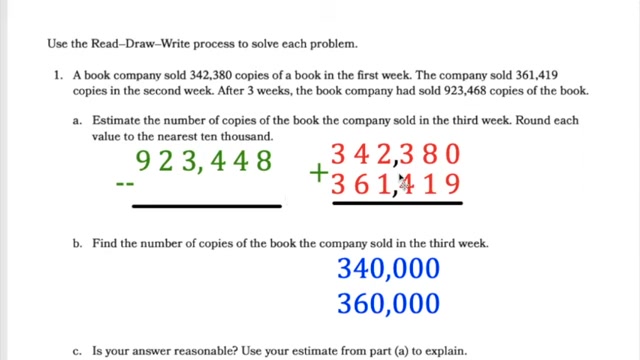
For instance, continuing with the book company example: Instead of adding 342,380 and 361,419 directly, you could round these numbers to the nearest ten thousand: 340,000 + 360,000. The estimated sum is 700,000. This estimation gives you a benchmark to compare against your final answer.
After completing the calculations, if your final answer is drastically different from the estimated 700,000, it indicates a potential error in your calculations that needs revisiting. Estimating provides a safety net, preventing you from submitting answers that are obviously incorrect.
Keywords: Estimating, answers, reasonableness, math, calculations, rounding, benchmark, error, check


Most people like




































Report
Please select a reason for reporting
- 13 Reasons to Switch from Snapchat to Text Messaging
- 7 Powerful Speech to Text Apps to Boost Productivity
- 10 Best Speech to Text Tools for Effortless Transcription
- 13 Free Tools to Easily Transcribe Audio to Text
- 15 Surprising Ways Google's Speech-to-Text Boosts Productivity
- 7 Best Free Online Audio to Text Transcription Tools
- 9 Tips to Transcribe Speech to Text Faster and Better
- 13 Best Speech to Text Software for Windows 10 in 2023
- 7 Tips for Choosing the Best Transcriber for Audio to Text
- 11 Reasons Why Dragon Speech-to-Text Apps are Game-Changers
- 6 Secrets to Enhance Your Speech to Text Transcription
- 6 Brilliant Ways to Boost Productivity with Talk-to-Text on Your MacBook
- 6 Ways Transcription Software Converts Audio to Text
- 8 Tips to Transcribe Speech to Text Like a Pro
- 6 Reasons IBM Watson Speech to Text is a Game-Changer
- 14 Powerful Ways Talk-to-Text Improves Your Workflow
- 12 Top Windows Speech-to-Text Software for Efficient Transcription
- 12 Game-Changing Benefits of Apple's Speech to Text Technology
- 9 Powerful Use Cases for AWS Speech to Text Technology
- 10 Easy Steps to Transcribe YouTube Videos to Text
- transcription audio en texte
- online audio transcription
- free audio file transcription
- free ai audio transcription
- audio transcription service
- audio transcription online free
- audio transcription free online
- audio to transcription software
- audio and transcript
- ai audio transcription free
- voice recording to text converter
- translate voice recording to text
- record voice to text
- audio recording to text converter
- voice recording and transcription
- chatgpt voice to text
- gmail voice to text
- speech to text reader
- speech to text ai free
- speech to talk
- Meshy AI: How to Create 3D Models from Text and Images
- How SEO and Marketing Dashboards Empower Agencies to Drive Results
- How to Use AI Tools to Find Internal Linking Opportunities Across a Business Website
- Discover Your Perfect Haircut with AI Hairstyle Apps
- Free Reputation Calculator Tools: How They're Adapting to Score AI Visibility, Not Just Rankings
- Design Professional Flyers for Free on Your Phone
- Best Free Flyer Maker Apps for Android: Design Like a Pro
- How to Know If Your Business Is Ready for an AI Customer Service Agent
- Revolutionizing Storytelling: From Novels to Screenplays with AI
- Create Engaging Animated Explainer Videos with a Free AI Tool
- Automate Lead Generation: A Comprehensive Guide with AI Agents
- Revideo.io: The Future of Reverse Video Search Technology
- Revolutionizing Email Marketing Agency with AI
- Breaking the Character Drift Dilemma: A Practical Test of Smart Shot
- Meshy AI: How to Create 3D Models from Text and Images
- ASOMobile Helps Teams Benchmark App Store Screenshots Against Competitors
- How to Match LMS Software With Your Organization's Training Plan
- How to Convert BTC to HNT
- Unleashing the Power of AI: Cognizant's Roadmap for Transformation
- Frame to Video Review: A Practical Look at Turning Two Still Frames Into Motion

Copyright ©2026 toolify