































Table of Contents
- Key Points
- Tackling Single Variable Calculus Problems
- Mastering Partial Fraction Decomposition
- Step-by-Step Guide to Solving Calculus Problems
- Pros and Cons of Single Variable Calculus Techniques
- Frequently Asked Questions
- Related Questions



Tackling Single Variable Calculus Problems
Finding Antiderivatives: A Systematic Approach
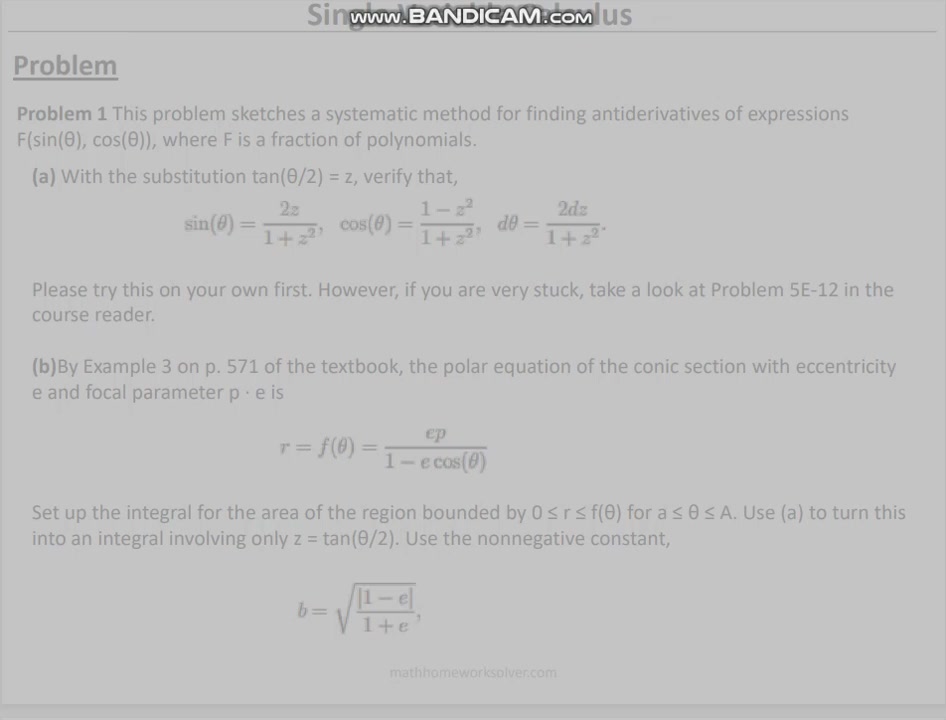
One of the core challenges in calculus is finding antiderivatives of functions. A systematic method is often the key to successfully solving these problems. Many integrals involve trigonometric functions, making it essential to understand trigonometric substitutions. A common type involves finding the antiderivatives of expressions in the form F(sin(θ), cos(θ)), where F is a fraction of polynomials.
The goal is to transform these expressions into a form that is easier to integrate.
Substitution Technique: A crucial technique is to use appropriate substitutions to simplify the integral. For instance, the substitution tan(θ/2) = z can be incredibly effective. With this substitution, it's possible to express sin(θ), cos(θ), and dθ in terms of z, allowing you to rewrite the integral in terms of a single variable. This can significantly simplify the integration process.
Trigonometric Identities: Trigonometric identities are your best friend here. Understanding and applying identities like sin(θ) = 2z/(1 + z^2), cos(θ) = (1 - z^2)/(1 + z^2), and dθ = 2dz/(1 + z^2) is crucial for transforming the integral into a solvable form. These identities help convert trigonometric functions into algebraic expressions, making integration simpler.
Remember, it's always a good idea to try solving the problem on your own first. However, if you find yourself stuck, resources like problem 5E-12 in a Course reader can provide valuable guidance.
Working with Conic Sections and Polar Equations
Conic sections, such as ellipses, parabolas, and hyperbolas, play a significant role in calculus. Understanding their polar equations is particularly useful when calculating areas and performing other related tasks.
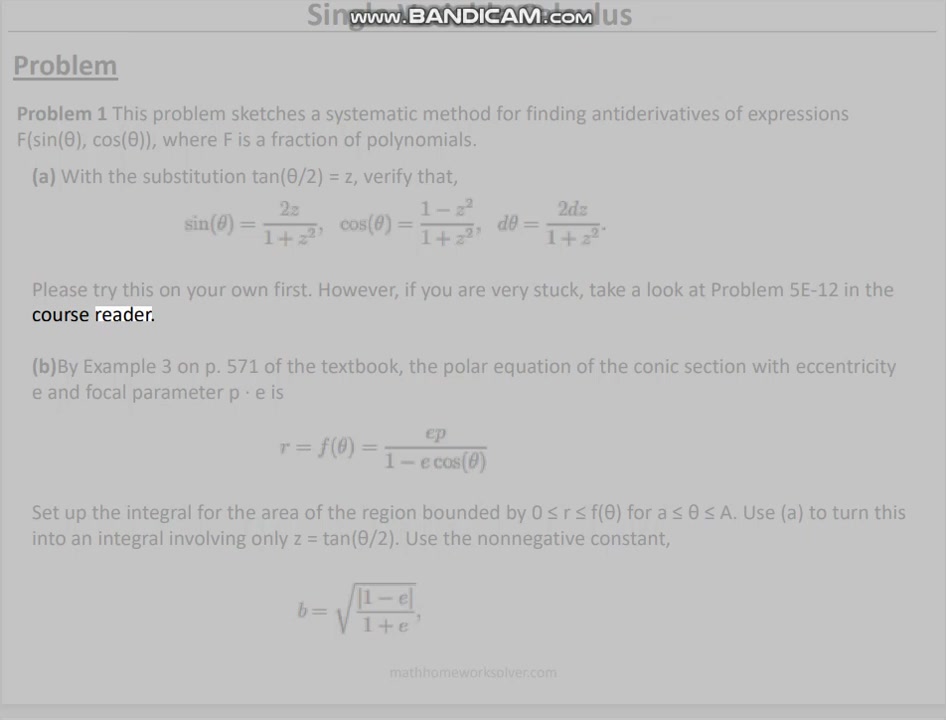
Consider a Scenario where you need to set up an integral for the area of a region bounded by 0 ≤ r ≤ f(θ) for a ≤ θ ≤ A.
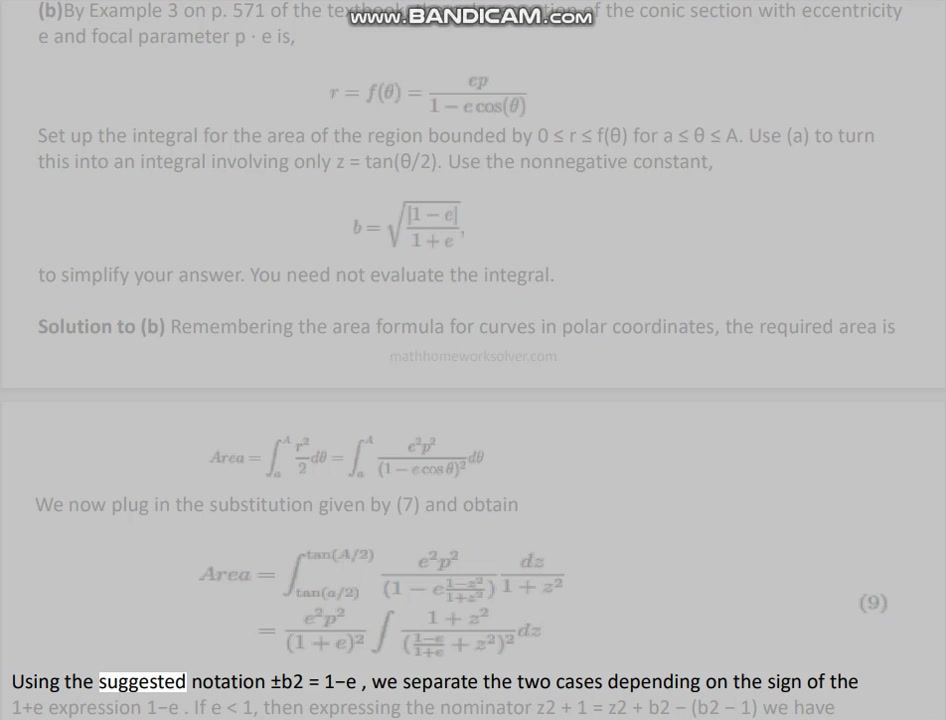
Polar Equation and Eccentricity: The polar equation of a conic section with eccentricity e and focal parameter p · e is given by r = f(θ) = ep / (1 - e cos(θ)). Understanding the parameters involved in this equation is crucial. The eccentricity, e, determines the type of conic section, while the focal parameter, p · e, influences its size and orientation.
Setting Up the Integral: To calculate the area, you would set up an integral in polar coordinates. However, the goal is often to transform this integral into one involving only z = tan(θ/2). To do this, you'll use the same substitution techniques Mentioned earlier, converting the trigonometric functions into algebraic expressions involving z.
Area Calculation: Once the integral is transformed, use the non-negative constant b = √(1 - e) / (1 + e) to simplify further. You usually don't need to evaluate the integral explicitly, but setting it up correctly is essential.
Integration by Parts: Advanced Techniques
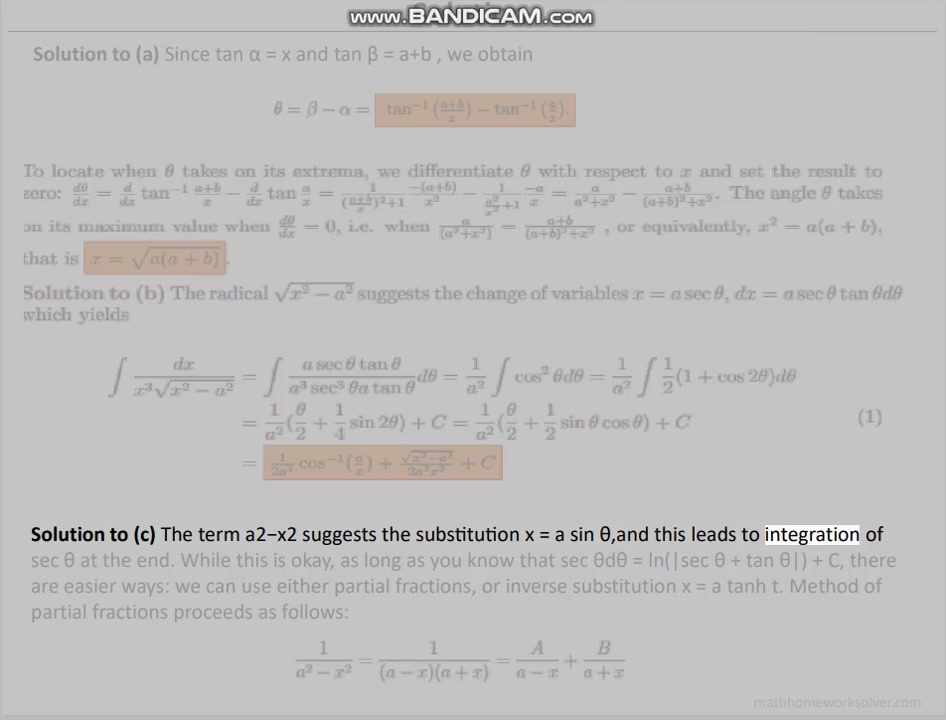
Integration by parts is a powerful tool, especially when dealing with integrals involving products of functions. Often, these integrals can be challenging, but integration by parts provides a way to simplify them. Assume you have an integral of the form ∫sinᵐ(θ) cosⁿ(θ) dθ where n ≥ 2. You can apply integration by parts by setting:
- u = sinᵐ(θ) cosⁿ⁻¹(θ)
- dv = cos(θ) dθ
Then, you determine du and v and apply the integration by parts formula: ∫u dv = uv - ∫v du.
This technique will often lead to a reduction formula that simplifies the original integral.
Reduction Formula: The goal is to find a reduction formula of the form ∫sinᵐ(θ) cosⁿ(θ) dθ = F(sin(θ), cos(θ)) + A∫sinᵐ+²(θ) cosⁿ⁻²(θ) dθ. This formula expresses the original integral in terms of another integral with lower powers of cos(θ), making it easier to evaluate.
While three different methods exist for evaluating the integral, focus on the one that seems easiest and fastest to use in an exam setting. Time management is key, and choosing the most efficient method can save valuable time.
Mastering Partial Fraction Decomposition
Understanding the Heaviside Cover-Up Method
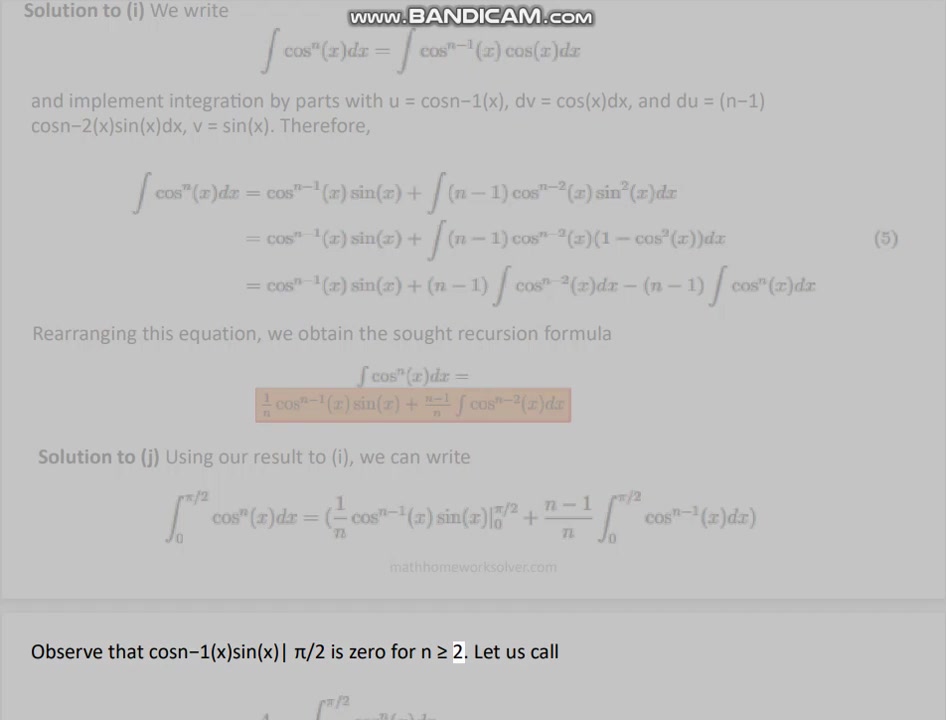
In many calculus problems, you'll encounter rational functions (polynomials divided by polynomials). Breaking down these functions into simpler components can make integration much easier. The Heaviside cover-up method is a powerful technique for performing partial fraction decomposition, especially when dealing with simple linear factors in the denominator.
Imagine you have a rational expression like (-4x² - 5x - 3) / (x(x+1)²). You want to decompose it into partial fractions of the form A/x + B/(x+1) + C/(x+1)². The Heaviside method provides a straightforward way to find the coefficients A, B, and C.
The method involves covering terms and assigning values to 'x' to isolate and find the coefficients.
How to Apply the Heaviside Method:
- Covering Terms: Focus on one factor at a time. For instance, to find A, cover the term 'x' in the denominator. You're left with (-4x² - 5x - 3) / (x+1)². Assign x = 0. So (-4(0)² - 5(0) - 3) / (0+1)² = -3, therefore, A = -3.
- Repeated Factors: While the Heaviside method works well for simple linear factors, it might not directly give all coefficients when dealing with repeated factors like (x+1)². In these cases, an alternative approach is needed. One efficient method is to plug in some arbitrary value for 'x' to find the remaining coefficients.
- Plugging in Values: For instance, to find 'B', plug in 'x=1' into the equation, and solve for 'B'. This provides an easy way to find B while keeping the algebra simple.
- Final Decomposition: After finding A, B, and C, you can rewrite the original rational function as a sum of simpler fractions. This will make integration a lot easier.
Step-by-Step Guide to Solving Calculus Problems
Step 1: Simplify and Transform the Integral
Begin by simplifying the integral as much as possible.
This may involve applying trigonometric identities, algebraic manipulations, or other simplification techniques. The goal is to transform the integral into a form that aligns with known integration formulas or can be approached using standard methods. If trigonometric functions are involved, consider using substitutions to convert the trigonometric functions into algebraic expressions, particularly when using z = tan(θ/2).
Step 2: Choose the Right Integration Technique
Selecting the appropriate integration technique is crucial. Here are some strategies:
- Integration by Parts: Useful when the integral involves a product of functions. Identify suitable 'u' and 'dv' and apply the integration by parts formula.
- Substitution: If a substitution can simplify the integral, apply it. Examples include using trigonometric substitutions or substituting parts of the function to reduce its complexity.
- Partial Fraction Decomposition: Break down rational functions into simpler fractions using methods like the Heaviside cover-up method. This can drastically simplify the integration process.
Choose the method that best fits the form of the integral.
Step 3: Apply the Integration Technique
Carefully apply the chosen integration technique, paying attention to details. For integration by parts, ensure you correctly differentiate 'u' to find 'du' and integrate 'dv' to find 'v'. When using substitution, don't forget to change the limits of integration if it's a definite integral.
Double-check your steps to avoid common mistakes like incorrect signs or misapplied formulas.
Step 4: Simplify and Evaluate
After applying the integration technique, simplify the resulting expression. This may involve algebraic manipulations, trigonometric identities, or other simplification methods. If possible, evaluate the integral and find the antiderivative.
For definite integrals, remember to evaluate the antiderivative at the upper and lower limits of integration and subtract the results. Ensure you simplify the final answer to its simplest form.
















Most people like






























Report
Please select a reason for reporting
- 13 Reasons to Switch from Snapchat to Text Messaging
- 7 Powerful Speech to Text Apps to Boost Productivity
- 10 Best Speech to Text Tools for Effortless Transcription
- 13 Free Tools to Easily Transcribe Audio to Text
- 15 Surprising Ways Google's Speech-to-Text Boosts Productivity
- 7 Best Free Online Audio to Text Transcription Tools
- 9 Tips to Transcribe Speech to Text Faster and Better
- 13 Best Speech to Text Software for Windows 10 in 2023
- 7 Tips for Choosing the Best Transcriber for Audio to Text
- 11 Reasons Why Dragon Speech-to-Text Apps are Game-Changers
- 6 Secrets to Enhance Your Speech to Text Transcription
- 6 Brilliant Ways to Boost Productivity with Talk-to-Text on Your MacBook
- 6 Ways Transcription Software Converts Audio to Text
- 8 Tips to Transcribe Speech to Text Like a Pro
- 6 Reasons IBM Watson Speech to Text is a Game-Changer
- 14 Powerful Ways Talk-to-Text Improves Your Workflow
- 12 Top Windows Speech-to-Text Software for Efficient Transcription
- 12 Game-Changing Benefits of Apple's Speech to Text Technology
- 9 Powerful Use Cases for AWS Speech to Text Technology
- 10 Easy Steps to Transcribe YouTube Videos to Text
- transcription audio en texte
- online audio transcription
- free audio file transcription
- free ai audio transcription
- audio transcription service
- audio transcription online free
- audio transcription free online
- audio to transcription software
- audio and transcript
- ai audio transcription free
- voice recording to text converter
- translate voice recording to text
- record voice to text
- audio recording to text converter
- voice recording and transcription
- chatgpt voice to text
- gmail voice to text
- speech to text reader
- speech to text ai free
- speech to talk
- 2026别再为 Claude多花冤枉钱了,ClaudeAPI.com国内直连让我每月省下 ¥780
- 5 Best AI Chat Apps for Mac in 2026
- What Makes Happy Horse 1.0 Different from Basic AI Video Tools
- Key Features of Happy Horse 1.0 AI Video Generator You Should Know
- 爱翻译功能全面解析:核心优势及主要功能
- Best AI Humanizers for SEO Content Writers in 2026
- Seedance 2.0 Prompting 101: The 6 Parameters You Need to Master (by Topview)
- Top 5 AI Text-to-Video Generators: A 2025 Review
- Create Professional UGC Videos with AI: Introducing Magic Ads
- Top 5 Browsers for Managing Multiple Accounts in 2026: What Actually Works
- AI Dropshipping in 2026: How Automation Is Changing Ecommerce
- Mastering Meeting Minutes: A Comprehensive Guide for Efficiency
- The Dangers of Deepfake for K-Pop: From Idol to Porn Star
- Key Metrics Used in AI Benchmarking for Enterprise Systems
- Top Free AI Video Generators: Latest Tools Compared!
- Top 5 Free AI Video Generators: Unlimited Options in 2025
- Top AI Video Generators: Ranking the Best Tools for 2025
- Top AI Video Generators: Create Stunning Videos Effortlessly
- Top AI Video Generators for Stunning Animations in 2024
- Free AI Video Generators: Unlimited & No Watermarks in 2025

Copyright ©2026 toolify