






Table of Contents
- Key Points
- Understanding Parallel and Perpendicular Gradients
- Worked Example: Determining Gradients of Lines
- Practical Application: How to Calculate Gradients
- Advantages and Disadvantages of Understanding Gradients
- Frequently Asked Questions (FAQ)
- Related Questions


Understanding Parallel and Perpendicular Gradients
Parallel Lines: Equal Gradients
Parallel lines are defined as lines that never intersect.
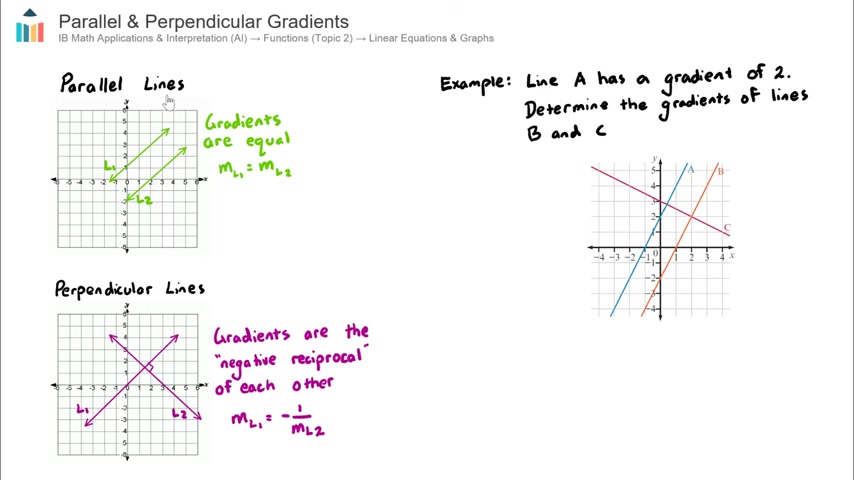
They maintain a constant distance from each other, much like train tracks stretching into the horizon. A crucial characteristic of parallel lines is that they have the same gradient. The gradient, often denoted as 'm', represents the steepness or slope of a line. If two lines are parallel, their gradients are equal, meaning m1 = m2. This is a fundamental concept when working with linear equations and graphs, significantly simplifying problems related to parallel relationships. Understanding this concept enables easier identification and construction of parallel lines.
Think of it this way: if two lines are climbing at the same rate, they'll stay side-by-side forever. This translates directly to their equations – the 'm' value is the same.
Key takeaway: Parallel lines possess identical slopes. When two or more lines share the same gradient, they will never intersect, regardless of how far they are extended. Mathematically, this is expressed as:
m1 = m2
Consider the following scenarios:
- If line A has a gradient of 3, any line parallel to it will also have a gradient of 3.
- If line B has a gradient of -2, a parallel line will also have a gradient of -2.
This concept can be particularly useful when determining equations of lines. If you know the gradient and a point on the line, you can easily construct the equation. Using this principle is helpful to solve many mathematical problems.
To further illustrate, imagine two lines on a coordinate plane. If both lines rise 2 units for every 1 unit they move to the right, they are parallel and have a gradient of 2. No matter where these lines are positioned on the plane, they will never cross each other because their slopes are identical. This is the essence of parallel lines and their equal gradients.
Perpendicular Lines: Negative Reciprocal Gradients
Perpendicular lines, unlike parallel lines, intersect at a right angle (90 degrees).
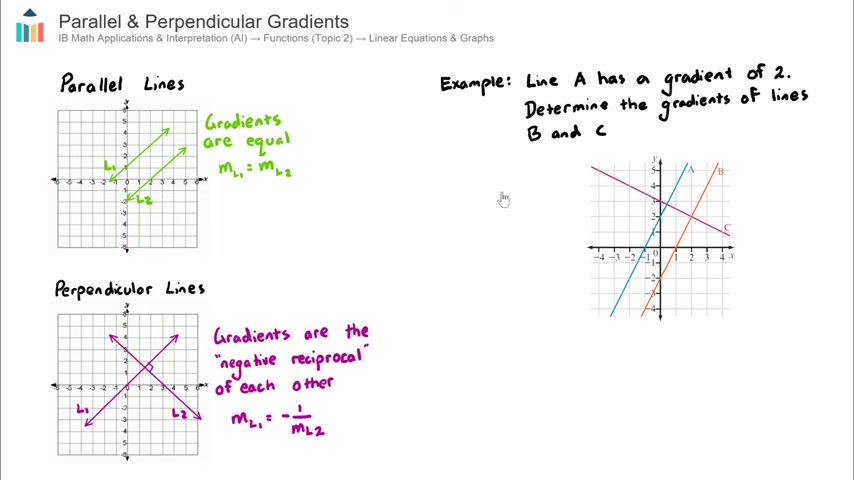
The relationship between their gradients is more complex but equally important. Perpendicular lines have gradients that are negative reciprocals of each other. This means that if one line has a gradient 'm', the gradient of a line perpendicular to it will be '-1/m'.
Consider the following:
If line A has a gradient of 2, the gradient of a line perpendicular to it would be -1/2. This inverse relationship ensures that the lines meet at a perfect right angle.
Mathematically:
m1 = -1/m2
This also means:
m1 * m2 = -1
This relationship allows us to solve various geometric problems related to perpendicularity. For instance, given the equation of one line, we can easily determine the gradient of a line that is perpendicular to it.
Key Points:
- Multiply the two gradients together, which should result in -1.
- Change the sign of the gradient.
- Invert the value of the gradient.
Let's consider a few examples:
- If line A has a gradient of 4, a line perpendicular to it will have a gradient of -1/4.
- If line B has a gradient of -3, a line perpendicular to it will have a gradient of 1/3.
- If line C has a gradient of 1/2, a line perpendicular to it will have a gradient of -2.
This knowledge can be applied to solve problems such as:
- Verifying if two lines are perpendicular.
- Finding the equation of a line perpendicular to a given line and passing through a specific point.
It's important to note that the negative reciprocal relationship only applies to lines in a two-dimensional plane. In three-dimensional space, perpendicularity is defined differently. Knowing the gradient of one line, a perpendicular gradient can be readily calculated and problems can be solved with this perpendicular gradient.
Worked Example: Determining Gradients of Lines
Applying the Concepts
To illustrate these concepts, let's work through an example.
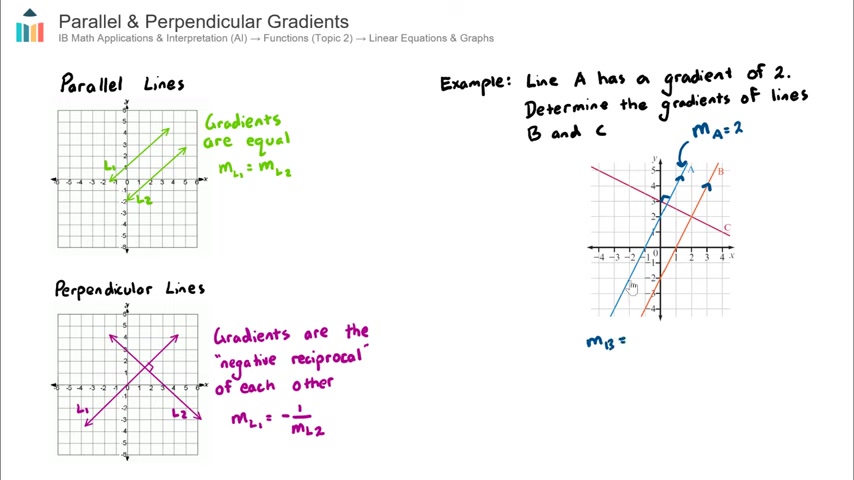
Suppose we have three lines: A, B, and C. We know that line A has a gradient of 2. Additionally, line B is parallel to line A, and line C is perpendicular to line A. Our goal is to find the gradients of lines B and C.
Step 1: Finding the Gradient of Line B
Since line B is parallel to line A, their gradients are equal. Therefore, the gradient of line B is also 2. This is because parallel lines have identical slopes.
Gradient of Line B = Gradient of Line A = 2
Step 2: Finding the Gradient of Line C
Since line C is perpendicular to line A, its gradient is the negative reciprocal of line A's gradient. This means we take the gradient of line A (which is 2), find its reciprocal (1/2), and then change its sign to negative. This yields the negative reciprocal is -1/2.
Gradient of Line C = -1 / Gradient of Line A = -1/2
Therefore, the gradient of line C is -1/2. To summarize:
- Line A: Gradient = 2
- Line B: Gradient = 2 (parallel to A)
- Line C: Gradient = -1/2 (perpendicular to A)
This example demonstrates how the relationships between parallel and perpendicular lines can be used to quickly determine the gradients of related lines. Being adept at using these relationships provides a quick and effective way to solve problems.
To recap the steps:
- Identify the reference line and its gradient.
- Determine the relationship between the lines (parallel or perpendicular).
- Apply the appropriate rule (equal gradients for parallel, negative reciprocal for perpendicular).
- Calculate the gradient of the target line.
Now, let’s further expand on the importance of identifying relationships for gradient calculations. With each example, remember the key takeaway for identifying the lines and applying the rules to perform accurate gradient calculations. This practice will improve accuracy and precision.





Most people like


































Report
Please select a reason for reporting
- 13 Reasons to Switch from Snapchat to Text Messaging
- 7 Powerful Speech to Text Apps to Boost Productivity
- 10 Best Speech to Text Tools for Effortless Transcription
- 13 Free Tools to Easily Transcribe Audio to Text
- 15 Surprising Ways Google's Speech-to-Text Boosts Productivity
- 7 Best Free Online Audio to Text Transcription Tools
- 9 Tips to Transcribe Speech to Text Faster and Better
- 13 Best Speech to Text Software for Windows 10 in 2023
- 7 Tips for Choosing the Best Transcriber for Audio to Text
- 11 Reasons Why Dragon Speech-to-Text Apps are Game-Changers
- 6 Secrets to Enhance Your Speech to Text Transcription
- 6 Brilliant Ways to Boost Productivity with Talk-to-Text on Your MacBook
- 6 Ways Transcription Software Converts Audio to Text
- 8 Tips to Transcribe Speech to Text Like a Pro
- 6 Reasons IBM Watson Speech to Text is a Game-Changer
- 14 Powerful Ways Talk-to-Text Improves Your Workflow
- 12 Top Windows Speech-to-Text Software for Efficient Transcription
- 12 Game-Changing Benefits of Apple's Speech to Text Technology
- 9 Powerful Use Cases for AWS Speech to Text Technology
- 10 Easy Steps to Transcribe YouTube Videos to Text
- transcription audio en texte
- online audio transcription
- free audio file transcription
- free ai audio transcription
- audio transcription service
- audio transcription online free
- audio transcription free online
- audio to transcription software
- audio and transcript
- ai audio transcription free
- voice recording to text converter
- translate voice recording to text
- record voice to text
- audio recording to text converter
- voice recording and transcription
- chatgpt voice to text
- gmail voice to text
- speech to text reader
- speech to text ai free
- speech to talk
- Meshy AI: How to Create 3D Models from Text and Images
- How SEO and Marketing Dashboards Empower Agencies to Drive Results
- How to Use AI Tools to Find Internal Linking Opportunities Across a Business Website
- Discover Your Perfect Haircut with AI Hairstyle Apps
- Free Reputation Calculator Tools: How They're Adapting to Score AI Visibility, Not Just Rankings
- Design Professional Flyers for Free on Your Phone
- Best Free Flyer Maker Apps for Android: Design Like a Pro
- How to Know If Your Business Is Ready for an AI Customer Service Agent
- Revolutionizing Storytelling: From Novels to Screenplays with AI
- Create Engaging Animated Explainer Videos with a Free AI Tool
- Automate Lead Generation: A Comprehensive Guide with AI Agents
- Revideo.io: The Future of Reverse Video Search Technology
- Revolutionizing Email Marketing Agency with AI
- Breaking the Character Drift Dilemma: A Practical Test of Smart Shot
- Meshy AI: How to Create 3D Models from Text and Images
- ASOMobile Helps Teams Benchmark App Store Screenshots Against Competitors
- How to Match LMS Software With Your Organization's Training Plan
- How to Convert BTC to HNT
- Unleashing the Power of AI: Cognizant's Roadmap for Transformation
- Frame to Video Review: A Practical Look at Turning Two Still Frames Into Motion

Copyright ©2026 toolify