































Table of Contents
- Key Points
- Understanding Positional Encoding
- Understanding the Math Behind Positional Encoding
- Positional Encoding: Pros and Cons
- FAQ
- Related Questions


Understanding Positional Encoding
The Need for Positional Encoding in Transformers
Traditional recurrent neural networks (RNNs)
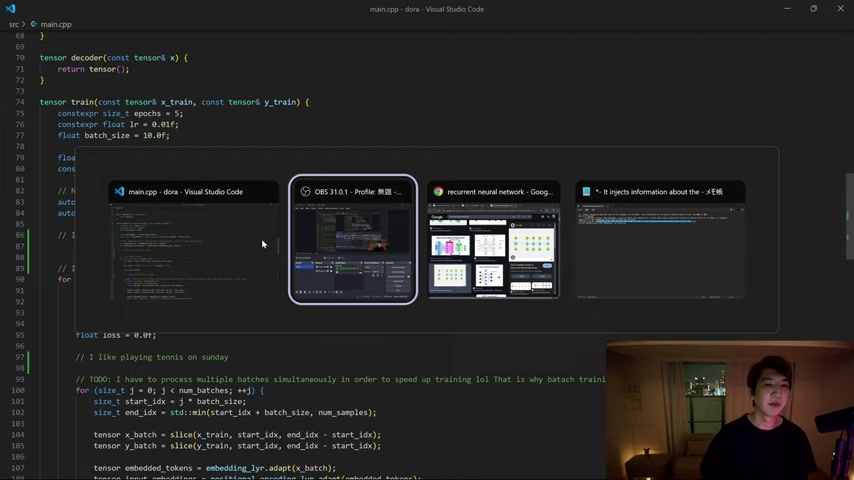
inherently capture sequential information because they process input tokens one at a time, maintaining a hidden state that evolves over time. This sequential processing allows RNNs to understand the order of words and their relationships in a sentence. However, transformer models differ significantly. They process all input tokens in parallel, without any inherent sense of order. This parallel processing is what makes transformers so efficient and scalable, but it also presents a challenge: how to provide the model with information about the position of each token in the sequence? This is where positional encoding plays a crucial role.
Transformer models need a mechanism to understand the order of words within a sentence or sequence. Without positional encoding, the model would treat the input as a bag of words, losing crucial contextual information. Consider these two sentences:
- "I like playing tennis on Sunday."
- "I like playing tennis."
Without positional information, the model might struggle to differentiate between these sentences because it would only see the presence of the same words, missing the important context provided by their order.
Positional encoding addresses this issue by adding a unique vector to each token's embedding, representing its position in the sequence. This allows the model to distinguish between tokens based not only on their meaning but also on their location within the input.
How Positional Encoding Works: Sinusoidal Functions
The key to positional encoding
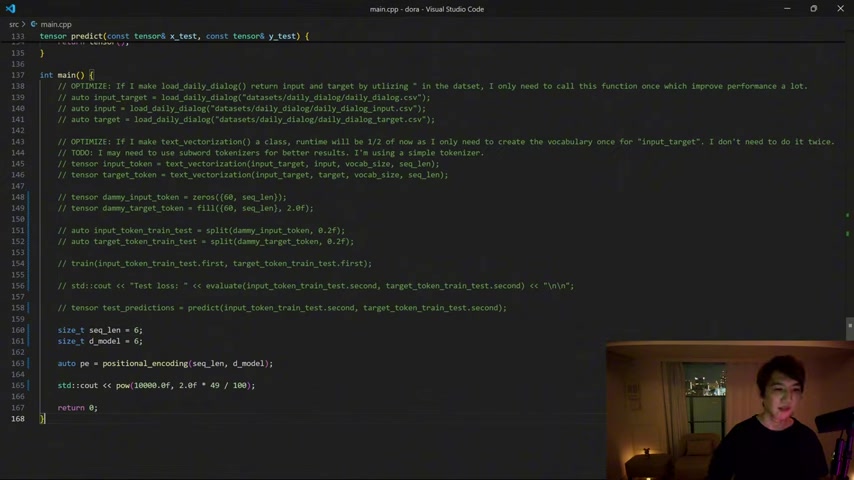
is to create a set of vectors that represent the position of each token in the sequence. A common and effective approach is to use sinusoidal functions, specifically sine and cosine waves, to generate these vectors. The formula used is:
PE(pos, 2i) = sin(pos / (10000^(2i/dmodel))) PE(pos, 2i+1) = cos(pos / (10000^(2i/dmodel)))
Where:
posis the position of the token in the sequence.iis the dimension index (ranging from 0 to dmodel/2).dmodelis the dimensionality of the embedding vector.
The crucial aspect of this formula is the denominator: 10000^(2i/dmodel). This ensures that different dimensions have different frequency scales. Dimensions with lower indices have shorter wavelengths, while dimensions with higher indices have longer wavelengths. This creates a unique pattern for each position, allowing the model to easily distinguish between them. This unique pattern creation enhances the positional encoding method, allowing for accurate token position recognition.
By using sinusoidal functions, the model can easily generalize to unseen sequence lengths because the relative positions between tokens are encoded in a continuous and predictable way. This is a significant advantage over simply using integer values to represent positions, which wouldn't generalize well to sequences longer than those seen during training.
For even indices, sine functions are employed, while cosine functions are employed for odd indices. The use of both sine and cosine functions provides the model with a rich representation of each position, allowing it to capture complex relationships between tokens. Specifically, for even indices, sin functions are used and for odd indices cosine functions are used.
Implementation Details
The implementation of positional encoding involves several steps:
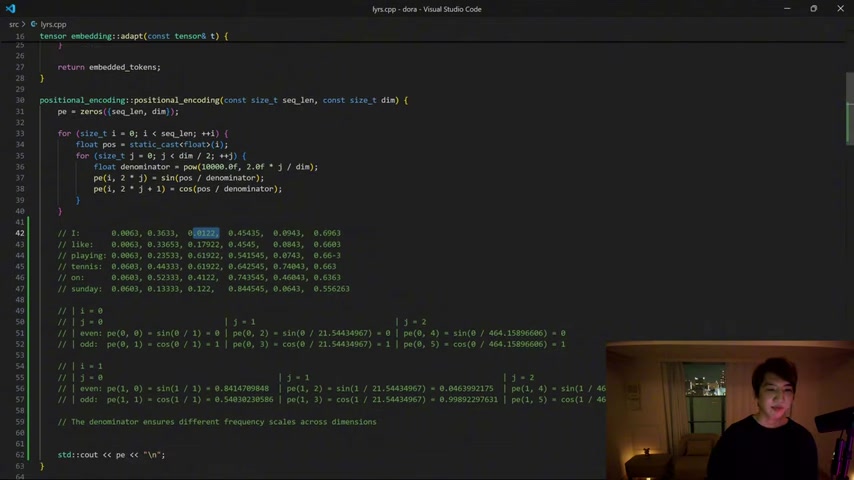
- Initialization: Create a matrix of zeros with dimensions (sequence length, dmodel).
- Position and Dimension Iteration: Iterate through each position (pos) from 0 to sequence length - 1 and each dimension (i) from 0 to dmodel/2 - 1.
- Denominator Calculation: Calculate the denominator using the formula:
denominator = 10000^(2*i/dmodel). - Positional Encoding Calculation: Calculate the positional encoding values for even and odd dimensions using the sine and cosine functions:
PE(pos, 2i) = sin(pos / denominator)PE(pos, 2i+1) = cos(pos / denominator)
- Addition: Add the resulting positional encoding matrix to the input embeddings.
This process ensures that each token's embedding is augmented with information about its position, allowing the transformer model to leverage sequential information for improved performance. Adding the positional encoding matrix to the input embeddings allows the Transformer model to use sequential information, improving performance significantly.



Most people like


































Report
Please select a reason for reporting
- 13 Reasons to Switch from Snapchat to Text Messaging
- 7 Powerful Speech to Text Apps to Boost Productivity
- 10 Best Speech to Text Tools for Effortless Transcription
- 13 Free Tools to Easily Transcribe Audio to Text
- 15 Surprising Ways Google's Speech-to-Text Boosts Productivity
- 7 Best Free Online Audio to Text Transcription Tools
- 9 Tips to Transcribe Speech to Text Faster and Better
- 13 Best Speech to Text Software for Windows 10 in 2023
- 7 Tips for Choosing the Best Transcriber for Audio to Text
- 11 Reasons Why Dragon Speech-to-Text Apps are Game-Changers
- 6 Secrets to Enhance Your Speech to Text Transcription
- 6 Brilliant Ways to Boost Productivity with Talk-to-Text on Your MacBook
- 6 Ways Transcription Software Converts Audio to Text
- 8 Tips to Transcribe Speech to Text Like a Pro
- 6 Reasons IBM Watson Speech to Text is a Game-Changer
- 14 Powerful Ways Talk-to-Text Improves Your Workflow
- 12 Top Windows Speech-to-Text Software for Efficient Transcription
- 12 Game-Changing Benefits of Apple's Speech to Text Technology
- 9 Powerful Use Cases for AWS Speech to Text Technology
- 10 Easy Steps to Transcribe YouTube Videos to Text
- transcription audio en texte
- online audio transcription
- free audio file transcription
- free ai audio transcription
- audio transcription service
- audio transcription online free
- audio transcription free online
- audio to transcription software
- audio and transcript
- ai audio transcription free
- voice recording to text converter
- translate voice recording to text
- record voice to text
- audio recording to text converter
- voice recording and transcription
- chatgpt voice to text
- gmail voice to text
- speech to text reader
- speech to text ai free
- speech to talk
- Create Engaging Animated Explainer Videos with a Free AI Tool
- Stop Multi-Subscribing: Benchmark Top AI Visual Models in One Canvas
- Best Seedance 2.5 API Provider: Every Price on the Market, Checked at Source
- AI OnlyFans: How to Generate $30,000/Month (Legally)
- Transform Your Script into an Engaging Video with AI Video Maker!
- AI Marketing Automation: A Comprehensive Guide for Small Businesses
- Midjourney Alternative for Anime Art Creators: Why PixAI May Be Better for Character Workflows
- 10 Things Most People Get Wrong About AI Image Search
- AI Girlfriend Apps: Top Choices Redefining Relationships 2025
- How to Reduce Quoting Errors in Salesforce with AI-Assisted Quote Creation
- AI Resume Builders: EnhanceCV, ResumeNerd AI, & Teal Compared
- ResumeAI: Crafting ATS-Optimized Resumes with AI
- AI in Resume Writing: A New Era for Job Seekers
- AI Resume Tools: Streamline Your Job Search and Land Your Dream Role
- AI Resume Optimization: The Right Way to Land Interviews
- Crafting a Killer Resume with AI: A Step-by-Step Guide
- Crafting a Winning Resume: AI Tools and Expert Tips
- AI Job Search: Level Up Your Career with AI Automation
- Empower Your Career Journey: Dynamic Resumes with AI
- AI Resume Builder: Create Professional Resumes Effortlessly

Copyright ©2026 toolify