































Table of Contents
- Key Points
- Understanding Predicate Logic: A Comprehensive Guide
- Translating Specific Sentences: Step-by-Step Examples
- Steps for Translating English Sentences into Predicate Logic
- Advantages and Disadvantages of Predicate Logic
- FAQ
- Related Questions



Understanding Predicate Logic: A Comprehensive Guide
What is Predicate Logic?
Predicate logic, also known as first-order logic, is a powerful system for representing knowledge and reasoning.
It builds upon propositional logic by adding predicates, variables, and quantifiers. In propositional logic, we deal with simple statements that are either true or false. Predicate logic allows us to express more complex relationships and properties.
Key Components of Predicate Logic:
- Predicates: These are statements about objects, expressing a property or relationship. For example, 'Child(x)' could represent 'x is a child', and 'Loves(x, y)' could represent 'x loves y'.
- Variables: These represent objects in the domain of discourse. 'x' and 'y' are commonly used variables.
- Constants: These are specific objects within the domain. 'John' could be a constant representing a particular person.
- Quantifiers: These specify the quantity of objects that satisfy a given predicate. The two main quantifiers are the universal quantifier (∀) and the Existential quantifier (∃).
Why Use Predicate Logic?
Predicate logic offers several advantages over propositional logic:
- Expressiveness: It can represent a wider range of statements and relationships.
- Generality: It allows us to make generalizations about collections of objects.
- Formal Reasoning: It provides a solid foundation for automated reasoning and inference.
Universal Quantifiers (∀): 'Every' and 'All'
The universal quantifier (∀) is used to express that a statement is true for all objects in a given domain. It's often read as 'for all' or 'every'.
Example:
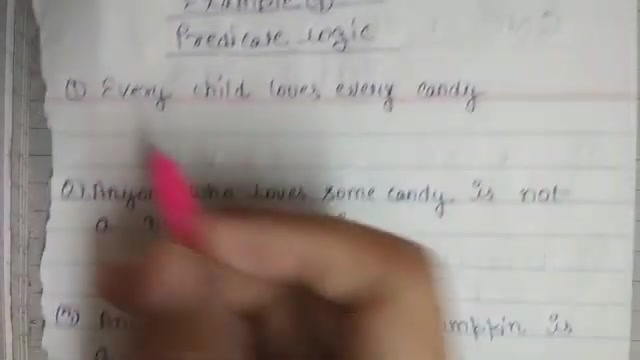
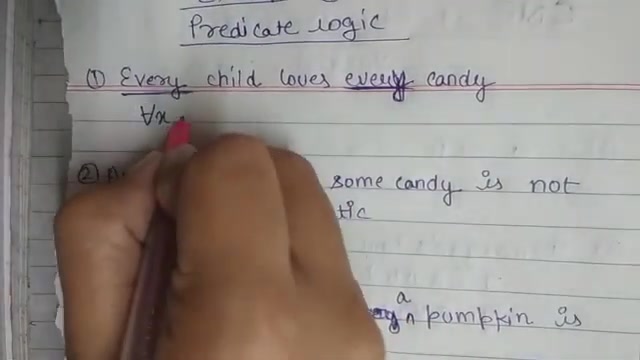
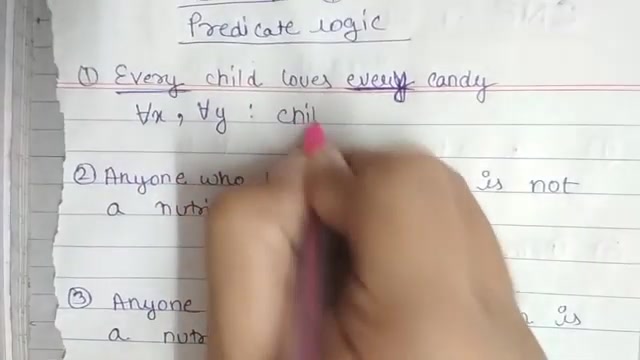
'Every child loves every candy'. To represent this in predicate logic, we can define the following predicates:
- Child(x): x is a child
- Candy(y): y is a candy
- Loves(x, y): x loves y
The predicate logic translation would be:
∀x ∀y ((Child(x) ∧ Candy(y)) → Loves(x, y))
Let's break this down:
- ∀x: For all x (every individual).
- ∀y: For all y (every individual).
- (Child(x) ∧ Candy(y)): x is a child and y is a candy.
- → Loves(x, y): implies x loves y.
In simpler terms, this statement says that for every individual x and every individual y, if x is a child and y is a candy, then x loves y. The ∧ (conjunction) ensures that we're only considering cases where x is a child and y is a candy. The → (implication) links the condition (child and candy) to the result (love). This is crucial. We're not saying that everything loves everything, only that children love candy.
Common Pitfalls with Universal Quantifiers:
- Incorrect Use of ∧ (Conjunction): Avoid using ∧ directly between quantifiers and predicates when an implication is intended.
- Overly Broad Statements: Ensure the scope of the universal quantifier is appropriately limited by the predicates. Otherwise, you might end up making claims that are too general.
Existential Quantifiers (∃): 'Some' and 'There Exists'
The existential quantifier (∃) is used to express that there exists at least one object in a domain for which a statement is true. It's often read as 'there exists' or 'some'.
Example:
'Anyone who loves some candy is not a nutrition fanatic.' This sentence needs careful handling. Let's define our predicates:
- Person(x): x is a person
- Candy(y): y is a candy
- Loves(x, y): x loves y
- NutritionFanatic(x): x is a nutrition fanatic
The predicate logic translation:
∀x (Person(x) → (∃y (Candy(y) ∧ Loves(x, y)) → ¬NutritionFanatic(x)))
Explanation:
- ∀x (Person(x) → ...): For all x, if x is a person, then...
- (∃y (Candy(y) ∧ Loves(x, y))): There exists a y such that y is candy and x loves y (x loves some candy).
- ( ... → ¬NutritionFanatic(x)): implies x is not a nutrition fanatic. Note the ¬ (negation) symbol. This is critical. We're saying they are not a fanatic.
This complex sentence means that for every person, if there exists some candy that they love, then that person is not a nutrition fanatic.
Why the Conjunction (∧) is Crucial with Existential Quantifiers:
The conjunction (∧) with the existential quantifier is used to combine different conditions into one true value. It is used to specify all conditions that need to be met. For example, if x needs to be a person and y needs to be a candy that they eat to indicate they are not a nutrition fanatic, both conditions have to be met in order for the existential quantifier to evaluate to true.
Challenges with Existential Quantifiers:
- Understanding the Scope: Make sure the existential quantifier applies to the correct part of the sentence. In the example, it needs to apply to the candy loved by the person.
- Distinguishing from Universal Quantifiers: Don't confuse 'some' with 'all'. The existential quantifier only requires one instance to be true, while the universal quantifier requires all instances to be true.
Common Translation Challenges and Solutions
Translating English sentences into predicate logic can be tricky. Here are some common challenges and how to address them:
- Hidden Keywords:
Words like 'a' or 'any' can imply the use of quantifiers. 'Anyone who eats a pumpkin is a nutrition fanatic' implies an existential quantifier for the pumpkin.
- Negation: Accurately placing the negation symbol (¬) is essential. Double negatives can be confusing. 'Not a nutrition fanatic' is represented as ¬NutritionFanatic(x).
- Conditional Statements: Pay close attention to the direction of implication (→). The order matters. 'If x is a child and y is a candy, then x loves y' is different from 'If x loves y, then x is a child and y is a candy'.
- 'Or' Statements: Use the disjunction symbol (∨). 'Anyone who buys any pumpkin either craves it or eats it' would involve an ∨ between 'craves' and 'eats'.
- Ambiguity: Some sentences can have multiple interpretations. Carefully analyze the intended meaning before translating.
Example illustrating 'or':
'Anyone who buys any pumpkin either craves it or eats it'
- Person(x): x is a person.
- Pumpkin(y): y is a pumpkin.
- Buys(x,y): x buys y
- Craves(x, y): x craves y
- Eats(x,y): x eats y
∀x (Person(x) → (∃y (Pumpkin(y) ∧ Buys (x,y)) → (Craves(x, y) ∨ Eats(x,y))))
This says: 'For all persons if they bought a pumpkin then they either crave it or eat it'. You can replace or with ∨.
Tip: Break down complex sentences into smaller, manageable parts before translating them into predicate logic. Identify the key predicates, variables, and quantifiers, and then combine them using the appropriate logical connectives. It would also be beneficial to test every single predicate with a table containing true and false inputs to ensure that all requirements are properly satisfied.






Most people like

































Report
Please select a reason for reporting
- 13 Reasons to Switch from Snapchat to Text Messaging
- 7 Powerful Speech to Text Apps to Boost Productivity
- 10 Best Speech to Text Tools for Effortless Transcription
- 13 Free Tools to Easily Transcribe Audio to Text
- 15 Surprising Ways Google's Speech-to-Text Boosts Productivity
- 7 Best Free Online Audio to Text Transcription Tools
- 9 Tips to Transcribe Speech to Text Faster and Better
- 13 Best Speech to Text Software for Windows 10 in 2023
- 7 Tips for Choosing the Best Transcriber for Audio to Text
- 11 Reasons Why Dragon Speech-to-Text Apps are Game-Changers
- 6 Secrets to Enhance Your Speech to Text Transcription
- 6 Brilliant Ways to Boost Productivity with Talk-to-Text on Your MacBook
- 6 Ways Transcription Software Converts Audio to Text
- 8 Tips to Transcribe Speech to Text Like a Pro
- 6 Reasons IBM Watson Speech to Text is a Game-Changer
- 14 Powerful Ways Talk-to-Text Improves Your Workflow
- 12 Top Windows Speech-to-Text Software for Efficient Transcription
- 12 Game-Changing Benefits of Apple's Speech to Text Technology
- 9 Powerful Use Cases for AWS Speech to Text Technology
- 10 Easy Steps to Transcribe YouTube Videos to Text
- transcription audio en texte
- online audio transcription
- free audio file transcription
- free ai audio transcription
- audio transcription service
- audio transcription online free
- audio transcription free online
- audio to transcription software
- audio and transcript
- ai audio transcription free
- voice recording to text converter
- translate voice recording to text
- record voice to text
- audio recording to text converter
- voice recording and transcription
- chatgpt voice to text
- gmail voice to text
- speech to text reader
- speech to text ai free
- speech to talk
- Design Professional Flyers for Free on Your Phone
- Best Free Flyer Maker Apps for Android: Design Like a Pro
- How to Know If Your Business Is Ready for an AI Customer Service Agent
- Revolutionizing Storytelling: From Novels to Screenplays with AI
- Create Engaging Animated Explainer Videos with a Free AI Tool
- Stop Multi-Subscribing: Benchmark Top AI Visual Models in One Canvas
- Best Seedance 2.5 API Provider: Every Price on the Market, Checked at Source
- AI OnlyFans: How to Generate $30,000/Month (Legally)
- Transform Your Script into an Engaging Video with AI Video Maker!
- AI Marketing Automation: A Comprehensive Guide for Small Businesses
- Design Professional Flyers for Free on Your Phone
- Best Free Flyer Maker Apps for Android: Design Like a Pro
- Unleash Creativity: AI Coloring Pages with ColoringBook.ai
- Generate Stunning AI Photos with Google Gemini: A Guide
- Boost Your Etsy Sales with Stunning Digital Invitations!
- Revolutionize Your Etsy Listing with AI Text Generator
- Create Coloring Pages with AI: A Bing AI Tutorial
- Photo Lab App: Transform Your Photos with Stunning AI Effects
- Effortless Design: Rewriting Text with Microsoft Designer's AI
- Create & Sell Kids' Coloring Books with AI - KDP Guide

Copyright ©2026 toolify