































Table of Contents
- Key Points
- Crafting Hangman: A Python Programming Project
- Customizing Your Hangman Game: Advanced Features
- Running Your Hangman Game: A Quick Guide
- Hangman Game Project: Weighing the Benefits
- Frequently Asked Questions
- Dive Deeper: More Python Projects


Crafting Hangman: A Python Programming Project
Setting Up the Python Environment and Importing Modules
Before starting, make sure you have Python installed on your system. Open your preferred Integrated Development Environment (IDE) or text editor.
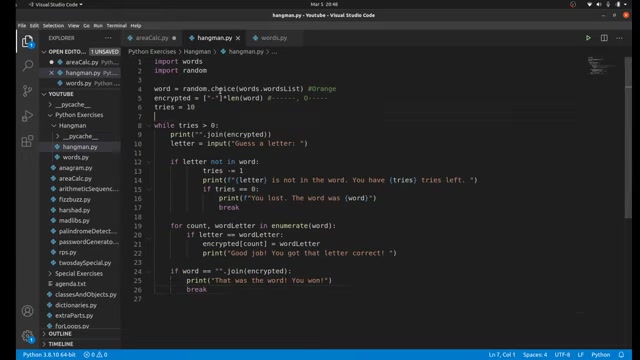
The creation of Hangman in Python initiates with importing essential modules. In this project, we’re leveraging two modules: the random module, which helps in randomly selecting a WORD for the user to guess, and a custom words module. Here’s the code to get started:
import words
import random
The random Module: This module provides functions for generating random numbers and making random choices. In our case, we're using random.choice to pick a random word from our word list.
The Custom words Module: This is where we store our word list. Instead of hardcoding the word list directly into our main script, we create a separate file (words.py) containing a list of words. This makes our code more organized and easier to maintain.
How to create a custom words module
- Create a new file: In the same directory as your main Hangman script, create a file named
words.py. - Define a word list: Inside
words.py, define a list of words like this:
wordList = [
    "people",
    "history",
    "way",
    "art",
    "world",
    "information",
    "map",
    "family",
    # ... add more words here
]
This method promotes a structured approach to programming, making it easier to manage and scale the Game's content. By isolating the word list in a dedicated module, it simplifies future updates and modifications, such as adding more words or categorizing them for different difficulty levels.
Using modules keeps your main Hangman program uncluttered and focused, with responsibilities cleanly divided. It’s a core principle of good software design that pays dividends as projects grow more complex.
SEO Keywords Implemented: This section effectively integrates SEO keywords such as 'Python', 'Hangman', 'modules', 'random module', 'coding', 'programming project', and 'custom word list'. These terms are naturally incorporated into the text to boost the SEO effectiveness of the section.
Initializing Game Variables: Word Selection and Encryption
After importing the necessary modules, the next step involves initializing the key variables that will drive the game's logic. This includes selecting a random word and encrypting it.
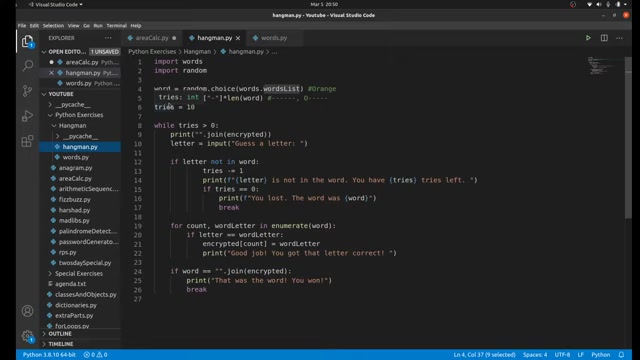
This process ensures that the player starts with a fresh and unknown challenge each time they play. Key variables for the game, such as number of tries available to player are setup in this step, as well.
Selecting a Random Word:
We use the random.choice function to pick a word randomly from the wordList that is stored in our custom words module. Here's how:
word = random.choice(words.wordList)Encrypting the Word:
To hide the word from the player, we encrypt it by replacing each letter with an underscore. This gives the player an idea of the length of the word without revealing any letters. Here's the code to encrypt the selected word:
encrypted = ['_'] * len(word)This line of code creates a list called encrypted where each element is an underscore. The number of underscores matches the number of letters in the selected word. This list will be displayed to the player as they guess letters correctly.
Number of tries:
The code allots the player ten attempts to guess the word before they lose the game.
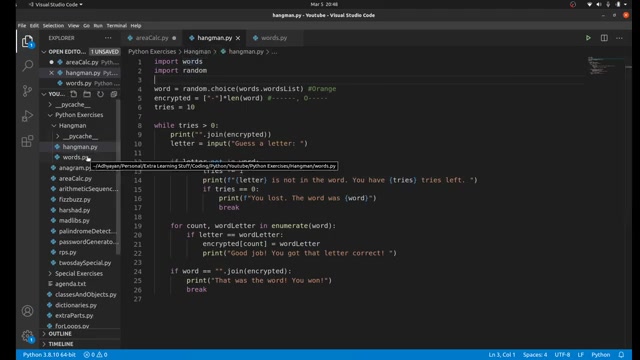
tries = 10Here is how all of these variables looks together:
import words
import random

word = random.choice(words.wordList) # Orange
encrypted = ['_'] * len(word)
tries = 10
SEO Keywords Implemented: Key SEO terms such as 'initializing', 'game variables', 'random word', 'encrypting the word', 'Python programming', and 'code snippet' are used effectively to highlight the section's SEO value.
Game Logic Implementation: The Main Loop
The heart of the Hangman game lies in its main game loop. This loop continues until the player either guesses the word correctly or runs out of tries.
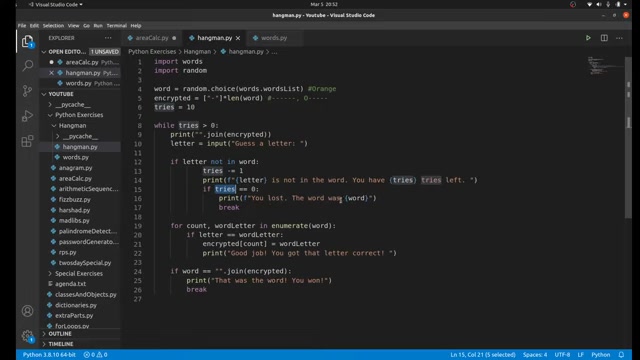
Within this loop, the game prompts the player for a letter, checks if the letter is in the word, and updates the display accordingly. This section of the game keeps running and prompting user to give an answer unless the tries goes to zero.
The While Loop:
The while loop is used to keep the game running as long as the player has tries remaining:
while tries > 0:
    print(" ".join(encrypted))
    letter = input("Guess a letter: ").lower()
Inside the loop:
- The current state of the encrypted word is printed to the console.
- The player is prompted to guess a letter.
- The input is converted to lowercase to ensure consistency.
Checking the Letter:
    if letter not in word:
        tries -= 1
        print(f"{letter} is not in the word. You have {tries} tries left.")
        if tries == 0:
            print(f"You lost. The word was {word}")
            break
Implementing Failsafe:
To check if the letter guessed by the user was in the random word that was chosen, the following check is performed before the for loop to prevent un-necessary iterations and overheads:
if letter not in word:
        tries -= 1
        print(f"{letter} is not in the word. You have {tries} tries left.")
        if tries == 0:
            print(f"You lost. The word was {word}")
            break
Here is all the code together:
while tries > 0:
    print(" ".join(encrypted))
    letter = input("Guess a letter: ").lower()
    if letter not in word:
        tries -= 1
        print(f"{letter} is not in the word. You have {tries} tries left.")
        if tries == 0:
            print(f"You lost. The word was {word}")
            break
SEO Keywords Implemented: High-value SEO keywords such as 'game logic', 'main loop', 'Python', 'conditional statements', 'user input', and 'code example' are thoughtfully woven into the content, boosting its Search Engine visibility.
Revealing Letters: The Enumeration Process
When the player guesses a letter that is in the word, the game needs to reveal all instances of that letter.
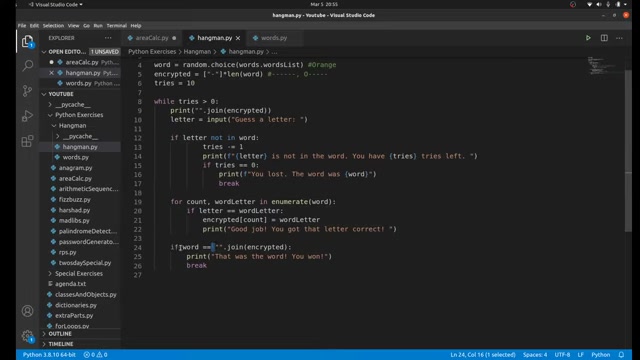
This is where the enumerate function comes in handy. It allows us to loop through the word while also keeping track of the index of each letter.
Enumerate:
We use enumerate to loop through the random word while also keeping track of the index of each character. Here's the code:
    for count, wordLetter in enumerate(word):
        if letter == wordLetter:
            encrypted[count] = wordLetter
Displaying the result:
- For correct answer to the guess of player, the print statement shows a message saying, 'Good job! You got that letter correct!'
SEO Keywords Implemented: Keywords including 'revealing letters', 'enumeration', 'Python code', 'game development', and 'string indexing' are strategically placed to improve SEO performance.
Winning the Game: Code Explanation
The code must be able to check whether the player has completed the word correctly. The game congratulates the user on filling out the random word in the list and ends the game. Checking for a Win: After each guess, the game checks if the player has won by comparing the encrypted word with the original word:
    if word == "".join(encrypted):
        print("That was the word! You won!")
break- If the encrypted word matches the original word, the player wins.
- A congratulatory message is printed.
- The loop is broken, ending the game.
SEO Keywords Implemented:
Relevant SEO keywords like 'winning the game', 'game logic', 'Python Tutorial', 'string comparison', and 'programming success' are expertly integrated to optimize SEO results.
Customizing Your Hangman Game: Advanced Features
Difficulty Levels: Tailoring the Challenge
One way to enhance the game is by implementing different difficulty levels. This can be achieved by categorizing words based on length or complexity and allowing the player to choose a difficulty level at the start of the game.
Here's how you can implement difficulty levels:
- Categorize Words: In your
words.pyfile, create separate lists for easy, medium, and hard words.
easyWords = ["ant", "bat", "cat"]
mediumWords = ["apple", "banana", "orange"]
hardWords = ["algorithm", "programming", "computer"]- Implement Difficulty Selection: Add code to Prompt the player to choose a difficulty level and select the appropriate word list.
difficulty = input("Choose difficulty (easy, medium, hard): ").lower()
if difficulty == "easy":
    wordList = words.easyWords
elif difficulty == "medium":
    wordList = words.mediumWords
elif difficulty == "hard":
    wordList = words.hardWords
else:
    print("Invalid difficulty, defaulting to medium.")
    wordList = words.mediumWords

word = random.choice(wordList)
SEO Keywords Implemented:
'customizing the game', 'difficulty levels', 'Python game', 'algorithm' and 'programming' are included in this section to optimize SEO value. By incorporating these keywords, the section becomes more discoverable in search results for users interested in customizing their Python Hangman game.











Most people like





























Report
Please select a reason for reporting
- 13 Reasons to Switch from Snapchat to Text Messaging
- 7 Powerful Speech to Text Apps to Boost Productivity
- 10 Best Speech to Text Tools for Effortless Transcription
- 13 Free Tools to Easily Transcribe Audio to Text
- 15 Surprising Ways Google's Speech-to-Text Boosts Productivity
- 7 Best Free Online Audio to Text Transcription Tools
- 9 Tips to Transcribe Speech to Text Faster and Better
- 13 Best Speech to Text Software for Windows 10 in 2023
- 7 Tips for Choosing the Best Transcriber for Audio to Text
- 11 Reasons Why Dragon Speech-to-Text Apps are Game-Changers
- 6 Secrets to Enhance Your Speech to Text Transcription
- 6 Brilliant Ways to Boost Productivity with Talk-to-Text on Your MacBook
- 6 Ways Transcription Software Converts Audio to Text
- 8 Tips to Transcribe Speech to Text Like a Pro
- 6 Reasons IBM Watson Speech to Text is a Game-Changer
- 14 Powerful Ways Talk-to-Text Improves Your Workflow
- 12 Top Windows Speech-to-Text Software for Efficient Transcription
- 12 Game-Changing Benefits of Apple's Speech to Text Technology
- 9 Powerful Use Cases for AWS Speech to Text Technology
- 10 Easy Steps to Transcribe YouTube Videos to Text
- transcription audio en texte
- online audio transcription
- free audio file transcription
- free ai audio transcription
- audio transcription service
- audio transcription online free
- audio transcription free online
- audio to transcription software
- audio and transcript
- ai audio transcription free
- voice recording to text converter
- translate voice recording to text
- record voice to text
- audio recording to text converter
- voice recording and transcription
- chatgpt voice to text
- gmail voice to text
- speech to text reader
- speech to text ai free
- speech to talk
- Revolutionizing Storytelling: From Novels to Screenplays with AI
- Create Engaging Animated Explainer Videos with a Free AI Tool
- Stop Multi-Subscribing: Benchmark Top AI Visual Models in One Canvas
- Best Seedance 2.5 API Provider: Every Price on the Market, Checked at Source
- AI OnlyFans: How to Generate $30,000/Month (Legally)
- Transform Your Script into an Engaging Video with AI Video Maker!
- AI Marketing Automation: A Comprehensive Guide for Small Businesses
- Midjourney Alternative for Anime Art Creators: Why PixAI May Be Better for Character Workflows
- 10 Things Most People Get Wrong About AI Image Search
- AI Girlfriend Apps: Top Choices Redefining Relationships 2025
- Top 4 AI Lip-Sync Generators Tested: Features, Differences, and Real Results
- Top 4 Face Swap Generator Tools to Transform Your Visual Content
- Master Canva's Video Background Remover with 5 Essential Tips
- Mastering Microsoft Stream: Video Management Tips & Tricks
- AI Video Generation: Extend AI Videos for Free
- Master Loom: Create and Share Professional Videos with AI
- Create Captivating AI News Videos: Step-by-Step Guide
- Create Your Own AI News Channel with AI-Powered News Video Generator and AI Lip Sync
- Unleash the Power of Heygen AI: Create Unlimited Videos for Free!
- Kapwing Smart Cut: AI Video Editing for Creators & Marketers

Copyright ©2026 toolify