
Solving Physics Problems with AI: A Step-by-Step Guide

Updated on Sep 14,2025

Artificial intelligence (AI) is rapidly transforming various fields, including education. For physics students, AI offers powerful tools to tackle complex problems and gain a deeper understanding of the subject. This guide explores how to use AI to solve physics problems, providing step-by-step instructions and examples to enhance learning and problem-solving skills. Mastering these techniques can significantly improve your approach to physics challenges.

Key Points

AI can assist in solving complex physics problems by providing step-by-step solutions.

Identifying given information is crucial before applying physics formulas.

Understanding the relevant physics formulas is essential for accurate problem-solving.

Trigonometry is often necessary for finding components of forces.

Converting units, such as joules to kilocalories, is important in physics calculations.

Using AI tools can significantly enhance learning and problem-solving skills in physics.

Understanding the Basics of Physics Problem Solving with AI

What is AI-Assisted Physics Problem Solving?

AI-assisted physics problem solving involves using artificial intelligence tools and algorithms to help students and researchers tackle complex physics problems. These tools can analyze problem statements, identify relevant formulas, perform calculations, and provide step-by-step solutions. This approach not only aids in finding the correct answers but also enhances understanding of the underlying physics principles. AI Tools can break down intricate problems into manageable steps, making it easier for learners to grasp the concepts and improve their problem-solving skills.

AI in physics education goes beyond just providing solutions; it offers personalized learning experiences. By analyzing a student's problem-solving approach, AI can identify areas of weakness and provide targeted feedback. This adaptive learning helps students focus on specific areas where they need improvement, making the learning process more efficient and effective. Furthermore, AI can generate practice problems tailored to a student's skill level, ensuring continuous learning and mastery of the subject.

AI-assisted problem solving is also valuable in research. Physicists can use AI tools to simulate complex systems, analyze large datasets, and make predictions. These tools can handle tasks that are too time-consuming or complex for manual calculations, accelerating the pace of scientific discovery. The integration of AI in physics research is opening new avenues for exploring the universe and understanding its fundamental laws.

The importance of AI in modern education and research cannot be overstated. As physics problems become increasingly complex, AI provides a necessary edge for students and professionals alike. By leveraging AI, learners can overcome challenges, deepen their understanding, and achieve greater success in their physics endeavors. The future of physics education and research is undoubtedly intertwined with the advancement and integration of AI technologies.

Identifying Given Information in Physics Problems

One of the most critical steps in solving physics problems is accurately identifying the given information. This involves carefully reading the problem statement and noting down all the known quantities, units, and conditions. Correctly identifying the given information is essential for selecting the appropriate formulas and applying them correctly. This process sets the foundation for a systematic and accurate solution.

To effectively identify given information, start by highlighting or underlining key quantities and units in the problem statement. For example, if a problem states, "A force of 15 N pulls on an object," you should immediately note that the force (F) is 15 N. Similarly, if the problem mentions an angle, such as "at an angle of 45 degrees with the horizontal," record the angle (θ) as 45°. This systematic approach ensures that you don't overlook any important details.

It is also important to pay attention to the units of each quantity. Physics formulas require consistent units, so make sure to convert all quantities to a standard unit system (e.g., SI units) before proceeding with calculations. For instance, if a problem provides distance in kilometers and requires the use of meters, convert the distance to meters before applying any formulas.

Understanding the conditions and assumptions of the problem is another crucial aspect of identifying given information. This may involve recognizing whether the problem assumes ideal conditions, such as neglecting air resistance or assuming a frictionless surface. These assumptions can simplify the problem and guide the selection of appropriate formulas.

In summary, identifying given information is a fundamental step in physics problem-solving. By systematically noting down all known quantities, units, and conditions, you can set the stage for a successful solution. This careful approach minimizes errors and enhances your understanding of the problem's underlying physics principles.

Understanding Key Physics Formulas

Understanding key physics formulas is paramount for solving any physics problem. Physics formulas are mathematical expressions that describe the relationships between different physical quantities. Knowing which formula to apply and how to apply it is essential for obtaining accurate solutions. Physics education relies heavily on the mastery and application of these fundamental formulas.

To effectively understand and apply physics formulas, start by familiarizing yourself with the basic formulas in each area of physics, such as mechanics, thermodynamics, electromagnetism, and optics. Create a formula sheet that lists the key formulas, along with the definitions of each variable and their units. This sheet can serve as a quick reference during problem-solving.

Next, practice applying these formulas to a variety of problems. Start with simple problems that involve direct application of a single formula, and gradually move on to more complex problems that require combining multiple formulas. Pay attention to the conditions under which each formula applies, as some formulas are only valid under specific circumstances.

For example, when dealing with work and energy, you should know the formula for work done by a force: Work = Force × Displacement × cos(angle). Understanding that this formula applies when the force is constant and the displacement is in a straight line is crucial. If the force is not constant, you may need to use integration to find the total work done.

Another important aspect of understanding physics formulas is being able to manipulate them to solve for different variables. For example, if you know the work done and the displacement, you should be able to rearrange the formula to solve for the force. This algebraic manipulation is a fundamental skill in physics problem-solving.

In conclusion, mastering key physics formulas is essential for success in physics. By familiarizing yourself with the basic formulas, practicing their application, and understanding their conditions of validity, you can significantly improve your problem-solving skills and gain a deeper appreciation for the laws of physics. Physics education continually emphasizes the importance of these principles.

Applying Trigonometry in Physics Calculations

Trigonometry plays a vital role in many physics calculations, particularly when dealing with vectors and forces at angles. Trigonometric functions like sine, cosine, and tangent are used to resolve vectors into their components, allowing for easier analysis and calculation. These functions provide a way to relate the angles of a triangle to the lengths of its sides, which is essential for many physics problems.

To effectively apply trigonometry in physics, it's crucial to understand the definitions of the trigonometric functions. In a right-angled triangle, the sine of an angle is the ratio of the length of the opposite side to the hypotenuse, the cosine is the ratio of the adjacent side to the hypotenuse, and the tangent is the ratio of the opposite side to the adjacent side. These definitions form the basis for resolving vectors into their components.

When dealing with forces at angles, you often need to find the horizontal and vertical components of the force. For example, if a force of 15 N is applied at an angle of 45 degrees with the horizontal, you can find the horizontal component using the formula: Horizontal component of force = Force × cos(angle). Similarly, the vertical component can be found using: Vertical component of force = Force × sin(angle).

Understanding how to use these components is crucial for solving problems involving equilibrium, motion, and energy. For instance, when calculating the work done by a force at an angle, you need to consider only the component of the force that is in the direction of displacement. This involves using the cosine function to find the component of the force along the direction of motion.

In addition to resolving vectors, trigonometry is also used in problems involving projectile motion, optics, and waves. Mastering the application of trigonometric functions is therefore essential for success in these areas of physics.

In summary, trigonometry is an indispensable tool in physics calculations. By understanding the definitions of trigonometric functions and practicing their application to a variety of problems, you can significantly enhance your problem-solving skills and gain a deeper understanding of the laws of physics.

Step-by-Step Example: Solving a Work-Energy Problem with AI

Problem Statement

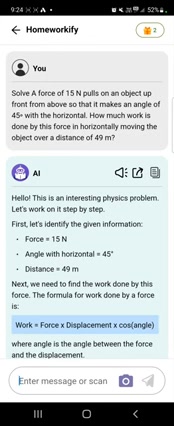
Consider the following problem: A force of 15 N pulls on an object up front from above so that it makes an angle of 45° with the horizontal. How much work is done by this force in horizontally moving the object over a distance of 49 m? This is a classic work-energy problem that can be efficiently solved with the help of AI.

This type of problem combines concepts from both forces and motion and requires a clear understanding of work and energy principles. AI can help break down this problem into manageable steps, ensuring accurate application of the relevant formulas.

To start, it's essential to identify the given information: the force (F) is 15 N, the angle (θ) is 45°, and the displacement (d) is 49 m. The objective is to find the work done (W) by the force. Recognizing these elements is the first step toward a successful solution. AI can assist in identifying these variables, especially for students who may find it challenging to extract the necessary information from the problem statement. AI enhances the precision in initial problem assessment.

Next, we need to consider the formula for work done by a force: Work = Force × Displacement × cos(angle). Understanding that only the horizontal component of the force contributes to the work done is crucial. Trigonometry will be needed to find this horizontal component. AI tools often provide this formula and explanation, guiding students to the correct approach and increasing comprehension.

By providing clear steps and relevant formulas, AI can transform complex physics problems into manageable tasks. This example highlights how AI not only assists in finding the answer but also enhances the understanding of the underlying physics principles, fostering a more effective learning experience.

Step 1: Identify Given Information Using AI Assistance

The first step in solving the problem is to identify the given information. AI tools can assist in this process by automatically extracting the key quantities from the problem statement. In this case, the AI would identify:

  • Force (F) = 15 N
  • Angle (θ) = 45°
  • Displacement (d) = 49 m

Using AI to identify these quantities ensures that no crucial information is overlooked. This is particularly helpful for students who may struggle with extracting the relevant data from the problem statement. AI can highlight these values, making them easily accessible and reducing the chance of errors.

AI tools also provide a clear explanation of each quantity and its units. This helps students understand the significance of each variable and how they relate to each other. For example, the AI might explain that the force is a measure of the push or pull on an object, measured in newtons (N), and that the displacement is the distance the object moves, measured in meters (m).

Furthermore, AI can check for consistency in units and Prompt the user to convert if necessary. This is important because physics formulas require consistent units for accurate calculations. For instance, if the displacement were given in kilometers, the AI would remind the user to convert it to meters before proceeding.

By automating the process of identifying given information, AI can save time and reduce the risk of errors. This allows students to focus on the more challenging aspects of the problem, such as selecting the appropriate formulas and performing the calculations. This initial step is vital for a successful problem-solving approach, setting the stage for accurate and efficient solutions.

Step 2: Apply the Correct Formula with AI Guidance

Once the given information is identified, the next step is to apply the correct physics formula. For this problem, the relevant formula is the work done by a force:

Work = Force × Displacement × cos(angle)

AI tools can guide students in selecting this formula by analyzing the problem statement and identifying the key concepts involved. The AI might suggest this formula based on the presence of force, displacement, and angle in the problem statement. This guidance ensures that students are using the appropriate formula for the given scenario.

AI can also provide a clear explanation of the formula and its components. This helps students understand the relationship between work, force, displacement, and angle. The AI might explain that the cosine of the angle accounts for the fact that only the component of the force in the direction of displacement contributes to the work done.

Furthermore, AI can assist in rearranging the formula to solve for different variables. For example, if the problem asked for the force required to do a certain amount of work, the AI could help rearrange the formula to solve for force.

By providing guidance in selecting and understanding the correct formula, AI can empower students to tackle physics problems with confidence. This step is crucial for developing problem-solving skills and gaining a deeper understanding of physics principles. AI reinforces formula comprehension.

Step 3: Calculate the Work Done

Now that we have the given information and the correct formula, we can proceed with the calculation. First, we need to find the horizontal component of the force using trigonometry:

Horizontal component of force = Force × cos(angle)

Substituting the given values:

Horizontal component of force = 15 N × cos(45°)

Horizontal component of force = 15 N × 0.707

Horizontal component of force ≈ 10.61 N

Next, we calculate the work done:

Work = Horizontal component of force × Displacement

Work = 10.61 N × 49 m

Work ≈ 520.89 J

Therefore, the work done by the force in horizontally moving the object over a distance of 49 m is approximately 520.89 joules.

AI tools can perform these calculations automatically, reducing the risk of errors and saving time. The AI can display the intermediate steps, allowing students to follow along and understand the process. AI can also check for errors in the calculation and provide feedback if necessary. Numerical precision is greatly enhanced through AI.

By automating the calculation process, AI can free up students to focus on the more conceptual aspects of the problem. This allows them to gain a deeper understanding of the underlying physics principles and develop their problem-solving skills.

Step 4: Convert Units if Necessary

In some cases, it may be necessary to convert units to obtain the desired result. For example, if the problem requires the answer in kilocalories (kcal) instead of joules (J), we need to convert using the following conversion factor:

1 kcal = 4184 J

To convert the work done from joules to kilocalories, we divide by 4184:

Work in kcal = Work in J / 4184

Work in kcal = 520.89 J / 4184

Work in kcal ≈ 0.124 kcal

Therefore, the work done is approximately 0.124 kilocalories. Conversion integrity is a critical function of AI tools.

AI tools can perform these conversions automatically, ensuring that the final answer is in the correct units. The AI can also display the conversion factor and the steps involved in the conversion process. Furthermore, AI can check for errors in the conversion and provide feedback if necessary. Unit conversion proficiency is greatly improved through AI assistance.

By automating the unit conversion process, AI can save time and reduce the risk of errors. This allows students to focus on the more conceptual aspects of the problem and develop their problem-solving skills.

Maximizing AI for Physics Problem Solving

Choosing the Right AI Tool

Selecting the right AI Tool is essential for effective physics problem-solving. There are numerous AI tools available, each with its own strengths and weaknesses. It’s important to choose a tool that aligns with your specific needs and learning style. Some tools may be better suited for beginners, while others are designed for advanced users.

One popular option is AI Chat, which allows users to input physics problems in natural language and receive step-by-step solutions. This tool is particularly useful for students who prefer a conversational approach to learning. AI Chat can also provide explanations of key concepts and formulas, enhancing understanding of the underlying physics principles. Choosing the right AI assistant is critical for an enriching learning experience.

Another effective tool is specifically designed to solve math problems. These specialized AI resources often come equipped with advanced computational capabilities, allowing them to handle complex equations and calculations with ease. They are proficient at breaking down intricate problems into manageable steps and providing detailed, step-by-step solutions.

AI problem-solving proficiency and mastery are essential for all STEM students.

Effective Prompt Engineering

Effective prompt engineering is essential for harnessing the full potential of AI tools. A well-crafted prompt can guide the AI to provide more accurate and relevant solutions. This involves clearly stating the problem, providing all the necessary information, and specifying the desired format of the output. Engineering targeted AI prompts yields insightful results.

When crafting a prompt, start by clearly defining the problem. Be as specific as possible, providing all the given information and any relevant conditions or assumptions. For example, instead of simply asking, "Solve this physics problem," provide the full problem statement, including all the quantities, units, and conditions.

Next, specify the desired format of the output. Do you want a step-by-step solution, a numerical answer, or an explanation of the underlying physics principles? Specifying the desired format ensures that the AI provides the information in a way that is most useful to you. Precise prompt formulation drives effective AI solutions.

Finally, experiment with different prompts to see what works best. Try rephrasing the problem, providing more or less information, or asking for different types of output. Through experimentation, you can learn how to craft prompts that consistently yield accurate and relevant results. Targeted prompt refinement generates optimal AI responsiveness.

Verifying AI-Generated Solutions

While AI tools can be incredibly helpful, it's important to verify the solutions they generate. AI is not infallible, and errors can occur due to incorrect prompts, flawed algorithms, or limitations in the AI’s Knowledge Base. Therefore, always double-check the AI-generated solutions to ensure accuracy. Validation of AI answers is critical.

One way to verify AI-generated solutions is to compare them with solutions obtained through other methods, such as manual calculations or consulting textbooks and online resources. If the AI-generated solution matches the solution obtained through other methods, it’s more likely to be correct.

Another way to verify AI-generated solutions is to check the steps involved in the solution process. Does each step make logical sense? Are the formulas applied correctly? If you can follow the steps and understand the reasoning behind them, the solution is more likely to be correct. Verification strategies ensure reliable AI-assisted learning.

Finally, don’t rely solely on AI tools. Use them as a supplement to your own learning and problem-solving efforts. The goal is to understand the physics principles and develop your own skills, not to simply get the right answer. Critical analysis of AI solutions boosts understanding.

Exploring Cost-Effective AI Physics Tools

Cost and Access

While some sophisticated AI tools come with subscription fees, there are also numerous free or low-cost options available. Many AI platforms offer basic access for free, with premium features unlocked through paid subscriptions. This allows students and educators to explore the capabilities of AI without a significant financial burden. Free AI resources empower widespread STEM education.

For instance, several online AI tools provide a certain number of free problem-solving sessions per month, which can be adequate for occasional use. Other platforms offer affordable monthly subscriptions, providing unlimited access to advanced features and comprehensive support. Cost-effective access enhances educational opportunities.

Educational institutions can also negotiate bulk discounts or site licenses for AI tools, making them available to all students and faculty members. This approach ensures that AI resources are seamlessly integrated into the curriculum, fostering a tech-enhanced learning environment. Institutional support maximizes resource accessibility.

The financial accessibility of AI tools is an important consideration, ensuring that all students have the opportunity to benefit from these powerful resources, regardless of their financial background. By leveraging free or low-cost options, educators can enhance their teaching methods and empower students to achieve greater success in physics.

Evaluating AI Physics Solver Advantages and Disadvantages

👍 Pros

Provides step-by-step solutions, which aids understanding.

Reduces calculation errors, ensuring accuracy.

Offers personalized feedback, tailoring learning.

Generates practice problems, enhancing mastery.

Automates unit conversions, saving time.

👎 Cons

May over-rely on AI, diminishing independent problem-solving.

Can provide inaccurate solutions due to input flaws.

Lacks contextual understanding, offering limited critical thinking.

May not cover creative problem methods, restricting learning.

Requires careful validation to ensure accuracy.

Discovering the Key Features of AI Physics Solvers

AI Tool Functions

AI physics solvers come equipped with a range of powerful features designed to enhance problem-solving and learning. One of the most important features is the ability to automatically extract key quantities and units from the problem statement. This saves time and reduces the risk of errors, allowing students to focus on the more challenging aspects of the problem. AI tools facilitate rapid data extraction.

Another key feature is the ability to guide students in selecting the appropriate physics formulas. AI tools can analyze the problem statement and identify the key concepts involved, suggesting the relevant formulas based on this analysis. This guidance ensures that students are using the correct formulas for the given scenario. Formula selection support enhances accuracy.

AI physics solvers can also perform complex calculations automatically, reducing the risk of errors and saving time. These tools can display the intermediate steps, allowing students to follow along and understand the process. AI ensures precision in complex calculations.

Furthermore, AI tools can check for consistency in units and prompt the user to convert if necessary. This is important because physics formulas require consistent units for accurate calculations. Unit conversion assistance prevents common errors.

In addition to these core features, some AI physics solvers offer personalized learning experiences. These tools can analyze a student’s problem-solving approach and provide targeted feedback, helping them focus on specific areas where they need improvement. Adaptive learning enhances individual progress.

Exploring Diverse Use Cases for AI in Physics Education

AI Application in Education

AI has numerous use cases in physics education, ranging from helping students with Homework assignments to assisting researchers with complex simulations. One of the most common use cases is providing step-by-step solutions to physics problems. This helps students understand the process and learn how to apply the relevant formulas. AI aids in structured problem breakdown.

AI can also be used to generate practice problems tailored to a student’s skill level. This ensures that students are continuously challenged and that they are mastering the material. Adaptive learning reinforces student confidence.

In addition, AI can provide personalized feedback to students, helping them identify areas where they need improvement. This feedback can be used to guide their learning and to focus on specific concepts or skills. Targeted feedback enhances individual learning trajectories.

AI can also be used in physics research. Researchers can use AI tools to analyze large datasets, simulate complex systems, and make predictions. These tools can handle tasks that are too time-consuming or complex for manual calculations, accelerating the pace of scientific discovery. Research acceleration is a key benefit of AI.

The integration of AI in physics education and research is opening new avenues for exploration and discovery, empowering students and researchers alike to achieve greater success in their endeavors.

Frequently Asked Questions About AI in Physics

Can AI replace physics teachers?
No, AI cannot replace physics teachers. While AI can assist with problem-solving and provide personalized feedback, it lacks the human touch and the ability to inspire and motivate students. AI should be used as a supplement to, not a replacement for, human teachers. Teachers inspire critical reasoning and creative thinking. Human mentorship is irreplaceable for students.
Is AI accurate in solving physics problems?
AI can be highly accurate in solving physics problems, but it's important to verify the solutions. Errors can occur due to incorrect prompts, flawed algorithms, or limitations in the AI’s knowledge base. Always double-check the AI-generated solutions to ensure accuracy. Cross-validation with other methods increases reliability.
What are the limitations of using AI in physics?
One limitation is that AI cannot understand the context and assumptions of a problem as well as a human. Another limitation is that AI may not be able to solve problems that require creative or critical thinking. AI is a tool, not a replacement for human intelligence. Thoughtful human oversight is indispensable.

Additional Inquiries on AI and Physics Education

How can AI enhance conceptual understanding in physics?

AI enhances conceptual understanding in physics by providing interactive simulations and visualizations, which allow students to explore abstract concepts in a dynamic and engaging way. AI can also generate personalized learning paths, focusing on areas where a student needs extra support. Through adaptive and targeted instruction, AI reinforces core physics principles, deepening knowledge retention and boosting comprehension. Real-time feedback from AI enhances knowledge reinforcement. AI-driven tools offer a multi-faceted approach to conceptual learning, blending practical problem-solving with theoretical knowledge to create a well-rounded educational experience. This innovative blend supports students in grasping the foundational aspects of physics, enhancing their aptitude for advanced study and application. A holistic learning experience is fostered through AI-assisted tools. Here is a breakdown of effective methods AI uses to enhance conceptual understanding in physics: Interactive Simulations: AI can power simulations that allow students to manipulate variables and observe the effects on physical systems. This hands-on experience transforms theoretical knowledge into tangible insights, fostering a deeper understanding of how different factors interact. Interactive simulation amplifies comprehension. Personalized Learning Paths: AI can assess a student's strengths and weaknesses, creating a tailored learning path that addresses specific areas of difficulty. This focused approach ensures that students receive targeted support where they need it most, facilitating efficient learning. Personalized paths address learning gaps efficiently. Adaptive Difficulty Levels: AI can adjust the difficulty level of practice problems based on a student’s performance, providing a continuous challenge without overwhelming the learner. This adaptive approach promotes engagement and mastery, as students are always working at the edge of their capabilities. Adaptive difficulty cultivates continuous improvement. Concept Mapping: AI can generate concept maps that visually represent the relationships between different physics concepts. This visual aid helps students see the big picture and understand how different ideas connect, leading to a more holistic understanding. Visual aids amplify knowledge organization. Real-Time Feedback: AI can provide immediate feedback on student responses, correcting misunderstandings and reinforcing correct concepts. This real-time interaction helps students learn from their mistakes and solidify their understanding of the material. Immediate feedback enhances retention. By leveraging these methods, AI transforms the study of physics from a passive exercise into an active and engaging learning experience, fostering a deeper and more lasting understanding of the fundamental concepts.

Most people like