































Table of Contents
- Key Points
- Fundamentals of Electrical Potentials and Currents
- Action Potential: Sending Signals
- Key Steps of an Action Potential
- Exploring the Pros and Cons of Action Potentials
- Frequently Asked Questions
- Related Questions



Fundamentals of Electrical Potentials and Currents
Electrophysiology: Studying Cellular Electricity
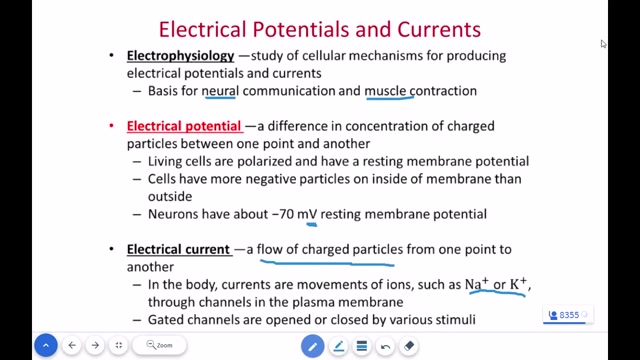
Electrophysiology is the study of the electrical properties of cells, including the cellular mechanisms that produce electrical potentials and currents. This field is crucial for understanding neural communication and muscle contraction.
At its core, it explains how cells use electricity to transmit information and initiate physiological processes. Electrophysiology bridges the gap between molecular events and whole-organism behavior. It involves techniques like voltage clamp and current clamp, which allow researchers to control and measure the electrical activity of cells. This provides insights into how ion channels function and how neurons generate signals. Electrophysiological studies are also vital for drug discovery, as they can identify compounds that affect ion channel function and neuronal excitability. Electrophysiology is the foundation for our comprehension of how the nervous system operates, providing insights into everything from sensory perception to motor control and cognitive processes. Understanding electrophysiology is fundamental to grasping the mechanisms behind neurological disorders and developing targeted therapies. Through advanced techniques and innovative research, electrophysiology continues to reveal new dimensions of cellular communication, improving our understanding of life processes at the most basic level.
By carefully examining the interactions between neurons, neuroscientists can decode how information is processed, stored, and transmitted within neural circuits. Electrophysiological techniques are also pivotal in muscle physiology, allowing researchers to probe the mechanisms of muscle contraction and the role of ion channels in regulating muscle activity. The implications of electrophysiology span from treating cardiac arrhythmias to understanding the basis of neurological diseases. This field not only enriches our knowledge of human physiology but also inspires Novel diagnostic and therapeutic strategies.
Moreover, emerging areas such as optogenetics combine genetic engineering with electrophysiological tools to achieve unprecedented control over neuronal activity. This groundbreaking approach provides an exceptional level of precision in manipulating and studying neural circuits. As technology evolves, electrophysiology remains a central pillar in biological research, pushing the boundaries of our knowledge about the electrical activity in living systems and its relevance to health and disease. The convergence of electrophysiology with other scientific disciplines holds immense promise for unlocking complex biological phenomena and creating future medical advancements.
Electrical Potential: The Charge Difference
Electrical potential, also known as membrane potential or membrane voltage, is the difference in electrical charge across a cell membrane.
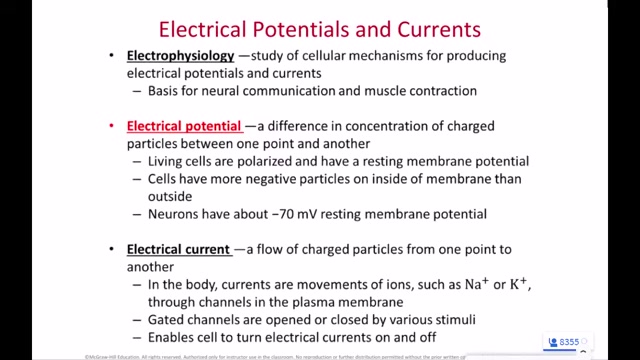
Living cells are typically polarized, meaning they have a resting membrane potential. This potential is usually negative, with neurons typically having around -70 mV. This is due to the unequal distribution of charged particles, such as ions, between the inside and outside of the cell. The resting membrane potential is critical for a cell's excitability, enabling it to respond to stimuli. Various factors contribute to the resting membrane potential, including the selective permeability of the cell membrane to different ions, and the action of ion pumps such as the sodium-potassium pump.
The cell membrane is selectively permeable, allowing some ions to pass more easily than others. This selectivity is primarily due to the presence of ion channels, specialized proteins that span the membrane and allow specific ions to flow through. Potassium channels, for example, are more permeable to potassium ions (K+) than to sodium ions (Na+). As a result, potassium ions tend to leak out of the cell, following their concentration gradient. This movement of positively charged potassium ions contributes to the negative charge inside the cell.
The sodium-potassium pump, another key player, actively transports sodium ions out of the cell and potassium ions into the cell. This pump uses energy in the form of ATP to move ions against their concentration gradients. By expelling three sodium ions for every two potassium ions it brings in, the pump further contributes to the negative charge inside the cell. This active transport ensures that the concentration gradients of sodium and potassium are maintained, which is vital for the cell’s electrical properties.
Electrical Current: The Movement of Ions
Electrical current in the body results from the flow of charged particles, primarily ions like sodium (Na+) and potassium (K+), across the plasma membrane. These ions move through channels that open or close in response to various stimuli. These gated channels enable the cell to turn electrical currents on and off. Electrical current is vital for neural communication and muscle contraction.
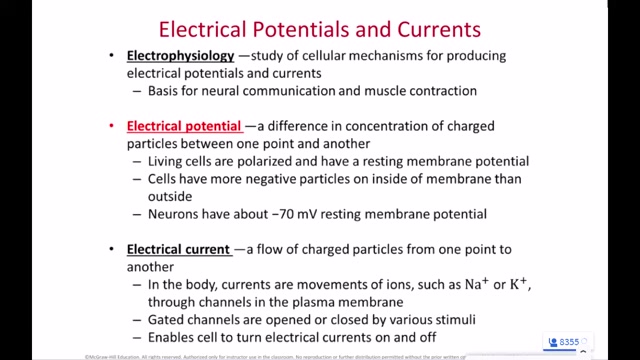
In the body, currents are movements of ions, such as Na+ or K+, through channels in the plasma membrane. Gated channels are opened or closed by various stimuli. Enables cell to turn electrical currents on and off. One type of gated channel is the voltage-gated channel, which opens in response to changes in membrane potential. These channels are fundamental to the generation and propagation of action potentials. Other types of gated channels include ligand-gated channels, which open when a specific molecule (ligand) binds to the channel, and mechanically gated channels, which respond to physical forces or pressure. Each type of channel plays a distinct role in cellular signaling and physiological processes. The precise regulation of these ion channels is crucial for maintaining cellular homeostasis and executing complex functions.
The flow of ions through these channels generates electrical currents that can alter the membrane potential. When positively charged ions like sodium enter the cell, they depolarize the membrane, making the inside of the cell less negative. Conversely, when positively charged ions like potassium exit the cell, they hyperpolarize the membrane, making the inside of the cell more negative. These changes in membrane potential can trigger various cellular responses, including the firing of action potentials, which are essential for neuronal communication and muscle contraction. Thus, understanding how electrical currents are generated and controlled in the body is critical for comprehending physiology and developing new therapeutic interventions.
Action Potential: Sending Signals
Understanding Action Potentials
Action potentials are the means by which cells send electrical signals down their length. Action potential are electrical signals traveling down the cell.
This process involves the movement of sodium and potassium ions across the membrane. Action potentials are essential for communication in the nervous system and for muscle contraction. Without action potentials, neurons could not transmit signals over long distances, and muscles could not contract. Action potentials are rapid, transient changes in membrane potential that allow cells to transmit information quickly and efficiently.
During an action potential, the membrane potential undergoes a rapid depolarization, followed by repolarization. This sequence of events results in a brief, but significant, change in voltage that propagates along the cell membrane. The process is driven by the coordinated opening and closing of voltage-gated ion channels. When the membrane potential reaches a certain threshold, sodium channels open, allowing sodium ions to rush into the cell. The influx of positively charged sodium ions causes a rapid depolarization of the membrane.
As the membrane potential becomes more positive, sodium channels begin to close, and potassium channels open. The outflow of positively charged potassium ions repolarizes the membrane, restoring the negative resting membrane potential. The sequential opening and closing of sodium and potassium channels creates the characteristic shape of the action potential. The speed and efficiency of action potential propagation are influenced by factors such as the diameter of the axon and the presence of myelin, a fatty substance that insulates the axon. In myelinated axons, action potentials jump from one node of Ranvier to the next, a process known as saltatory conduction, which dramatically increases the speed of signal transmission. Understanding the factors that govern action potential propagation is essential for comprehending how the nervous system functions and responds to stimuli.
Furthermore, action potentials are governed by the 'all-or-none' principle, meaning that once the membrane potential reaches the threshold, a full action potential is triggered. This principle ensures that signals are transmitted faithfully, without any degradation or loss of information. The refractory period, a brief period following an action potential, limits the frequency with which a neuron can fire, preventing signals from overlapping and ensuring that each action potential is distinct. Through a combination of precise ion channel regulation and the all-or-none principle, action potentials serve as robust and reliable carriers of information throughout the body.
Key Steps of an Action Potential
Resting Membrane Potential
The process starts with the neuron in a resting state, with a membrane potential of about -70 mV. The membrane is polarized, meaning there is a difference in charge across the membrane.
This resting potential is maintained by the sodium-potassium pump and leak channels that allow the flow of potassium ions out of the cell and the limited flow of sodium ions into the cell. During this phase, the cell is primed and ready to respond to incoming stimuli. The stability of the resting membrane potential is critical for the neuron’s ability to generate action potentials. Without a stable resting state, the neuron cannot effectively transmit signals. Thus, maintaining the balance of ions across the membrane is essential for neural function.
Depolarization
A stimulus causes sodium channels to open, allowing sodium ions to rush into the cell. This influx of positive charge makes the inside of the cell less negative, moving the membrane potential towards zero. When the depolarization reaches a critical threshold, typically around -55 mV, more sodium channels open, leading to a rapid increase in sodium influx. This positive feedback loop causes a dramatic depolarization of the membrane, driving it towards a positive value. The depolarization phase is characterized by a rapid and steep increase in membrane potential, indicating the neuron is becoming more active. This phase is crucial for initiating an action potential and transmitting signals through the nervous system. The sequential opening and closing of ion channels is carefully regulated to ensure that action potentials are generated accurately and efficiently.
Repolarization
At the peak of depolarization, sodium channels close, and potassium channels open. Potassium ions flow out of the cell, reducing the positive charge inside and bringing the membrane potential back towards its negative resting state. The outflow of potassium ions is driven by both the concentration gradient and the electrical gradient. As the membrane potential returns to negative values, potassium channels begin to close. This process of repolarization is essential for resetting the membrane potential and preparing the neuron for subsequent action potentials. The repolarization phase is characterized by a rapid and steep decrease in membrane potential, restoring the negative charge inside the cell. The orderly sequence of ion channel events ensures that the neuron can fire action potentials repeatedly and reliably.
Hyperpolarization
Potassium channels remain open for a short time after the membrane potential reaches its resting level, causing a brief period of hyperpolarization where the membrane potential becomes more negative than usual. This occurs because the potassium channels are slow to close, allowing an excessive outflow of potassium ions. This hyperpolarized state makes it more difficult for the neuron to reach threshold again, a protective mechanism known as the refractory period. The refractory period helps to ensure that action potentials are discrete and unidirectional. After hyperpolarization, the sodium-potassium pump works to restore the original ion concentrations, bringing the membrane potential back to its resting state. The hyperpolarization phase is an important part of the action potential cycle, regulating neuronal excitability and preventing signal overlap.






Most people like




































Report
Please select a reason for reporting
- 13 Reasons to Switch from Snapchat to Text Messaging
- 7 Powerful Speech to Text Apps to Boost Productivity
- 10 Best Speech to Text Tools for Effortless Transcription
- 13 Free Tools to Easily Transcribe Audio to Text
- 15 Surprising Ways Google's Speech-to-Text Boosts Productivity
- 7 Best Free Online Audio to Text Transcription Tools
- 9 Tips to Transcribe Speech to Text Faster and Better
- 13 Best Speech to Text Software for Windows 10 in 2023
- 7 Tips for Choosing the Best Transcriber for Audio to Text
- 11 Reasons Why Dragon Speech-to-Text Apps are Game-Changers
- 6 Secrets to Enhance Your Speech to Text Transcription
- 6 Brilliant Ways to Boost Productivity with Talk-to-Text on Your MacBook
- 6 Ways Transcription Software Converts Audio to Text
- 8 Tips to Transcribe Speech to Text Like a Pro
- 6 Reasons IBM Watson Speech to Text is a Game-Changer
- 14 Powerful Ways Talk-to-Text Improves Your Workflow
- 12 Top Windows Speech-to-Text Software for Efficient Transcription
- 12 Game-Changing Benefits of Apple's Speech to Text Technology
- 9 Powerful Use Cases for AWS Speech to Text Technology
- 10 Easy Steps to Transcribe YouTube Videos to Text
- transcription audio en texte
- online audio transcription
- free audio file transcription
- free ai audio transcription
- audio transcription service
- audio transcription online free
- audio transcription free online
- audio to transcription software
- audio and transcript
- ai audio transcription free
- voice recording to text converter
- translate voice recording to text
- record voice to text
- audio recording to text converter
- voice recording and transcription
- chatgpt voice to text
- gmail voice to text
- speech to text reader
- speech to text ai free
- speech to talk
- How SEO and Marketing Dashboards Empower Agencies to Drive Results
- How to Use AI Tools to Find Internal Linking Opportunities Across a Business Website
- Discover Your Perfect Haircut with AI Hairstyle Apps
- Free Reputation Calculator Tools: How They're Adapting to Score AI Visibility, Not Just Rankings
- Design Professional Flyers for Free on Your Phone
- Best Free Flyer Maker Apps for Android: Design Like a Pro
- How to Know If Your Business Is Ready for an AI Customer Service Agent
- Revolutionizing Storytelling: From Novels to Screenplays with AI
- Create Engaging Animated Explainer Videos with a Free AI Tool
- Stop Multi-Subscribing: Benchmark Top AI Visual Models in One Canvas
- 5 Data Problems That Stall AI Projects in Financial Compliance
- Master Storyboard Drawing: Expert Tips for Non-artists
- The Future of Smart Glasses: Explained & Assembling Guide
- DeepL Translator: The AI-Powered Translation Tool
- AI Video Upscaling: Top Tools Compared for Enhanced Quality
- Bridging the Gap: How One Indie Developer Solved the "Art Asset Nightmare" Using AI Style Transfer
- How I Direct Consistent AI Clips: A Hands-On Guide to Multi-Model Generation
- My Honest Review of VideoAI: The Ultimate Character Voice Generator I've Been Using Lately
- Why do so many AI tools underdeliver for online stores?
- My Brand New Logo: AI-Powered Logo Design for Startups

Copyright ©2026 toolify