































Table of Contents
- Key Points
- Understanding Probability: From Certainty to Impossibility
- Visualizing Probability: The Probability Line
- Applying Probability: Beyond Coin Tosses
- Practical Probabilities: Making Predictions
- Basic Probability: A Helpful Way to Forecast
- Summarizing Probability and Making it Palatable
- How to Properly Solve Basic Probability Problems
- Frequently Asked Questions
- Dive Deeper into Probability: Related Concepts



Understanding Probability: From Certainty to Impossibility
What is Probability?
In mathematics, we often deal with things that always happen the same way; these are completely certain. For example, 1 + 1 will always equal 2, and 2 x 3 will always equal 6
. There’s no uncertainty involved here.
However, in the real world, things aren’t always so predictable . This is where the concept of probability comes into play. Probability allows us to analyze and quantify the likelihood of unpredictable or random events, like a coin toss. Understanding probability involves grasping how likely an event is to occur, ranging from impossible to certain.
When we say an event is 'likely,' we mean it has a good chance of happening. On the other HAND, 'unlikely' events have a slim chance of occurring . Probability gives these terms numerical meaning, allowing us to compare different outcomes with precision.
Randomness and Coin Tosses: A Classic Example
Consider a classic example: a coin toss. We can't predict whether a coin toss will result in heads or tails
. It’s unpredictable, or random. Yet, despite this randomness, we know certain things about a fair coin toss. Heads is just as likely to show up as tails.
Probability is the value that tells us how likely an event is to happen . Since a coin has two sides, the probability of flipping heads is ½, and the probability of flipping tails is also ½ . This means that with a fair coin toss, each side is equally likely to appear.
If we flipped a coin a large number of times, we'd expect that roughly half the flips would be heads and half would be tails . This illustrates a fundamental aspect of probability: over many trials, the actual results tend to converge toward the expected probabilities.
Visualizing Probability: The Probability Line
The Scale of Likelihood
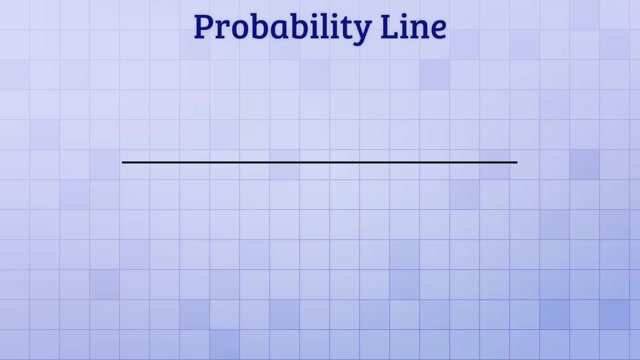
To better understand probability, we can use a probability line
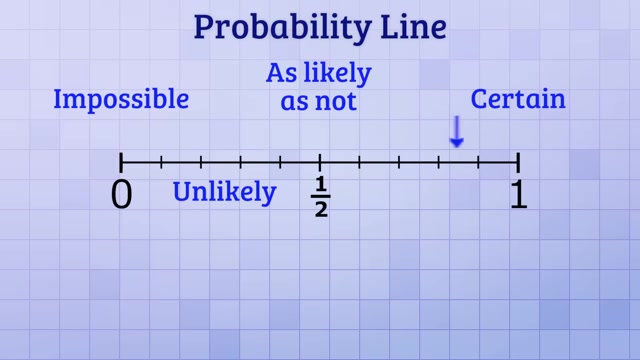
. This number line ranges from 0 to 1.
- A probability of 0 means an event cannot happen . It's impossible.
- A probability of 1 means an event is definitely going to happen . It's certain.
- A probability of 1/2 (or 0.5) means an event is just as likely to happen as it is not .
Therefore, the probability line is constrained between 0 and 1 . An event can't be less likely than impossible or more likely than certain.
Probabilities can also be written as decimals or percentages :
- A probability of 0 is the same as a 0% chance.
- A probability of 1/2 is the same as a 50% chance.
- A probability of 1 is the same as a 100% chance.
Applying Probability: Beyond Coin Tosses
Understanding Dice Roll Probabilities
A standard die has six sides numbered 1 through 6. When you roll it, any of those sides is just as likely to come up as the others. That's different than flipping a coin because a coin has 2 possible options compared to 6 possible options when rolling a die. It's certain that one of those six sides will land facing upwards. Therefore, the probability of this action is 1, or 100%. Since only one side can face upwards, we have to divide up that value among all the possibilities. If the probability of rolling a 3 is 50%, but we need to remember what a coin toss consists of as compared to what rolling a die looks like.
Trials and Averages: Getting Closer to the Truth
In probability, a trial (or experiment) is a process that has a random outcome, like tossing a coin or rolling a die. But because there are so many side to a die in contrast to a coin, it isn't as likely that I'll Roll a 3, but it's just as likely as rolling any other number on the die
.
The total number of possibilities needs to equal 1, so as a summary for all the different probabilities when rolling a standard die. 1/6+1/6+1/6+1/6+1/6+1/6 totals 1, or 100% . The more trials you do the closer your results will get to the expected probabilities .
Practical Probabilities: Making Predictions
Using Probability for Real-World Decisions
In rolling trials or experients, all 6 numbers have the same probability
. That means each number should come up about as often as the others. For example, how many sixes were rolled in 100 trails. Let's look at the below table:
Summarizing Probability and Making it Palatable
The Key Principles of Probability
To be as clear as possible, here is a succinct list of all of the best methods of probability that are discussed previously
:
- Make a fraction with the number of outcomes that give you what you want.
- Have a denominator that represents the total number of possibilities.
- Probabilities can't be less than 0 or more than 1.
How to Properly Solve Basic Probability Problems
Basic Probability Fractions
This article gives an idea of what probability is, as well as showing many examples, including die, coin and marble-related instances of calculating this math.
For coin problems, remember that you can flip it and expect 2 different outcomes. With a roll of the die, you're expected to have 6. When selecting an object from an area with many of them, such as a bag of marbles, then you have to take note of that total. For a quick reference, here's a table of values to look at when doing problems
:





Most people like






































Report
Please select a reason for reporting
- 13 Reasons to Switch from Snapchat to Text Messaging
- 7 Powerful Speech to Text Apps to Boost Productivity
- 10 Best Speech to Text Tools for Effortless Transcription
- 13 Free Tools to Easily Transcribe Audio to Text
- 15 Surprising Ways Google's Speech-to-Text Boosts Productivity
- 7 Best Free Online Audio to Text Transcription Tools
- 9 Tips to Transcribe Speech to Text Faster and Better
- 13 Best Speech to Text Software for Windows 10 in 2023
- 7 Tips for Choosing the Best Transcriber for Audio to Text
- 11 Reasons Why Dragon Speech-to-Text Apps are Game-Changers
- 6 Secrets to Enhance Your Speech to Text Transcription
- 6 Brilliant Ways to Boost Productivity with Talk-to-Text on Your MacBook
- 6 Ways Transcription Software Converts Audio to Text
- 8 Tips to Transcribe Speech to Text Like a Pro
- 6 Reasons IBM Watson Speech to Text is a Game-Changer
- 14 Powerful Ways Talk-to-Text Improves Your Workflow
- 12 Top Windows Speech-to-Text Software for Efficient Transcription
- 12 Game-Changing Benefits of Apple's Speech to Text Technology
- 9 Powerful Use Cases for AWS Speech to Text Technology
- 10 Easy Steps to Transcribe YouTube Videos to Text
- transcription audio en texte
- online audio transcription
- free audio file transcription
- free ai audio transcription
- audio transcription service
- audio transcription online free
- audio transcription free online
- audio to transcription software
- audio and transcript
- ai audio transcription free
- voice recording to text converter
- translate voice recording to text
- record voice to text
- audio recording to text converter
- voice recording and transcription
- chatgpt voice to text
- gmail voice to text
- speech to text reader
- speech to text ai free
- speech to talk
- How SEO and Marketing Dashboards Empower Agencies to Drive Results
- How to Use AI Tools to Find Internal Linking Opportunities Across a Business Website
- Discover Your Perfect Haircut with AI Hairstyle Apps
- Free Reputation Calculator Tools: How They're Adapting to Score AI Visibility, Not Just Rankings
- Design Professional Flyers for Free on Your Phone
- Best Free Flyer Maker Apps for Android: Design Like a Pro
- How to Know If Your Business Is Ready for an AI Customer Service Agent
- Revolutionizing Storytelling: From Novels to Screenplays with AI
- Create Engaging Animated Explainer Videos with a Free AI Tool
- Stop Multi-Subscribing: Benchmark Top AI Visual Models in One Canvas
- Top 5 Cold Email Software: Maximize Your Outreach in 2025
- Magic School AI: Revolutionizing Quiz & Assessment Generation
- Create Your Own Email Bot and Automate Your Email Tasks
- Beyond Pure Prompts: Optimizing Production with 'Text With Reference' Generation
- Stop Using Boring TTS: My Honest Deep Dive Into VideoAI and the Hunt for the Perfect Custom Voices
- AI & Elections: Defending Democracy Against Misinformation
- Navigating Political Discourse: AI, Deepfakes, and Reality Checks
- Detecting Political Bias in News Articles: A Powerful AI Algorithm
- AI Bias Unveiled: Political Leanings in ChatGPT & Beyond
- Revolutionize Learning: Discover Quizzes AI for Engaging Interactive Quizzes

Copyright ©2026 toolify