































Table of Contents
- Key Points
- Polynomial Representation of Codewords
- Cyclic Linear Codes and Their Properties
- Encoding a Message with a Generator Polynomial
- Pros and Cons of Cyclic Codes
- Frequently Asked Questions
- Further Exploration of Cyclic Codes


Polynomial Representation of Codewords
From Binary Digits to Polynomials
In the realm of cyclic codes, a codeword isn't just a sequence of binary digits; it's a polynomial expression. Understanding this representation is fundamental to grasping how these codes function. Let's start with a simple example.

Consider a five-digit binary codeword: b₀ b₁ b₂ b₃ b₄. We can represent this codeword as a polynomial c(x) where the digits act as coefficients.
The polynomial representation is given by:
c(x) = b₀ + b₁x + b₂x² + b₃x³ + b₄x⁴
Here, each digit bᵢ corresponds to the coefficient of x raised to the power i. This polynomial c(x) encapsulates the entire codeword in a convenient algebraic form. This conversion is crucial because it allows us to use polynomial arithmetic for encoding and decoding, leveraging powerful mathematical tools.
Key benefits of using polynomials:
- Algebraic Manipulation: Polynomials can be added, subtracted, multiplied, and divided, providing a rich set of algebraic operations.
- Efficient Encoding: Generator polynomials can be used to systematically encode messages into valid codewords.
- Effective Decoding: Polynomial division can be used to detect and correct errors in received codewords.
The power of this representation will become even more apparent as we delve into modular arithmetic and irreducible polynomials.
Modular Arithmetic in Polynomial Rings
When dealing with polynomials that represent codewords, modular arithmetic plays a significant role in maintaining the code's structure and properties. Specifically, we often work in a polynomial ring modulo another polynomial.
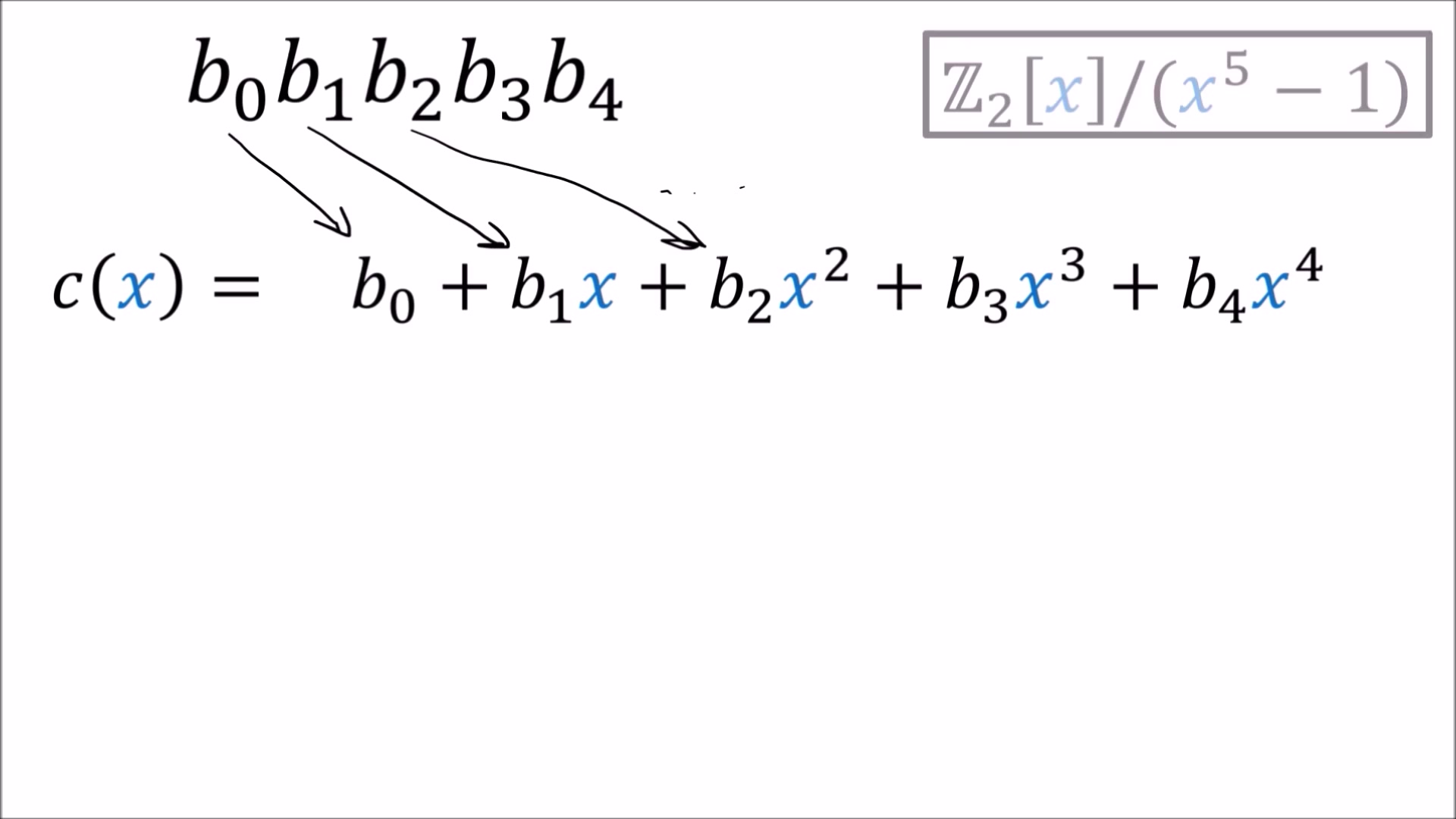
Consider the set Z₂[x] / (x⁵ - 1). What does this mean?
Understanding the notation:
- Z₂[x] represents the set of all polynomials in the variable 'x' with coefficients in the integers modulo 2 (i.e., binary coefficients, either 0 or 1).
- / (x⁵ - 1) signifies that we're considering these polynomials modulo (x⁵ - 1). This means that any polynomial is equivalent to its remainder after division by (x⁵ - 1).
In essence, (x⁵ - 1) is treated as zero, implying that:
x⁵ ≡ 1
This condition has profound implications for how we manipulate and interpret these polynomials. For example, any term with x raised to the power of 5 or higher can be reduced to a lower-degree term. This ensures that we’re always dealing with polynomials of degree less than 5, maintaining the structure of our codeword representation.
Modular arithmetic allows us to work with a finite set of polynomials, making encoding and decoding operations computationally feasible.
Polynomial modular arithmetic has wide applications, summarized in the table below:
| Operation | Integers | Polynomials |
|---|---|---|
| Division & Remainder | 17 ÷ 5 = 3, Rem 2 | (x³ + x² + 1) ÷ (x² + 1) = (x + 1), Rem (-x) |
| Modular Arithmetic | 8 ≡ 3 mod 5 | x⁵ ≡ x mod (x³ - x) |
| Primes/Irreducibles | 2, 3, 5, 7, 11, 13... | x² + 1 |
The Significance of Cyclic Shifts
Cyclic shifts are a fundamental concept in cyclic codes, defining how code digits can be rearranged while maintaining the code's inherent structure. Let's explore what happens when we perform a cyclic shift on our codeword representation.
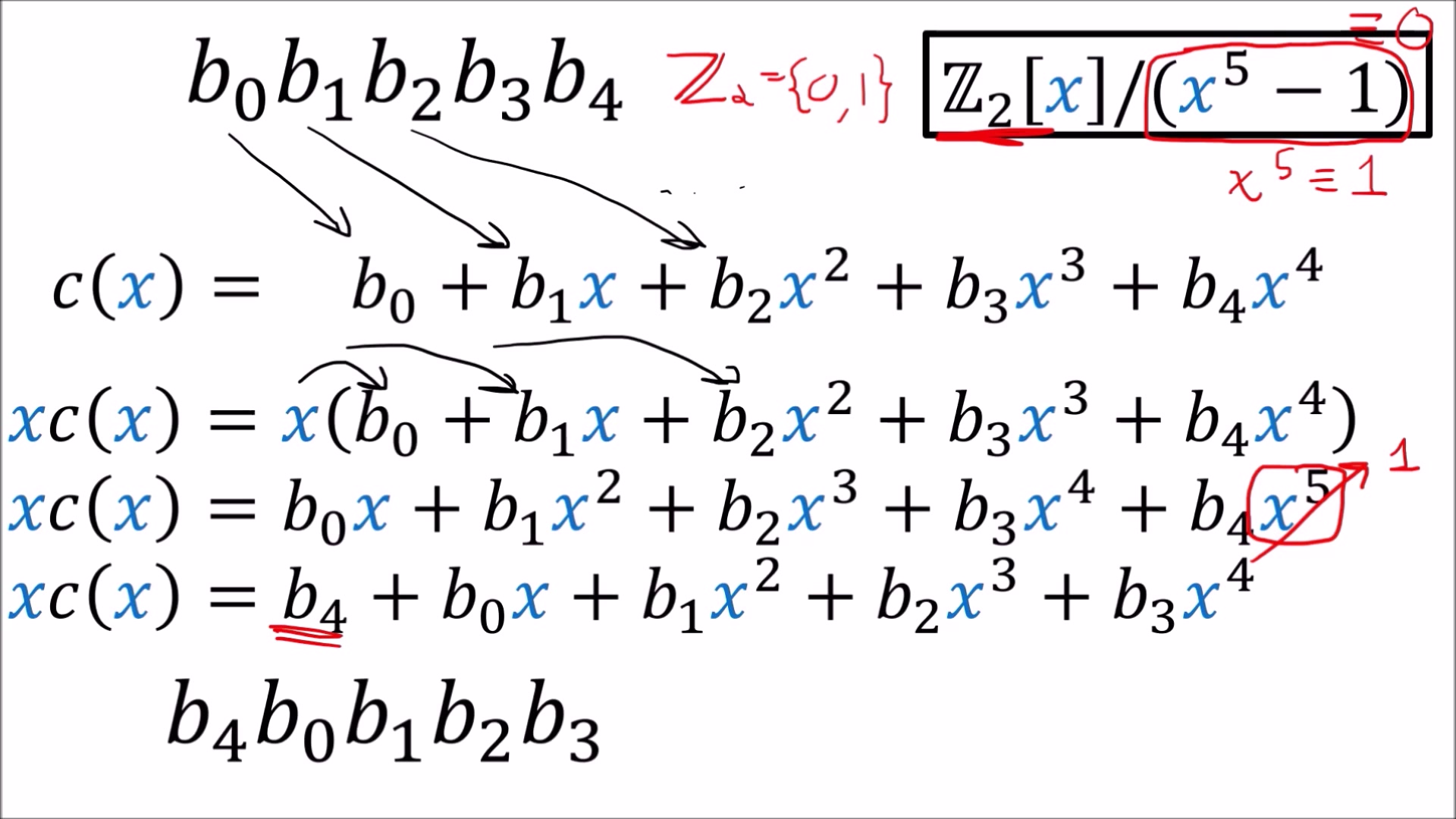
Consider multiplying the polynomial c(x) representing our codeword by x:
x c(x) = x (b₀ + b₁x + b₂x² + b₃x³ + b₄x⁴)
Distributing the x across the polynomial, we get:
*x c(x) = b₀x + b₁x² + b₂x³ + b₃x⁴ + b₄x⁵**
Now, recall that we're operating modulo (x⁵ - 1), meaning x⁵ ≡ 1. Therefore, we can rewrite the above expression as:
*x c(x) = b₄ + b₀x + b₁x² + b₂x³ + b₃x⁴**
Notice anything interesting? The coefficients have been cyclically shifted! Digit b₄, which was previously the last coefficient, has now become the constant term, and all other coefficients have shifted one position to the right. In the digit representation, if our original code word was b₀ b₁ b₂ b₃ b₄, the new code WORD after the shift is b₄ b₀ b₁ b₂ b₃.
This relationship between polynomial multiplication by x and cyclic shifts is a key property of cyclic codes. It means that if c(x) is a valid codeword, then *x c(x)** is also a valid codeword within our code. This property is what makes cyclic codes particularly useful for error detection and correction, because you can easily and efficiently check the codes that the system receives.
The same logic extends to codewords of any length. For a codeword with 'n' digits, living in the set Z₂[x] / (xⁿ - 1), multiplying by x will produce a cyclic shift of the digits.
Cyclic Linear Codes and Their Properties
Combining Linearity and Cyclic Shifts
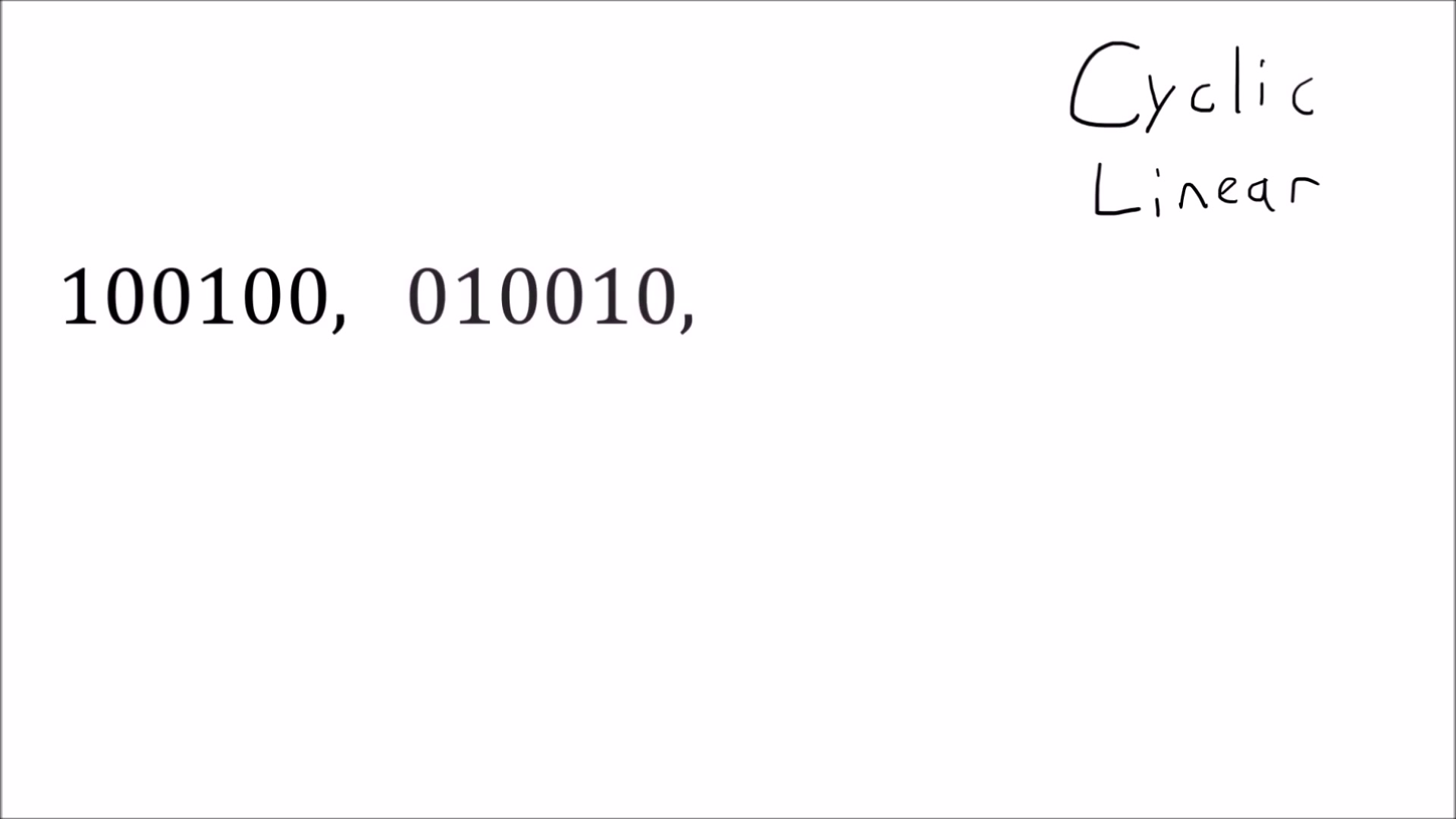
Cyclic codes gain even more power when combined with the property of linearity. Linearity means that the sum of any two valid codewords is also a valid codeword. This property has significant implications for constructing and analyzing cyclic codes.
Consider any two valid codewords, c₁(x) and c₂(x). Because the codes are linear, then their sum, c₁(x) + c₂(x) is also a valid codeword. Furthermore, any multiplication by x is also linear, so therefore any multiple of x by our valid code words, such as x²c₁(x) + x³c₂(x) are also valid codewords.
The following table summarizes everything we've learned so far:
| Property | Implication |
|---|---|
| Cyclic | If c(x) is a valid codeword, then x*c(x) is also a valid codeword. |
| Linear | If c₁(x) and c₂(x) are valid codewords, then c₁(x) + c₂(x) is also a valid codeword. |
| Generator Polyn | Any valid codeword can be generated by multiplying the message polynomial, m(x), by the generator polynomial, g(x). |
This is the definition of a valid cyclic linear code. This allows us to write a general formula to generate codes: Given u(x), any arbitrary polynomial, every valid code word can be expressed as u(x)c(x).
In a way, these features are all interconnected. We know that for any multiplication by a power of x, it results in a cyclic shift, therefore, that is another valid codeword. We also have total control over which powers of x we want to include in the sum of the various code digits. This all tells us that any polynomial multiplication of the codewords is another valid codeword.
In simpler terms, with cyclic linear codes, we're able to generate a set of codewords efficiently, analyze their properties, and perform error correction. Because every shift and power of x is another valid code, it's trivial to generate a larger group of codes and to do so with minimal computational power. The cyclic and linear properties help narrow it down to the code word space, where it guarantees that it has certain nice and useful properties.
Encoding a Message with a Generator Polynomial
Working with Polynomial and Binary Message Formats
Let's work through the encoding process to solidify these concepts.
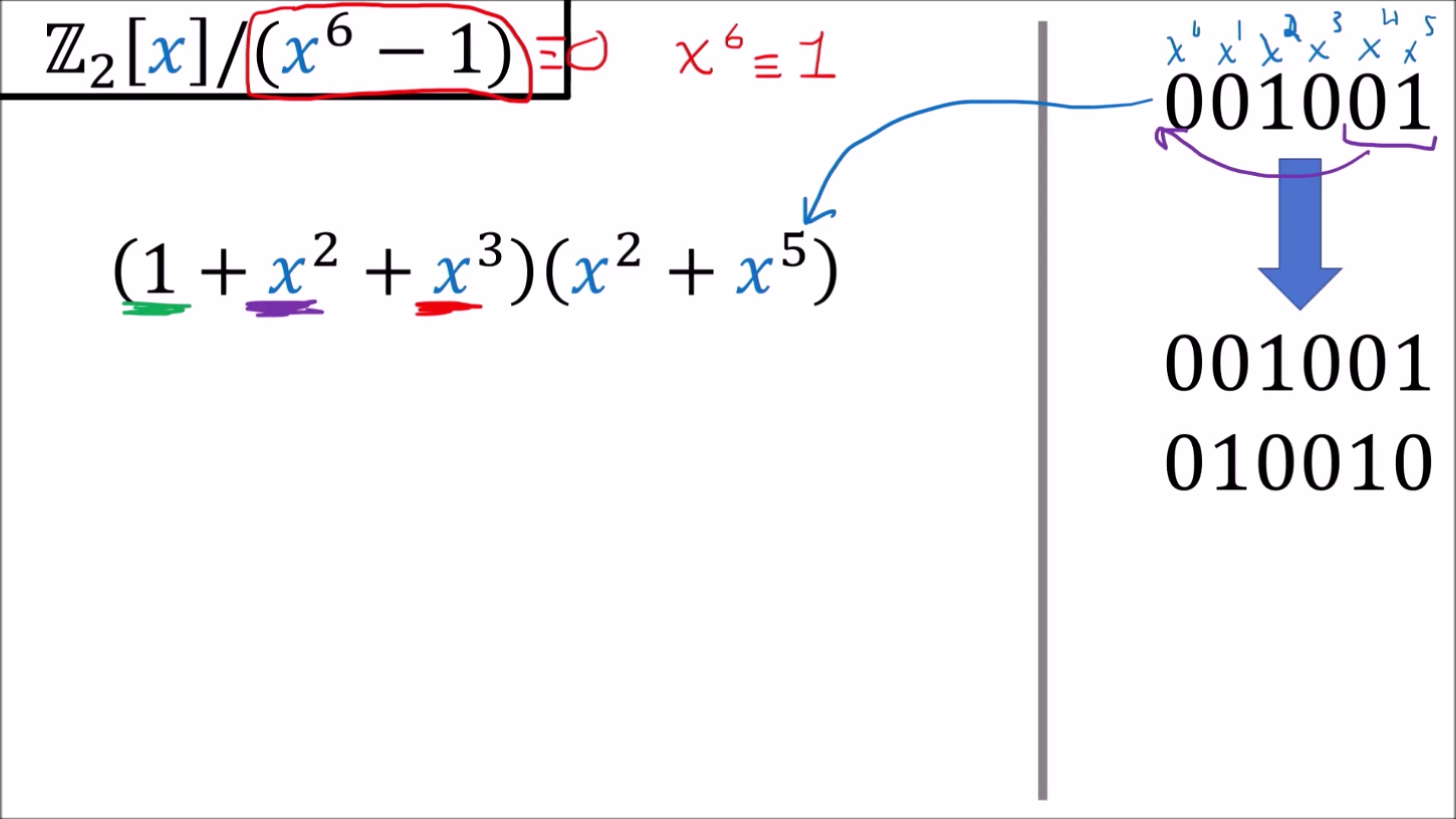
Let's say we're working with six-digit codewords, so we are operating modulo (x⁶ - 1). What is a cyclic linear code, without looking back at the other explanations?
Let’s start with the code word 001001. The polynomial representation of this code word is x² + x⁵.
We'll also be working with the formula for every valid code: u(x)c(x). This code tells us all the properties of this code, as well as tells us how to write the formula.
Next, we'll be using an existing generator 1 + x² + x³. This code is the one we get when we remember that everything is defined by the initial codes. The equation also determines the level of code compression, message size, and so on. The entire operation, in other words, can be described by the generator. If we know this, we know everything. We therefore want to select it carefully.
Putting these two ideas together, we will see if another valid code digit will be formed. Because these codes are the same thing as integers (to a certain extent), it should still hold. It is important to note that every code word is uniquely determined by the starting position.
When multiplication was completed, we got x + x⁴. In integer division, we’re basically multiplying two factors. What's unique here is how similar it is to what we would have expected from integers, which can be extremely useful. This allows us to create codes that are both space conserving, but also are easy to operate, transmit, verify and correct, all of which makes the systems robust and resistant to failure. The properties are the most important for the engineer, not so much the specific polynomials or operations involved.









Most people like




























Report
Please select a reason for reporting
- 13 Reasons to Switch from Snapchat to Text Messaging
- 7 Powerful Speech to Text Apps to Boost Productivity
- 10 Best Speech to Text Tools for Effortless Transcription
- 13 Free Tools to Easily Transcribe Audio to Text
- 15 Surprising Ways Google's Speech-to-Text Boosts Productivity
- 7 Best Free Online Audio to Text Transcription Tools
- 9 Tips to Transcribe Speech to Text Faster and Better
- 13 Best Speech to Text Software for Windows 10 in 2023
- 7 Tips for Choosing the Best Transcriber for Audio to Text
- 11 Reasons Why Dragon Speech-to-Text Apps are Game-Changers
- 6 Secrets to Enhance Your Speech to Text Transcription
- 6 Brilliant Ways to Boost Productivity with Talk-to-Text on Your MacBook
- 6 Ways Transcription Software Converts Audio to Text
- 8 Tips to Transcribe Speech to Text Like a Pro
- 6 Reasons IBM Watson Speech to Text is a Game-Changer
- 14 Powerful Ways Talk-to-Text Improves Your Workflow
- 12 Top Windows Speech-to-Text Software for Efficient Transcription
- 12 Game-Changing Benefits of Apple's Speech to Text Technology
- 9 Powerful Use Cases for AWS Speech to Text Technology
- 10 Easy Steps to Transcribe YouTube Videos to Text
- transcription audio en texte
- online audio transcription
- free audio file transcription
- free ai audio transcription
- audio transcription service
- audio transcription online free
- audio transcription free online
- audio to transcription software
- audio and transcript
- ai audio transcription free
- voice recording to text converter
- translate voice recording to text
- record voice to text
- audio recording to text converter
- voice recording and transcription
- chatgpt voice to text
- gmail voice to text
- speech to text reader
- speech to text ai free
- speech to talk
- Create Engaging Animated Explainer Videos with a Free AI Tool
- Stop Multi-Subscribing: Benchmark Top AI Visual Models in One Canvas
- Best Seedance 2.5 API Provider: Every Price on the Market, Checked at Source
- AI OnlyFans: How to Generate $30,000/Month (Legally)
- Transform Your Script into an Engaging Video with AI Video Maker!
- AI Marketing Automation: A Comprehensive Guide for Small Businesses
- Midjourney Alternative for Anime Art Creators: Why PixAI May Be Better for Character Workflows
- 10 Things Most People Get Wrong About AI Image Search
- AI Girlfriend Apps: Top Choices Redefining Relationships 2025
- How to Reduce Quoting Errors in Salesforce with AI-Assisted Quote Creation
- AI Resume Builders: EnhanceCV, ResumeNerd AI, & Teal Compared
- ResumeAI: Crafting ATS-Optimized Resumes with AI
- AI in Resume Writing: A New Era for Job Seekers
- AI Resume Tools: Streamline Your Job Search and Land Your Dream Role
- AI Resume Optimization: The Right Way to Land Interviews
- Crafting a Killer Resume with AI: A Step-by-Step Guide
- Crafting a Winning Resume: AI Tools and Expert Tips
- AI Job Search: Level Up Your Career with AI Automation
- Empower Your Career Journey: Dynamic Resumes with AI
- AI Resume Builder: Create Professional Resumes Effortlessly

Copyright ©2026 toolify