































Table of Contents
- Key Points
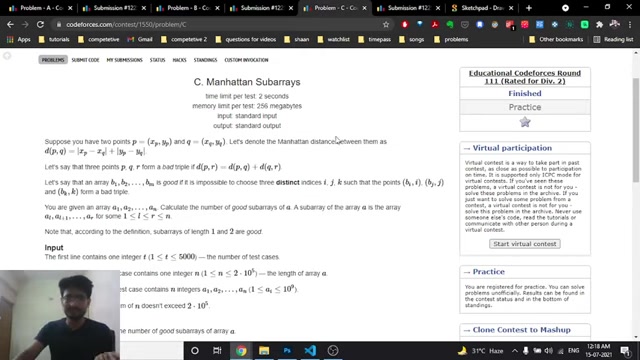
- Decoding the Manhattan Subarrays Problem
- Strategic Observations and Problem Simplification
- Implementing a Solution: Step-by-Step
- Analyzing the Solution: Pros and Cons of the Brute-Force Approach
- Frequently Asked Questions
- Further Exploration: Diving Deeper into Related Concepts


Decoding the Manhattan Subarrays Problem
What is Manhattan Distance?
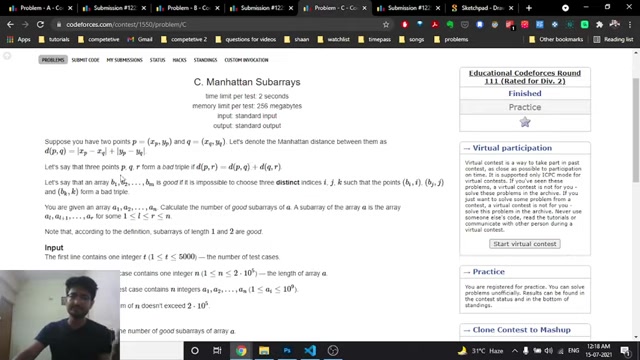
At the heart of this problem lies the concept of Manhattan distance. Unlike Euclidean distance, which calculates the straight-line distance between two points, Manhattan distance calculates the distance by summing the absolute differences of their coordinates. This means moving only horizontally and vertically, as if traversing city blocks. For two points p(xp, yp) and q(xq, yq), the Manhattan distance d(p, q) is given by: d(p, q) = |xp - xq| + |yp - yq|. This definition is crucial for understanding the subsequent criteria for 'bad triplets'. This distance measure is particularly relevant in grid-based scenarios and forms the basis for evaluating relationships between elements within the subarrays. The formula d(p, q) = |xp - xq| + |yp - yq| captures the essence of movement restricted to horizontal and vertical axes, much like navigating the grid-like streets of Manhattan, hence the name. The Manhattan distance is not only a geometric concept but also a valuable tool for solving various algorithmic challenges where grid-based navigation and discrete distances are paramount considerations. For example, in pathfinding algorithms on grid-based maps, the Manhattan distance can serve as an effective heuristic for estimating the distance to the goal, guiding the search towards promising paths. In image processing, it can be utilized to measure the similarity between pixels or regions based on their spatial proximity and intensity differences. Furthermore, the Manhattan distance finds applications in Data Mining and machine learning, where it can be employed as a distance metric for clustering or classification tasks involving categorical or ordinal features. By capturing the notion of movement along orthogonal axes, the Manhattan distance provides a versatile and computationally efficient means of quantifying distance and similarity in a wide range of applications. Its simplicity and interpretability make it a valuable tool for analyzing spatial relationships and solving problems in various domains, extending far beyond its geometric origins. The efficient calculation of Manhattan distance is crucial for solving the Manhattan Subarrays problem within the given time constraints. Optimizing this calculation can significantly impact the overall performance of the solution, particularly for larger input arrays. By leveraging the properties of absolute differences and employing efficient coding techniques, programmers can minimize the computational overhead associated with Manhattan distance calculations, enabling them to process the input data more effectively and achieve faster execution times. Moreover, a thorough understanding of the problem constraints and the properties of Manhattan distance can lead to the development of more sophisticated algorithms that exploit specific characteristics of the input data to further optimize performance and reduce the overall time complexity.
Defining a 'Bad Triplet' and its Implications
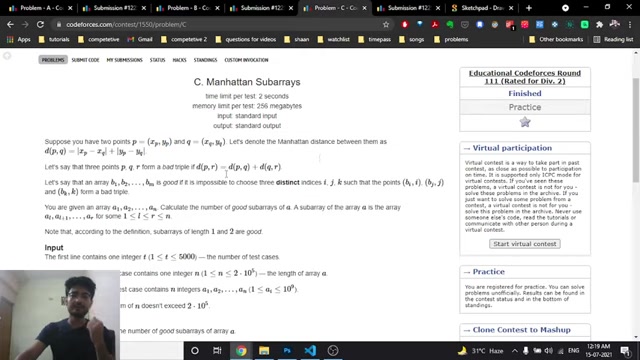
A 'bad triplet' introduces a specific relationship between three distinct indices within an array. Given three points p, q, and r, they form a bad triplet if d(p, r) = d(p, q) + d(q, r), where d is the Manhattan distance. This condition implies that the point q lies on the 'Manhattan path' between p and r. In simpler terms, the distance from p to r is exactly the sum of the distances from p to q and from q to r. If the total distance between P and R is eqaul to P and Q and Q to R, than it's bad triplet. The problem statement specifies that a 'good' subarray is one where it's impossible to find such a bad triplet. This forces us to consider all possible combinations of three indices within a subarray. The existence of even a single bad triplet disqualifies the entire subarray. This definition adds a layer of complexity to the problem, as we must not only calculate Manhattan distances but also carefully analyze the relationships between all possible triplets within each subarray. The concept of a 'bad triplet' is closely tied to the geometry of Manhattan distance and its implications for spatial arrangement. The condition d(p, r) = d(p, q) + d(q, r) implies that the points p, q, and r are collinear in the Manhattan space, meaning that they lie on a straight line when movement is restricted to horizontal and vertical axes. This geometric interpretation provides valuable insights into the structure of subarrays and the relationships between their elements, enabling us to develop more efficient algorithms for identifying 'good' subarrays. For example, we can exploit the collinearity property to prune the search space for bad triplets, focusing only on those combinations of indices that are likely to satisfy the condition. By understanding the underlying geometric principles, we can transform the problem from a purely computational task into a more intuitive and manageable challenge, paving the way for elegant and efficient solutions. Moreover, the concept of a 'bad triplet' can be extended to higher dimensions and other distance metrics, leading to a broader understanding of spatial relationships and geometric constraints in various applications. By exploring the properties of different distance metrics and their corresponding notions of collinearity, we can gain valuable insights into the structure of multidimensional data and develop more sophisticated algorithms for tasks such as dimensionality reduction, outlier detection, and similarity search. The identification of bad triplets is essential for solving the Manhattan Subarrays problem, but it requires careful consideration of computational efficiency. Brute-force approaches that iterate through all possible combinations of three indices can quickly become computationally expensive, especially for larger input arrays. Therefore, it is crucial to develop more sophisticated algorithms that exploit specific properties of the problem to reduce the number of Manhattan distance calculations and optimize the overall time complexity. By leveraging techniques such as pruning, caching, and geometric reasoning, programmers can design efficient solutions that effectively identify bad triplets within the given time constraints.
Defining Good Subarrays: The Target of Our Search
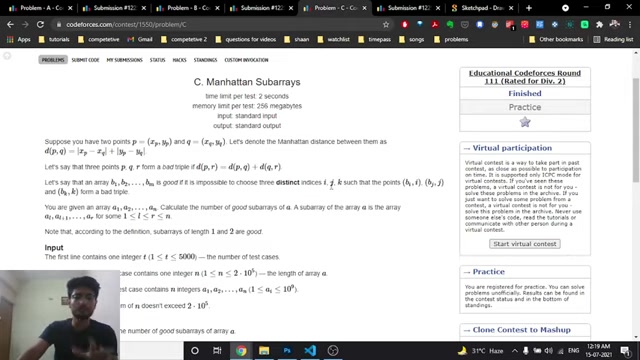
The objective of the Manhattan Subarrays problem is to calculate the number of 'good' subarrays within a given array. An array or subarray is deemed 'good' if it is impossible to choose three distinct indices (i, j, k) such that the points (bi, i), (bj, j), and (bk, k) form a bad triplet. In essence, a 'good' subarray is one that does not contain any bad triplets. This definition requires a thorough examination of each subarray to ensure that no combination of three indices satisfies the bad triplet condition. If there exist a good and impossible point, you can't choose all the indexes in the triple combination (i,j,k). The overall task, therefore, translates to examining all potential subarrays and carefully evaluating each to identify and exclude those containing bad triplets. This makes the problem a blend of combinatorial analysis and geometric reasoning. The condition for a 'good' subarray emphasizes the absence of a specific geometric configuration, namely, the collinear arrangement of three points in the Manhattan space. This focus on exclusion, rather than inclusion, adds a unique twist to the problem, requiring us to adopt a more defensive approach. Instead of directly identifying 'good' subarrays, we must actively seek out bad triplets and disqualify any subarray that contains them. This strategy highlights the importance of negative constraints and their role in defining permissible structures within a given dataset. In practical terms, this means developing algorithms that efficiently enumerate potential bad triplets and quickly determine whether they satisfy the condition d(p, r) = d(p, q) + d(q, r). By systematically eliminating subarrays that fail this test, we can gradually narrow down the search space and accurately count the remaining 'good' subarrays. Furthermore, the concept of a 'good' subarray can be generalized to other geometric shapes and distance metrics, leading to a more comprehensive understanding of structural constraints and permissible arrangements in various applications. By exploring the interplay between geometry, combinatorics, and algorithm design, we can gain valuable insights into the nature of structured data and develop more powerful tools for analyzing and manipulating it. Counting good subarrays efficiently is the ultimate goal of the Manhattan Subarrays problem. While it may seem straightforward at first glance, the task poses significant computational challenges, particularly for larger input arrays. Brute-force approaches that examine all possible subarrays and triplets can quickly become computationally infeasible, exceeding the time constraints imposed by the problem. Therefore, it is crucial to develop more sophisticated algorithms that leverage specific properties of the problem to reduce the search space and optimize the overall time complexity. This involves carefully analyzing the relationships between subarrays and exploiting any symmetries or redundancies that may exist. By adopting a more strategic approach, we can design efficient solutions that accurately count the number of good subarrays within the given time constraints, paving the way for a deeper understanding of algorithmic design and optimization.
Strategic Observations and Problem Simplification
Key Observation: Subarrays with Limited Length

The problem definition offers a crucial piece of information: subarrays of length 1 and 2 are considered inherently 'good'. This dramatically reduces the scope of our search. We only need to focus on subarrays of length 3 or greater. This simplifies the problem by allowing us to disregard a significant portion of the potential subarrays, focusing our efforts on those that have the potential to contain bad triplets. This simplification highlights the importance of carefully analyzing problem constraints and identifying any inherent properties that can be exploited to reduce the computational complexity of the solution. By recognizing that shorter subarrays are automatically 'good', we can avoid unnecessary Manhattan distance calculations and triplet evaluations, significantly improving the overall efficiency of our algorithm. The observation that short subarrays are always 'good' stems from the geometric nature of the 'bad triplet' condition. In order to form a 'bad triplet', we require at least three distinct points that satisfy the collinearity property. Subarrays of length 1 and 2 simply do not have enough points to form such a configuration, making them trivially 'good'. This geometric insight provides a valuable shortcut for solving the problem, allowing us to bypass a significant portion of the computational work and focus on the more complex cases where bad triplets are actually possible. Furthermore, the observation that short subarrays are always 'good' can be generalized to other geometric problems and distance metrics, leading to a broader understanding of structural constraints and permissible arrangements in various applications. By exploring the interplay between geometry, combinatorics, and algorithm design, we can gain valuable insights into the nature of structured data and develop more powerful tools for analyzing and manipulating it. The focus on subarrays of length 3 or greater allows us to optimize our algorithm by avoiding unnecessary computations for shorter subarrays. This optimization is particularly important for larger input arrays, where the number of shorter subarrays can be substantial. By strategically pruning the search space, we can significantly reduce the overall time complexity of the solution and ensure that it meets the performance requirements of the problem. Moreover, this optimization highlights the importance of carefully considering the order in which we perform our computations. By prioritizing the analysis of longer subarrays, we can potentially identify bad triplets earlier in the process, allowing us to disqualify entire ranges of subarrays and further reduce the computational overhead.
Identifying a Threshold: The Significance of Subarray Length 5
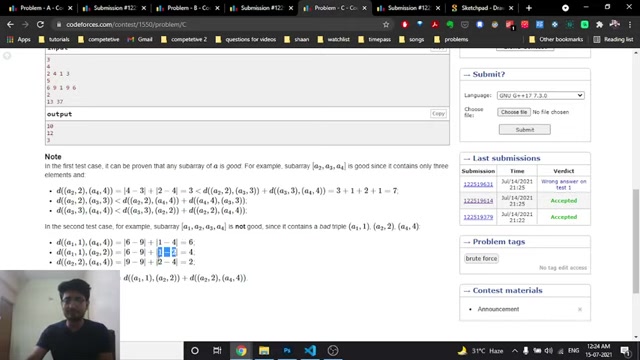
An even more important observation drastically reduces the effort required: if a subarray of size A[1...4] is not 'good', a chain reaction occurs. Any subarray containing A[1...4] (e.g. A[1...5]) is guaranteed to also be 'not good'. The reason for this behavior is simple: if the original has a bad triple, the larger array has that exact same bad triple. This realization unlocks the ability to break out of a loop once a 'bad' subarray is found, preventing useless work. The observation regarding subarrays of length 5 and beyond builds upon the previous insight, providing a powerful pruning technique for further optimizing our algorithm. The fact that a 'bad' subarray of length 4 implies that all larger subarrays containing it are also 'bad' allows us to avoid redundant calculations and significantly reduce the search space. This is because if a 'bad triplet' exists within a subarray of length 4, that same triplet will also exist within any larger subarray containing it. By exploiting this property, we can effectively eliminate entire ranges of subarrays from consideration, focusing our efforts on those that have not yet been disqualified. This strategic pruning technique can dramatically improve the overall efficiency of our solution, allowing us to process even larger input arrays within the given time constraints. Moreover, the observation regarding subarrays of length 5 and beyond highlights the importance of recognizing dependencies and relationships between different parts of the input data. By identifying patterns and structures that propagate through the data, we can develop more sophisticated algorithms that exploit these dependencies to reduce the computational overhead and improve the overall performance. In this case, the presence of a 'bad triplet' within a smaller subarray implies the presence of that same triplet within any larger subarray containing it, allowing us to avoid redundant calculations and streamline the search process. The knowledge that subarrays of size five or more are always bad with that condition means that an extremely reduced number of good conditions exits in general. Subarrays of greater length are automatically disqualified. Thus, only small arrays needs testing. Therefore, an extremely optimized algorithm isn't necessarily needed, brute force is possible. The limitation to subarrays of a maximum length of 4 significantly reduces the number of computations required, enabling a brute-force solution to be viable. This is a key point, transforming the problem from a potentially complex algorithmic challenge into a manageable coding task. By acknowledging this constraint, we can simplify our approach and focus on efficiently implementing the Manhattan distance calculation and bad triplet identification for subarrays of limited size. Moreover, the effectiveness of a brute-force approach depends on the specific constraints of the problem and the size of the input data. In cases where the input data is extremely large or the computational requirements are more stringent, more sophisticated algorithms may be necessary to achieve optimal performance. However, for the Manhattan Subarrays problem, the limited subarray length allows us to effectively employ a brute-force approach without exceeding the time constraints imposed by the problem.
Implementing a Solution: Step-by-Step
Step 1: Iterating Through Subarrays
First you make sure that you iterate through all possible subarrays of the given array. Since arrays of more than length four aren't possible, all subarrays will necessarily be smaller or equal to four. Use nested loops to define the start and end points of each subarray. The outer loop iterates through all possible starting indices, while the inner loop iterates through all possible ending indices, ensuring that we consider every possible subarray within the given array. This systematic approach ensures that we do not miss any potential candidates for 'good' subarrays and allows us to thoroughly analyze the entire search space. This step is essential for ensuring the correctness of our solution, as any missed subarrays could potentially lead to an inaccurate count of 'good' subarrays. By carefully designing the iteration process, we can ensure that we examine every possible combination of elements within the given array, providing a solid foundation for the subsequent steps in our algorithm. Furthermore, the iteration process should be optimized to minimize unnecessary computations and reduce the overall time complexity. By carefully considering the order in which we iterate through the subarrays, we can potentially identify and disqualify 'bad' subarrays earlier in the process, allowing us to avoid redundant calculations and streamline the search process. This optimization is particularly important for larger input arrays, where the number of subarrays can be substantial.
Step 2: Identifying bad triplets
Take each subarray and look for bad triplets. For each candidate subarray, implement a function to check if it contains any bad triplets. This involves iterating through all combinations of three distinct indices (i, j, k) within the subarray and calculating the Manhattan distance between the corresponding points (bi, i), (bj, j), and (bk, k). If a bad triplet is found, the subarray is disqualified. This step is essential for accurately classifying subarrays as 'good' or 'bad' and ensuring the correctness of our solution. By systematically evaluating each combination of indices, we can identify any instances that violate the geometric constraint imposed by the bad triplet condition. The bad triplet identification process needs to be optimized for computational efficiency. Brute-force approaches that iterate through all possible combinations of three indices can quickly become computationally expensive, especially for larger subarrays. Therefore, it is crucial to develop more sophisticated algorithms that exploit specific properties of the problem to reduce the number of Manhattan distance calculations and streamline the search process. This involves carefully considering the order in which we evaluate the triplets and employing techniques such as pruning and caching to avoid redundant calculations. Moreover, the bad triplet identification process should be designed to handle edge cases and potential errors gracefully. This includes validating input data, handling numerical precision issues, and ensuring that the algorithm correctly identifies and disqualifies subarrays that contain bad triplets. By addressing these challenges proactively, we can create a robust and reliable solution that accurately classifies subarrays regardless of their size or composition. The efficient identification of bad triplets is a critical factor in determining the overall performance of our algorithm. The faster we can identify and disqualify 'bad' subarrays, the more time we can save for analyzing the remaining 'good' subarrays. This optimization is particularly important for larger input arrays, where the number of potential bad triplets can be substantial. Therefore, it is crucial to carefully design the bad triplet identification process and employ techniques that minimize the computational overhead associated with it.
Step 3: Counting the 'Good' Subarrays
If a subarray passes the bad triplet check, increment a counter representing the total number of 'good' subarrays. This simply process accumulates the total number of 'good' subarrays, so that you find if no triple combo satisfies what's on line (27).
Now the overall algorithm works. The final count represents the solution to the problem. Return this count as the output. This step is straightforward but essential for obtaining the correct answer. The incrementing process needs to be carefully implemented to ensure that we accurately count only those subarrays that have been positively identified as 'good' after thorough analysis. This includes properly initializing the counter, handling edge cases where the initial count may be non-zero, and ensuring that the incrementing process is synchronized and thread-safe if the algorithm is parallelized. By paying close attention to these details, we can minimize the risk of errors and ensure that our solution provides an accurate count of 'good' subarrays. The final count of 'good' subarrays should be carefully validated to ensure its correctness and consistency. This can involve comparing the results with known test cases, performing boundary condition analysis, and implementing sanity checks to verify that the algorithm is behaving as expected. By thoroughly validating the final count, we can increase our confidence in the reliability of our solution and ensure that it provides an accurate representation of the problem's solution space. Moreover, the final count of 'good' subarrays can be analyzed to gain further insights into the structure and properties of the input data. By examining the distribution of 'good' and 'bad' subarrays, we can potentially identify patterns and relationships that may not be immediately apparent, leading to a deeper understanding of the problem and its underlying characteristics. This knowledge can be used to develop more sophisticated algorithms or refine existing solutions, further enhancing our ability to analyze and manipulate structured data.










Most people like




























Report
Please select a reason for reporting
- 13 Reasons to Switch from Snapchat to Text Messaging
- 7 Powerful Speech to Text Apps to Boost Productivity
- 10 Best Speech to Text Tools for Effortless Transcription
- 13 Free Tools to Easily Transcribe Audio to Text
- 15 Surprising Ways Google's Speech-to-Text Boosts Productivity
- 7 Best Free Online Audio to Text Transcription Tools
- 9 Tips to Transcribe Speech to Text Faster and Better
- 13 Best Speech to Text Software for Windows 10 in 2023
- 7 Tips for Choosing the Best Transcriber for Audio to Text
- 11 Reasons Why Dragon Speech-to-Text Apps are Game-Changers
- 6 Secrets to Enhance Your Speech to Text Transcription
- 6 Brilliant Ways to Boost Productivity with Talk-to-Text on Your MacBook
- 6 Ways Transcription Software Converts Audio to Text
- 8 Tips to Transcribe Speech to Text Like a Pro
- 6 Reasons IBM Watson Speech to Text is a Game-Changer
- 14 Powerful Ways Talk-to-Text Improves Your Workflow
- 12 Top Windows Speech-to-Text Software for Efficient Transcription
- 12 Game-Changing Benefits of Apple's Speech to Text Technology
- 9 Powerful Use Cases for AWS Speech to Text Technology
- 10 Easy Steps to Transcribe YouTube Videos to Text
- transcription audio en texte
- online audio transcription
- free audio file transcription
- free ai audio transcription
- audio transcription service
- audio transcription online free
- audio transcription free online
- audio to transcription software
- audio and transcript
- ai audio transcription free
- voice recording to text converter
- translate voice recording to text
- record voice to text
- audio recording to text converter
- voice recording and transcription
- chatgpt voice to text
- gmail voice to text
- speech to text reader
- speech to text ai free
- speech to talk
- Create Engaging Animated Explainer Videos with a Free AI Tool
- Stop Multi-Subscribing: Benchmark Top AI Visual Models in One Canvas
- Best Seedance 2.5 API Provider: Every Price on the Market, Checked at Source
- AI OnlyFans: How to Generate $30,000/Month (Legally)
- Transform Your Script into an Engaging Video with AI Video Maker!
- AI Marketing Automation: A Comprehensive Guide for Small Businesses
- Midjourney Alternative for Anime Art Creators: Why PixAI May Be Better for Character Workflows
- 10 Things Most People Get Wrong About AI Image Search
- AI Girlfriend Apps: Top Choices Redefining Relationships 2025
- How to Reduce Quoting Errors in Salesforce with AI-Assisted Quote Creation
- Why AI Language Tutors Underperform in Low-Resource Languages (And How to Work Around It)
- Top 5 AI Detector Tools: Ensuring Originality in Your Content
- How to Tell If an AI Study Tool Is Actually Helping You Learn (6 Checks for 2026)
- From Auto-Cuts to Generative Clips: Top 4 AI Video Editor Platforms Tested
- AI Resume Builders: EnhanceCV, ResumeNerd AI, & Teal Compared
- ResumeAI: Crafting ATS-Optimized Resumes with AI
- AI in Resume Writing: A New Era for Job Seekers
- AI Resume Tools: Streamline Your Job Search and Land Your Dream Role
- AI Resume Optimization: The Right Way to Land Interviews
- Crafting a Killer Resume with AI: A Step-by-Step Guide

Copyright ©2026 toolify