






Table of Contents
- Key Points
- Understanding Vector Databases
- Key Metrics and Algorithms in Vector Databases
- Getting Started with Vector Databases
- Exploring Popular Vector Database Solutions
- Pros and Cons of Using Vector Databases
- Core Features Deep Dive
- Real-World Use Cases of Vector Databases
- FAQ
- Related Questions



Understanding Vector Databases
What is a Vector Database?
At its core, a vector database is a specialized database designed to store, index, and query high-dimensional vectors efficiently.
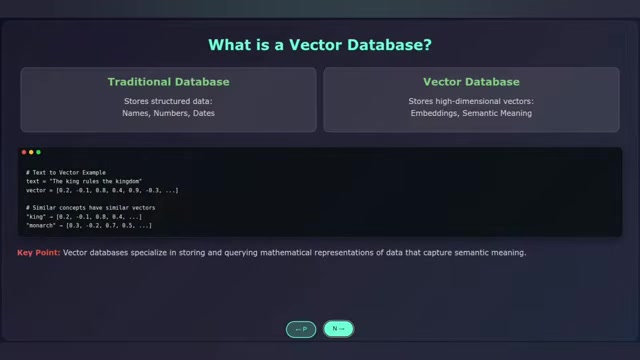
Unlike traditional databases that store structured data like names, numbers, and dates, vector databases focus on mathematical representations of data, known as vectors or embeddings. These vectors capture the semantic meaning of data, regardless of whether it is text, images, audio, or other types of content.
Traditional databases excel at storing structured data but struggle with the complex, unstructured data that AI models often process. For instance, consider the challenge of finding 'similar products' in an e-commerce database using SQL. Traditional SQL queries often rely on exact keyword matches, missing out on items that are semantically similar but described differently. This is where vector databases shine, enabling similarity searches that go beyond exact matches to find data points that are conceptually related.
For example, the WORD 'king' can be represented as a vector: [0.2, -0.1, 0.8, 0.4, ...]. The magic happens because similar concepts, like 'monarch', have vectors that are close to each other in high-dimensional space. Vector databases are specialized to efficiently handle these types of high dimensional vectors, making them ideal for AI applications.
Key Takeaway: Vector databases specialize in storing and querying mathematical representations of data that capture semantic meaning, making them ideal for AI applications that rely on understanding relationships and similarities between data points.
Why Vector Databases are Essential for AI
Traditional databases often fall short when dealing with the unique demands of AI applications.
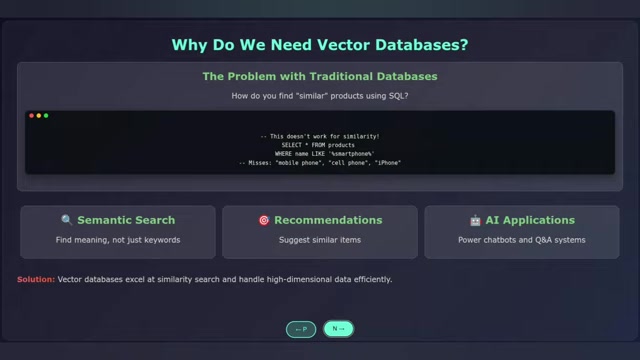
Consider the challenge of semantic search, where the goal is to find meaning, not just keywords. Imagine searching for 'smartphones' in an e-commerce database. A traditional SQL query like SELECT * FROM products WHERE name LIKE '%smartphones%' would miss results like 'mobile phones', 'cell phones', or 'iPhones', because it relies on exact string matches. Vector databases, on the other hand, leverage similarity search capabilities to find products that are semantically similar, even if they are described using different keywords. They excel at similarity search and handle high-dimensional data efficiently.
This capability is essential for various AI-driven tasks:
- Semantic Search: Enables finding information based on meaning and context, going beyond keyword matching.
- Recommendations: Facilitates suggesting similar items based on user preferences and data relationships.
- AI Applications: Powers chatbots and Q&A systems that require nuanced understanding of language.
- Content Discovery: Helps users find relevant content based on semantic similarity, enhancing user engagement.
Key Takeaway: Vector databases overcome the limitations of traditional databases by enabling semantic understanding and similarity search, essential for modern AI applications.
How Vector Databases Work: A Simplified Overview
The process of using a vector database involves several steps, transforming raw data into insightful results.
- Embedding: Raw data (text, images, etc.) is converted into vectors using AI models called embedding models. Examples include OpenAI's
text-embedding-ada-002or Google's Universal Sentence Encoder. These models capture the semantic meaning of the data. - Indexing: The vector database creates specialized indexes to organize the vectors in high-dimensional space. This is not your traditional B-tree indexes but uses algorithms like HNSW, IVF, or LSH to optimize similarity searches.
- Querying: When a query is made, it's converted into a vector using the same embedding model. The database then finds the most similar vectors using distance metrics such as Cosine Similarity or Euclidean Distance.
Code Example:
# Python Example with OpenAI Embeddings
import openai
import pinecone

# Step 1: Convert text to vector
response = openai.Embedding.create(
 input="What is machine learning?",
 model="text-embedding-ada-002"
)
query_vector = response['data'][0]['embedding']

# Step 2: Search for similar vectors
results = index.query(
 vector=query_vector,
 top_k=5,
 include_metadata=True
)
This snippet converts text into a vector embedding and searches for similar vectors within the database.
Key Point: Vector databases use a process of embedding, indexing, and querying to retrieve similar vectors efficiently, providing meaningful search results for AI applications.
Key Metrics and Algorithms in Vector Databases
Understanding Distance Metrics
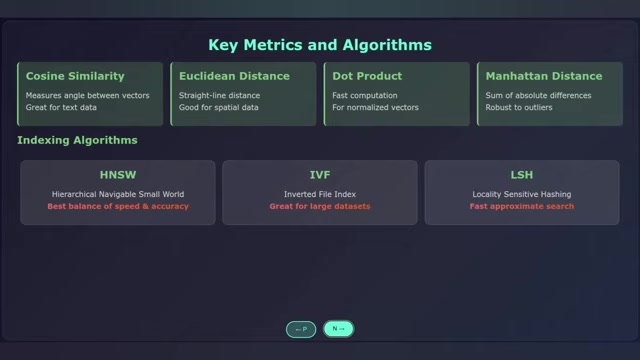
Various distance metrics are employed to measure the similarity between vectors in vector databases. The choice of metric can significantly impact the accuracy and performance of the search results.
| Metric | Description | Best Use Cases |
|---|---|---|
| Cosine Similarity | Measures the angle between vectors, ideal for text data. | Text data analysis, document similarity |
| Euclidean Distance | Straight-line distance in N-dimensional space, suited for spatial data. | Spatial data, image analysis |
| Dot Product | Fast computation, effective for normalized vectors. | Normalized data vectors, fast similarity checks |
| Manhattan Distance | Sum of absolute differences, robust to outliers. | Data with outliers, urban distance calculation |
The decision is based on the characteristics of the dataset and the specific goals of the application.
Indexing Algorithms Explained
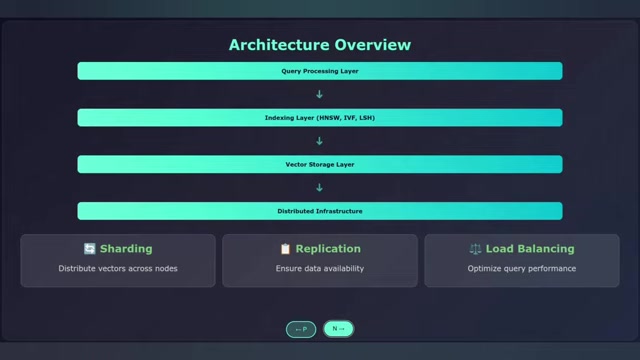
Indexing is crucial for optimizing search speed in vector databases, especially with massive datasets. Different indexing algorithms offer various trade-offs between speed and accuracy.
- HNSW (Hierarchical Navigable Small World): Provides the best balance of speed and accuracy. It excels in navigating high-dimensional spaces efficiently, making it suitable for various applications.
- IVF (Inverted File Index): Ideal for large datasets, it partitions the vector space to speed up search. This is suitable for applications where the dataset is very large.
- LSH (Locality Sensitive Hashing): Offers fast approximate search, making it useful when speed is prioritized over perfect accuracy. LSH is commonly used in applications like near-duplicate detection.
Getting Started with Vector Databases
Building a Document Search System
Here's a simple example of how to build a document search system using a vector database:
from sentence_transformers import SentenceTransformer
import chromadb

# Initialize the Sentence Transformer model
model = SentenceTransformer('all-MiniLM-L6-v2')

# Initialize ChromaDB client
client = chromadb.Client()

# Create a collection to store documents
collection = client.create_collection("documents")

# Add documents to the collection
docs = [
 "Machine learning basics",
 "Deep learning guide"
]
embeddings = model.encode(docs)
collection.add(embeddings=embeddings, documents=docs)

# Search for documents
query = "AI Fundamentals"
query_embedding = model.encode(query)
results = collection.query(query_embeddings=query_embedding, n_results=2)

print(results)
This code initializes a Sentence Transformer model, creates a ChromaDB collection, adds documents, and performs a similarity search. This example showcases how raw text, embedding model can convert text data into vectors.




Most people like



































Report
Please select a reason for reporting
- 13 Reasons to Switch from Snapchat to Text Messaging
- 7 Powerful Speech to Text Apps to Boost Productivity
- 10 Best Speech to Text Tools for Effortless Transcription
- 13 Free Tools to Easily Transcribe Audio to Text
- 15 Surprising Ways Google's Speech-to-Text Boosts Productivity
- 7 Best Free Online Audio to Text Transcription Tools
- 9 Tips to Transcribe Speech to Text Faster and Better
- 13 Best Speech to Text Software for Windows 10 in 2023
- 7 Tips for Choosing the Best Transcriber for Audio to Text
- 11 Reasons Why Dragon Speech-to-Text Apps are Game-Changers
- 6 Secrets to Enhance Your Speech to Text Transcription
- 6 Brilliant Ways to Boost Productivity with Talk-to-Text on Your MacBook
- 6 Ways Transcription Software Converts Audio to Text
- 8 Tips to Transcribe Speech to Text Like a Pro
- 6 Reasons IBM Watson Speech to Text is a Game-Changer
- 14 Powerful Ways Talk-to-Text Improves Your Workflow
- 12 Top Windows Speech-to-Text Software for Efficient Transcription
- 12 Game-Changing Benefits of Apple's Speech to Text Technology
- 9 Powerful Use Cases for AWS Speech to Text Technology
- 10 Easy Steps to Transcribe YouTube Videos to Text
- transcription audio en texte
- online audio transcription
- free audio file transcription
- free ai audio transcription
- audio transcription service
- audio transcription online free
- audio transcription free online
- audio to transcription software
- audio and transcript
- ai audio transcription free
- voice recording to text converter
- translate voice recording to text
- record voice to text
- audio recording to text converter
- voice recording and transcription
- chatgpt voice to text
- gmail voice to text
- speech to text reader
- speech to text ai free
- speech to talk
- Meshy AI: How to Create 3D Models from Text and Images
- How SEO and Marketing Dashboards Empower Agencies to Drive Results
- How to Use AI Tools to Find Internal Linking Opportunities Across a Business Website
- Discover Your Perfect Haircut with AI Hairstyle Apps
- Free Reputation Calculator Tools: How They're Adapting to Score AI Visibility, Not Just Rankings
- Design Professional Flyers for Free on Your Phone
- Best Free Flyer Maker Apps for Android: Design Like a Pro
- How to Know If Your Business Is Ready for an AI Customer Service Agent
- Revolutionizing Storytelling: From Novels to Screenplays with AI
- Create Engaging Animated Explainer Videos with a Free AI Tool
- Automate Lead Generation: A Comprehensive Guide with AI Agents
- Revideo.io: The Future of Reverse Video Search Technology
- Revolutionizing Email Marketing Agency with AI
- Breaking the Character Drift Dilemma: A Practical Test of Smart Shot
- Meshy AI: How to Create 3D Models from Text and Images
- ASOMobile Helps Teams Benchmark App Store Screenshots Against Competitors
- How to Match LMS Software With Your Organization's Training Plan
- How to Convert BTC to HNT
- Unleashing the Power of AI: Cognizant's Roadmap for Transformation
- Frame to Video Review: A Practical Look at Turning Two Still Frames Into Motion

Copyright ©2026 toolify