




Total runs:
44.1K
Run Growth:
1.2K
Growth Rate:
2.62%
This model was generated using
llama.cpp
at commit
16724b5b6
.
I've been experimenting with a new quantization approach that selectively elevates the precision of key layers beyond what the default IMatrix configuration provides.
In my testing, standard IMatrix quantization underperforms at lower bit depths, especially with Mixture of Experts (MoE) models. To address this, I'm using the
--tensor-type
option in
llama.cpp
to manually "bump" important layers to higher precision. You can see the implementation here:
👉
Layer bumping with llama.cpp
While this does increase model file size, it significantly improves precision for a given quantization level.
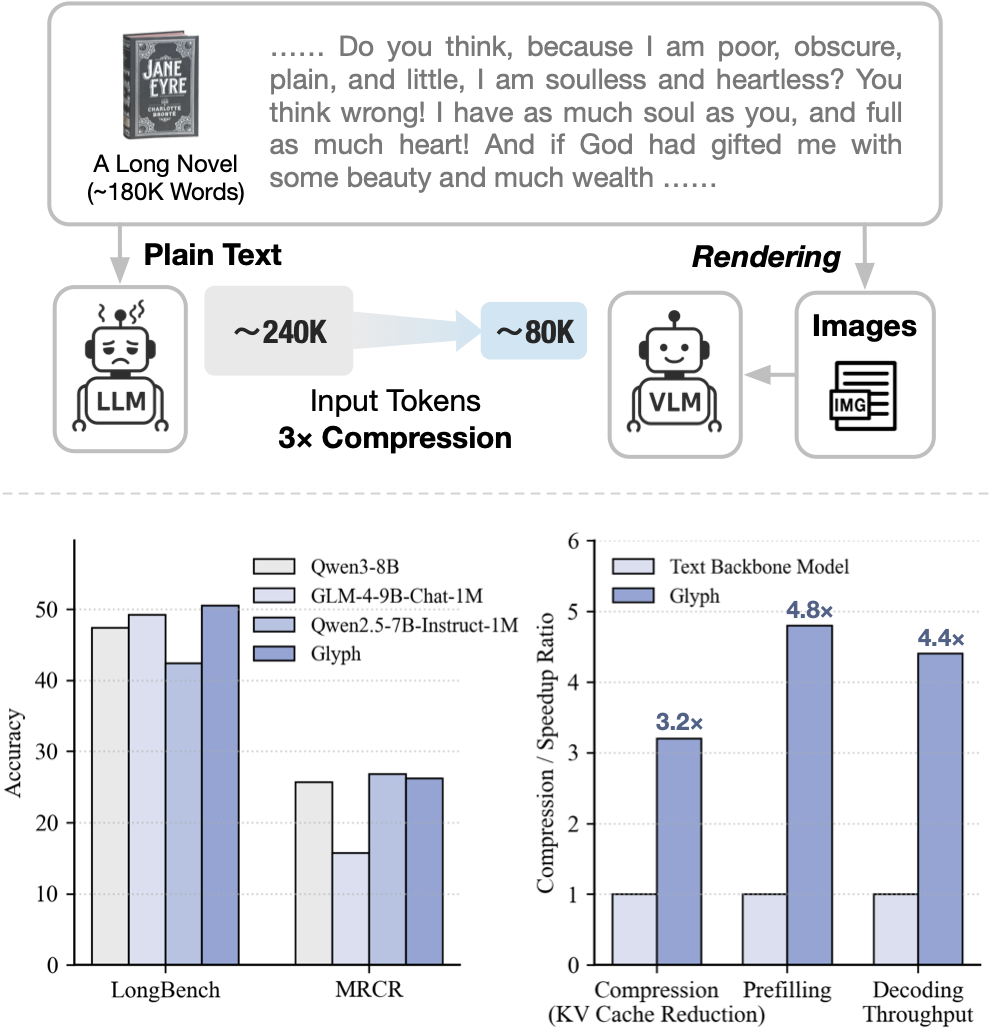
Glyph is a framework for scaling the context length through visual-text compression. Instead of extending token-based context windows, Glyph renders long textual sequences into images and processes them using vision–language models (VLMs). This design transforms the challenge of long-context modeling into a multimodal problem, substantially reducing computational and memory costs while preserving semantic information.
Our model is built on GLM-4.1V-9B-Base .
This is a simple example of running single-image inference using the
transformers
library.
First, install the
transformers
library:
pip install transformers>=4.57.1
Then, run the following code:
from transformers import AutoProcessor, AutoModelForImageTextToText
import torch

messages = [
    {
        "role": "user",
        "content": [
            {
                "type": "image",
                "url": "https://raw.githubusercontent.com/thu-coai/Glyph/main/assets/Little_Red_Riding_Hood.png"
            },
            {
                "type": "text",
                "text": "Who pretended to be Little Red Riding Hood's grandmother"
            }
        ],
    }
]
processor = AutoProcessor.from_pretrained("zai-org/Glyph")
model = AutoModelForImageTextToText.from_pretrained(
    pretrained_model_name_or_path="zai-org/Glyph",
    torch_dtype=torch.bfloat16,
    device_map="auto",
)
inputs = processor.apply_chat_template(
    messages,
    tokenize=True,
    add_generation_prompt=True,
    return_dict=True,
    return_tensors="pt"
).to(model.device)
generated_ids = model.generate(**inputs, max_new_tokens=8192)
output_text = processor.decode(generated_ids[0][inputs["input_ids"].shape[1]:], skip_special_tokens=False)
print(output_text)
See our Github Repo for more detailed usage.
If you find our model useful in your work, please cite it with:
@article{cheng2025glyphscalingcontextwindows,
    title={Glyph: Scaling Context Windows via Visual-Text Compression},
    author={Jiale Cheng and Yusen Liu and Xinyu Zhang and Yulin Fei and Wenyi Hong and Ruiliang Lyu and Weihan Wang and Zhe Su and Xiaotao Gu and Xiao Liu and Yushi Bai and Jie Tang and Hongning Wang and Minlie Huang},
    journal={arXiv preprint arXiv:2510.17800},
    year={2025}
}
Help me test my AI-Powered Quantum Network Monitor Assistant with quantum-ready security checks :
The full Open Source Code for the Quantum Network Monitor Service available at my github repos ( repos with NetworkMonitor in the name) : Source Code Quantum Network Monitor . You will also find the code I use to quantize the models if you want to do it yourself GGUFModelBuilder
💬
How to test
:
Choose an
AI assistant type
:
TurboLLM
(GPT-4.1-mini)
HugLLM
(Hugginface Open-source models)
TestLLM
(Experimental CPU-only)
I’m pushing the limits of small open-source models for AI network monitoring , specifically:
🟡 TestLLM – Current experimental model (llama.cpp on 2 CPU threads on huggingface docker space):
🟢 TurboLLM – Uses gpt-4.1-mini :
🔵 HugLLM – Latest Open-source models:
"Give me info on my websites SSL certificate"
"Check if my server is using quantum safe encyption for communication"
"Run a comprehensive security audit on my server"
I fund the servers used to create these model files, run the Quantum Network Monitor service, and pay for inference from Novita and OpenAI—all out of my own pocket. All the code behind the model creation and the Quantum Network Monitor project is open source . Feel free to use whatever you find helpful.
If you appreciate the work, please consider buying me a coffee ☕. Your support helps cover service costs and allows me to raise token limits for everyone.
I'm also open to job opportunities or sponsorship.
Thank you! 😊