































Table of Contents
- Key Points
- The Evolving Landscape of AI in Programming
- Understanding Programmers' Trust in AI Assistants
- Calibrated Trust: Using AI Effectively
- Evaluating AI Programming Assistants: Pros and Cons
- Frequently Asked Questions About Trust in AI Programming
- Related Questions About Human-AI Collaboration in Programming



The Evolving Landscape of AI in Programming
The Rise of AI Programming Assistants
AI programming assistants have emerged as powerful allies in the software development process, offering unprecedented opportunities to streamline coding tasks and enhance productivity. Tools like GitHub Copilot are designed to generate code snippets, suggest solutions, and even complete entire functions based on natural language prompts or existing code. These assistants utilize machine learning algorithms trained on vast datasets of code, enabling them to recognize patterns, predict needs, and automate many of the routine aspects of programming.
However, the integration of AI into coding raises important questions about trust, reliability, and the future of programming skills. Programmers must learn to effectively collaborate with AI, understanding its strengths and limitations. This collaboration requires a calibrated approach to trust, where developers leverage AI's capabilities while maintaining critical oversight and judgment. Over-reliance on AI can lead to the acceptance of suboptimal or insecure code, while a complete rejection of AI's assistance can result in missed opportunities for efficiency and innovation. The key is to find the right balance, ensuring that AI enhances, rather than replaces, human expertise in the software development lifecycle.
The adoption of AI programming assistants also has significant implications for education and training. As AI becomes more prevalent in the industry, educational institutions must adapt their curricula to prepare students for a world where AI is an integral part of the coding process. This includes teaching not only fundamental programming concepts but also how to effectively use AI Tools, debug AI-generated code, and critically evaluate AI's suggestions. By fostering a mindset of collaboration and critical thinking, educators can empower students to harness the power of AI while maintaining the essential skills and judgment necessary for successful software development.

This section explores the evolution of trust in these AI assistants, highlighting the necessity for programmers to understand and navigate the capabilities and limitations of AI in their workflows. This article references the paper Evolution of Programmers' Trust in Generative AI Programming Assistants. This paper is an exploration into how the programmer's trust in these tools evolves with experience.
Trending Articles and Human-Computer Interaction
The growing interest in AI programming assistants is reflected in trending articles within the field of human-computer interaction. These articles often discuss the challenges of integrating AI into workflows, the importance of user trust, and the ethical considerations surrounding AI-generated code. They emphasize the need for designers and developers to create AI tools that are transparent, explainable, and aligned with human values. As AI becomes more sophisticated, it is crucial to ensure that it remains a tool that empowers humans, rather than replacing their skills and judgment. Human-computer interaction (HCI) principles play a critical role in shaping the design of AI programming assistants to ensure they are user-friendly, intuitive, and trustworthy.
One of the central themes in HCI research is the concept of trust. Trust is essential for users to effectively interact with and rely on AI systems. However, trust must be carefully calibrated to avoid over-reliance or unwarranted skepticism. Programmers need to understand how AI assistants work, what their limitations are, and how to validate their suggestions. This requires a combination of technical knowledge, critical thinking, and a willingness to experiment and learn. HCI researchers are exploring various approaches to build and maintain trust in AI programming assistants, including providing clear explanations of AI's reasoning, allowing users to control AI's behavior, and designing interfaces that promote transparency and accountability.
The field of HCI also recognizes the importance of considering the social and ethical implications of AI. AI programming assistants have the potential to democratize software development, making it accessible to a broader range of people. However, they also raise concerns about bias, fairness, and the potential for misuse. HCI researchers are working to address these concerns by developing methods for detecting and mitigating bias in AI systems, ensuring that AI tools are used in an ethical and responsible manner, and promoting inclusivity in the design and development of AI technologies.
In summary, trending articles in human-computer interaction highlight the growing importance of AI programming assistants and the need for a human-centered approach to their design and development. Trust, transparency, and ethical considerations are key themes in this research, reflecting the commitment of the HCI community to creating AI tools that empower humans and contribute to a more equitable and sustainable future.
Understanding Programmers' Trust in AI Assistants
The Core Problem: Robot Homework Helper Analogy
The paper highlights a fundamental problem: how do programmers learn to trust AI helpers, such as generative AI programming assistants? To illustrate this, consider an analogy: a robot Homework helper. Initially, this robot seems amazing, capable of assisting with tasks quickly and efficiently. However, what happens when the robot gives the wrong answer? This scenario introduces a dilemma: Should you trust the AI helper, and how much?
This analogy underscores the importance of calibrated trust. Programmers, like students, must learn to assess the reliability of AI-generated code. Over-trusting the AI can lead to accepting incorrect or insecure code, while under-trusting it can result in missed opportunities for increased productivity. The right balance requires programmers to verify and validate AI suggestions, ensuring they align with best practices and security standards. This verification process is essential to maintain code quality and prevent errors that could compromise software functionality.
The robot homework helper analogy also raises questions about the role of human oversight. Even with advanced AI, human expertise remains critical for problem-solving, debugging, and creative coding. AI should be viewed as a tool that enhances human capabilities, not a replacement for them. Programmers must continue to develop their skills and judgment to effectively collaborate with AI and ensure the accuracy and security of the code they produce.
Furthermore, the homework helper scenario emphasizes the need for programmers to understand the fundamental concepts of computer science. Without a solid foundation in programming principles, it can be difficult to evaluate AI-generated code or identify potential errors. Education and training play a crucial role in equipping programmers with the knowledge and skills necessary to effectively use AI assistants and maintain control over the software development process. This blend of technical know-how and human judgment is essential for harnessing the power of AI while mitigating the risks associated with its use.
The Programmer's Dilemma: Trust vs. Efficiency
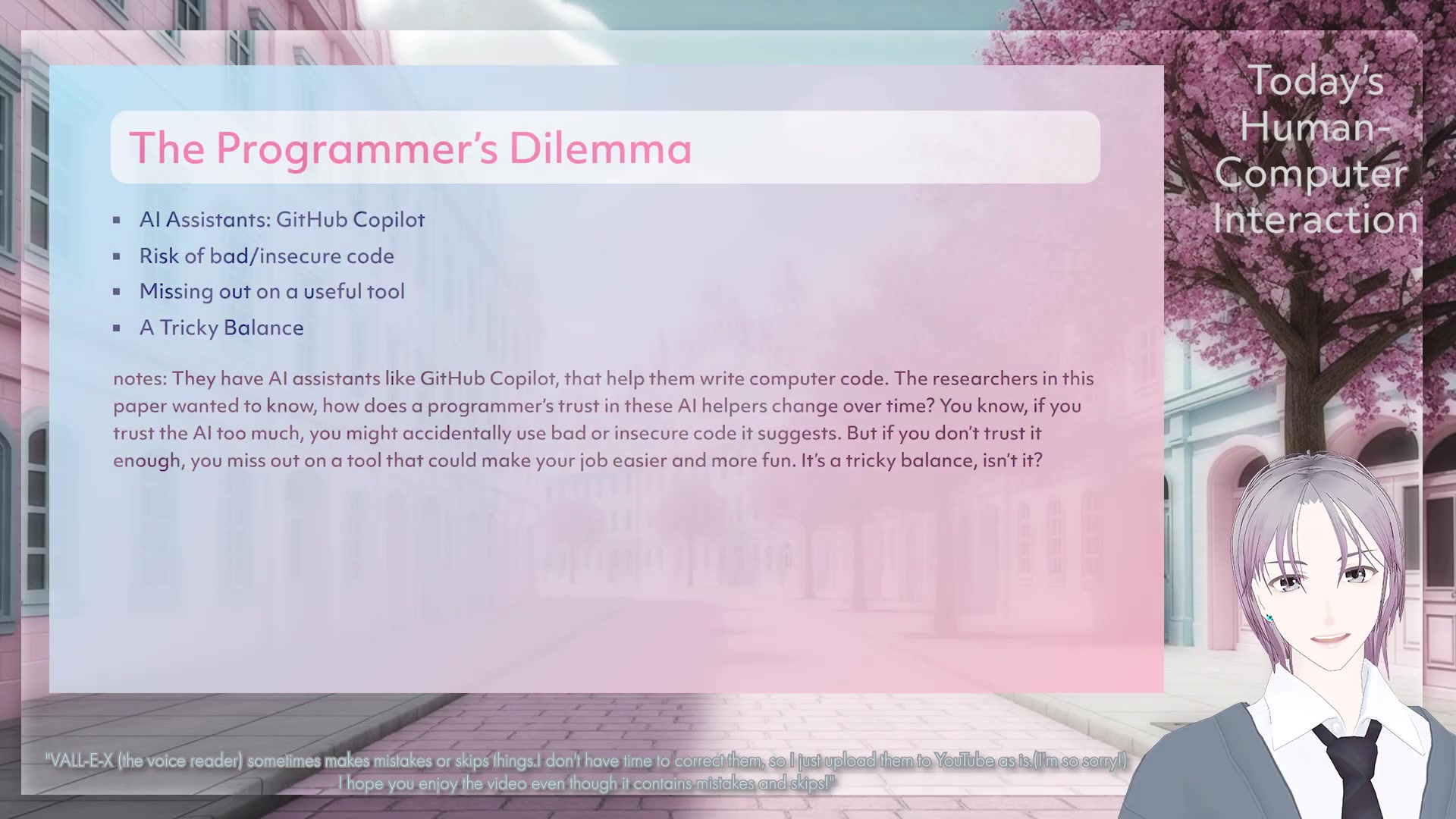
The rise of AI assistants like GitHub Copilot presents a unique dilemma for programmers. These tools are designed to help write computer code, increasing efficiency and productivity. However, the fundamental question remains: How does a programmer's trust in these AI helpers change over time? Do they blindly accept the AI's suggestions, or do they critically evaluate the code before integrating it into their projects?
This dilemma is rooted in the trade-off between trust and efficiency. Programmers who trust the AI too much risk using bad or insecure code, potentially compromising the stability and security of their software. On the other hand, programmers who don't trust the AI enough miss out on a valuable tool that could make their job easier and more fun. The key is to find a balance: leveraging the AI's capabilities while maintaining critical oversight and judgment.
Researchers have explored this dilemma by investigating how programmers interact with AI assistants in real-world scenarios. They found that programmers' trust in AI tends to evolve over time, influenced by factors such as the AI's accuracy, the programmer's experience, and the complexity of the task at hand. Programmers often start with a cautious approach, carefully reviewing AI's suggestions before accepting them. However, as they gain confidence in the AI's abilities, they may become more willing to trust its recommendations, leading to increased efficiency.
However, this increased trust must be tempered with a healthy dose of skepticism. Programmers should always be aware of the potential for errors and biases in AI-generated code, and they should continue to validate and verify the AI's suggestions. This requires a combination of technical knowledge, critical thinking, and a willingness to question the AI's reasoning. By adopting a calibrated approach to trust, programmers can harness the power of AI while maintaining the essential skills and judgment necessary for successful software development.
Calibrated Trust: Using AI Effectively
Real-World Examples of Calibrated Trust
To illustrate the concept of calibrated trust, the paper offers several real-world examples where human oversight is essential when working with AI. These examples highlight the importance of understanding AI's limitations and maintaining critical judgment.
Example 1: Web Design
In web design, AI can suggest layouts and design elements quickly and efficiently. However, designers must ensure that the AI-generated designs are accessible to all users, including those with disabilities. A smart designer would use AI for ideas but then leverage their own expertise to test and refine the design, ensuring it meets accessibility standards and provides a user-friendly experience for everyone.
Example 2: VR Medical Training
Virtual reality (VR) medical training programs can use AI to guide trainee surgeons through complex procedures. However, trainees must possess fundamental knowledge and the ability to question the AI's suggestions. If the AI is slightly off in its guidance, a trainee who over-trusts the AI might make a mistake. A competent surgeon would learn the fundamentals so that they can question the AI and say, 'Wait, that doesn't seem right.' The AI is a tool to help them learn, not a replacement for their own knowledge.
Example 3: Accessibility Tech
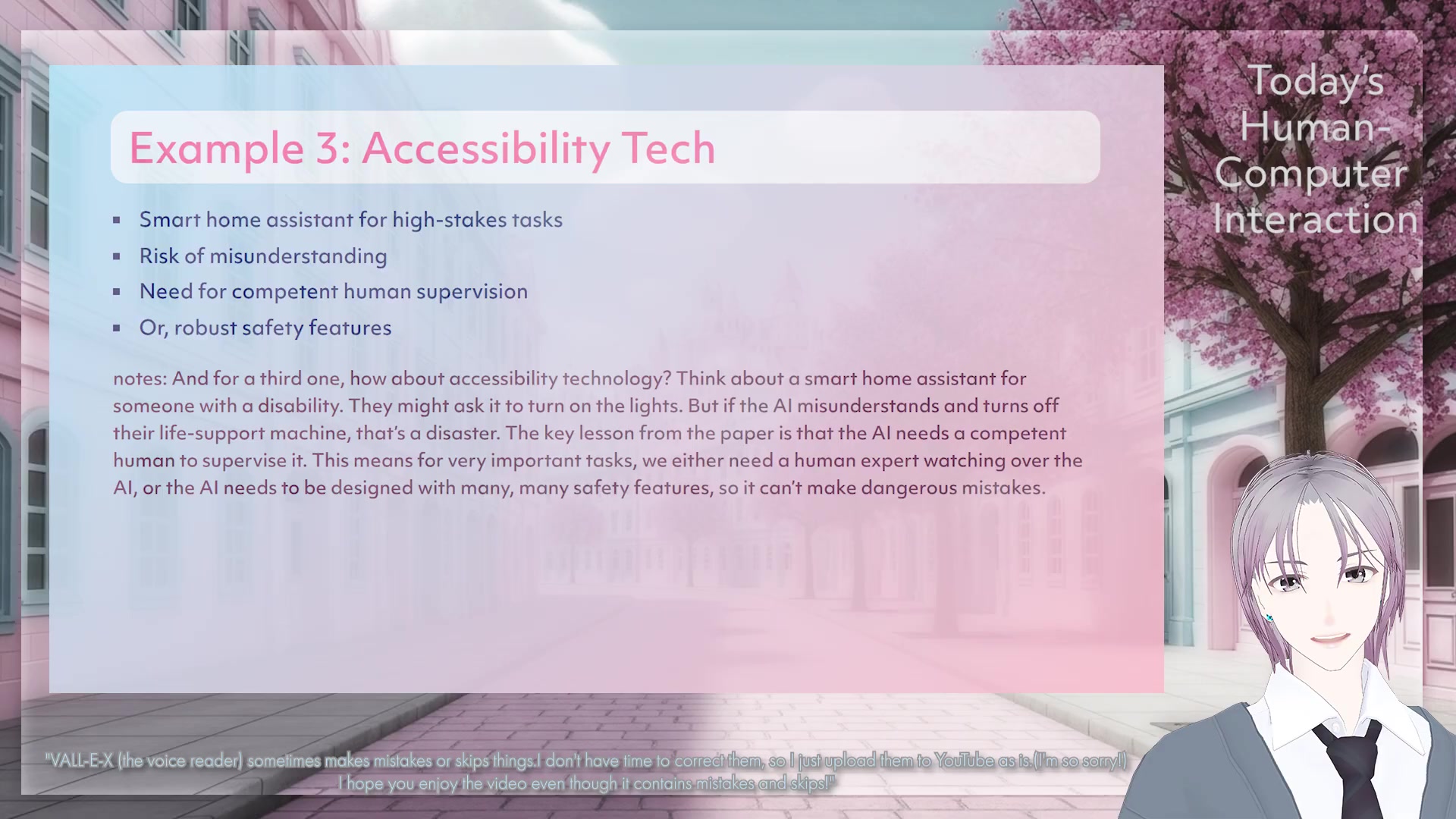
Smart home assistants can improve accessibility for people with disabilities, but misunderstandings can have serious consequences. For instance, if the AI misunderstands a command and turns off a life-support machine, that's a disaster. This highlights the need for competent human supervision or AI that is designed with many safety features to prevent such dangerous mistakes. Technology serves to help but must still be watched.
These examples underscore the importance of maintaining a balance between trust and skepticism when working with AI. Programmers and developers must understand AI's capabilities and limitations, validate its suggestions, and maintain critical judgment to ensure the safety, security, and accessibility of their applications.








Most people like




































![AIcut: Automate Viral Text Story Videos Creation [2025]](https://i.ytimg.com/vi/AFGu13ApHLw/hq720.jpg?sqp=-oaymwEnCNAFEJQDSFryq4qpAxkIARUAAIhCGAHYAQHiAQoIGBACGAY4AUAB&rs=AOn4CLBW-Ky_AEvG3-v4VH_sxmqLhbESEQ)


Report
Please select a reason for reporting
- 13 Reasons to Switch from Snapchat to Text Messaging
- 7 Powerful Speech to Text Apps to Boost Productivity
- 10 Best Speech to Text Tools for Effortless Transcription
- 13 Free Tools to Easily Transcribe Audio to Text
- 15 Surprising Ways Google's Speech-to-Text Boosts Productivity
- 7 Best Free Online Audio to Text Transcription Tools
- 9 Tips to Transcribe Speech to Text Faster and Better
- 13 Best Speech to Text Software for Windows 10 in 2023
- 7 Tips for Choosing the Best Transcriber for Audio to Text
- 11 Reasons Why Dragon Speech-to-Text Apps are Game-Changers
- 6 Secrets to Enhance Your Speech to Text Transcription
- 6 Brilliant Ways to Boost Productivity with Talk-to-Text on Your MacBook
- 6 Ways Transcription Software Converts Audio to Text
- 8 Tips to Transcribe Speech to Text Like a Pro
- 6 Reasons IBM Watson Speech to Text is a Game-Changer
- 14 Powerful Ways Talk-to-Text Improves Your Workflow
- 12 Top Windows Speech-to-Text Software for Efficient Transcription
- 12 Game-Changing Benefits of Apple's Speech to Text Technology
- 9 Powerful Use Cases for AWS Speech to Text Technology
- 10 Easy Steps to Transcribe YouTube Videos to Text
- transcription audio en texte
- online audio transcription
- free audio file transcription
- free ai audio transcription
- audio transcription service
- audio transcription online free
- audio transcription free online
- audio to transcription software
- audio and transcript
- ai audio transcription free
- voice recording to text converter
- translate voice recording to text
- record voice to text
- audio recording to text converter
- voice recording and transcription
- chatgpt voice to text
- gmail voice to text
- speech to text reader
- speech to text ai free
- speech to talk
- How SEO and Marketing Dashboards Empower Agencies to Drive Results
- How to Use AI Tools to Find Internal Linking Opportunities Across a Business Website
- Discover Your Perfect Haircut with AI Hairstyle Apps
- Free Reputation Calculator Tools: How They're Adapting to Score AI Visibility, Not Just Rankings
- Design Professional Flyers for Free on Your Phone
- Best Free Flyer Maker Apps for Android: Design Like a Pro
- How to Know If Your Business Is Ready for an AI Customer Service Agent
- Revolutionizing Storytelling: From Novels to Screenplays with AI
- Create Engaging Animated Explainer Videos with a Free AI Tool
- Stop Multi-Subscribing: Benchmark Top AI Visual Models in One Canvas
- 5 Data Problems That Stall AI Projects in Financial Compliance
- Master Storyboard Drawing: Expert Tips for Non-artists
- The Future of Smart Glasses: Explained & Assembling Guide
- DeepL Translator: The AI-Powered Translation Tool
- AI Video Upscaling: Top Tools Compared for Enhanced Quality
- Bridging the Gap: How One Indie Developer Solved the "Art Asset Nightmare" Using AI Style Transfer
- How I Direct Consistent AI Clips: A Hands-On Guide to Multi-Model Generation
- My Honest Review of VideoAI: The Ultimate Character Voice Generator I've Been Using Lately
- Why do so many AI tools underdeliver for online stores?
- My Brand New Logo: AI-Powered Logo Design for Startups

Copyright ©2026 toolify