































Table of Contents
- Key Points
- Understanding Naive Bayes
- Feature Extraction Techniques with Naive Bayes
- Building a Naive Bayes Classifier: Step-by-Step Guide
- Pricing
- Pros and Cons
- Core Features
- Use Cases
- FAQ
- Related Questions


Understanding Naive Bayes
What is Naive Bayes?
The Naive Bayes algorithm is a supervised learning technique rooted in probability and Bayes' theorem. Its primary function is classification, making it particularly useful in text analysis. Despite its name, implying simplicity, Naive Bayes is a powerful tool, particularly for tasks involving high-dimensional data. This success is often attributed to how well this method handles textual data and the specific attributes that commonly accompany text datasets. Naive Bayes relies on a crucial simplifying assumption: features are independent of each other. While this "naive" assumption doesn't always hold true in real-world scenarios, especially with text, the algorithm demonstrates robustness and effectiveness in text classification.
Bayes' Theorem lies at the foundation of the Naive Bayes classifier. It's expressed as:
P(A|B) = [P(B|A) * P(A)] / P(B)
Where:
- P(A|B) is the posterior probability of class (target) A given predictor (attribute) B.
- P(B|A) is the likelihood which is the probability of predictor B given class A.
- P(A) is the prior probability of class A.
- P(B) is the prior probability of predictor B.
Historical Context
Named after Thomas Bayes, an 18th-century clergyman and mathematician
, this theorem provides a framework for updating beliefs based on new evidence. Although Bayes initially developed the theory to explore the existence of God, it was Pierre-Simon Laplace who operationalized its use.
The Naive Bayes algorithm leverages this theorem, providing an efficient approach to classifying text data.
Advantages and Disadvantages of Naive Bayes Classifiers
Like any machine learning algorithm, Naive Bayes comes with its own set of advantages and disadvantages
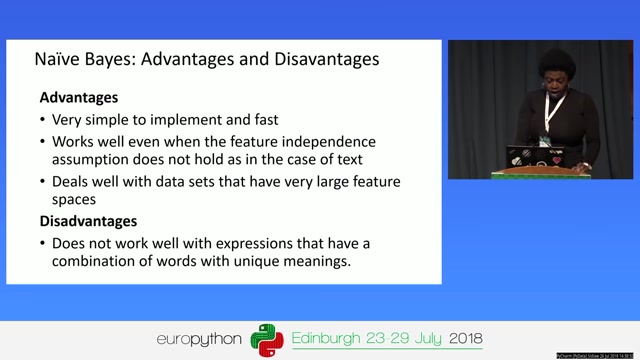
. Understanding these aspects helps determine when and where to apply the algorithm effectively.
Advantages:
- Simplicity and Speed: Naive Bayes is straightforward to implement and computationally fast. This makes it ideal for large datasets and real-time predictions.
- Effective with High-Dimensional Data: The algorithm excels when dealing with text datasets that have numerous features (words). This is due to its ability to handle multiple attributes with ease.
- Works Well Despite Independence Assumption: Even when the independence assumption of features doesn't hold, Naive Bayes can still perform remarkably well in many text classification scenarios.
Disadvantages:
- Limited with Complex Expressions: Naive Bayes struggles with expressions where the combination of words carries a unique meaning not captured by individual WORD probabilities. For example, phrases with sarcasm or irony might not be accurately interpreted.
- Relies on Feature independence: This means that the features should be all independent. But what does this exactly mean in practice?
Here's a table summarizing the advantages and disadvantages of Naive Bayes:
Feature Extraction Techniques with Naive Bayes
Bag of Words (BoW) Approach
The Bag of Words model is a fundamental technique used in text processing and natural language processing (NLP). It simplifies the representation of text data by focusing on the frequency of words within a document, disregarding grammar and word order. Instead, it treats each document as an unordered collection (or 'bag') of words.
Key Steps:
- Tokenization: Breaking down the text into individual words or tokens.
- Vocabulary Creation: Creating a list of all unique words in the entire dataset.
- Encoding: Counting the occurrences of each word in each document to form a document-term matrix.
The bag of words approach involves converting a text document into a vector of word counts. This vector represents the frequency of each word in the document.
There are some limitations though:
- It doesn't account for the importance of words (TF-IDF fixes it).
- It doesn't retain information about the word order or semantics.
- It's not very useful for sentiment analysis.
Despite these limitations, BoW remains a simple and effective starting point for many text classification tasks.
TF-IDF (Term Frequency-Inverse Document Frequency)
TF-IDF refines the BoW approach. This is achieved by factoring in the relevance or importance of each word in a document, relative to the entire collection of documents, known as a corpus.
TF-IDF consists of two components:
- Term Frequency (TF): Measures how frequently a term occurs in a document.
TF(t,d) = (Number of times term t appears in document d) / (Total number of terms in document d)
- Inverse Document Frequency (IDF): Measures how unique or rare a term is across the entire corpus.
IDF(t) = log(Total number of documents / Number of documents with term t)
TF-IDF value for a term in a document:
TF-IDF(t,d) = TF(t,d) * IDF(t)
The main difference is that the TF-IDF increases for terms that occur frequently within the document and are rare across the corpus.
Here's a table comparing BoW and TF-IDF:
Building a Naive Bayes Classifier: Step-by-Step Guide
Loading the Dataset
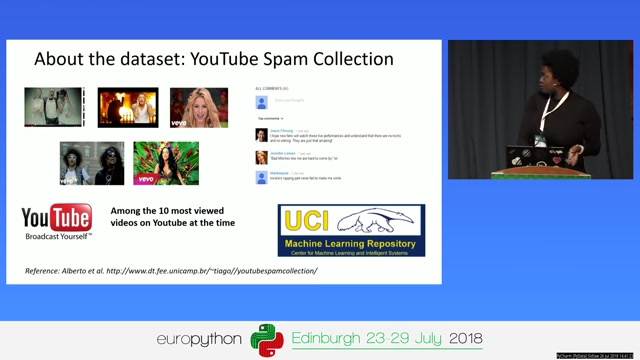
This initial stage involves importing the necessary Python libraries, including pandas for data manipulation, NumPy for numerical operations, and glob for file path handling. The YouTube Spam Collection dataset, consisting of multiple CSV files, is loaded into the environment. The goal is to consolidate all the files into a single data structure for ease of use.
This section covers:
- Importing required libraries like pandas, NumPy, and glob.
- Reading multiple CSV files containing the dataset.
- Combining the data from multiple files into a single pandas DataFrame.
Here's an example of how to achieve this:
Data Preprocessing
Data preprocessing is a crucial step to prepare text data for the Naive Bayes algorithm. It generally improves the accuracy of the classification process. The process typically includes tokenization, lowercasing, and the removal of stop words.
This part contains:
-
Selecting the content and class columns.
-
Splitting the dataset into training and testing sets.
-
Using
train_test_splitfromsklearn.model_selectionfor dataset partitioning. -
Creating data subsets for training and testing (e.g., 70% for training and 30% for testing).
Feature Extraction: Bag of Words
Feature extraction is the process of transforming text into numerical features. In the steps that are shown on this video, it's used the Bag of Words (BoW) and TF-IDF approaches. It will transform our strings into integers for the Model to make use of. Using the methods that we said before, create a Document Term Matrix. For TF-IDF set the arguments, the stop_words parameter has been configured to english.
Training the Naive Bayes Classifier
With the data preprocessed and vectorized, the next step is to train the Naive Bayes classifier. Scikit-learn provides a MultinomialNB class, suitable for text classification tasks.
Now, its time to configure the algorithm: the alpha value should stay on a range of values, to have a better accuracy. After that, we want to get the Naive Bayes classifier from the module.
Testing and Evaluation
With a trained model, it's important to evaluate its performance on unseen data. Accuracy and a confusion matrix is measured to assess the ability of the model's capabilities.










Most people like





























Report
Please select a reason for reporting
- 13 Reasons to Switch from Snapchat to Text Messaging
- 7 Powerful Speech to Text Apps to Boost Productivity
- 10 Best Speech to Text Tools for Effortless Transcription
- 13 Free Tools to Easily Transcribe Audio to Text
- 15 Surprising Ways Google's Speech-to-Text Boosts Productivity
- 7 Best Free Online Audio to Text Transcription Tools
- 9 Tips to Transcribe Speech to Text Faster and Better
- 13 Best Speech to Text Software for Windows 10 in 2023
- 7 Tips for Choosing the Best Transcriber for Audio to Text
- 11 Reasons Why Dragon Speech-to-Text Apps are Game-Changers
- 6 Secrets to Enhance Your Speech to Text Transcription
- 6 Brilliant Ways to Boost Productivity with Talk-to-Text on Your MacBook
- 6 Ways Transcription Software Converts Audio to Text
- 8 Tips to Transcribe Speech to Text Like a Pro
- 6 Reasons IBM Watson Speech to Text is a Game-Changer
- 14 Powerful Ways Talk-to-Text Improves Your Workflow
- 12 Top Windows Speech-to-Text Software for Efficient Transcription
- 12 Game-Changing Benefits of Apple's Speech to Text Technology
- 9 Powerful Use Cases for AWS Speech to Text Technology
- 10 Easy Steps to Transcribe YouTube Videos to Text
- transcription audio en texte
- online audio transcription
- free audio file transcription
- free ai audio transcription
- audio transcription service
- audio transcription online free
- audio transcription free online
- audio to transcription software
- audio and transcript
- ai audio transcription free
- voice recording to text converter
- translate voice recording to text
- record voice to text
- audio recording to text converter
- voice recording and transcription
- chatgpt voice to text
- gmail voice to text
- speech to text reader
- speech to text ai free
- speech to talk
- Revolutionizing Storytelling: From Novels to Screenplays with AI
- Create Engaging Animated Explainer Videos with a Free AI Tool
- Stop Multi-Subscribing: Benchmark Top AI Visual Models in One Canvas
- Best Seedance 2.5 API Provider: Every Price on the Market, Checked at Source
- AI OnlyFans: How to Generate $30,000/Month (Legally)
- Transform Your Script into an Engaging Video with AI Video Maker!
- AI Marketing Automation: A Comprehensive Guide for Small Businesses
- Midjourney Alternative for Anime Art Creators: Why PixAI May Be Better for Character Workflows
- 10 Things Most People Get Wrong About AI Image Search
- AI Girlfriend Apps: Top Choices Redefining Relationships 2025
- Master Canva's Video Background Remover with 5 Essential Tips
- Mastering Microsoft Stream: Video Management Tips & Tricks
- AI Video Generation: Extend AI Videos for Free
- Master Loom: Create and Share Professional Videos with AI
- Create Captivating AI News Videos: Step-by-Step Guide
- Create Your Own AI News Channel with AI-Powered News Video Generator and AI Lip Sync
- Unleash the Power of Heygen AI: Create Unlimited Videos for Free!
- Kapwing Smart Cut: AI Video Editing for Creators & Marketers
- Upscale Video Quality with UniFab Upscaler AI: A Complete Guide
- Automate Cutting Long Videos with AI for Engaging Clips

Copyright ©2026 toolify