































Table of Contents
- Key Points
- Understanding Multi-Functional Central Pattern Generators (mCPGs)
- Mathematical Foundation and Modeling of mCPGs
- Practical Applications of mCPGs
- Affordable Neuromimetic Innovation
- Balance of Bio-Inspired Innovation
- Frequently Asked Questions (FAQ)
- Related Questions


Understanding Multi-Functional Central Pattern Generators (mCPGs)
What are Central Pattern Generators?
Central Pattern Generators (CPGs) are small, biologically-based neural networks that control many rhythmic behaviors in animals, from walking to breathing
. These networks are often comprised of just a few cells, but they can generate complex Patterns of activity that drive coordinated movements. The key characteristic of CPGs is their ability to produce rhythmic outputs without requiring continuous input from higher brain centers. This allows for fast, efficient, and adaptable control of repetitive tasks.
CPGs are found in the spinal cord and brainstem of vertebrates, and they interact with higher brain functions through sensory neurons and axons. This interaction forms a nervous system capable of reflex actions without direct brain input. This is why you can pull your HAND away from a hot stove before you even consciously register the pain . The speed and efficiency of these reflexes are crucial for survival.
Temporal-spatial dependencies are key. Biological Neural Networks have temporal-Spatial dependencies, biologically networks can adapt to time-dependent system changes and correct for evolving conditions, this adaptation is crucial for real-world applications where conditions are constantly changing.
The Innovation: Multi-Functionality
While traditional CPGs are often dedicated to a single rhythmic behavior, Multi-Functional Central Pattern Generators (mCPGs) offer a more versatile approach. mCPGs have the possibility for multiple output phase patterns given different inputs. This means that a single mCPG can control a variety of movements or behaviors, depending on the signals it receives
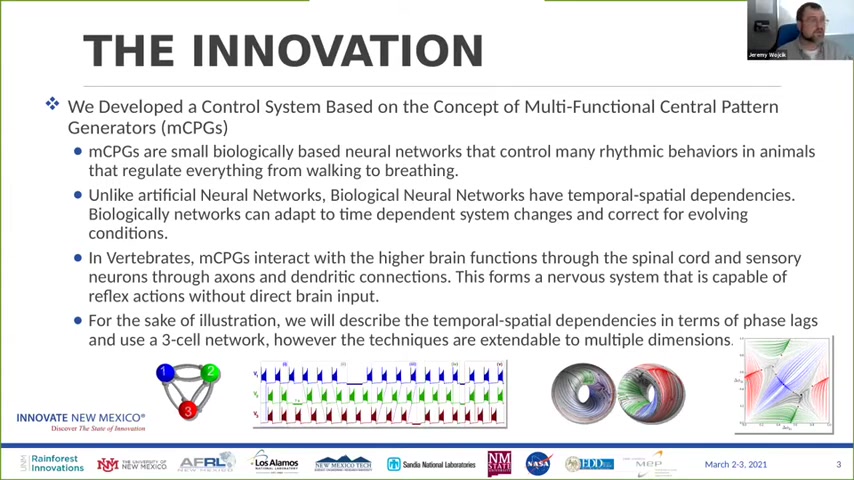
. This multi-functionality opens up new possibilities for creating highly adaptable and efficient control systems.
Imagine a robot that can seamlessly switch between walking, running, and climbing, all controlled by a single mCPG. Or a prosthetic limb that can adapt to different terrains and activities, providing a more natural and intuitive experience for the user. These are just a few of the potential applications of mCPGs.
The temporal-spatial dependencies in mCPGs can be described in terms of phase lags, using a 3-cell network. This technique is extendable to multiple Dimensions, creating systems more complex than standard Artificial Neural Networks. Often times there's a dedicated central Pattern Generator that will do one particular thing, and has one particular output rhythm.
mCPGs vs. Artificial Neural Networks (ANNs)
Artificial Neural Networks (ANNs) are popular right now, the biological neural network has temporal spatial dependencies artificial neural networks don't
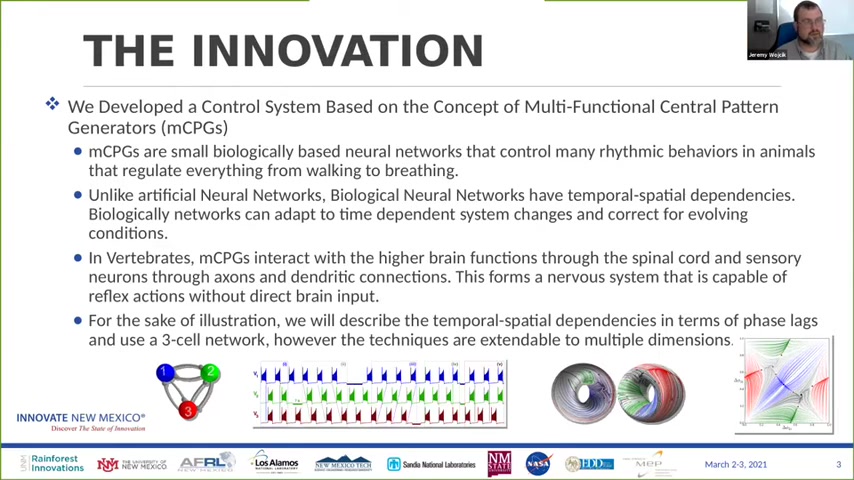
. It's important to understand the key differences between mCPGs and traditional Artificial Neural Networks (ANNs). While ANNs have proven effective for a wide range of tasks, they lack the inherent temporal dynamics and adaptability of biological neural networks. ANNs are basically big graph theory problems and combinatorics which allows it to do a lot of the things it does.
Biological Neural Networks on the other hand are different, they are much richer dynamics. ANNs rely on vast amounts of training data to learn complex patterns, biological neural networks can adapt to changing conditions in real-time. This is because biological neural networks have temporal-spatial dependencies, which means that their activity is influenced by both time and location.
Key Differences Summarized:
| Feature | mCPGs (Biological Neural Networks) | ANNs (Artificial Neural Networks) |
|---|---|---|
| Temporal-Spatial Dependencies | Yes | No |
| Adaptability | High, adapts to time-dependent system changes | Low, requires retraining for new conditions |
| Rhythmic Output | Inherent, generates rhythmic patterns naturally | Requires specific design and training |
| Energy Efficiency | High, efficient for repetitive tasks | Can be energy-intensive, especially for complex tasks |
| Reflex Actions | Capable of reflex actions without direct brain input | Requires explicit programming for reflex-like responses |
These temporal-spatial dependencies are difficult to replicate in artificial systems, but they are crucial for creating truly intelligent and adaptable control systems. This makes Biological neural networks much richer.
Mathematical Foundation and Modeling of mCPGs
Phase Lags and Temporal-Spatial Dynamics
The temporal-spatial dependencies inherent in mCPGs can be described mathematically using the concept of phase lags
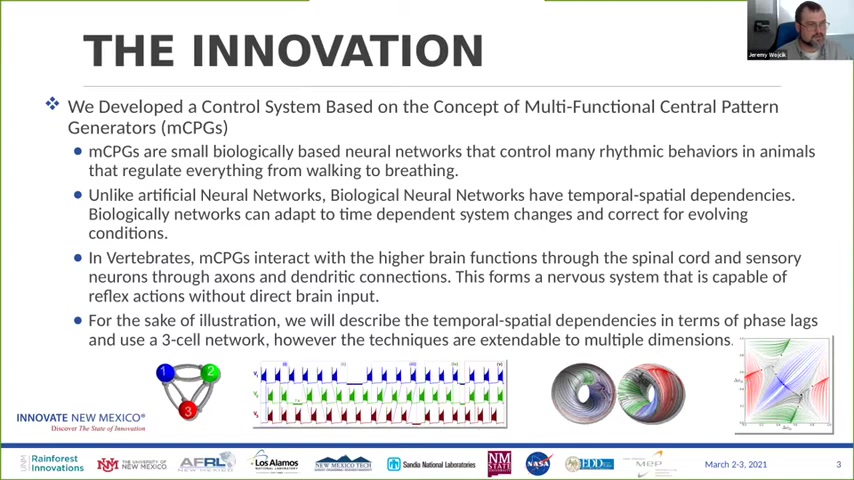
. Phase lag is the time difference between the activity of two neurons in a network. By carefully controlling the phase lags between different neurons, it is possible to create complex and coordinated patterns of activity.
For example, in a 3-cell network, the phase lags between the neurons can be represented as angles on a circle. By varying these angles, it is possible to generate different rhythmic outputs. This mathematical framework allows for a systematic and predictable way to design and control mCPGs.
The solution space for biological neural networks is based on time dependencies. We have to look at how we interpret the solution space for biological neural networks differently. What results comes up with what the mathematical solution will be. Solution spaces could be flattened, cut open for us to see. It naturally falls on a Taurus pattern.
Affordable Neuromimetic Innovation
Accessible R&D Investment
With a $45k Subcontract Under AFRL Contract FA9453-16-D-0004-0009, BlueHalo is dedicated to making Neuromimetic Innovation accessible and affordable. Term of Period Ends March 15, 2021
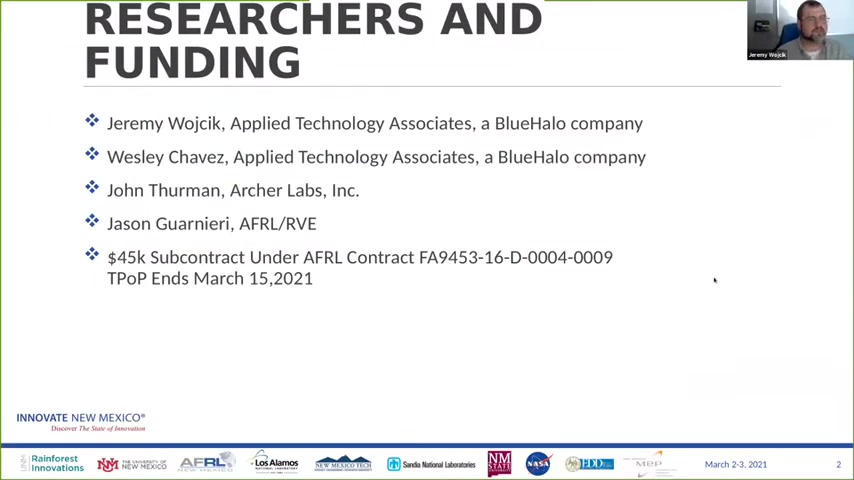
. The team that made this possible include Jeremy Wojcik, Wesley Chavez, John Thurman, and Jason Guarnieri.








Most people like


































Report
Please select a reason for reporting
- 13 Reasons to Switch from Snapchat to Text Messaging
- 7 Powerful Speech to Text Apps to Boost Productivity
- 10 Best Speech to Text Tools for Effortless Transcription
- 13 Free Tools to Easily Transcribe Audio to Text
- 15 Surprising Ways Google's Speech-to-Text Boosts Productivity
- 7 Best Free Online Audio to Text Transcription Tools
- 9 Tips to Transcribe Speech to Text Faster and Better
- 13 Best Speech to Text Software for Windows 10 in 2023
- 7 Tips for Choosing the Best Transcriber for Audio to Text
- 11 Reasons Why Dragon Speech-to-Text Apps are Game-Changers
- 6 Secrets to Enhance Your Speech to Text Transcription
- 6 Brilliant Ways to Boost Productivity with Talk-to-Text on Your MacBook
- 6 Ways Transcription Software Converts Audio to Text
- 8 Tips to Transcribe Speech to Text Like a Pro
- 6 Reasons IBM Watson Speech to Text is a Game-Changer
- 14 Powerful Ways Talk-to-Text Improves Your Workflow
- 12 Top Windows Speech-to-Text Software for Efficient Transcription
- 12 Game-Changing Benefits of Apple's Speech to Text Technology
- 9 Powerful Use Cases for AWS Speech to Text Technology
- 10 Easy Steps to Transcribe YouTube Videos to Text
- transcription audio en texte
- online audio transcription
- free audio file transcription
- free ai audio transcription
- audio transcription service
- audio transcription online free
- audio transcription free online
- audio to transcription software
- audio and transcript
- ai audio transcription free
- voice recording to text converter
- translate voice recording to text
- record voice to text
- audio recording to text converter
- voice recording and transcription
- chatgpt voice to text
- gmail voice to text
- speech to text reader
- speech to text ai free
- speech to talk
- How to Know If Your Business Is Ready for an AI Customer Service Agent
- Revolutionizing Storytelling: From Novels to Screenplays with AI
- Create Engaging Animated Explainer Videos with a Free AI Tool
- Stop Multi-Subscribing: Benchmark Top AI Visual Models in One Canvas
- Best Seedance 2.5 API Provider: Every Price on the Market, Checked at Source
- AI OnlyFans: How to Generate $30,000/Month (Legally)
- Transform Your Script into an Engaging Video with AI Video Maker!
- AI Marketing Automation: A Comprehensive Guide for Small Businesses
- Midjourney Alternative for Anime Art Creators: Why PixAI May Be Better for Character Workflows
- 10 Things Most People Get Wrong About AI Image Search
- How to Know If Your Business Is Ready for an AI Customer Service Agent
- Top 4 AI Platforms to Extend Video: The Ultimate Comparison for Creators
- Top 8 Best AI Image Editor Tools for Creative Professionals in 2026
- Experience the Future of Virtual Assistants with F.R.I.D.A.Y. AI
- Learn How to Train an AI to Play Snake with Reinforcement Learning
- Creating a Unique AI Game Environment with Pygame
- Mastering the Classic Java Snake Game
- Discover the Power of Codex: Snake Game Created in Python
- Building an AI to Master Snake Game
- Revolutionize the Classic Snake Game with AI

Copyright ©2026 toolify