































Table of Contents
- Key Points
- ChatGPT-4o: A New Era for Programmers
- Dive Deeper: Practical AI Coding Assistant Application
- Mastering ChatGPT-4o: Usage Tips and Tricks
- ChatGPT-4o Pricing: Accessibility and Cost-Effectiveness
- Pros and Cons: Assessing the Value of ChatGPT-4o for Programming
- Core Features of ChatGPT-4o: A Comprehensive Overview
- Use Cases of ChatGPT-4o: Revolutionizing Programming Tasks
- Frequently Asked Questions about ChatGPT-4o
- Related Questions: Deepening Your Understanding of AI in Programming



ChatGPT-4o: A New Era for Programmers
Understanding ChatGPT-4o and its Capabilities
ChatGPT-4o represents a significant leap in AI technology, offering a wide array of features that can greatly benefit programmers. This innovative model combines audio, visual, and textual reasoning capabilities into a single platform, making it an all-in-one assistant for various programming tasks.
One of the most notable advancements is the introduction of ai Voice Assistants, exemplified by 'Sky.'
ChatGPT-4o’s functionalities are designed to streamline workflows and offer real-time assistance, potentially leading to increased productivity and a more intuitive coding experience. By integrating multiple sensory inputs, the model provides more nuanced and contextual support, making it easier to solve complex programming problems.
Key improvements over previous models include enhanced natural language processing, improved code generation, and better debugging capabilities. These features are specifically tailored to meet the demands of modern software development, where speed and accuracy are paramount.
For instance, ChatGPT-4o’s advanced code generation can help automate repetitive tasks, freeing up programmers to focus on more strategic and creative aspects of their work. Additionally, its real-time debugging feature allows for quicker identification and resolution of errors, reducing the time spent on troubleshooting. The integration of audio, visual, and textual inputs also allows for more natural and intuitive interactions, making the process of coding more accessible and efficient.
With ChatGPT-4o, programmers can look forward to a future where AI not only assists in coding but also enhances the overall programming experience.
The Rise of AI Voice Assistants in Programming
One of the most captivating aspects of ChatGPT-4o is the integration of AI Voice Assistants. 'Sky,' an AI voice assistant similar to Cortana from Halo, aims to provide a more natural and intuitive programming experience.

These assistants can understand spoken commands, provide real-time feedback, and even engage in complex problem-solving dialogues with programmers. The potential for hands-free coding and on-the-go assistance is immense.
However, the introduction of AI voice assistants also raises ethical and legal concerns. The likeness of AI voices to celebrities, as seen with Scarlett Johansson, has sparked debates about consent, intellectual property, and the potential for misuse. These issues highlight the importance of establishing clear guidelines and regulations for the use of AI voices.
The core function of these AI assistants is to simplify programming tasks. By allowing programmers to verbally express their coding intentions and receive instant feedback, these AI systems can help reduce errors, speed up development time, and provide personalized guidance.
Several applications can benefit from AI voice assistants. For example, in mobile app development, programmers can use voice commands to design interfaces, test functionalities, and troubleshoot problems. Similarly, in web development, AI assistants can automate the creation of HTML and CSS code, allowing developers to focus on creating engaging user experiences. The integration of AI voice assistants is set to revolutionize how programmers interact with their tools and code, potentially leading to more efficient and innovative development processes.
ChatGPT-4o and the Scarlett Johansson Voice Controversy
The release of ChatGPT-4o has not been without controversy, particularly regarding the voice of 'Sky'. Concerns emerged when actress Scarlett Johansson expressed her dismay over the likeness of the AI's voice to her own, raising questions about consent and usage rights.

OpenAI has since pulled the 'Sky' voice from ChatGPT, but the issue underscores the ethical challenges of AI in mimicking human traits.
This controversy prompts a deeper examination of the legal and ethical boundaries surrounding AI and intellectual property. While AI-generated content can offer numerous benefits, it's crucial to respect the rights and identities of individuals. The incident serves as a reminder of the need for careful consideration and robust regulations in the AI development space.
Potential legal ramifications include: copyright infringement, violation of publicity rights, and unauthorized use of personal likeness. These issues highlight the importance of obtaining explicit consent from individuals before using their voices or likenesses in AI systems.
The broader implications of the controversy extend to the need for greater transparency in AI development processes. Users should be informed about how their data is being used and have the ability to control the use of their personal information. This level of transparency is essential for building trust and ensuring the responsible development of AI technologies.
Going forward, it is vital for AI developers to prioritize ethical considerations and legal compliance. Establishing guidelines that protect individual rights and promote transparency will be key to fostering innovation and ensuring that AI technologies are used for the benefit of society.
The Future of AI in the Programming Industry
As AI technology continues to evolve, its integration into the programming industry is only set to grow. ChatGPT-4o is just a glimpse of what’s possible. The combination of AI with coding presents opportunities for both enhanced efficiency and increased creativity. By automating tasks and providing intelligent suggestions, AI can help programmers achieve more in less time.
Enhanced Code Analysis and Debugging: AI systems can analyze code in real-time, identifying potential errors and suggesting improvements. This can lead to more robust and reliable software.
Automated Testing: AI can automate the testing process, ensuring that software performs as expected under various conditions. This can help reduce the risk of bugs and improve the overall quality of the software.
Personalized Learning Paths: AI can personalize the learning experience for programmers, providing tailored recommendations and resources based on individual skill levels and goals. This can help programmers learn more effectively and efficiently.
The integration of AI into programming also means that programmers will need to adapt their skill sets. While AI can automate many routine tasks, it cannot replace the critical thinking, problem-solving, and creative abilities of human programmers. As AI becomes more prevalent, programmers will need to focus on developing these higher-level skills to remain competitive.
The future of AI in programming is not about replacing programmers but about augmenting their abilities and enabling them to achieve more. By embracing AI, programmers can unlock new levels of productivity, creativity, and innovation.
Dive Deeper: Practical AI Coding Assistant Application
Live Demo of ChatGPT-4o as a Coding Assistant
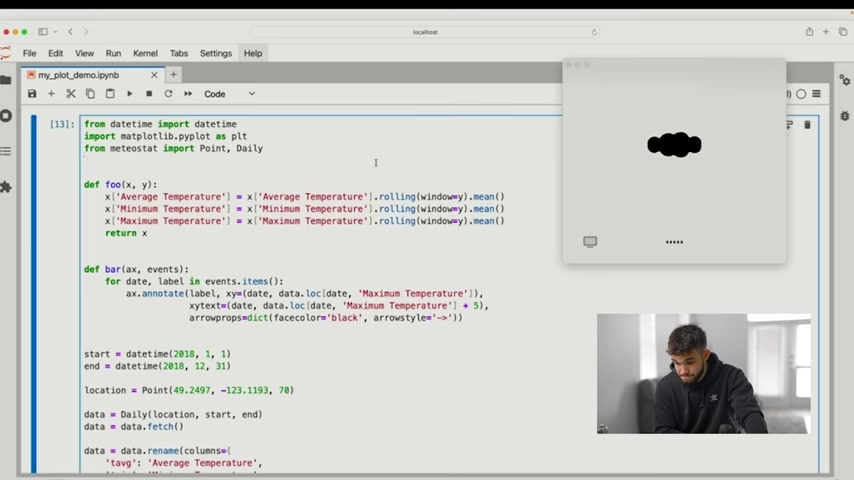
Let's explore how ChatGPT-4o functions as a coding assistant, enhancing efficiency and accuracy for programmers
.
Step 1: Setting the Scene The stage is set in a modern, collaborative workspace. Two engineers and a consultant are present. One engineer opens the ChatGPT desktop application, a tool meant to assist in coding and other tasks, the screen displays lines of Python code, ready to be analyzed.
Step 2: Initial Voice Interaction The engineer shares some code with ChatGPT-4o and asks the AI for a one-sentence description of the code’s function. With impressive speed, the AI responds with a precise summary. It accurately details that the code fetches daily weather data for a specific location and time period, smoothes the temperature data using a rolling average, annotates a significant weather event on the resulting plot, and then displays the plot with average, minimum, and maximum temperatures over the year.
Step 3: Detailed Code Explanation Then, the engineer decides to ask a more specific question. He selects a specific function and requests a description of what the plot (x,y) takes in and he quickly receives the answer. The AI dives deep into the code's function, it is able to provide more detail on the temperature data.
Step 4: Understanding Visual Output Next, the plot is visually displayed, and the engineer turns to ChatGPT-4o again, and they then use the AI's image recognition features. He points out some aspects of the resulting data, asking if certain labels have been coded correctly. The AI checks the resulting image, and they have to the linear aspects of the resulting graphs.
Step 5: Synthesizing and Learning The demonstration shows ChatGPT-4o excels as a tool that not only parses and debugs code, but learns as well. As new features or lines of code are introduced, ChatGPT-4o continues to parse and explain with an uncanny human element that is meant to be used, and not just relied upon.








Most people like


































Report
Please select a reason for reporting
- 13 Reasons to Switch from Snapchat to Text Messaging
- 7 Powerful Speech to Text Apps to Boost Productivity
- 10 Best Speech to Text Tools for Effortless Transcription
- 13 Free Tools to Easily Transcribe Audio to Text
- 15 Surprising Ways Google's Speech-to-Text Boosts Productivity
- 7 Best Free Online Audio to Text Transcription Tools
- 9 Tips to Transcribe Speech to Text Faster and Better
- 13 Best Speech to Text Software for Windows 10 in 2023
- 7 Tips for Choosing the Best Transcriber for Audio to Text
- 11 Reasons Why Dragon Speech-to-Text Apps are Game-Changers
- 6 Secrets to Enhance Your Speech to Text Transcription
- 6 Brilliant Ways to Boost Productivity with Talk-to-Text on Your MacBook
- 6 Ways Transcription Software Converts Audio to Text
- 8 Tips to Transcribe Speech to Text Like a Pro
- 6 Reasons IBM Watson Speech to Text is a Game-Changer
- 14 Powerful Ways Talk-to-Text Improves Your Workflow
- 12 Top Windows Speech-to-Text Software for Efficient Transcription
- 12 Game-Changing Benefits of Apple's Speech to Text Technology
- 9 Powerful Use Cases for AWS Speech to Text Technology
- 10 Easy Steps to Transcribe YouTube Videos to Text
- transcription audio en texte
- online audio transcription
- free audio file transcription
- free ai audio transcription
- audio transcription service
- audio transcription online free
- audio transcription free online
- audio to transcription software
- audio and transcript
- ai audio transcription free
- voice recording to text converter
- translate voice recording to text
- record voice to text
- audio recording to text converter
- voice recording and transcription
- chatgpt voice to text
- gmail voice to text
- speech to text reader
- speech to text ai free
- speech to talk
- How SEO and Marketing Dashboards Empower Agencies to Drive Results
- How to Use AI Tools to Find Internal Linking Opportunities Across a Business Website
- Discover Your Perfect Haircut with AI Hairstyle Apps
- Free Reputation Calculator Tools: How They're Adapting to Score AI Visibility, Not Just Rankings
- Design Professional Flyers for Free on Your Phone
- Best Free Flyer Maker Apps for Android: Design Like a Pro
- How to Know If Your Business Is Ready for an AI Customer Service Agent
- Revolutionizing Storytelling: From Novels to Screenplays with AI
- Create Engaging Animated Explainer Videos with a Free AI Tool
- Stop Multi-Subscribing: Benchmark Top AI Visual Models in One Canvas
- ASOMobile Helps Teams Benchmark App Store Screenshots Against Competitors
- How to Match LMS Software With Your Organization's Training Plan
- Revolutionizing Email Marketing Agency with AI
- How to Convert BTC to HNT
- Unleashing the Power of AI: Cognizant's Roadmap for Transformation
- Frame to Video Review: A Practical Look at Turning Two Still Frames Into Motion
- NVIDIA NIM: Revolutionizing Supply Chain Data Analysis with AI
- Top AI Tools That Help Brands Stand Out Offline (Not Just Online)
- Top 5 Cold Email Software: Maximize Your Outreach in 2025
- Magic School AI: Revolutionizing Quiz & Assessment Generation

Copyright ©2026 toolify