































Table of Contents
- Key Takeaways of EmbodiedSAM
- Understanding EmbodiedSAM: The Next Generation in 3D Perception
- Refining 3D Queries: The Role of Auxiliary Tasks
- Affordable EmbodiedSAM
- EmbodiedSAM: Weighing the Advantages and Disadvantages
- Explore the Core Features of EmbodiedSAM
- EmbodiedSAM Use Cases
- Frequently Asked Questions About EmbodiedSAM
- Further Insights: Exploring Related Questions About EmbodiedSAM



Understanding EmbodiedSAM: The Next Generation in 3D Perception
What is EmbodiedSAM?
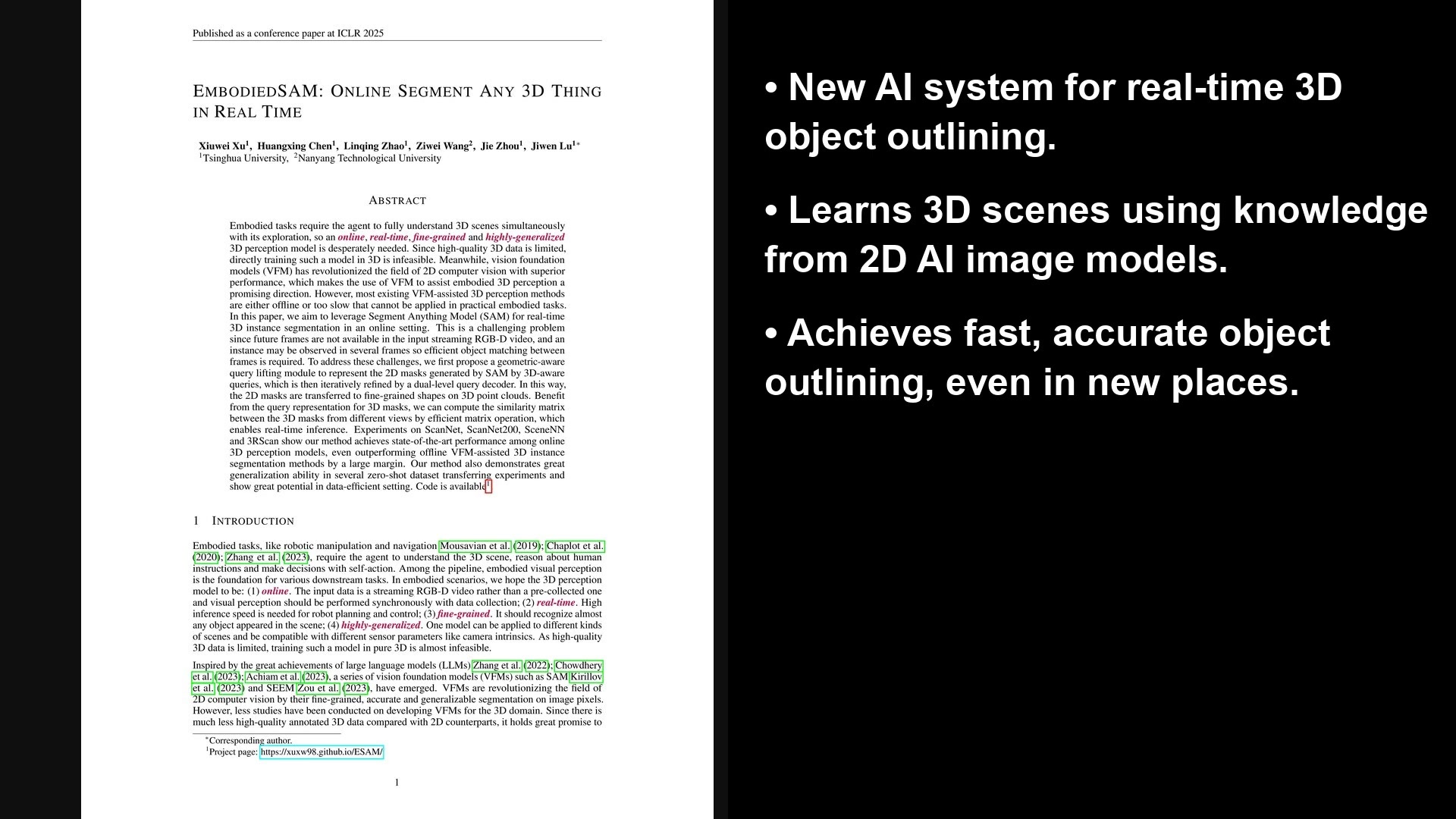
EmbodiedSAM, or ESAM, is an AI system created for 3D instance segmentation in real-time. In essence, it empowers AI agents to identify and outline individual 3D objects within their environment as they explore it. This has vast implications for embodied AI, which is essentially creating AI systems that can interact with the physical world in a nuanced way. The core of EmbodiedSAM lies in its ability to leverage knowledge gleaned from 2D AI image models. Traditional 3D perception often requires extensive, high-quality 3D data for training, which can be limited or expensive to acquire. EmbodiedSAM circumvents this challenge by cleverly using 2D vision foundation models. These are pre-trained AI models that have learned to understand visual data from vast amounts of 2D images.
The process involves processing live RGBD (Red, Green, Blue, Depth) video, which is video footage that also includes depth information. This depth information provides crucial geometric details about the scene. By using these 2D AI vision foundation models and depth data, EmbodiedSAM can then understand 3D scenes in a much more efficient and scalable way.
The Innovative Method Behind EmbodiedSAM
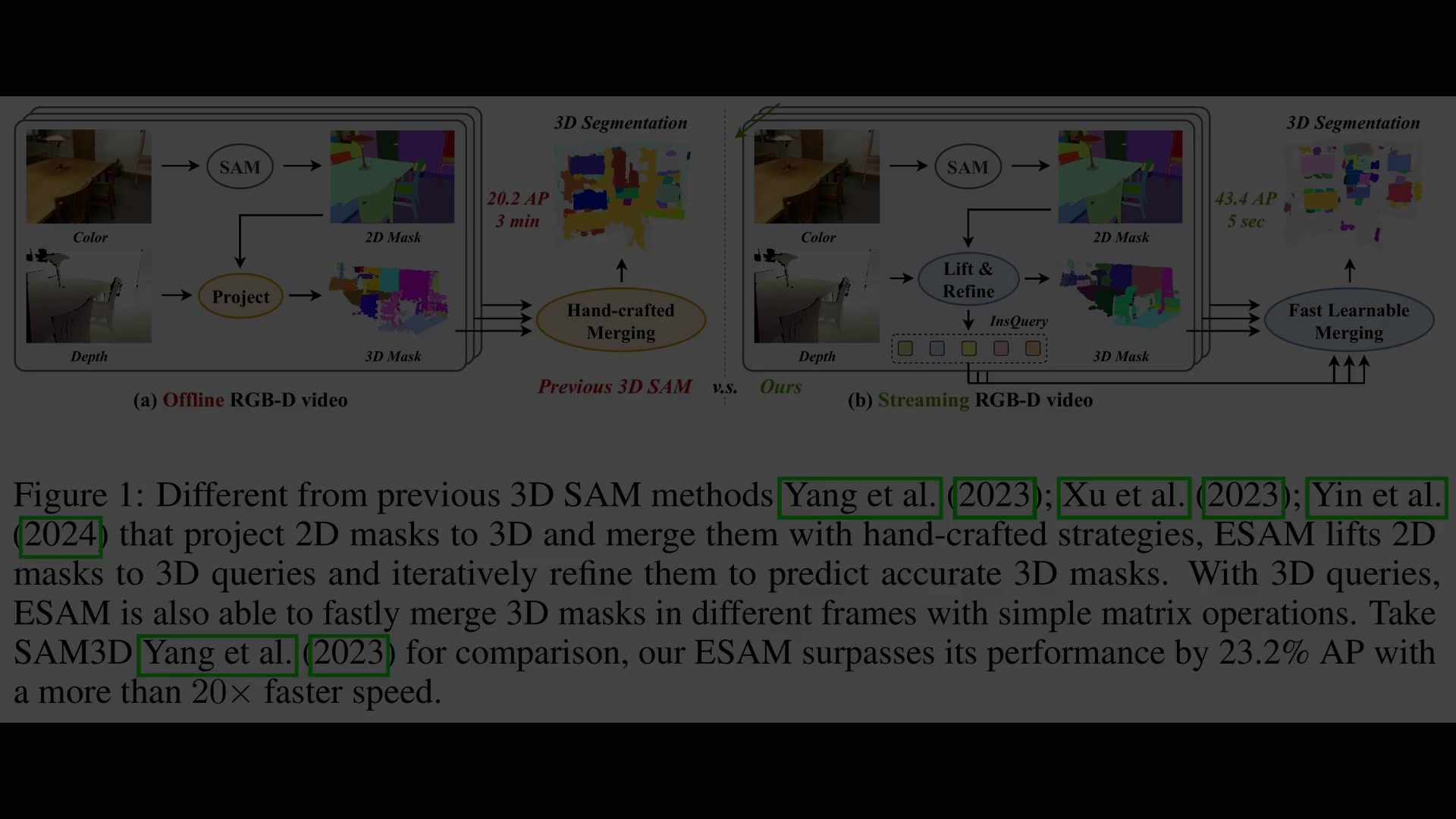
At the core of EmbodiedSAM's architecture is a comparison with previous 3D SAM methods. Unlike earlier approaches that project 2D masks onto 3D space and merge them using hand-crafted strategies, EmbodiedSAM elevates 2D masks into 3D queries.
Let's break down this process:
- 2D Masking Using SAM: It starts using the Segment Anything Model (SAM). The SAM model generates 2D instance masks (object outlines) from the video input.
- Geometric-Aware Query Lifting: The next step is a geometric-aware query lifting module which takes those 2D masks and turns them into 3D queries. This step is key because it maintains fine-grained shape information from the 2D masks.
- Dual-Level Decoder Refinement: After lifting those 2D masks to 3D queries, the 3D queries (Qt) are refined by a dual-level decoder to ensure accurate 3D masks. The decoder enables efficient cross-attention and generates fine-grained point-wise masks.
- Fast Query Merging: Finally, these 3D masks are merged using a fast query merging strategy, incorporating information from previous frames to maintain consistent object tracking.
EmbodiedSAM’s approach surpasses its performance by 23.2% average precision with a more than 20 times faster speed, according to data from Yang et al. (2023).
Key Architectural Components of EmbodiedSAM
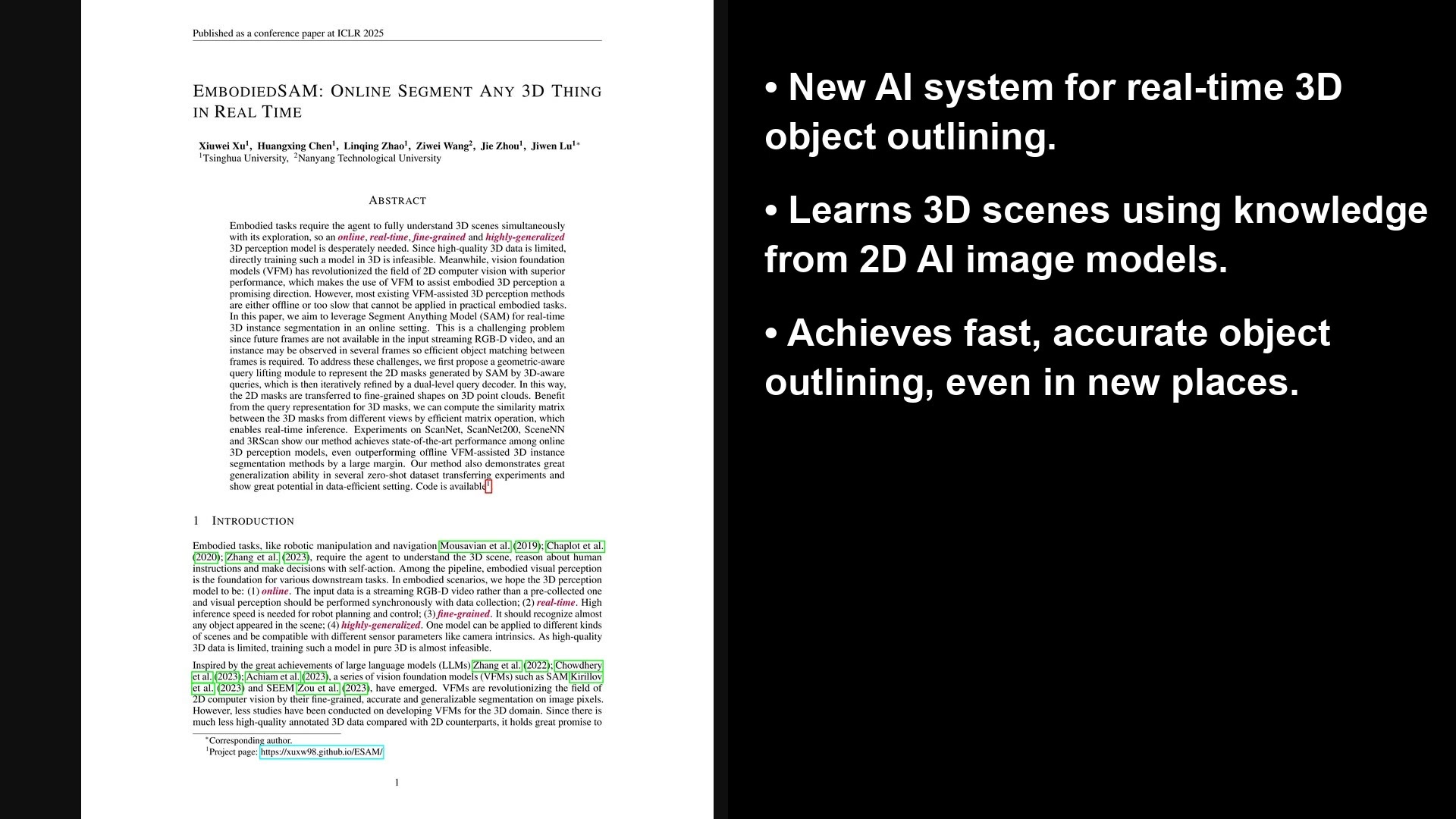
The effectiveness of EmbodiedSAM hinges on several key architectural components working in harmony:
- Vision Foundation Models (VFMs): It leverages powerful 2D vision foundation models, adapting their insights for 3D understanding.
- Geometric-Aware Query Lifting: It proposes a geometric-aware query lifting module to lift 2D instance masks to 3D queries, preserving fine-grained shape information.
- Dual-Level Decoder: The dual-level decoder refines the 3D queries, enabling cross-attention and generating point-wise masks for precise object segmentation.
- Query Merging Strategy: Employs an efficient query merging strategy to integrate information from previous frames, achieving consistent object tracking over time.
Refining 3D Queries: The Role of Auxiliary Tasks
Auxiliary Tasks for Enhanced Performance
The refinement of 3D queries in EmbodiedSAM is further enhanced through the use of auxiliary tasks. These tasks serve as specialized training goals that help to refine object descriptions and improve the merging strategy. Three primary auxiliary tasks are employed:
- Geometric Auxiliary Task: Focuses on capturing the overall shape of the object. This ensures that the 3D queries accurately reflect the object's physical form.
- Contrastive Auxiliary Task: Aids in distinguishing between different instances of objects. By maximizing the dissimilarity between different objects, the system can more effectively separate and identify them.
- Semantic Auxiliary Task: Incorporates object categories (e.g., chair, table) to improve recognition and understanding of the scene.
The combination of these auxiliary tasks leads to more distinct numerical summaries for each object. The system efficiently compares these numerical summaries, eliminating unlikely matches and applying bipartite matching to identify the best pairings for object tracking.




Most people like






























Report
Please select a reason for reporting
- 13 Reasons to Switch from Snapchat to Text Messaging
- 7 Powerful Speech to Text Apps to Boost Productivity
- 10 Best Speech to Text Tools for Effortless Transcription
- 13 Free Tools to Easily Transcribe Audio to Text
- 15 Surprising Ways Google's Speech-to-Text Boosts Productivity
- 7 Best Free Online Audio to Text Transcription Tools
- 9 Tips to Transcribe Speech to Text Faster and Better
- 13 Best Speech to Text Software for Windows 10 in 2023
- 7 Tips for Choosing the Best Transcriber for Audio to Text
- 11 Reasons Why Dragon Speech-to-Text Apps are Game-Changers
- 6 Secrets to Enhance Your Speech to Text Transcription
- 6 Brilliant Ways to Boost Productivity with Talk-to-Text on Your MacBook
- 6 Ways Transcription Software Converts Audio to Text
- 8 Tips to Transcribe Speech to Text Like a Pro
- 6 Reasons IBM Watson Speech to Text is a Game-Changer
- 14 Powerful Ways Talk-to-Text Improves Your Workflow
- 12 Top Windows Speech-to-Text Software for Efficient Transcription
- 12 Game-Changing Benefits of Apple's Speech to Text Technology
- 9 Powerful Use Cases for AWS Speech to Text Technology
- 10 Easy Steps to Transcribe YouTube Videos to Text
- transcription audio en texte
- online audio transcription
- free audio file transcription
- free ai audio transcription
- audio transcription service
- audio transcription online free
- audio transcription free online
- audio to transcription software
- audio and transcript
- ai audio transcription free
- voice recording to text converter
- translate voice recording to text
- record voice to text
- audio recording to text converter
- voice recording and transcription
- chatgpt voice to text
- gmail voice to text
- speech to text reader
- speech to text ai free
- speech to talk
- Create Engaging Animated Explainer Videos with a Free AI Tool
- Stop Multi-Subscribing: Benchmark Top AI Visual Models in One Canvas
- Best Seedance 2.5 API Provider: Every Price on the Market, Checked at Source
- AI OnlyFans: How to Generate $30,000/Month (Legally)
- Transform Your Script into an Engaging Video with AI Video Maker!
- AI Marketing Automation: A Comprehensive Guide for Small Businesses
- Midjourney Alternative for Anime Art Creators: Why PixAI May Be Better for Character Workflows
- 10 Things Most People Get Wrong About AI Image Search
- AI Girlfriend Apps: Top Choices Redefining Relationships 2025
- How to Reduce Quoting Errors in Salesforce with AI-Assisted Quote Creation
- Convert PDF to Audio: Free Urdu Text-to-Speech Tool
- Automatically Transcribe and Subtitle Audio and Video with Descript
- Revolutionize your video editing with AI-generated transcripts
- Mastering Wordpad: Essential Tips for Windows 10 Users
- AfirstSoft PDF Editor: The Ultimate PDF Solution of 2025
- UPDF: The Ultimate PDF Editor for iPadOS and macOS
- Translate PDF Documents: A Comprehensive Guide with OnlineDocTranslator
- Tenorshare PDNob PDF Editor: Smarter AI-Powered Editing
- uPDF Pro Review: AI-Powered PDF Editing for Professionals
- Master the Art of Wrapping Text in Illustrator CC

Copyright ©2026 toolify