































Table of Contents
- Key Points
- Understanding Face Recognition and Verification
- Learning Similarity Functions with Logistic Regression
- Training the Siamese Network and Logistic Regression
- Advantages and Disadvantages of Siamese Networks for Face Recognition
- Frequently Asked Questions
- Related Questions



Understanding Face Recognition and Verification
Face Recognition as Binary Classification
Face recognition is more than just identifying a person; it's about confirming that the person is who they claim to be. This is face verification. One way to approach face verification involves treating it as a binary classification problem. Instead of identifying numerous faces, you train a system to answer a simple question: "Are these two faces the same person?" This binary outcome makes the problem more manageable and computationally efficient. This strategy involves a Siamese network, which consists of two identical neural networks that share the same weights and architecture. Each network processes one of the input images, and their outputs are then compared to produce a similarity score. If the score exceeds a threshold, the faces are considered a match; otherwise, they're deemed different. The goal is to ensure the target output is 1 if both images show the same person and 0 if they show different people. This contrasts with more complex approaches that require differentiating among a large number of known individuals.
The Siamese Network Architecture
The core of this method lies in the Siamese network architecture.
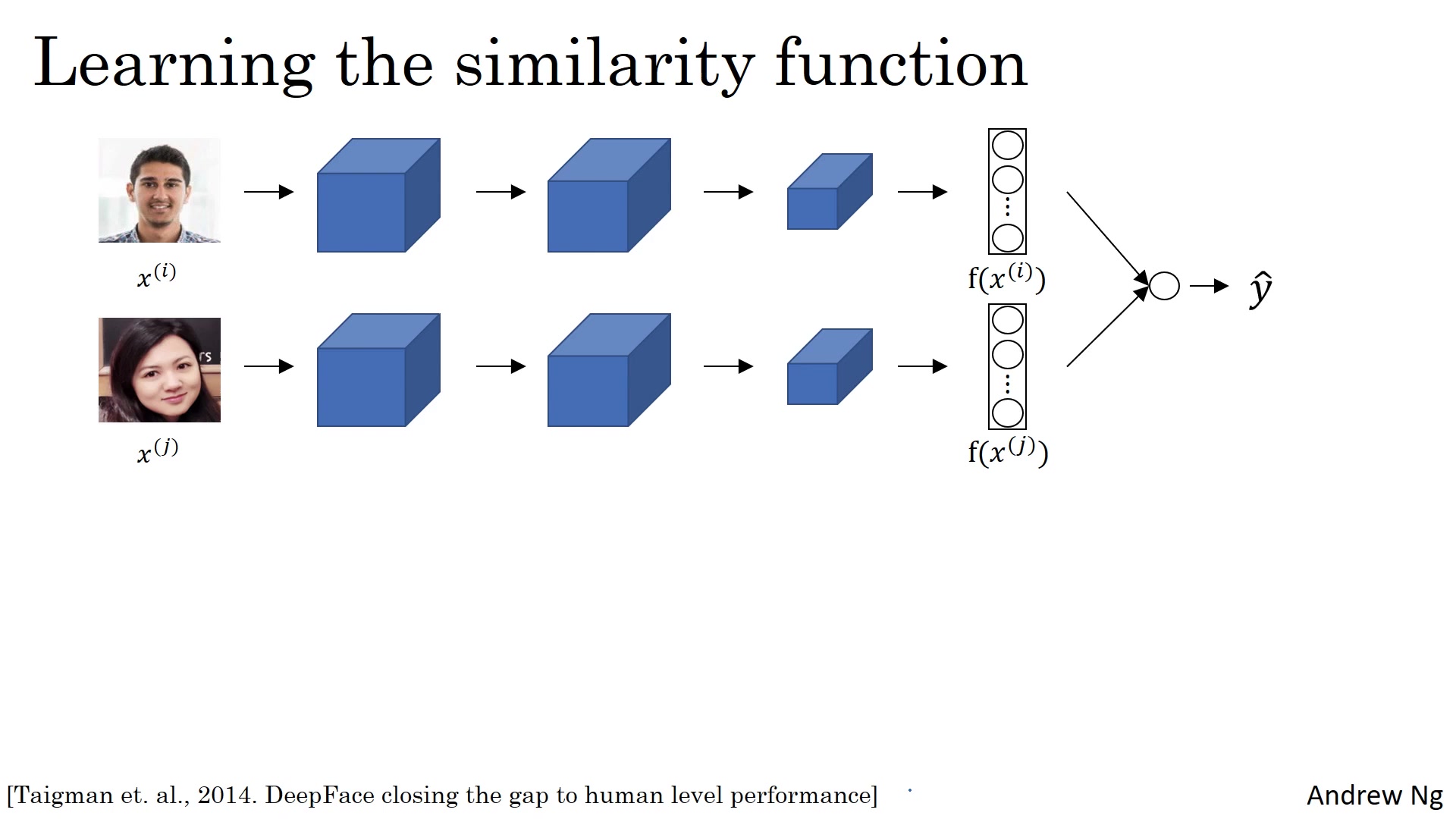
This involves using a pair of identical neural networks, each processing one of the two input images. These networks are designed to compute embeddings, which are high-dimensional vectors that represent the unique characteristics of each face. By comparing these embeddings, the system can determine how similar the two faces are. The embedding process itself typically involves several layers of convolution, pooling, and fully connected layers. Each layer extracts increasingly complex features from the image, ultimately generating a vector that encapsulates the most important aspects of the face. These embeddings might be, for example, 128-dimensional vectors, though higher dimensions are also possible to capture more subtle variations. The key is that both networks in the Siamese architecture share the same parameters. This ensures that the embeddings produced are directly comparable, because they’re generated using the same feature extraction process.
Learning Similarity Functions with Logistic Regression
Using Logistic Regression
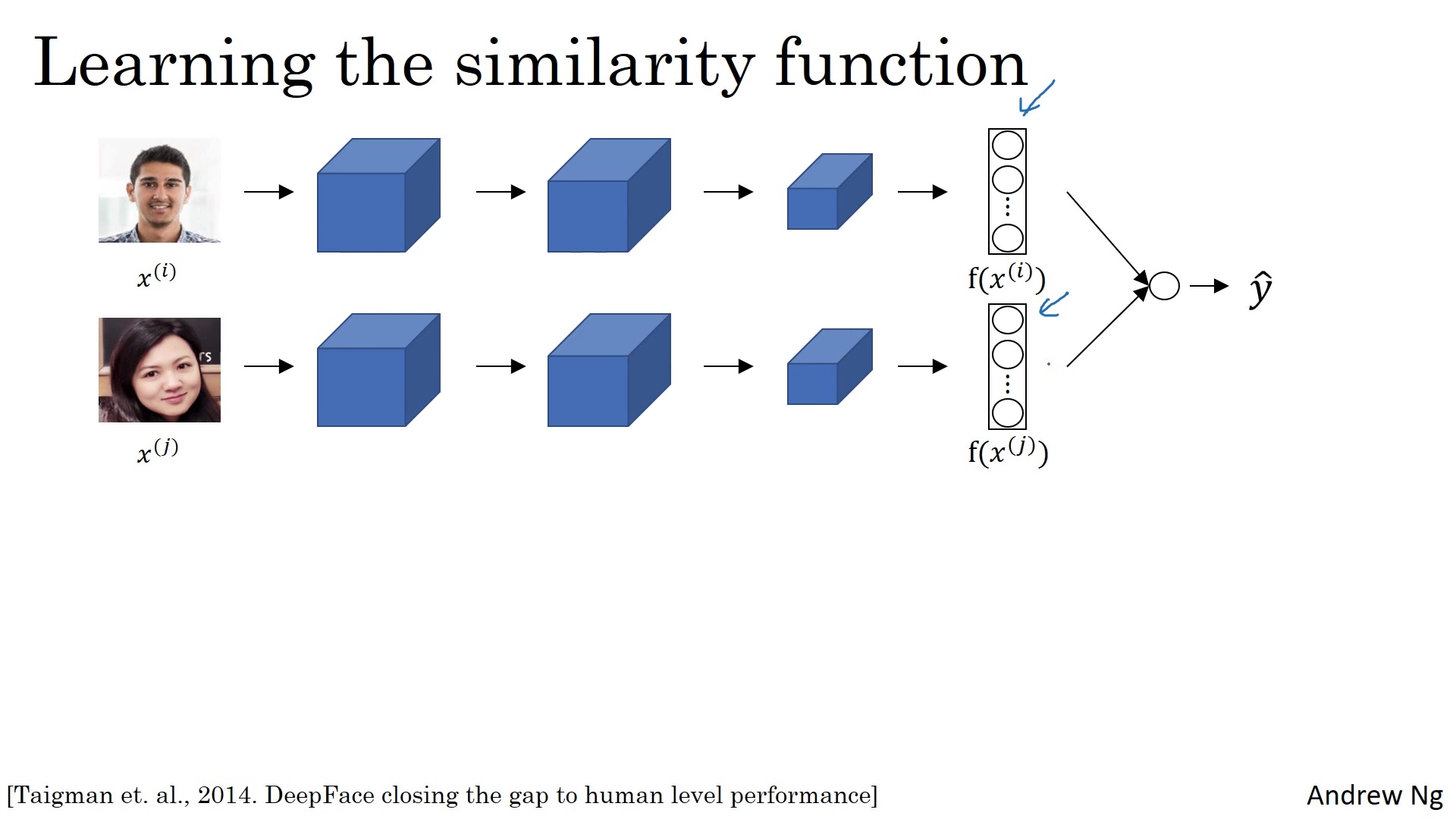
To make a final prediction about whether two faces belong to the same person, the embeddings generated by the Siamese network need to be compared. The logistic regression unit takes the embeddings from both networks and applies a sigmoid function to produce a probability score. This score indicates the likelihood that the two faces are of the same person. The input to the logistic regression unit isn't the raw embeddings; instead, it's a set of features derived from those embeddings. One common approach is to calculate the element-wise absolute difference between the two embeddings. This highlights the features that differ the most between the two faces. Other methods, such as the chi-square similarity, are also used. The aim is to create a set of features that are highly discriminative, allowing the logistic regression unit to make accurate predictions. The element-wise differences are then fed into the logistic regression unit, which learns to weight these differences appropriately. If the differences are small, the logistic regression unit outputs a high probability, indicating that the faces are likely the same person. Conversely, if the differences are large, it outputs a low probability, suggesting that the faces are different.








Most people like



































Report
Please select a reason for reporting
- 13 Reasons to Switch from Snapchat to Text Messaging
- 7 Powerful Speech to Text Apps to Boost Productivity
- 10 Best Speech to Text Tools for Effortless Transcription
- 13 Free Tools to Easily Transcribe Audio to Text
- 15 Surprising Ways Google's Speech-to-Text Boosts Productivity
- 7 Best Free Online Audio to Text Transcription Tools
- 9 Tips to Transcribe Speech to Text Faster and Better
- 13 Best Speech to Text Software for Windows 10 in 2023
- 7 Tips for Choosing the Best Transcriber for Audio to Text
- 11 Reasons Why Dragon Speech-to-Text Apps are Game-Changers
- 6 Secrets to Enhance Your Speech to Text Transcription
- 6 Brilliant Ways to Boost Productivity with Talk-to-Text on Your MacBook
- 6 Ways Transcription Software Converts Audio to Text
- 8 Tips to Transcribe Speech to Text Like a Pro
- 6 Reasons IBM Watson Speech to Text is a Game-Changer
- 14 Powerful Ways Talk-to-Text Improves Your Workflow
- 12 Top Windows Speech-to-Text Software for Efficient Transcription
- 12 Game-Changing Benefits of Apple's Speech to Text Technology
- 9 Powerful Use Cases for AWS Speech to Text Technology
- 10 Easy Steps to Transcribe YouTube Videos to Text
- transcription audio en texte
- online audio transcription
- free audio file transcription
- free ai audio transcription
- audio transcription service
- audio transcription online free
- audio transcription free online
- audio to transcription software
- audio and transcript
- ai audio transcription free
- voice recording to text converter
- translate voice recording to text
- record voice to text
- audio recording to text converter
- voice recording and transcription
- chatgpt voice to text
- gmail voice to text
- speech to text reader
- speech to text ai free
- speech to talk
- How SEO and Marketing Dashboards Empower Agencies to Drive Results
- How to Use AI Tools to Find Internal Linking Opportunities Across a Business Website
- Discover Your Perfect Haircut with AI Hairstyle Apps
- Free Reputation Calculator Tools: How They're Adapting to Score AI Visibility, Not Just Rankings
- Design Professional Flyers for Free on Your Phone
- Best Free Flyer Maker Apps for Android: Design Like a Pro
- How to Know If Your Business Is Ready for an AI Customer Service Agent
- Revolutionizing Storytelling: From Novels to Screenplays with AI
- Create Engaging Animated Explainer Videos with a Free AI Tool
- Stop Multi-Subscribing: Benchmark Top AI Visual Models in One Canvas
- My Brand New Logo: AI-Powered Logo Design for Startups
- Create Stunning Logos with Free AI Logo Generator!
- AI Logo Maker: Design a Stunning Logo in Minutes
- Elevate Your Zoom Experience with Enhanced Name Tags by Warmly
- Top 5 AI Logo Makers in 2025: Design a Stunning Brand
- Creative Fabrica's AI Tools: Flow, Studio, and Font Generator
- Create Stunning Logos with Canva's Free AI Logo Generator
- Create Professional and Memorable Logos with LogoMaker.ai
- Design Your Own Font: A Step-by-Step Guide with Vectornator Pro
- AI Font Generator: Revolutionizing Typeface Design with AI

Copyright ©2026 toolify